
How Often to Clean Air Ducts in Bell, CA: For Most Homes, Every 2 to 3 Years - Shorter If You Live Near I-710 or Vernon
Most homeowners should schedule professional air duct cleaning every 3 to 5 years. In Bell, we recommend every 2 to 3 years for the typical household, and every 18 to 24 months for homes within a few blocks of the I-710 corridor or the industrial edge near Vernon. The standard guideline assumes average suburban air quality. Bell does not have average suburban air quality. If you’re unsure whether your system has reached that threshold, call Bellows Air Duct & Vent Co. at (844) 685-6342 and we’ll run a camera through your ducts before recommending anything.
Ray Castillo, who started this company in 1984 after learning the trade at East Los Angeles College and working crawl spaces across southeast LA, has spent four decades watching Bell’s ductwork accumulate contamination faster than the industry textbooks suggest. The difference isn’t theory. When our technicians open a return vent in a Bell home that’s gone three years without cleaning, the debris coating the duct walls is visibly darker and oilier than what we pull from homes in coastal communities. That dark, greasy residue is diesel ultrafines from the Long Beach Freeway mixed with industrial particulates from neighboring Vernon. It does not behave like ordinary household dust, and it does not wait five years to become a problem.
Why Bell’s Environment Shortens the Standard Recommendation
The 3-to-5-year rule was developed for homes in moderate climates with reasonable air quality and modern duct systems. Bell’s conditions diverge from that baseline in four specific ways that legitimately justify more frequent cleaning.
Outdoor Air Quality: Trapped Basin Air With No Coastal Relief
Bell sits deep in the Los Angeles Basin, far enough inland that the Pacific’s cleansing sea breezes rarely reach it with any force. On weekday mornings, when I-710 truck traffic peaks heading to and from the Ports of Los Angeles and Long Beach, the particulate load in ambient air near the freeway climbs measurably. Your HVAC system does not discriminate. It pulls that same outdoor air through the return vents, runs it across the evaporator coil, and pushes it through your supply ducts into every room.
Unlike coastal communities where onshore flow disperses emissions within hours, Bell’s geography allows pollutants to linger and concentrate. The inversion layer that settles over the basin during stable weather traps ground-level contaminants. Your ducts become a slow archive of every traffic peak and industrial release. We’ve opened systems in Bell where the interior duct surfaces were coated with a thin, dark film that smeared under a finger - not the fluffy gray accumulation of pollen and skin cells, but a sooty deposit that spoke to years of breathing freeway air.
HVAC Runtime: Long Cooling Cycles, Constant Air Movement
Bell’s climate demands extended air conditioning operation through much of the year. Without coastal cooling, interior temperatures climb higher and stay elevated longer. The HVAC system runs more hours annually than equivalent systems in milder zones, moving more total air volume through the duct network. Every hour of operation is another hour of filtration, another hour of particle deposition on duct walls, another hour of gradual accumulation.
A home in a coastal city might run its air handler 1,200 hours annually. In Bell, 1,800 to 2,000 hours is common. The math is straightforward: more runtime equals more contamination buildup, and the standard timeline compresses accordingly.
Duct Age and Material: Post-War Systems Never Designed for Modern Loads
Bell’s housing stock is dominated by post-WWII bungalows and small multi-unit buildings constructed between the 1940s and 1960s. Many retain original sheet-metal duct runs that were fabricated before modern filtration standards existed. These systems were designed to move heated air, not to filter fine particulates. The seams are often unsealed, the returns undersized, and the overall design assumes a world before diesel ultrafines and industrial PM2.5 were recognized hazards.
Pre-1980 insulated ductwork in these homes may incorporate asbestos-containing duct wrap or duct board. This is not a reason to avoid cleaning - it is a reason to hire technicians who know how to identify these materials and handle them appropriately before work begins. At Bellows, we assess duct construction during our initial camera inspection and proceed accordingly. We do not disturb asbestos-containing materials without proper containment and abatement protocols.
Proximity to Industrial Emissions: Vernon’s Shadow
Bell sits directly adjacent to Vernon, California’s most intensively industrialized city. The cumulative effect of nearby manufacturing, warehousing, and heavy truck movement creates a baseline particulate load that suburban guidelines simply do not account for. Homes near the shared boundary, or downwind of prevailing patterns, experience this most acutely. Even homes farther inland in the 90706 and 90707 ZIP codes operate within this broader airshed.
The debris our technicians extract from Bell ductwork has a character we do not see in cleaner basin communities. It is darker, denser, more oily. Under magnification, it contains carbon black particles consistent with diesel combustion, metallic flakes from industrial processes, and the usual household constituents of skin cells, pollen, and fiber fragments. The proportion of outdoor-source contamination is simply higher.
What Actually Determines Your Home’s Interval: Four Questions to Ask
Rather than applying a calendar rule blindly, we assess four factors that adjust the timeline up or down for a specific household.
- Has the home had continuous occupancy with regular filter changes? A home where someone lives year-round and replaces the HVAC filter every 60 to 90 days accumulates contamination more slowly than a neglected system in a vacant or intermittently occupied property. Filter maintenance is the single biggest variable homeowners control.
- When was the last professional cleaning, and was it done thoroughly? A cut-rate job that agitated debris without full extraction can leave significant contamination behind, effectively restarting the clock from a worse baseline. We have opened ducts that were “cleaned” two years prior by discount operators and found packed debris still clinging to trunk lines.
- Are there allergy sufferers, respiratory conditions, or immune compromises in the household? These conditions do not change the physical state of the ducts, but they change the health consequence of that state. For sensitive occupants, the 2-to-3-year interval compresses toward the shorter end.
- What does the camera show right now? This is the only honest answer. We will take a look at what is actually there, and then we will tell you what we found. The camera inspection at the start of every Bellows job removes guesswork. If the ducts are clean, we say so. If they need work, we show you the footage and explain why.
What Bellows Air Duct & Vent Co. Checks Before Recommending Any Timeline
Our process begins with a camera inspection, not a sales pitch. A flexible borescope travels through your supply and return lines, transmitting high-resolution video to a monitor we review with you. We are looking for specific indicators that determine whether cleaning is warranted and, if so, what approach the duct construction requires.
| What the Camera Reveals | What It Means for Timing |
|---|---|
| Light dust coating, no visible debris accumulation | Cleaning can wait; we note the finding and recommend rechecking in 12 months |
| Moderate buildup, some darkening near returns | Cleaning advisable within 6 months; typical 2-to-3-year interval applies |
| Heavy accumulation, visible debris, dark oily residue | Cleaning needed now; likely near I-710 or industrial zone, interval shortens to 18-24 months |
| Pre-1980 duct wrap or damage to duct board | Asbestos assessment required before cleaning; modified protocol with containment |
This inspection is the foundation of our Air Duct Cleaning service. We do not quote cleaning until we know what we are dealing with. The number we give you over the phone, based on your description of the home and system, is the number on the invoice - but the final recommendation follows the camera, not the calendar.
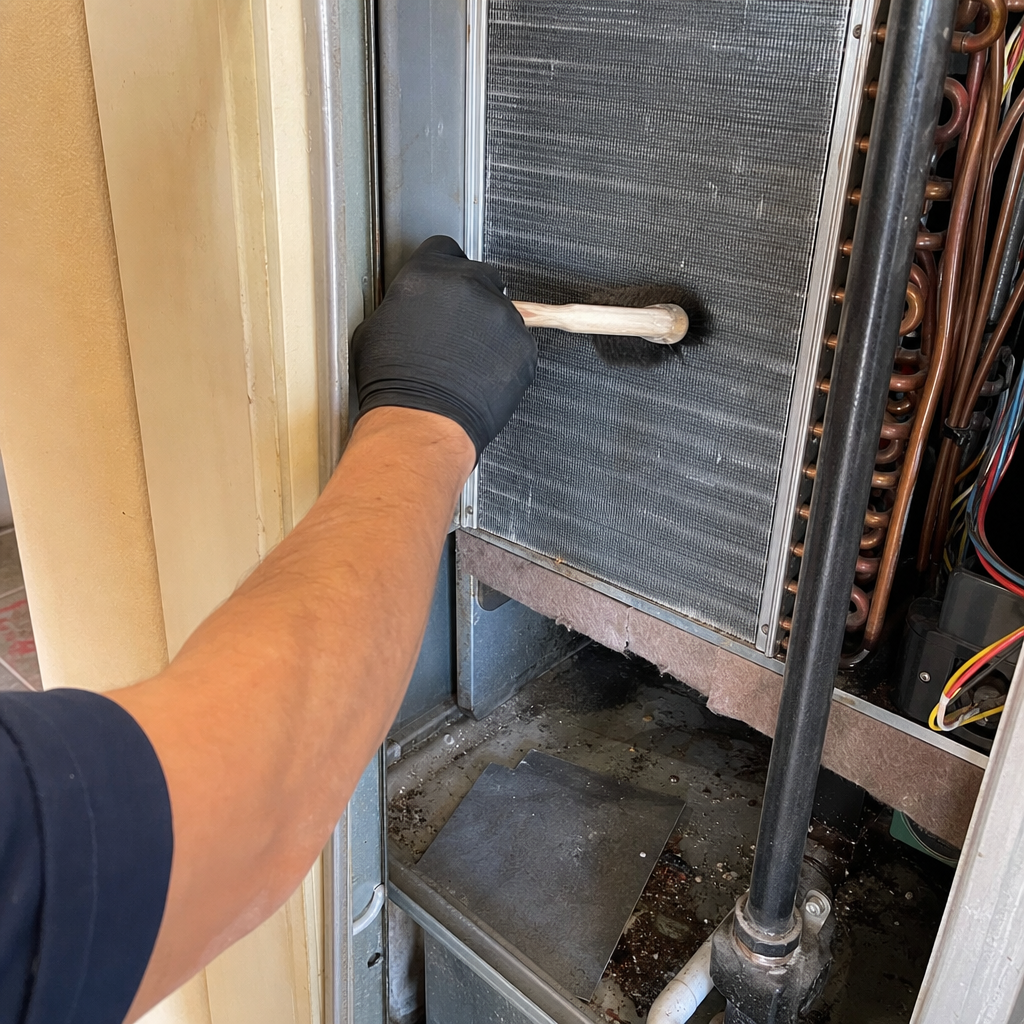
Our technicians use professional-grade equipment from Rotobrush, Nikro, and Abatement Technologies, the same brands serious HVAC contractors specify for commercial and institutional work. The tools matter less than the operator, but the right tools in trained hands produce consistent, verifiable results. Every job is camera-inspected after completion as well, so you see the before and after, not just our word.
How Bellows Pricing Works: No Bait, No Surprises
We disclose pricing before lifting a single tool. For a typical single-family home in Bell, air duct cleaning ranges from $350 to $650 depending on system size, accessibility, and contamination level. Homes with original post-war ductwork requiring additional care, or systems with pre-1980 materials needing assessment, may fall at the higher end. Multi-unit buildings and larger homes are quoted individually after inspection.
Our standing offers include $50 off any repair over $250, a free second opinion on any written estimate, an $89 seasonal tune-up, and a permanent 5% senior and veteran discount. These are not introductory come-ons - they have been in place for years because they represent how we believe pricing should work.
The 90-Day Done Right Promise applies to every job. If the work is not right, we return at no charge with no paperwork required. Ray Castillo put this in writing four decades ago because he had watched too many homeowners chase contractors who disappeared after the check cleared. We stand behind it - no arguing, no forms to fill out.
FAQs
Every 2 to 3 years for most Bell homes, and every 18 to 24 months for homes near I-710 or the Vernon industrial zone. The standard 3-to-5-year recommendation assumes cleaner suburban air than Bell’s basin-trapped, freeway-adjacent environment provides. Call (844) 685-6342 for a camera inspection that tells you exactly where your system stands.
Waiting typically costs more, not less. Heavy accumulation requires more labor, more aggressive agitation, and sometimes repairs to components strained by restricted airflow. A system cleaned on a reasonable interval maintains efficiency and avoids the compounded cost of deferred maintenance. Our $89 seasonal tune-up can help you monitor whether the interval should adjust.
You can spot some warning signs: visible dust blowing from supply vents when the system starts, musty or oily odors when the air handler runs, or uneven airflow between rooms. But these symptoms appear after significant accumulation has already occurred. The camera inspection reveals what you cannot see in trunk lines and return plenums. We do not charge to look and tell you honestly whether cleaning is needed.
Yes. If the camera shows clean ducts with light, normal dust accumulation, we say so and recommend waiting. Ray Castillo has built this company’s reputation on finding the actual problem, not inventing one. We have walked away from jobs where the system did not need service, because the only schedule that matters is your ductwork’s actual condition.
When to Call for an Assessment
If your home is in the 90706 or 90707 ZIP code, sits near I-710, or has gone more than two years without a professional duct inspection, the honest next step is a camera look. Not a sales call - a look. We’ll show you what is in your ducts, explain what it means for your home’s air quality and system efficiency, and give you a price before any work begins. Most jobs are completed in a single visit by background-checked, uniformed technicians. Calls are answered by a live person 24 hours a day, not a voicemail system.
If you’d rather have it looked at, Bellows Air Duct & Vent Co. offers a no-pressure assessment in Bell - call (844) 685-6342.
Written by Ray Castillo, Owner, Bellows Air Duct & Vent Co. at Bellows Air Duct & Vent Co., serving Bell, CA.