
Duct Sealing vs Duct Replacement in Bell, CA: Start With What’s Actually in Your Walls
Choose duct sealing if your sheet-metal runs are structurally sound with separated joints or small gaps, and choose replacement only when the ductwork is corroded, collapsed, or lined with deteriorating material that cannot be safely sealed. For most Bell homes built between the 1940s and 1960s, there’s a critical step before either decision: identifying whether pre-1980 duct wrap or duct board contains asbestos-containing material, since both sealing and replacement disturb the duct surface. If you’re weighing these options in Bell, call Bellows Air Duct & Vent Co. at (844) 685-6342 and we’ll walk through what your particular system needs.
Why Bell’s Ductwork Demands a Different Starting Point
Bell’s housing stock is dominated by post-WWII bungalows and small multi-unit buildings put up between the 1940s and 1960s. Many still run on original sheet-metal ductwork that was never designed for the filtration loads modern HVAC equipment pulls. The insulation wrapped around those old galvanized runs, and the fiberboard plenums common in that era, frequently incorporated asbestos-containing materials before 1980.
Here’s what neither the aerosol-sealing company nor the replacement contractor tends to volunteer: both procedures disturb the duct surface. Aerosol sealing blows sealant through the system under pressure. Replacement involves cutting, removing, and disposing of old material. If the wrap is friable and nobody checked, fibers release into the airstream your family breathes.
Ray Castillo, who started Bellows Air Duct & Vent Co. in 1984 after working his way through crawl spaces across southeast LA, put it plainly after a call on Gage Avenue last year. The homeowner had already received two quotes, one for sealing and one for replacement. Neither contractor had looked at the gray, corrugated wrap on the attic mains. We will take a look at what is actually there, and then we will tell you what we found. That attic job turned out to be clean material, but we’ve seen the opposite on Birch Street and around Bell Park. The order matters: identify first, then decide.
How I-710 Freight Traffic Wears Out Bell Ductwork Faster
Bell sits directly adjacent to Vernon, California’s most intensively industrialized city, and the I-710 Long Beach Freeway bisects the city with heavy diesel truck traffic serving the Ports of LA and Long Beach. This isn’t abstract local color. Decades of diesel ultrafine infiltration through soffit vents, crawl space vents, and every gap in the building envelope accelerate joint failure in older sheet-metal duct runs.
Our technicians working Bell homes regularly pull debris with a distinctly dark, oily character from duct interiors. It’s a signature mix of diesel exhaust ultrafines from I-710 and industrial fallout from neighboring Vernon, visually and texturally different from the pale dust-and-allergen buildup common in cleaner LA Basin communities farther from the freight corridor. That particulate load doesn’t just dirty the ducts. It acts as an abrasive at joints, accelerates corrosion where condensation collects, and forces longer cooling cycles that stress connections.
The practical result: leak rates in Bell’s older housing stock tend to run higher on average than in comparable postwar neighborhoods farther from the freight corridor. A system that might hold together with sealing in Downey or Whittier often needs more aggressive intervention here. But “more aggressive” does not automatically mean “tear it all out.” It means the diagnostic step matters more.
Our Camera Inspection: The Decision Tool Both Camps Skip
Every Bellows job starts with camera inspection of the ductwork, before and after any work begins. We run a lighted borescope through the full run and document what we see: visible joint separation, liner deterioration, corrosion patterns, and the character of debris accumulation. This isn’t a sales prop. It’s the objective record that determines whether sealing is viable or replacement is necessary.
What we’re looking for specifically in Bell homes:
- Joint separation at longitudinal seams and takeoff connections - common where thermal cycling and vibration have loosened original sealant
- Deterioration of internal fiberglass liner - if the liner is breaking down and releasing fibers, sealing over it traps the problem inside
- Corrosion or rust-through on galvanized sheet metal - particularly where condensation pools from oversized AC units short-cycling
- Condition of external insulation/wrap - identifying asbestos-containing material before any disturbance
- Debris character and depth - the dark, oily buildup typical near I-710 indicates how much exterior infiltration the system is pulling
Only after this documentation do we recommend sealing, replacement, or a hybrid approach. The camera footage goes to the homeowner. The recommendation follows the evidence, not a commission structure.
Sealing vs Replacement: What Each Actually Involves
Duct Sealing
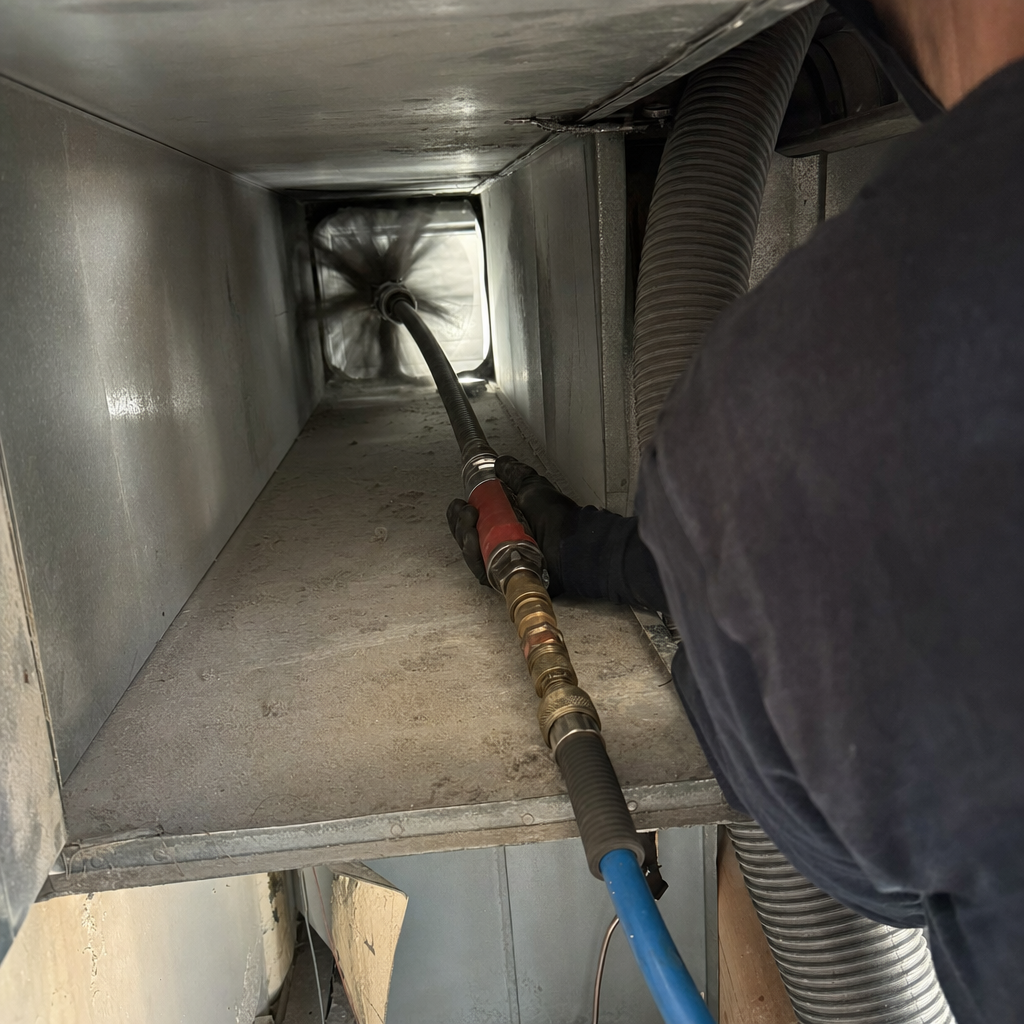
Professional duct sealing addresses leaks at joints, seams, and connections without removing the existing duct runs. At Bellows, we use professional-grade equipment and materials, including systems from established HVAC manufacturers like Aprilaire and Abatement Technologies, rather than hardware-store aerosol products that can leave gaps in aging systems.
The process applies sealant to accessible joint surfaces, often combined with mechanical reinforcement where connections have loosened. For Bell’s original sheet-metal runs with intact structure but separated seams, this restores system pressure and stops the conditioned-air loss that’s driving up utility bills. Most sealing jobs complete in a single visit by our background-checked, uniformed technicians.
Sealing makes sense when:
- The galvanized metal is structurally sound with no rust-through
- External insulation/wrap has been identified as non-asbestos or is intact and non-friable
- Joint separation is the primary failure mode, not collapse or widespread corrosion
- The homeowner plans to stay in the home long enough to recover the investment through efficiency gains
Duct Replacement
Replacement removes the existing duct runs and installs new fabricated ductwork, typically modern sheet metal or fiberglass duct board with proper insulation values for current Title 24 energy standards. This is the necessary path when the original material is beyond repair.
Replacement becomes the honest recommendation when:
- Galvanized metal has rusted through or collapsed in sections
- Internal liner is deteriorating and releasing fibers into the airstream
- Asbestos-containing wrap is friable and must be removed by a licensed abatement contractor
- The original duct sizing is so poorly matched to current HVAC equipment that sealing would leave fundamental airflow problems unaddressed
Cost Comparison for Bell Homeowners
Pricing varies with system size, accessibility, and material condition, but Bell homeowners should expect these general ranges based on typical postwar bungalow layouts:
| Service | Typical Range | What Affects Price |
|---|---|---|
| Duct sealing (whole system) | $1,800 - $3,400 | Linear footage of duct, number of joints, attic vs crawl space access |
| Partial duct replacement | $2,800 - $5,500 | Section length, whether asbestos abatement is required, matching to existing |
| Full duct replacement | $5,500 - $11,000+ | System tonnage, number of zones, insulation type, permit requirements |
| Asbestos identification testing | $350 - $750 | Number of samples, lab turnaround, whether air monitoring is included |
Our $50 Off Any Repair Over $250 applies to sealing work that qualifies. We also offer a Free Second Opinion on Any Written Estimate if you’ve already been quoted elsewhere and want the camera-inspection verification we provide.
Upfront pricing is disclosed before a single tool is lifted. The number on the phone is the number on the invoice. No bait coupons, no price changes at the door.
Common Local Scenarios We See in Bell
The 1952 bungalow on Pine Avenue: Original galvanized mains in the attic, gray corrugated wrap intact but unidentified. Camera inspection showed clean metal with separated longitudinal seams and moderate dark debris. Asbestos test came back negative. Sealing restored 23% measured airflow improvement. Homeowner’s summer cooling bill dropped noticeably.
The duplex near Florence Avenue: Duct board plenum from the 1960s with crumbling edges and visible fiber release. Camera showed internal liner deteriorating. Replacement was the only safe option; we coordinated with a licensed abatement contractor for the wrap removal before our installation.
The home near Bell Park: Mixed system with some original metal and a 1980s retrofit section. Camera revealed the original runs were sound but the retrofit had been poorly supported and was sagging, creating condensate pools and rust. We sealed the original, replaced the failed section, and matched airflow to the existing HVAC capacity.
Each of these started with the same step: looking at what was actually there.
Our Recommendation for Most Bell Homes
For Bell’s 1940s-1960s housing stock, the correct sequence is material identification first, then condition assessment, then the sealing-versus-replacement calculation. Not the reverse.
If the ductwork is original galvanized sheet metal with intact structure and the insulation has been properly identified, sealing is usually the better investment. It preserves the durable original material, addresses the actual failure mode, and avoids the disruption and cost of full replacement. The 90-Day Done Right Promise applies: if the sealing doesn’t perform as documented, we return at no charge with no paperwork required.
Replacement is the right call when the material itself has failed, when asbestos-containing wrap must be removed, or when the system sizing is fundamentally mismatched to current equipment. We don’t recommend tearing out sound metal just to sell a bigger job.
Either way, the decision follows the camera inspection, not a sales script.
FAQs
Duct sealing in Bell typically runs $1,800-$3,400 for a whole system, while full replacement ranges from $5,500-$11,000 or more depending on system size and whether asbestos abatement is needed. The exact price for your home depends on linear footage, accessibility, and material condition, which our camera inspection determines before any quote. Call (844) 685-6342 for a free estimate with upfront pricing disclosed before work begins.
No, not until the material has been properly identified by a certified inspector. Both aerosol sealing and physical replacement disturb the duct surface, which can release asbestos fibers if the wrap is friable. We require identification first, and if asbestos is present, we coordinate with licensed abatement contractors before any sealing or replacement work begins. This step protects your family’s health and is non-negotiable in our process.
Yes, sealing is typically 40-60% less expensive than full replacement, and professionally applied sealant on sound metal ductwork lasts 15-20 years or more. The key qualifier is “on sound metal.” Sealing applied to corroded or collapsing ducts fails quickly, which is why our camera inspection verifies structural integrity first. Our 90-Day Done Right Promise backs every sealing job: if it doesn’t hold, we make it right at no charge.
Most days we can offer same-day or next-day inspection appointments in the 90706 and 90707 ZIP codes. Calls are answered by a live person 24 hours a day, not voicemail or an app. The camera inspection takes about 45-60 minutes, and you’ll see the footage same-day with our recommendation based on what we found. Call (844) 685-6342 to schedule.
What to Expect When You Call Bellows
You’ll speak to a live person, day or night. We’ll schedule a camera inspection at your Bell home, conducted by a background-checked, uniformed technician. You’ll receive the footage, a clear explanation of what we found, and upfront pricing for either sealing or replacement if work is needed. No pressure, no bait pricing, no surprises on the bill.
Our standing offers apply: $50 Off Any Repair Over $250, Free Second Opinion on Any Written Estimate, $89 Seasonal Tune-Up, and a permanent 5% Senior and Veteran discount. Most jobs complete in a single visit. And every job carries the 90-Day Done Right Promise in writing, backed by the K.E.Y.S. values code we’ve operated under since 1984.
If you’d rather have it looked at, Bellows Air Duct & Vent Co. offers a no-pressure assessment in Bell, call (844) 685-6342.
Written by Ray Castillo, Owner, Bellows Air Duct & Vent Co. at Bellows Air Duct & Vent Co., serving Bell, CA.