
Nikro Air Duct Cleaning in Los Angeles: A Homeowner’s Guide
Nikro air duct cleaning in Los Angeles typically costs between $400 and $900 for a full residential system using source-removal equipment, and the key difference from budget services is that Nikro’s negative-pressure vacuums extract debris rather than pushing it deeper into your ductwork. If you’d rather not sort through equipment claims yourself, call Bellows Air Duct & Vent Co. at (844) 685-6342 - we’ll walk you through what your home actually needs.
Most homeowners judge an air duct cleaning by how clean the vents look afterward. The real measure is what the negative-pressure vacuum pulled out. We’ve been in Los Angeles homes where the registers gleamed but the main trunk line was still packed with construction debris from a 1987 remodel. Nikro’s engineering philosophy is built around preventing exactly that - which is worth understanding before you hire anyone.
What “Source-Removal” Actually Means
Nikro Industries designs its air duct cleaning equipment around a specific principle: debris should be extracted at the point of contact, not dislodged and left to settle elsewhere. This is called source-removal cleaning, and it differs fundamentally from contact-cleaning methods that use rotary brushes or compressed air without simultaneous vacuum capture.
Here’s the distinction that matters for Los Angeles homeowners. In a contact-cleaning setup, a technician might run a spinning brush through your ducts to knock loose dust and particulate. That debris falls. Some of it exits through your vents. Much of it resettles in low-velocity sections of the system - typically the horizontal runs in attics where our summer temperatures hit 110°F and baked-on dust becomes nearly adhesive.
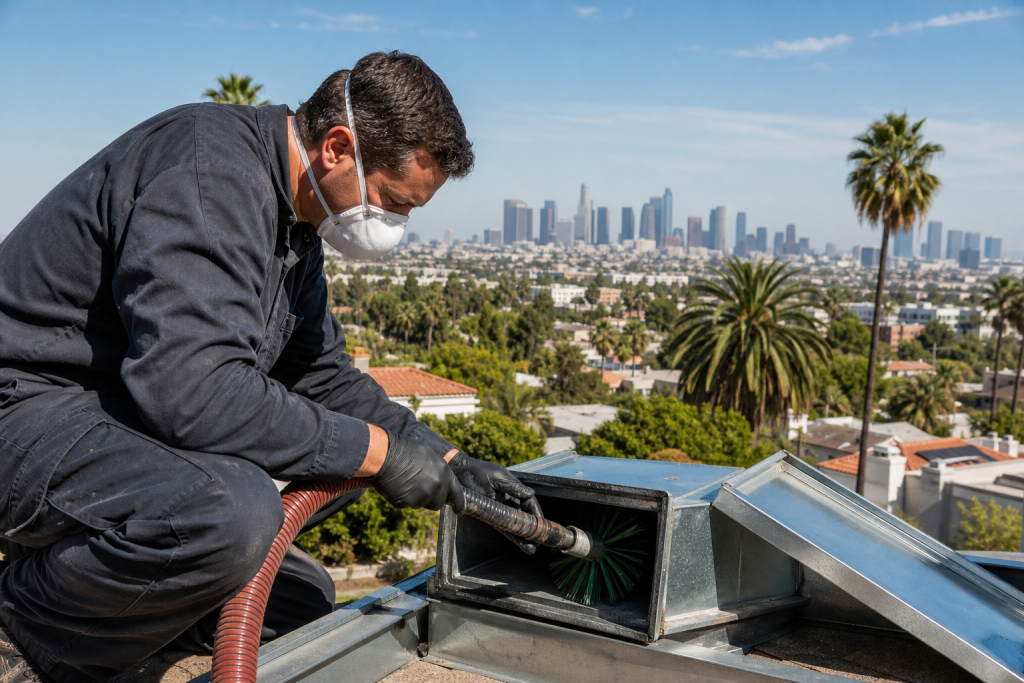
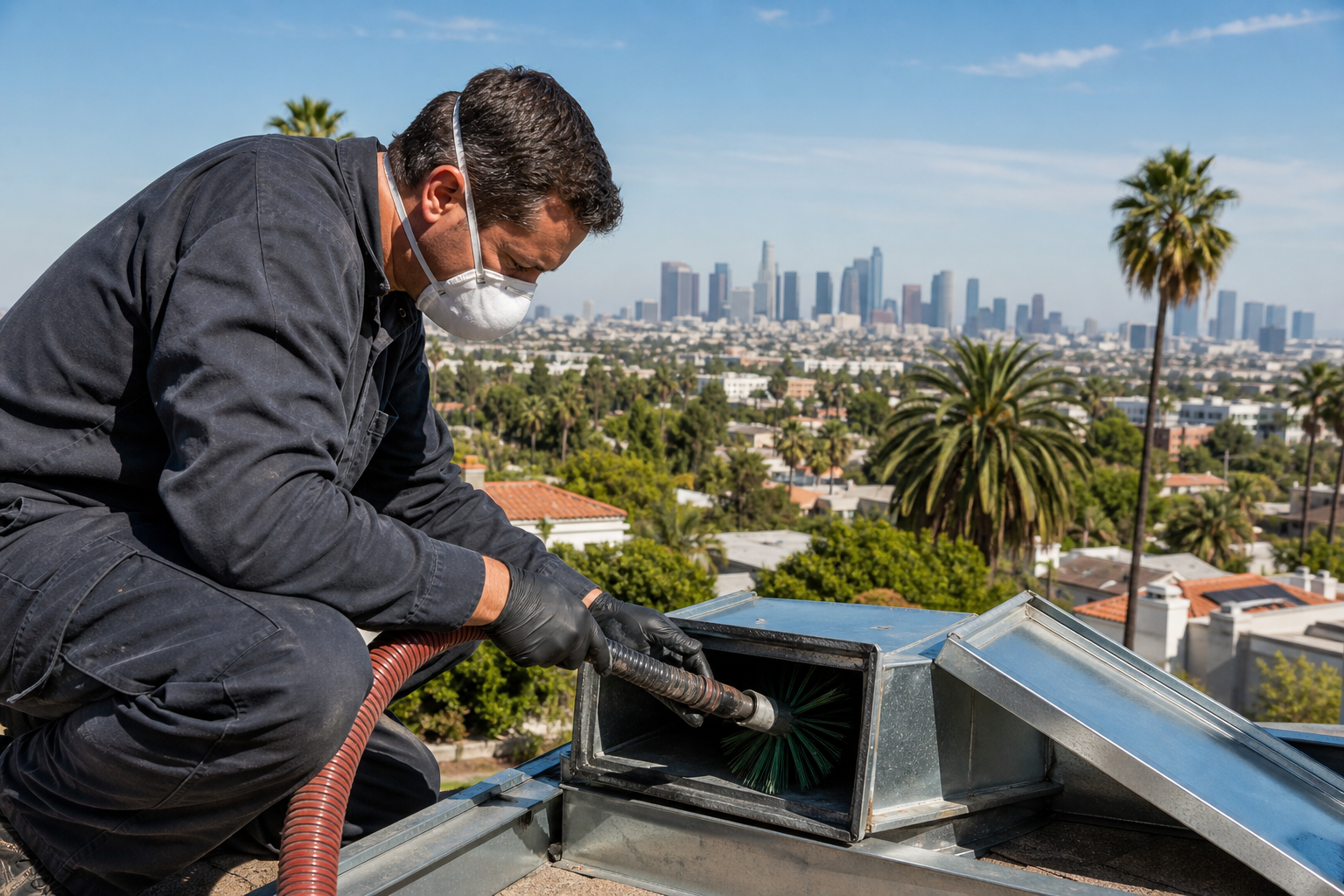
Nikro’s portable and truck-mounted systems pair agitation tools with continuous negative pressure. The vacuum runs throughout the cleaning, pulling dislodged material through a sealed hose and into a containment chamber. The agitation disturbs the debris; the vacuum captures it before gravity takes over.
Not every home needs this level of extraction. A relatively new build in Playa Vista with light household dust may do fine with a less aggressive approach. But in older Los Angeles neighborhoods - think Hancock Park, Los Feliz, or the pre-war stock in Mid-City - we’ve found source-removal essential. Those galvanized steel ducts from the 1940s and 50s hold decades of layered particulate that contact-cleaning simply redistributes.
HEPA Filtration and Wildfire Season
Los Angeles air quality has changed. The Bobcat Fire, the Woolsey Fire, the increasingly routine fall smoke events - these leave particulate matter that standard filters don’t catch. Nikro’s industrial HEPA filtration is rated at 99.97% efficiency at 0.3 microns, which matters for two reasons specific to our region.
First, wildfire smoke particulate ranges from 0.4 to 0.7 microns. A HEPA-equipped Nikro system captures this during cleaning rather than exhausting it back into your living space. We’ve inspected ducts in Altadena and La Canada Flintridge where the interior coating was visibly gray from fire season - standard vacuums would have blown that material straight through.
Second, and less obvious: without HEPA containment, cleaning your ducts can temporarily worsen indoor air quality. The disturbance releases settled particles. In a sealed Nikro setup, those particles enter the vacuum stream and stay there. In an unsealed or under-filtered system, your home becomes the filter.
For Los Angeles homeowners with respiratory sensitivity, this isn’t a minor specification. It’s the difference between a cleaning that helps and one that creates a problem you didn’t have.
Recognizing a Proper Nikro Setup
Equipment brand means nothing if the staging is rushed. Here’s what a legitimate source-removal clean looks like inside your home, so you can recognize when corners are being cut.
- Access panel creation: The technician should cut a minimum 8-inch access into the main supply and return trunks, not just remove vent covers. This allows tool entry into the ductwork itself, not just the boots.
- Register sealing: All supply and return registers get sealed with adhesive covers or magnetic blanks. This forces negative pressure through the system rather than drawing air from the rooms.
- Vacuum placement: The Nikro unit sits near the air handler, connected to the main trunk through the access panel. Hose runs should be minimal - excessive length reduces suction efficiency.
- Agitation sequencing: Tools move from farthest register toward the vacuum, pushing debris into the suction zone. Reversing this sequence defeats the purpose.
We walked a job in Sherman Oaks last year where a competitor had run a Nikro vacuum but left half the registers unsealed. The unit was working hard, pulling conditioned air from the living room instead of from the ducts. The homeowner paid for source-removal and got a very loud room fan. The equipment was correct. The application was not.
When Equipment Brand Matters Less Than the Operator
Nikro builds capable machines. So do Rotobrush, Abatement Technologies, and several others we specify. The honest truth: a trained technician with mid-grade equipment outperforms an untrained operator with the best machine on the market.
The questions that reveal actual competence have nothing to do with brand loyalty. Ask these instead:
- “Will you camera-inspect before and after?” - A technician who understands source-removal can show you the extraction path and verify completion. Anyone reluctant to document their work is someone who doesn’t want documentation.
- “Where do you place the vacuum relative to the air handler?” - Wrong answers include “near the front door for convenience” or “wherever the hose reaches.”
- “What do you do with registers that won’t seal?” - There are legitimate techniques for irregular boots. “We skip those” is not one of them.
- “How do you handle flex duct?” - Flexible ducting, common in Los Angeles additions and retrofits, requires different agitation tools. Rigid rotary brushes destroy it.
At Bellows Air Duct & Vent Co., we’ve operated Nikro, Rotobrush, and Abatement Technologies equipment over our 42 years. We specify by job condition, not by marketing arrangement. The technician’s training matters more than the decal on the van.
Camera Verification After Source-Removal
This is where the homeowner gets protected. After a Nikro source-removal clean, camera inspection should confirm three things: that the extraction path is clear from access point to terminus, that no debris dam remains at turns or junctions, and that the duct interior shows bare metal or liner without coating.
The documentation serves you if problems arise. We’ve had Los Angeles clients call six months after a competitor’s “cleaning” with the same airflow issues. No photos, no video, no proof of what was or wasn’t accomplished. Our 90-Day Done Right Promise is non-negotiable precisely because we document every job - if it’s not right, we return at no charge with no paperwork required, but the camera record means we almost never need to.
What to request: time-stamped video of the main trunk before work, the same view after, and close-ups of any problem areas noted during inspection. A technician doing honest work has no reason to withhold this.
When to Call a Pro
If your ducts haven’t been cleaned in fifteen years, if you’ve recently completed renovation work, or if you’re experiencing uneven heating and cooling with no HVAC mechanical fault, source-removal cleaning is worth exploring. The same applies if you’ve noticed persistent dust accumulation on surfaces shortly after cleaning, or if your system was running during any of Los Angeles’s major smoke events without upgraded filtration.
Related services in Los Angeles: Air Duct Cleaning in Seymour | Dryer Vent Cleaning in Seymour | HVAC Cleaning in Seymour
The Bottom Line
Nikro equipment is purpose-built for source-removal extraction, and in Los Angeles’s older housing stock and challenging air quality environment, that capability matters. But the machine is only as good as its staging, its filtration, and the technician operating it. Demand camera documentation. Ask specific questions about setup. And be wary of any quote that seems to treat all duct systems as identical - they’re not.
If you’re in Los Angeles and want an honest assessment of whether your home would benefit from source-removal cleaning, Bellows Air Duct & Vent Co. offers free estimates. We’ll camera-inspect first, explain what we find, and show you our upfront price before any work begins. Call (844) 685-6342. We’ve been standing behind our work since 1984 - no paperwork, no arguing, just done right.
Frequently Asked Questions
A full residential source-removal clean using Nikro equipment in Los Angeles typically runs $400 to $900 depending on system size, accessibility, and contamination level. Larger homes with multiple HVAC zones, or properties with significant construction debris or rodent issues, fall at the higher end. Call (844) 685-6342 for a free estimate - we’ll inspect first and give you an exact number before any work starts.
Neither is universally better; they’re designed for different conditions. Nikro excels at heavy source-removal extraction in contaminated systems. Rotobrush contact-cleaning works well for lighter maintenance cleaning in newer ductwork. In our experience across Los Angeles, we specify by what the camera inspection reveals, not by brand preference. The right tool for the actual condition - that’s the square deal.
Most residential jobs take 3 to 5 hours for a complete source-removal clean with proper staging, agitation, and verification. Anyone promising a full system clean in 90 minutes is skipping access points, leaving registers unsealed, or both. We complete most jobs in a single visit, but we don’t rush the setup - that’s where the actual cleaning happens.
Yes, when properly configured with HEPA filtration and appropriate agitation tools. The particulate from Los Angeles wildfire events bonds to duct surfaces and requires source-removal extraction rather than surface contact alone. We’ve restored systems in fire-affected areas from Pacific Palisades to Topanga, but the key is the complete staging - HEPA vacuum, sealed registers, and methodical agitation - not just the brand name on the equipment.
Written by the team at Bellows Air Duct & Vent Co., serving Los Angeles since 2012.
Need Air Duct Cleaning Help?
Call Bellows Air Duct & Vent Co. - licensed & insured, here with fast after-hours help in Los Angeles.
(844) 685-6342