
Duct Repair & Sealing: Repair or Replace? How Los Angeles Homeowners Decide
Most Los Angeles homeowners with leaky ductwork should start with targeted repair and sealing, which solves 60 to 80 percent of leakage problems without tearing into walls. Full replacement becomes the smarter choice when flex duct has degraded from heat exposure, when metal ducts show corrosion or collapse, or when leakage exceeds 25 to 30 percent of total airflow. If you’d rather not diagnose this yourself, call us at (844) 685-6342 and we’ll run a camera inspection and blower door test to give you a straight answer.
The Department of Energy estimates that the typical home loses 20 to 30 percent of conditioned air through duct leaks. In a Los Angeles home running AC from April through October, that’s a significant utility bill line item hiding behind a sheet-metal wall. We’ve been in attics across this city for over 42 years, and the story repeats: homeowner replaces a perfectly good HVAC unit, bills stay high, and the real culprit was the ductwork carrying the air.
How to Tell If Your Problem Is Leakage or Duct Damage
Not every comfort problem points to the same fix. Learning to read your home’s symptoms saves you from paying for work you don’t need.
Symptoms that point to leakage (sealing usually fixes these):
- Uneven room temperatures, especially rooms farthest from the air handler
- High utility bills despite a newer HVAC unit
- Dusty rooms that return to dusty within days of cleaning
- Whistling or hissing from registers when the system runs
Symptoms that point to physical duct damage (repair or replacement needed):
- Collapsed or disconnected flex duct you can see in the attic
- Water stains or rust on metal ductwork
- Rooms that never cool regardless of runtime
- Musty smells that persist after cleaning
In our experience across Los Angeles, from the older bungalows of Highland Park to the hillside homes in Eagle Rock, flex duct installed in the 1980s and 1990s has often reached the end of its useful life. The material breaks down where it connects to plenums and registers. Metal duct from the same era tends to last longer but suffers at joints and seams where tape has dried out.
What a Duct Blaster or Blower Door Test Reveals
Before you commit to any work, ask for measurable data. A duct blaster test pressurizes your duct system and measures airflow loss through a calibrated fan. A blower door test depressurizes the entire house to find how much air leaks through the building envelope versus the ductwork specifically.
Here’s what the numbers mean in practical terms:
- Under 10% leakage: Your ducts are in reasonable shape. Minor sealing at joints and registers is optional.
- 10% to 20% leakage: Targeted sealing will pay for itself in comfort and efficiency. This is the sweet spot for Aeroseal or manual mastic sealing.
- 20% to 30% leakage: Significant work needed. Likely a combination of sealing damaged sections and replacing degraded flex runs.
- Over 30% leakage: The system is essentially broken. Replacement of major duct sections is usually more cost-effective than chasing every leak.
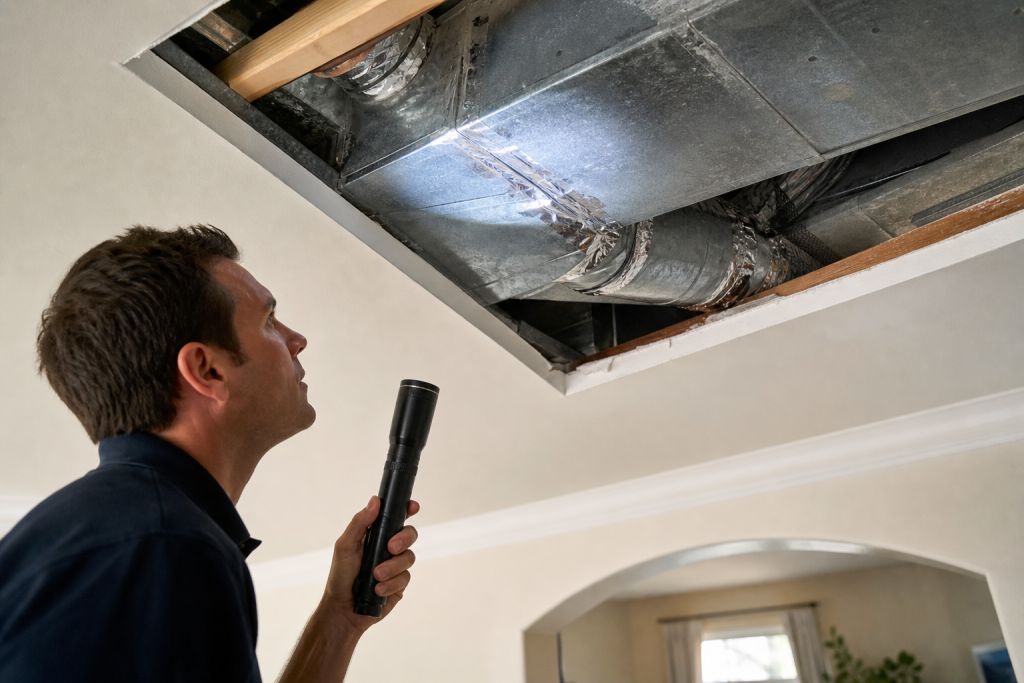
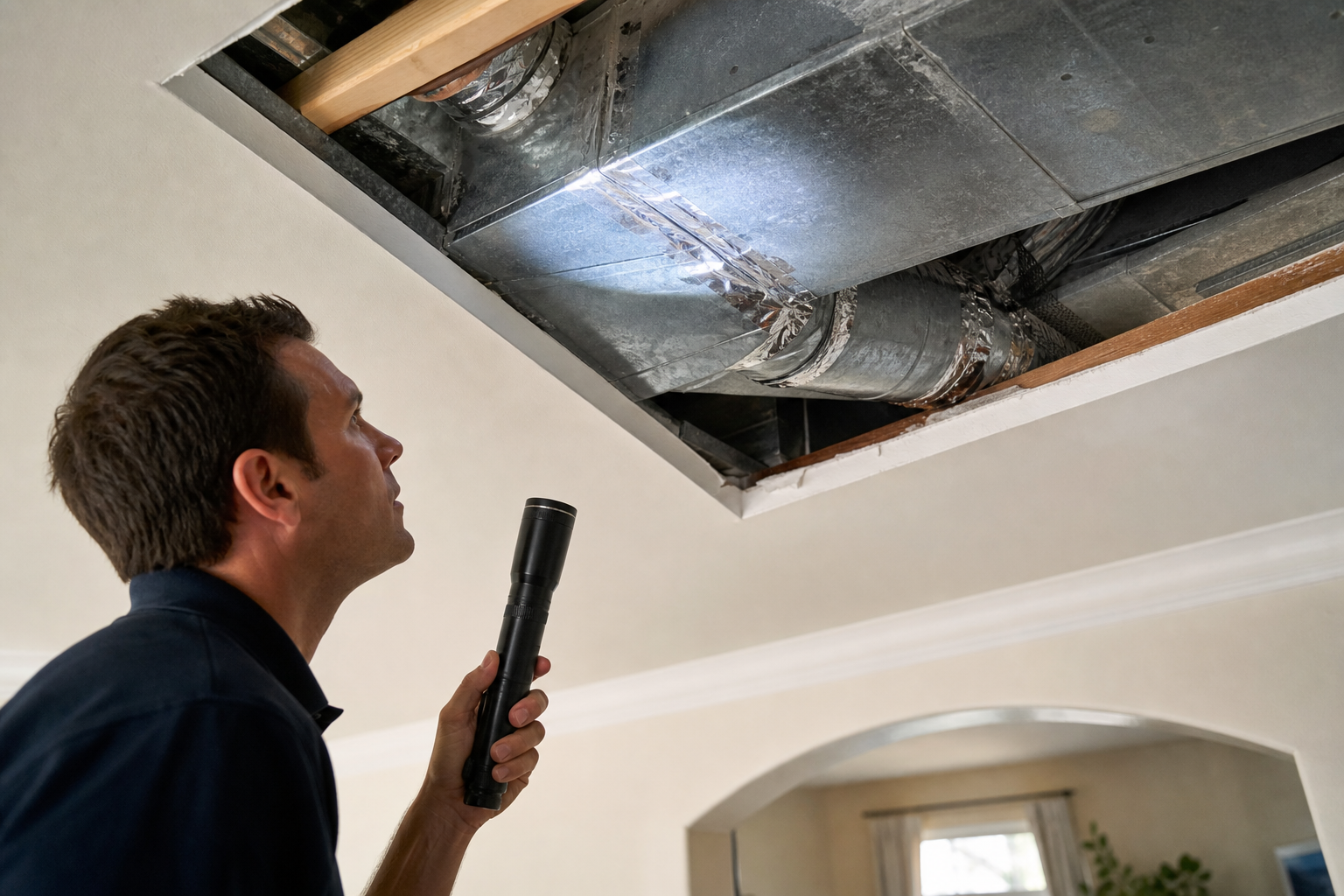
We run camera inspections before and after every job at Bellows Air Duct & Vent Co. home, so you see what we see. No claims without proof. If a contractor in Los Angeles won’t show you the leakage percentage in writing, that’s a reason to pause.
When Aeroseal Works and When Ducts Need Physical Replacement
Aeroseal is an internal sealing process that blows adhesive particles through pressurized ductwork, building up at leak points to form a seal from the inside. It’s effective for small to medium leaks throughout a system, especially in finished walls where accessing ducts would require drywall repair.
Aeroseal makes sense when:
- Leakage is distributed across many small joints and seams
- Ducts are physically intact but poorly sealed at connections
- The ductwork is inaccessible without significant demolition
- Your metal trunk lines are sound but branch lines leak
Physical replacement makes sense when:
- Flex duct is brittle, torn, or collapsed from heat degradation
- Metal duct shows corrosion, holes, or structural damage
- Previous repairs have created a patchwork of incompatible materials
- Leakage is concentrated at a few major failure points
The Los Angeles climate creates a specific pattern we see regularly. Attic temperatures here spike to 140 degrees or higher in summer. Flex duct, especially the older vinyl-backed type common in postwar construction, hardens and cracks at the elbows where it bends. Rigid metal duct handles these heat cycles better but still suffers at joints where original tape has baked off. A visual inspection with a camera tells the story in about ten minutes.
The LA-Specific Reality: Older Flex Duct and Heat Degradation
If your Los Angeles home was built between 1960 and 1995 and still has original ductwork, there’s a strong chance you’re working with flex duct that has outlived its design life. The insulation wrapping compresses. The inner liner develops micro-tears. The connection collars loosen.
We inspected a system last month in a 1978 ranch house near the Sepulveda Basin. The flex duct looked fine from the attic hatch, fifteen feet away. Up close with a camera, the inner liner had the texture of dried rubber bands. Every elbow was leaking. The homeowner had already replaced two HVAC units in twenty years, never suspecting the delivery system.
Metal duct from the same era fares better structurally but often suffers from original design shortcuts: unsealed drive cleats, missing end caps, panned joist returns that leak into wall cavities. These are fixable with proper sealing and some section replacement, but only if someone looks carefully enough to find them.
A Simple Cost-Benefit Framework for Los Angeles Homes
Use this decision tree based on what a proper test reveals:
| Leakage Level | Typical Action | Expected Investment Range | Payback Period |
|---|---|---|---|
| Under 10% | Monitor, optional spot sealing | $0 to $400 | 3 to 5 years |
| 10% to 20% | Targeted sealing (Aeroseal or manual) | $800 to $2,000 | 2 to 4 years |
| 20% to 30% | Sealing plus partial replacement | $1,500 to $4,000 | 3 to 5 years |
| Over 30% | Major replacement recommended | $3,000 to $7,000+ | 5 to 8 years |
These ranges reflect Los Angeles market conditions in 2024-2025, including permit requirements for duct modifications in unincorporated areas and some municipalities. The payback periods assume typical LA utility rates and cooling-season usage.
Our standing offer of $50 Off Any Repair Over $250 applies to sealing work that crosses that threshold. We also provide a Free Second Opinion on Any Written Estimate if you’ve already been quoted by another contractor and want verification.
When to Call a Professional
If your utility bills have climbed without explanation, if some rooms never reach the thermostat setting, or if you’ve replaced your HVAC unit recently and saw no improvement, the ducts are suspects number one. A professional test takes about 90 minutes and gives you a number to work with instead of guesswork.
Related services in Los Angeles: Air Duct Cleaning in Seymour, Dryer Vent Cleaning in Seymour, and HVAC Cleaning in Seymour.
The Bottom Line
Start with a test, not a sales pitch. Leakage under 20 percent usually responds well to sealing. Leakage over 30 percent, or any significant physical damage, points toward replacement. The middle ground, 20 to 30 percent, is where experience matters most, a combination approach often wins.
We’ve been serving Los Angeles homeowners since 1984 with one rule: show the problem, quote the fix, do the work, and stand behind it. Our 90-Day Done Right Promise means if it’s not right, we return at no charge with no paperwork required. That’s not marketing language. It’s how we’ve operated for 42 years.
If you’re in Los Angeles and need help deciding whether to repair, seal, or replace your ductwork, call (844) 685-6342 for a free estimate. We’ll run the camera, run the numbers, and give you a straight answer you can use.
Frequently Asked Questions
Targeted duct sealing in Los Angeles typically runs $800 to $2,000 for a single-family home, depending on system size and accessibility. Aeroseal runs toward the higher end of that range, manual mastic sealing toward the lower. Full replacement of degraded ductwork starts around $3,000. Call (844) 685-6342 for an exact quote on your home, estimates are free.
Repair and sealing is cheaper upfront and usually the right choice for leakage under 25 percent with physically sound ducts. Replacement becomes more economical when ducts are degraded by age or heat damage, because repeated repair calls add up fast. We offer a Free Second Opinion on Any Written Estimate if you want help comparing options.
Yes. When conditioned air leaks into your attic or crawl space before reaching rooms, the thermostat never satisfies. Your AC runs longer cycles, wears faster, and still leaves you uncomfortable. We’ve seen Los Angeles homeowners replace perfectly good HVAC units when the real problem was duct leakage all along.
Demand a post-work test showing reduced leakage percentage, and ask to see camera footage of key joints. At Bellows, we camera-inspect before and after every job and provide visual documentation. If your contractor can’t show you the difference in measurable terms, the work may not have been done thoroughly.
Written by the team at Bellows Air Duct & Vent Co., serving Los Angeles since 2012.
Need Air Duct Cleaning Help?
Call Bellows Air Duct & Vent Co. - licensed & insured, here with fast after-hours help in Los Angeles.
(844) 685-6342