
The dryer shuts off before the load is done
What’s Happening
A dryer that cuts off mid-cycle almost always means the machine is overheating, and overheating almost always traces back to a blocked dryer vent. When lint builds up in the exhaust duct, heat has nowhere to go – the dryer’s thermal safety switch trips, and the drum stops. That’s the protection working exactly as designed. The problem isn’t the dryer. It’s what’s choking the vent behind it.
Most homeowners assume the machine is failing and start pricing a new dryer. Nine times out of ten, that’s the wrong call. A clogged vent restricts airflow so severely that the dryer runs hotter and hotter with each cycle. The thermal fuse or high-limit thermostat does its job and cuts power before anything catches fire. Clear the blockage, restore the airflow, and the dryer runs to the end of every cycle the way it’s supposed to. We’ve seen this pattern repeat in home after home for over 42 years – the symptom is nearly always the vent, not the appliance.
Why It Happens
Lint accumulation in the vent line
Lint bypasses the lint trap on every single load – fine fibers, fabric softener residue, and moisture all travel into the exhaust duct and stick to the walls. Over months and years, the buildup narrows the duct until airflow is barely moving. You can often confirm this is the issue by stepping outside while the dryer runs and holding your hand near the exterior vent cap. Weak or barely-warm exhaust is a clear sign the duct is partially or fully blocked.
A crushed, kinked, or undersized duct
Many dryers sit against the wall with the flexible duct behind them bent at a sharp angle. That kink cuts airflow as surely as a clog does. Foil accordion-style hose is especially prone to this – it collapses under its own weight and traps lint in every fold. If you can safely pull the dryer forward a few inches and see a sharp bend or a flattened section of hose, that’s likely contributing to the problem.
A stuck or blocked exterior vent cap
The flap cover on the outside of your house can jam shut with lint, a bird nest, or ice in cold weather. When it won’t open fully, exhaust backs up into the duct and the dryer overheats fast. Walk around to wherever your vent exits the house – it’s usually on a side wall or through the soffit – and check whether the damper flap opens freely when the dryer is running. If it’s stuck, blocked, or missing entirely, that’s your problem.
A faulty thermal fuse or thermostat (secondary cause)
If you’ve had the vent professionally cleared recently and the dryer still cuts off short, the thermal fuse or high-limit thermostat may have failed permanently. These are small electrical components, and once a fuse blows it doesn’t reset – the dryer simply won’t run to completion no matter how clear the vent is. This is a repair for an appliance technician, but it almost always develops because the vent was blocked first. Fix the vent before replacing the part, or the replacement fuse will fail again.
What to Do Right Now
- Stop using the dryer until the vent is cleared. Running repeated cycles through a blocked vent deposits more lint, raises internal temperatures, and puts real stress on the thermal components. One more load is not worth a lint fire.
- Check the lint trap and clean it completely. Pull the trap, rinse it under water if a film of fabric softener is clogging the mesh, and let it dry before reinstalling. This doesn’t fix the duct, but it’s a sensible first step and costs nothing.
- Look at the flexible duct behind the dryer. If you can see it without moving anything, check for obvious kinks, tears, or disconnected sections. Do not reach behind electrical components or attempt to move a gas dryer yourself – gas connections require a qualified technician to handle safely.
- Go outside and inspect the vent cap. Look for lint buildup around the damper, visible blockage at the opening, or a flap that won’t move. Take a photo – it helps the technician who arrives understand what they’re walking into.
- Do not attempt to clean deep into the duct yourself with a vacuum hose or improvised tools. You can compact the blockage further into the line, making the professional clear-out harder. Leave the duct itself to someone with the right equipment.
How We Fix It
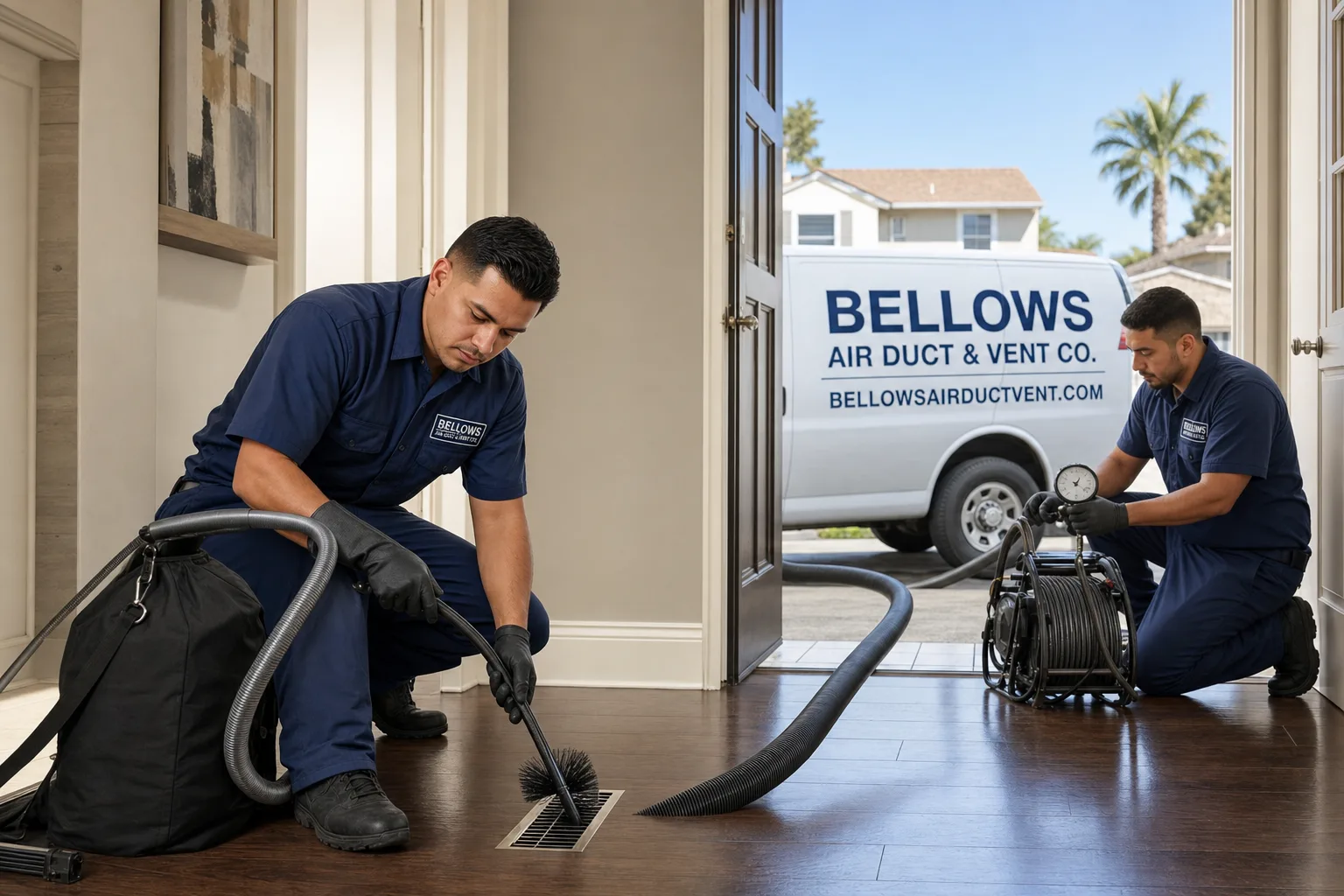
When your local Bellows Air Duct & Vent Co. team arrives, the first thing a technician does is a camera inspection of the vent line – before a single tool goes in. You see what we see. That inspection tells us exactly where the blockage is, how dense it is, and whether the duct itself is intact. No guessing, no assumptions.
From there, dryer vent cleaning uses professional-grade equipment – rotary brush systems and high-powered vacuum tools from manufacturers like Rotobrush and Nikro – to break up the compacted lint and pull it cleanly out of the line. The technician clears from the dryer collar to the exterior cap, checks that the damper opens and closes freely, and runs the dryer through a full cycle to confirm airflow is restored. If there’s a crushed section of duct or a damaged cap that needs to be replaced, that’s part of our duct repair and sealing service, and the price for any repair work is given to you in writing before anything starts.
Most jobs finish in a single visit. The 90-Day Done Right Promise covers every job: if something isn’t right within 90 days, we come back. No paperwork, no arguing. That’s in writing, because that’s how we’ve worked since 1984.
For pricing, the honest answer is that every vent situation is different – length of run, number of bends, condition of the duct. We give you a written estimate before work begins. The number you hear on the phone is the number on the invoice. That’s been our founding promise since the beginning, and it hasn’t changed.
Frequently Asked Questions
Yes, it should be treated as one. The thermal cutoff tripping means the dryer reached a dangerous internal temperature – the only reason it stopped is that the safety system worked. Lint inside a hot duct is the leading cause of residential dryer fires in the United States. The fact that the dryer cut off before finishing the cycle is a warning, not a reason to keep running loads and hope for the best. Stop using the dryer and call (844) 685-6342 to get it looked at today.
It needs to be handled now. A clogged dryer vent is a live fire risk, not a nuisance. Every cycle you run through a blocked vent deposits more lint in a hot duct. We answer the phone around the clock with a live person – not a voicemail, not an app – so you don’t have to wait until Monday morning. Call (844) 685-6342 and we’ll get your local team scheduled.
In most cases, clearing the vent fully restores normal operation. The thermal fuse trips because of heat, and the heat builds because airflow is blocked. Restore the airflow and the fuse resets or, if it blew permanently, it can then be replaced by an appliance technician with confidence that the root cause is gone. If the vent clears completely and the dryer still cuts off short, that’s the time to call an appliance repair technician for the fuse or thermostat. We’ll tell you honestly what we find.
That depends on your local Bellows Air Duct & Vent Co. team’s schedule, but we make every effort to get to urgent calls quickly – and we answer the phone 24 hours a day so you’re never stuck leaving a message. Call us at (844) 685-6342 right now and a live person will tell you exactly when we can be there. Most jobs are handled in a single visit, so once we’re on the schedule, it’s done.
Get It Fixed
Call (844) 685-6342 right now and a live person answers – not a voicemail. Your local Bellows Air Duct & Vent Co. team will give you a written estimate before work begins, clear the vent completely, and back the job with the 90-Day Done Right Promise. No surprises on the bill.
Written by Ray Castillo, Owner at Bellows Air Duct & Vent Co., proudly serving local communities since 1984.