
Rooms That Never Get Enough Air
What’s Happening
When one or more rooms in your house stay stuffy, cold in winter, or stifling in summer no matter how long the system runs, the most common cause is restricted or leaking ductwork – not a failing HVAC unit. Air is being lost, blocked, or redirected before it reaches those rooms. In most cases, a duct inspection and cleaning resolves it in a single visit.
The duct system in a house is a lot like the circulatory system in a body. When one branch is clogged, collapsed, or leaking, the rooms at the end of that run simply don’t get their share of conditioned air. The system keeps running, your energy bill keeps climbing, and the room stays uncomfortable. What makes this frustrating is that your thermostat reads fine – because it’s measuring the air near the unit, not the air in the problem room. The fix usually isn’t a new furnace or air conditioner. It’s finding where the duct system broke down and correcting it.
Why It Happens
1. Clogged or Packed Ductwork
Over years of normal use, dust, debris, pet dander, and insulation fibers accumulate inside ducts. When buildup reaches a point where it restricts airflow, the rooms farthest from the air handler – the ones at the end of the longest runs – feel it first. If you pull a supply register off the wall and shine a flashlight inside and see a visible gray layer coating the walls of the duct, restriction is almost certainly part of your problem.
2. Disconnected or Crushed Flex Duct
Flexible duct – the ribbed tubing common in attics and crawlspaces – can sag, kink, or pull apart at joints over time, especially in homes more than fifteen or twenty years old. A disconnected section dumps conditioned air directly into an attic or crawlspace instead of the room it’s meant to serve. If a specific room went from fine to cold or hot without any change to the system, and you can safely look in your attic, a sagging or disconnected flex duct run is worth checking. If the attic access is difficult or the duct is near electrical equipment, stop and call a technician.
3. Leaking Duct Joints and Seams
Sheet metal duct sections are joined at collars and sealed at the factory or during installation. That seal – typically mastic or foil tape – dries, cracks, and separates after a decade or two of thermal cycling. The result is slow air loss along the entire run, so every room served by that branch gets a little less than it should. You can sometimes hear this as a faint hissing near a duct joint in a basement or utility room when the system is running. A camera inspection will show it clearly.
4. Blocked or Closed Dampers
Many duct systems have manual dampers – small levers or wing-nuts on the outside of the duct, usually near the air handler – that were set during the original installation to balance airflow between zones. If someone bumped one closed during a renovation, or if a damper rusted in a partial position, a whole branch of rooms can be quietly starved for air. Check the main trunk lines near your furnace or air handler for any adjustable levers. If one is turned perpendicular to the duct, it’s closed. This is one of the few things a careful homeowner can safely check and correct on their own.
What to Do Right Now
- Check your air filter first. A severely clogged filter restricts airflow to the entire system. Pull it out and hold it up to a light. If you can’t see light through it, replace it before anything else – it’s a two-dollar fix that occasionally solves the problem entirely.
- Walk the house and note which rooms are affected. Write it down: which rooms, whether they’re hot or cold, which floor, and which direction they face. This map helps a technician trace the duct run and find the failure point faster.
- Check visible supply and return registers. Make sure none are blocked by furniture, rugs, or curtains. Hold your hand near each register when the system is running and note which ones have strong airflow and which feel weak or dead.
- Do not attempt to inspect, repair, or tape ducts near your electrical panel, gas lines, or in high attic spaces without a safe, stable work platform. Ductwork that runs near these areas should be left for a trained technician. The ductwork itself is not dangerous, but the surroundings can be.
- Photograph anything that looks wrong. A sagging flex duct you can see from an accessible attic hatch, a gap at a collar joint in the basement – photograph it and have it ready when you call. It helps us know what tools to bring.
How We Fix It
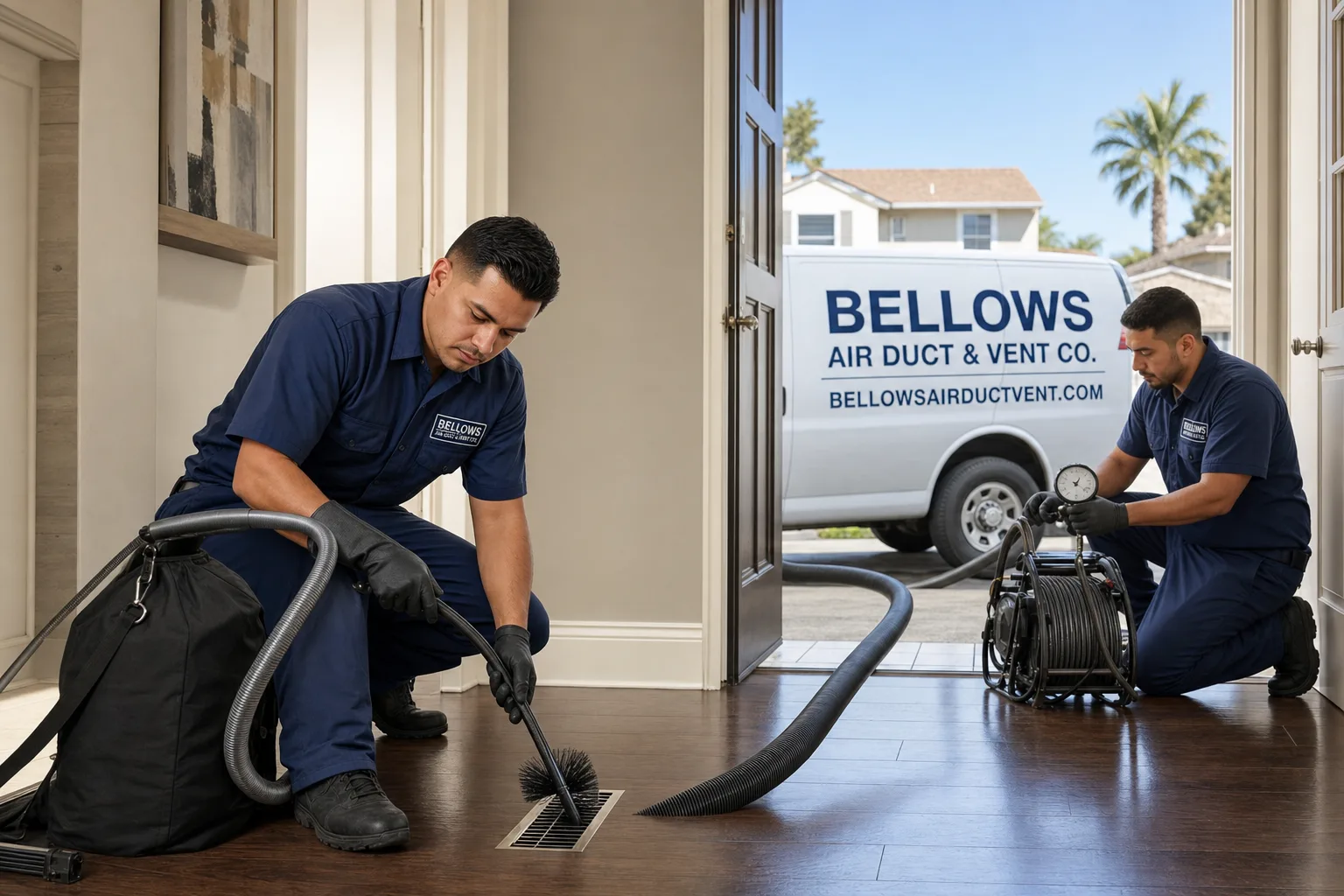
When your local Bellows Air Duct & Vent Co. team arrives, the first thing that happens is a camera inspection of the ductwork – before a single tool comes off the truck. That inspection tells us whether the problem is restriction from buildup, a physical failure like a disconnected or crushed run, or leakage at the joints. You see what we see. There’s no guessing and no upselling on things the camera doesn’t show.
If the issue is buildup restricting airflow, we clean the system fully using professional-grade equipment from Rotobrush and Nikro – the kind serious HVAC contractors specify – and do a second camera pass when we’re done so you can see the difference. If the problem is a disconnected, crushed, or leaking duct section, our technicians handle duct repair and sealing on the same visit in most cases. Pricing is presented upfront in writing before work begins – the number you’re given is the number on the invoice, no surprises. Most jobs are completed in a single visit. And every job carries the 90-Day Done Right Promise: if it’s not right, we come back, no paperwork, no arguing. That’s in writing.
Frequently Asked Questions
In most cases it’s not an emergency – it’s a comfort and efficiency problem, not a safety crisis. That said, if the airflow loss is sudden and you also notice a burning smell, unusual noises from the system, or visible damage to ductwork near a gas appliance or your electrical panel, stop running the system and call right away. Lingering buildup in ducts can also degrade your indoor air quality over time, so it’s worth addressing sooner rather than later. Call us at (844) 685-6342 and we’ll help you sort out how urgent your situation is.
It’s possible, but if only specific rooms are affected while others feel fine, the equipment itself is rarely the culprit – a failing blower motor or refrigerant issue tends to reduce airflow house-wide. When the problem is room-specific, the duct branch serving those rooms is almost always where the fault lies. A camera inspection will confirm it either way, and if the equipment does turn out to be the source, you’ll have a written record showing the ducts were ruled out.
Duct restriction and leakage typically develop gradually over years, not overnight, which is why many homeowners don’t notice until a room becomes genuinely uncomfortable. The same buildup that restricts airflow also circulates dust, allergens, and debris through the house every time the system runs. If anyone in your home has noticed increased dust on surfaces, more frequent allergy symptoms, or musty odors from the vents, those are related signs. Our air quality and sanitizing service can be added to the same visit if the inspection shows it’s warranted.
In most cases, yes – your local Bellows Air Duct & Vent Co. team works to schedule same-day and next-day visits for situations like this. Our phones are answered by a live person around the clock, every day of the year – not a voicemail, not an app. Call (844) 685-6342 right now and someone will pick up, ask a few quick questions about what you’re seeing, and get a technician scheduled.
Get It Fixed
Call (844) 685-6342 and a live person will answer – day or night. Your local Bellows Air Duct & Vent Co. team will inspect your ductwork on camera, give you a straight written estimate before anything starts, and in most cases have it done in a single visit. No surprises on the bill.
Written by Ray Castillo, Owner at Bellows Air Duct & Vent Co., proudly serving local communities since 1984.