
Signs of a Clogged Dryer Vent
What’s Happening
A clogged dryer vent means lint, debris, or a crushed section of duct is blocking the warm, moist air your dryer needs to exhaust out of the house. When that air can’t escape, your dryer runs longer, your clothes stay damp, and heat builds up inside the drum and duct in a way that creates a real fire risk.
Most of the time, a clogged dryer vent isn’t a mystery. It announces itself clearly – clothes that used to dry in 45 minutes now take two full cycles, the laundry room feels unusually warm, or you notice a musty, slightly burnt smell that wasn’t there six months ago. None of those are quirks to live with. They’re a vent that needs attention. Lint is surprisingly flammable, and a blocked exhaust line is one of the leading causes of home fires tied to laundry appliances. The fix is straightforward when you catch it early; the consequences of ignoring it are not.
Why It Happens
Lint Accumulation in the Duct Line
Every load of laundry sheds lint. Your lint trap catches most of it, but a meaningful amount passes through and gradually coats the inside walls of the exhaust duct. Over a few years – sometimes faster in a busy household – that coating thickens into a real restriction. You can often suspect this cause when drying times have been creeping up slowly over months rather than changing overnight. Pull the duct away from the back of the dryer and look inside with a flashlight; a heavy grey coating on the inner walls confirms it.
A Kinked, Crushed, or Poorly Routed Duct
Flexible foil or plastic duct – the accordion-style connector used behind many dryers – kinks easily when a dryer gets pushed back against the wall. A sharp bend chokes airflow the same way a kink chokes a garden hose. If your dryer was recently moved for cleaning or a repair, and performance dropped right after, a crushed section is the first thing to check. Slide the dryer forward and visually inspect the full length of the flex section; any tight angle or visible collapse tells the story.
A Blocked or Damaged Exterior Vent Cap
The vent cap on the outside of your house opens when air is flowing and closes when the dryer is off, keeping birds and rodents from nesting inside the duct. Flapper dampers on these caps get clogged with lint, bend out of shape, or simply fail after years of use. Go outside while the dryer is running and hold your hand near the vent cap; you should feel a clear, steady flow of warm air. Weak airflow or none at all, combined with a damper that doesn’t fully open, points to this as the cause.
A Long or Complex Duct Run
Building codes limit how far exhaust duct can run before it loses enough velocity to carry lint out cleanly. Every elbow in the run reduces effective distance further. If your laundry room sits far from an exterior wall, or if the duct travels through a ceiling or crawlspace with multiple turns, it was working against physics from the start. Buildup accelerates in long runs because lint has more time to settle before it reaches the exit. The symptom here often appears in a house that’s ten or fifteen years old and has never had the vent professionally cleaned – not because anything broke, just because the miles caught up with it.
What to Do Right Now
- Stop running the dryer until the vent is cleared. A blocked exhaust line can cause heat to build to the point of ignition. If the dryer feels hot to the touch on the outside, or if you smell anything burning, unplug it and do not use it again until the vent has been inspected.
- Check the lint trap and clean it completely. Pull it out, remove every bit of lint, and hold it up to a light – if you can’t see light through the mesh, wash it gently with a soft brush and let it dry before replacing it. A clogged screen forces lint deeper into the duct faster.
- Go outside and look at the vent cap. With the dryer off, check whether the damper flap moves freely. With the dryer running (briefly, to check), confirm you can feel warm air exiting. No airflow at all is a signal to stop use immediately and call for service.
- Slide the dryer out and visually inspect the flex duct behind it. Look for kinks, tears, or a crushed section. Do not attempt to clean the duct yourself with a household vacuum – it doesn’t reach far enough and can compact lint further into the line. Note what you see so you can describe it when you call.
- Photograph what you find. A quick photo of the vent cap, the flex connector, and any visible damage helps your technician arrive prepared. It also gives you a record of condition before work begins, which our camera inspection will confirm in detail on arrival anyway.
How We Fix It
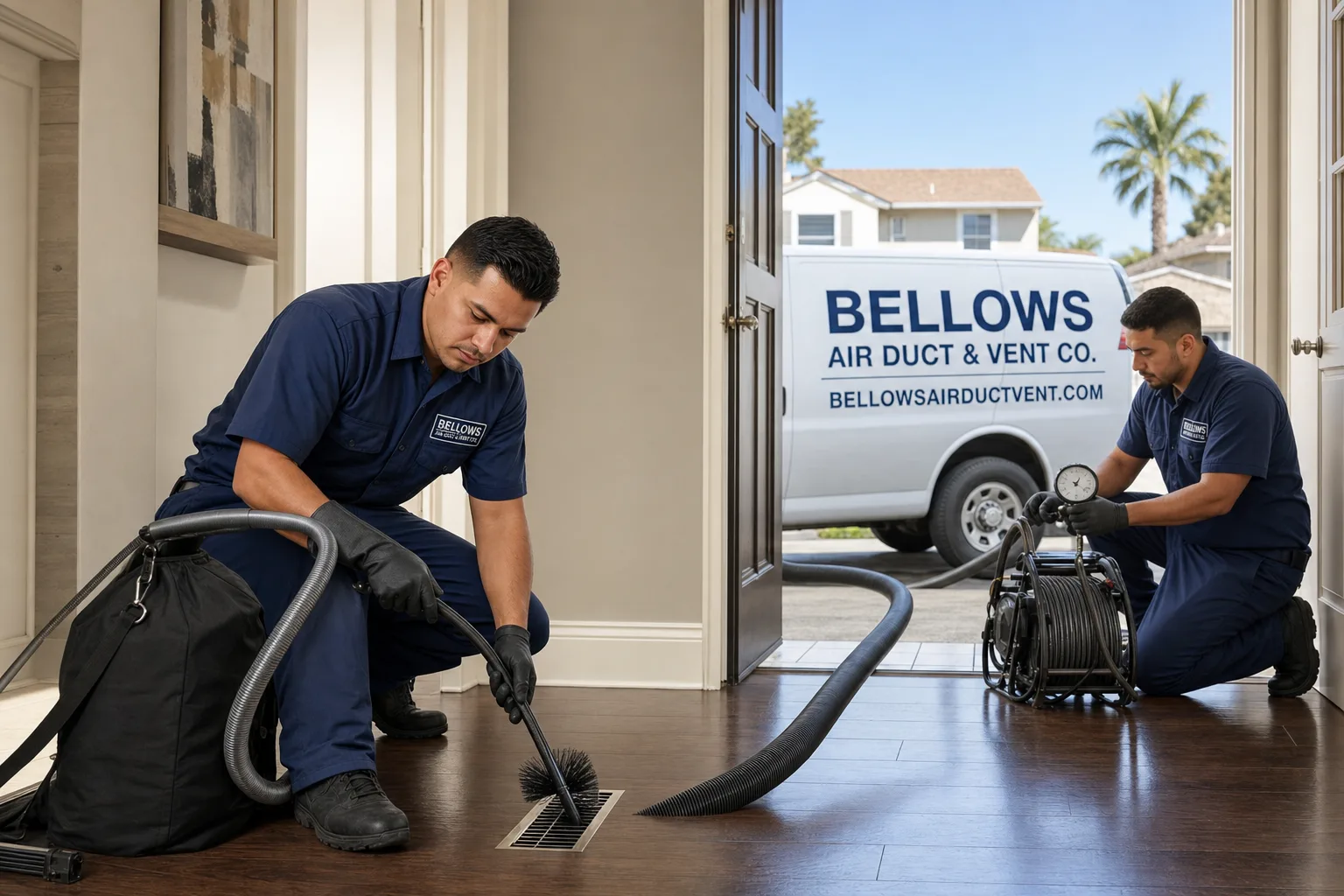
When your local Bellows Air Duct & Vent Co. team arrives, the first step is a camera inspection of the full duct run – from the dryer collar to the exterior cap. That inspection is done before a single tool goes to work, so you and the technician both know exactly what’s inside. No guessing, no upselling based on something you can’t see. The price for the work is shown to you in writing before anything starts – that’s not a policy we invented yesterday; it’s been the way we do business since 1984.
The core service here is Dryer Vent Cleaning, performed with professional-grade equipment from Rotobrush and Nikro – the same tools serious HVAC contractors specify. If the inspection turns up a crushed flex section, a failed vent cap, or a duct that’s pulling loose at a joint, our technicians handle that under Duct Repair & Sealing on the same visit. Most jobs are completed in a single visit. When work is done, we run a second camera pass so you can see the clean duct yourself. That’s the job finished right. And if for any reason it isn’t, the 90-Day Done Right Promise means we come back – in writing, no arguing, no paperwork.
Frequently Asked Questions
A clogged dryer vent is a genuine fire hazard and should not be left running in that condition. Lint is highly flammable, and a blocked duct traps heat that would otherwise exhaust safely outside the house. If your dryer is running unusually hot, taking two cycles to dry a normal load, or producing any burning smell, stop using it and schedule service now. Call (844) 685-6342 – our phones are answered by a live person, 24 hours a day, and we’ll get your local team scheduled as soon as possible.
In most cases, yes – your local Bellows Air Duct & Vent Co. team works to get same-day or next-day appointments when a dryer vent concern involves a safety symptom like burning smells or overheating. Call (844) 685-6342 and a live person will tell you what’s available in your area. We don’t route you to a voicemail or an app – someone picks up.
The vent and the appliance are separate problems. A dryer that’s running long cycles because the vent is clogged is not necessarily a failing dryer – it’s a dryer being starved of airflow. Once the vent is cleared and the exhaust path is confirmed clean, most appliances return to normal cycle times. A camera inspection will tell you whether the duct is the issue. If the dryer itself has a mechanical fault, that’s a separate conversation with an appliance technician – but it’s worth ruling out the vent first before spending money on a new machine.
For a straightforward single-story duct run, most dryer vent cleanings are completed in under two hours, including the before-and-after camera inspection. A longer duct run, an access difficulty in the ceiling or crawlspace, or a repair that’s needed on the same visit can add time, but your technician will walk you through that before work begins. No work starts until the price is in front of you in writing – no surprises on the bill.
Get It Fixed
Call (844) 685-6342 to speak with a live person right now, or book online. Your local Bellows Air Duct & Vent Co. team will schedule a camera inspection, give you an upfront written price before anything starts, and get the vent cleared – backed by the 90-Day Done Right Promise.
Written by Ray Castillo, Owner at Bellows Air Duct & Vent Co., proudly serving local communities since 1984.