
Allergies Worse Indoors
What’s Happening
When your allergies are worse inside your home than outside, dirty ductwork is almost always the reason. Your HVAC system circulates air through every room in the house, and if the ducts are coated with dust, pollen, pet dander, or mold spores, it redistributes those particles every time the system runs. A professional air duct cleaning removes that built-up contamination at the source.
Most people assume the outdoors is the problem – ragweed, tree pollen, the neighbor’s grass. But sealed indoor air that cycles through dirty ducts can carry a far heavier allergen load than a breezy afternoon outside. The ducts hold what they collect. They don’t shed it unless something physically removes it. That’s not a scare tactic; it’s just how sheet metal and fiberglass liner work. If you’ve changed your filter regularly and still feel worse the moment the blower kicks on, the filter is doing its job at one point in the system while everything upstream and downstream of it stays dirty.
Why It Happens
Dust and Debris Buildup in the Duct System
Over years of normal use, a layer of fine dust, skin cells, and tracked-in particles settles along the floor of every supply and return duct. When the blower runs, that layer gets disturbed and pushed into your living space. You can get a rough read on this yourself: remove a supply register, hold your phone flashlight into the opening, and look along the bottom of the duct. A thin grey coat is normal. A visible ridge of packed material is not.
Mold or Mildew Growing Inside the Ducts
If your symptoms include not just sneezing but also a musty smell when the system first starts up, there’s a reasonable chance moisture has gotten into the duct system and mold has taken hold. This happens most often in homes where the A/C coil drains slowly, where there’s been any water intrusion near an air handler, or where flex duct has sagged and pooled condensation. Mold spores are potent allergens even in small concentrations, and a blower fan is an efficient way to spread them.
Dirty or Damaged HVAC Coils and Drain Pans
The evaporator coil and the drain pan directly beneath it are warm, sometimes damp, and collect anything the filter misses. A coil caked with dust restricts airflow and creates a surface where biological growth can start. If you notice a sour or earthy smell on cooling days specifically, this is the likely culprit. The coil itself is not something to clean with household products – the fins are fragile and the drain chemicals can be harsh – but a trained technician can assess and clean it properly as part of an HVAC cleaning visit.
Leaking or Disconnected Duct Joints
Ducts that run through attics, crawlspaces, or unconditioned basements can pull in unfiltered air at any gap, joint, or disconnected section. That air bypasses your filter entirely and carries whatever is in those spaces – insulation fibers, rodent dander, dead insects, soil particles – straight into the living area. A sharp musty or dusty smell that’s worse in one room than another is a sign worth investigating. A camera inspection will show whether a joint has separated or whether flex duct has pulled away from a boot collar.
What to Do Right Now
- Check and replace your air filter. Pull it out and hold it up to a light. If you can’t see light through it, replace it before the system runs again. A clogged filter doesn’t trap more – it starts bypassing, and particles go around it into the blower housing.
- Photograph the inside of one or two supply registers. Remove a register cover, take a photo with your phone’s flash, and note what you see. This gives a technician useful baseline information before they arrive and documents the condition of the system.
- Stop running the system in fan-only mode. “Fan on” without heating or cooling circulates air continuously and redistributes whatever is sitting in the ducts. Run the system on auto until it’s been inspected.
- Note which rooms feel worst and when. If one room is significantly worse, or if symptoms spike at a specific time of day, write that down. It narrows down where in the duct system the problem is concentrated.
- Do not attempt to clean duct interiors yourself with a vacuum hose or brush. Residential shop vacs don’t create the negative pressure needed to contain dislodged debris, and you can spread contamination into the living space rather than remove it. Leave the interior work to equipment rated for the job.
How We Fix It
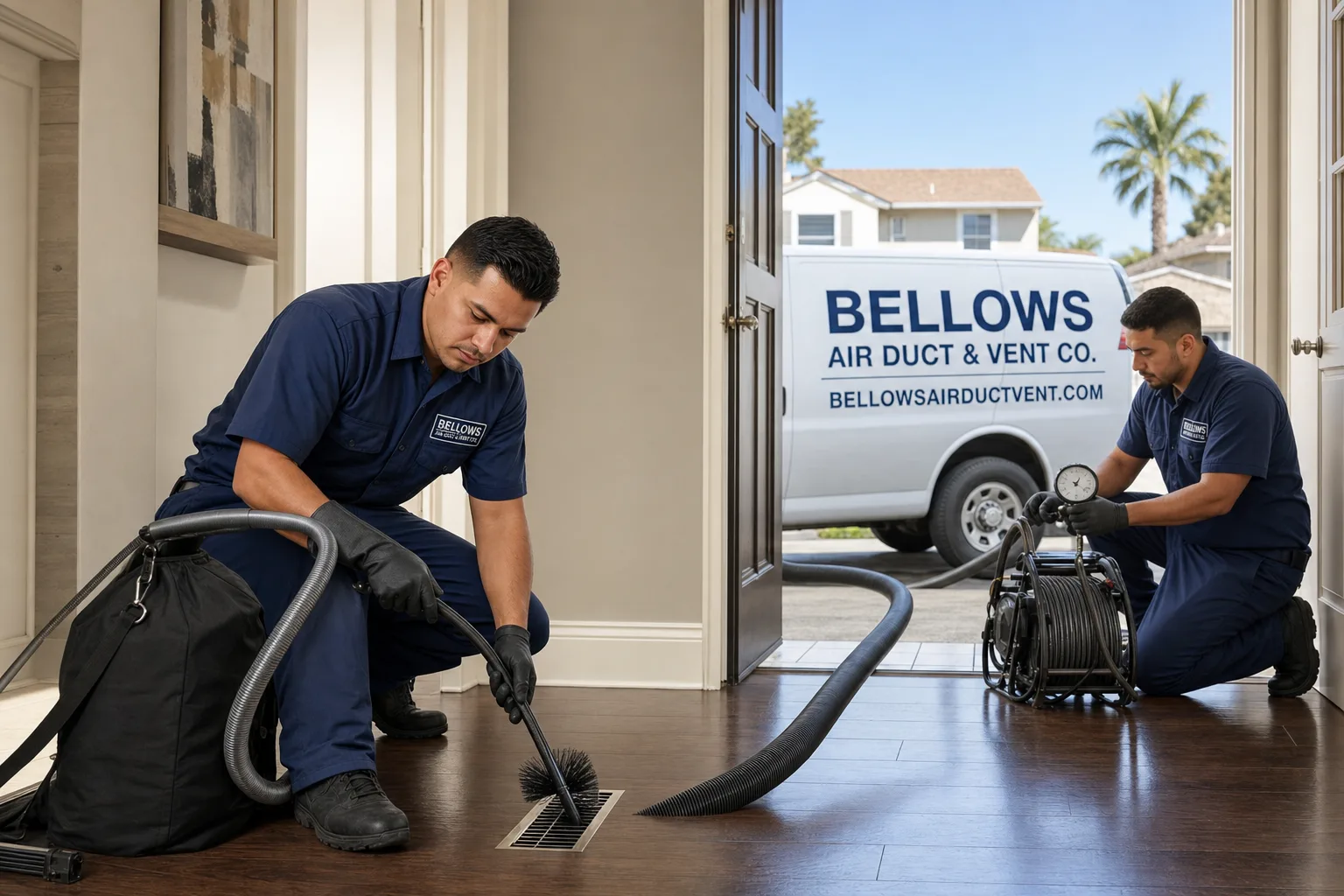
When your local Bellows Air Duct & Vent Co. team arrives, the first thing a technician does is a camera inspection of the duct system – before a single tool is turned on. That inspection tells us exactly what’s in there and where. You see it too. Nothing is assumed and nothing is exaggerated.
From there, we run professional-grade negative-pressure equipment from Rotobrush and Nikro that keeps the system under suction the entire time, so dislodged material gets pulled out rather than blown around. We clean to the collar at every register, brush the main trunk lines, and address the air handler cabinet. If the camera inspection or your symptoms point to mold or biological growth, our air quality and sanitizing service treats the interior surfaces with EPA-registered products after the mechanical clean. Most jobs finish in a single visit.
Before any of that starts, you have a written estimate in hand – the exact price for this specific job, disclosed before we lift a tool. That’s been the founding promise since Ray Castillo opened this company in 1984, and it hasn’t changed. The job is also covered by our 90-Day Done Right Promise: if it’s not right, we come back, no paperwork, no arguing.
Frequently Asked Questions
Yes, dirty ducts are a direct and common cause of worsened indoor allergy symptoms. The HVAC system moves all the air in your home multiple times a day, and if the ducts are holding accumulated dust, pollen, pet dander, or mold, every cycle reintroduces those particles. That said, a camera inspection before we start will confirm what’s actually in your system – so the recommendation is always based on what we find, not what we assume.
For most households, running a dirty duct system is an air quality problem rather than a safety emergency – but it does mean continued allergen exposure every hour the blower runs. If you’re smelling something musty or seeing visible mold near registers, we’d encourage you to reduce system use until the inspection. Call us at (844) 685-6342 and a live person will help you figure out the right urgency level for your situation.
Most residential air duct cleanings are completed in a single visit, and the work is self-contained – our equipment stays connected and under suction, so there’s no dust storm in your living room. You’re free to be home during the job. The technician will walk you through the before-and-after camera inspection so you can see the difference yourself before they pack up.
In most cases, yes – your local Bellows Air Duct & Vent Co. team schedules jobs promptly and our phones are answered by a live person 24 hours a day, not a voicemail. Call (844) 685-6342 right now and we’ll find the earliest available time that works for you. We’ll give you a straight answer on availability, not a runaround.
Get It Fixed
Call (844) 685-6342 – a live person answers 24/7, not a voicemail. Your local Bellows Air Duct & Vent Co. team will schedule the visit, do a camera inspection before anything starts, and hand you a written estimate before a single tool is turned on. Background-checked, uniformed technicians. 90-Day Done Right Promise on every job.
Written by Ray Castillo, Owner at Bellows Air Duct & Vent Co., proudly serving local communities since 1984.