
5 Mistakes to Avoid With Dryer Vent Cleaning
The most dangerous dryer vent mistakes aren’t skipping cleaning entirely - they’re the shortcuts that leave homeowners believing the job was done when the underlying hazard is still there. In our 42 years serving Los Angeles homes, we’ve seen five errors create a false sense of safety more often than complete neglect. If you’d rather have a trained technician handle it, call (844) 685-6342 for a free estimate.
Here’s a sobering example from last month: we were called to a duplex in Silver Lake where the previous “cleaning” had pushed lint from a flexible foil duct into a wall cavity. The vent terminated inside the structure, a code violation common in older Los Angeles multifamily conversions. The homeowner had a receipt saying the vent was cleaned. What they had was a fire hazard relocated to a spot no one could reach.
Mistake 1: Cleaning Flexible Foil Duct Instead of Replacing It
That Silver Lake job points to our first mistake. Flexible foil or plastic accordion-style ducting traps lint in its ridges and sagging low points. Running a brush through it dislodges some buildup but never fully clears it. Worse, the bristles can tear the thin material, creating gaps where lint escapes into walls, attics, or crawl spaces.
Los Angeles adopted stricter fire code amendments after the 2008 statewide building standards update, yet we still find foil ducting in homes from Santa Monica to Pasadena, especially in rentals where landlords swapped dryers without pulling permits. The proper fix is replacing it with smooth, rigid metal ducting, typically 4-inch galvanized steel, secured with metal tape (never screws, which catch lint).
We carry rigid metal duct and the tools to install it on every dryer vent cleaning in Seymour job, because we’ve learned to expect the worst. If a technician cleans your foil duct without mentioning replacement, they’re either untrained or unwilling to do the harder work. Either way, you don’t have a safe vent - you have a slightly less dirty one.
Mistake 2: Not Confirming the Termination Cap Opens Freely
A vent can be spotless inside and still fail completely if the exterior cap is stuck. We find them painted shut by overzealous painters in Hancock Park, bird-nested in the hills around Griffith Park, and clogged with dryer sheets that blew back and wedged in the flap. One home in Los Feliz had a cap so rusted the flapper had fused to the frame; the dryer had been fighting against it for three years, overheating every cycle.
The test takes ten seconds. With the dryer running, go outside and watch the cap. You should feel warm, moist air and see the flapper lift freely. If it barely moves, chatters, or stays flat, you’ve got a blockage at the termination. Common culprits:
- Lint packed behind the flapper (especially on caps with screens, which we remove - they’re lint traps)
- Paint or caulk sealing the hinge
- Bird nests, particularly in spring; house finches love the warmth
- Improper installation with the cap angled to catch debris
We document the cap’s operation with our camera inspection before and after every clean. If it’s not opening fully, we fix it or flag it for replacement. No point in brushing a vent that can’t exhale.
Mistake 3: Measuring by Calendar Instead of Airflow Performance
“Clean it every year” is decent general advice and terrible specific advice. A retired couple in Brentwood running two loads weekly needs far less frequent cleaning than a family of five in Van Nuys doing seven loads with heavy towels and pet bedding. The metric that matters is airflow, not months elapsed.
We measure with an anemometer at the termination cap, comparing cubic feet per minute against the dryer’s rated output. A reading below 80% of manufacturer spec means restriction is building, even if the vent looks clean to the eye. Other performance signals Los Angeles homeowners should watch:
- Clothes still damp after a full cycle, especially heavy items
- The dryer exterior or laundry room noticeably hotter than usual
- A burnt lint smell, more common in summer when ambient heat already stresses the system
- Longer run times creeping up over weeks, not days - sudden changes usually mean a complete blockage
Los Angeles coastal humidity is lower than the Southeast, but Santa Ana wind events blow fine dust and ash that compound lint buildup in vents facing the wrong direction. Calendar cleaning ignores all of this. Performance-based maintenance doesn’t.
Mistake 4: Trusting a “Clean” Certificate Without a Full-Length Brush Run
The discount coupon services are masters of this particular illusion. They arrive with a shop vac and a 6-foot flex wand, clean what they can reach from the laundry room, and present a certificate saying your vent is clean. What they can’t reach - the 15-foot vertical run to your roof, the 90-degree elbow behind the drywall, the transition through an unconditioned attic - stays packed with lint.
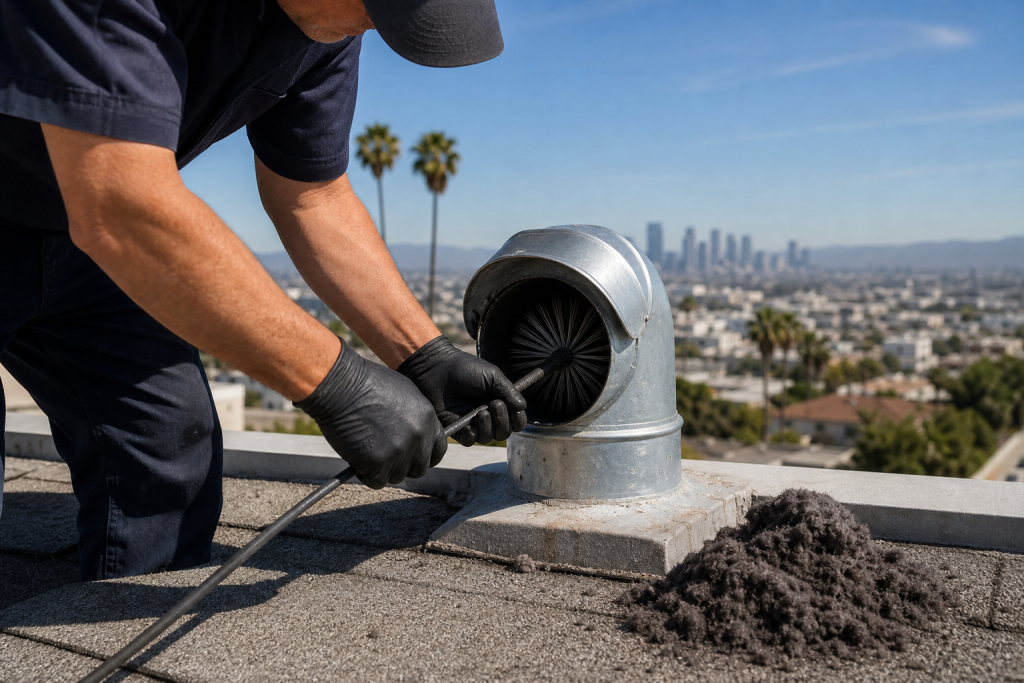
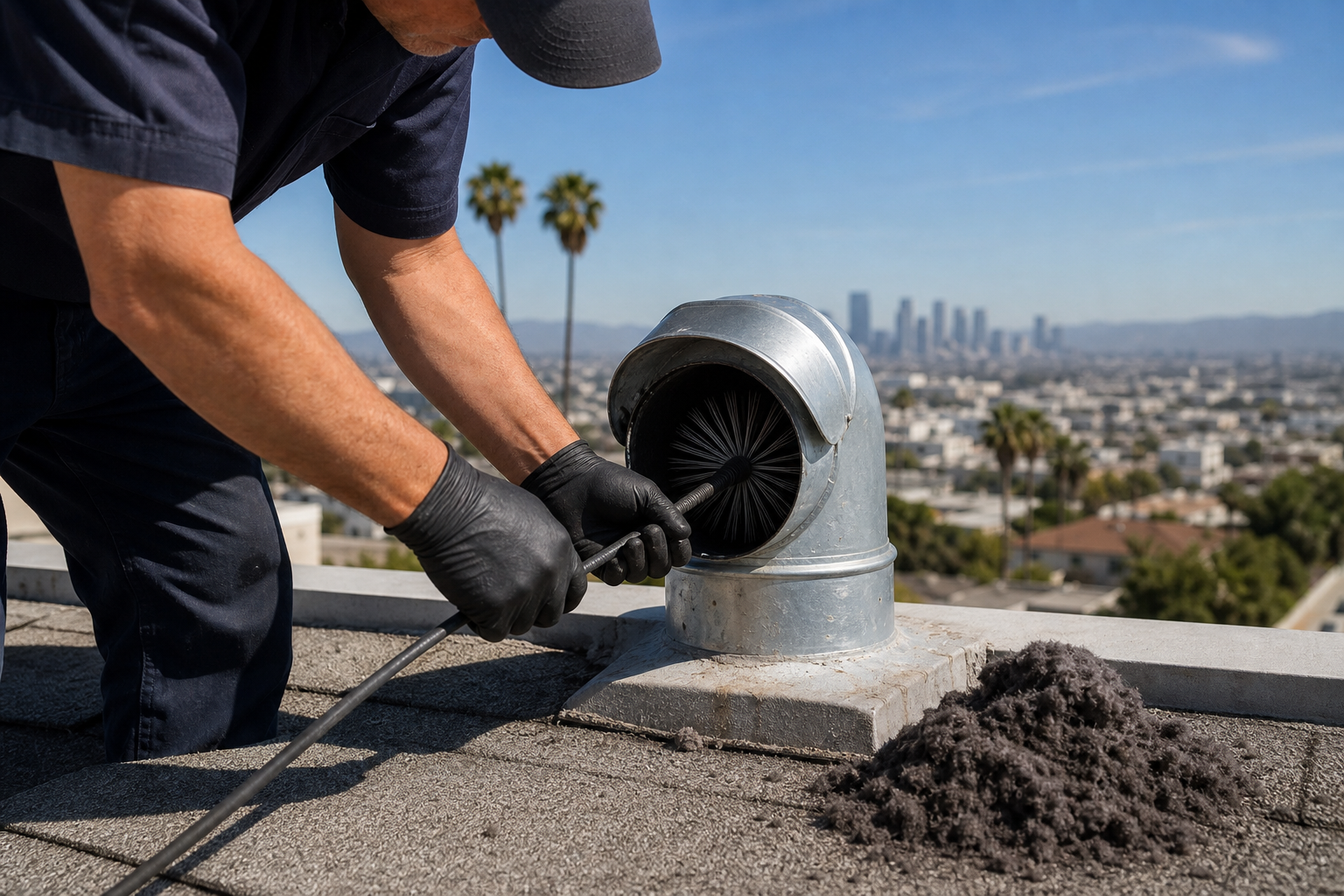
A proper cleaning requires a rotary brush system sized to your duct diameter, run the full length from dryer connection to termination. Our crews use Rotobrush and Nikro equipment with extendable rods and reverse-blowing capabilities to push debris out rather than deeper in. We camera-verify the full length before we start and after we finish. The homeowner sees the difference, not just takes our word.
That certificate from the $49 special? It’s paper. The lint still in your vent is fuel. We’ve been called after fires in Koreatown and Mid-City where the homeowner produced a recent cleaning receipt. The insurance adjuster’s photos showed packed lint past the first elbow. The brush never made it that far.
Mistake 5: Ignoring the Connection Point Inside the Dryer Itself
This is the mistake even conscientious homeowners make. The vent line is clean, the cap opens freely, but lint is still accumulating inside the dryer’s internal housing - around the heating element, in the blower wheel, beneath the drum. Every load sheds some lint past the screen. Over years, it builds to a genuine ignition risk.
We pulled one out of a garage over in Echo Park last week where the homeowner had meticulously cleaned his roof vent annually for a decade. Never once opened the dryer’s back panel. The heating element was cocooned in lint so compacted it had started to char at the edges. Another month, another high-heat cycle, and we’d have been looking at a different kind of call.
Accessing the internal housing requires partial disassembly and knowledge of the specific model’s layout. It’s not a homeowner task for most people. Our technicians are trained on major brands and carry the thermal cutout tools to test safety components while we’re inside. This step is part of our standard Bellows Air Duct & Vent Co. home dryer vent service, not an upsell. If a company isn’t mentioning it, they either don’t know or don’t want the liability of opening the appliance.
When to Call a Professional
If your dryer shows any performance decline, if you’ve never had the internal housing inspected, or if your home has the flexible foil ducting common in pre-1990 Los Angeles construction, it’s worth a professional assessment. We offer free estimates, present pricing before any work begins, and back every job with our 90-Day Done Right Promise. No paperwork, no arguing - if it’s not right, we return at no charge.
Related services in Los Angeles: Air Duct Cleaning in Seymour | HVAC Cleaning in Seymour
The Bottom Line
False safety is worse than acknowledged risk. The homeowner who knows their vent needs cleaning at least avoids using the dryer until it’s handled. The homeowner who believes it’s clean - because of a certificate, a calendar reminder, or a partial job - runs the hazard daily without knowing.
The five mistakes circle back to one principle: verification beats assumption. Rigid metal ducting verified by sight. Termination cap verified by operation. Cleaning interval verified by airflow measurement. Work scope verified by camera. Internal condition verified by opening the housing.
We’ve been in Los Angeles long enough to know the building stock, the code history, and the shortcuts that pass for service. If you want your dryer vent inspected properly, with upfront pricing and a written guarantee, call (844) 685-6342. Estimates are free, and most jobs finish in a single visit.
Key Takeaways
- Flexible foil ducting should be replaced with rigid metal, not cleaned repeatedly
- Always verify the exterior termination cap opens fully under dryer airflow
- Schedule cleaning by performance signals, not just calendar dates
- Demand camera verification of the full duct length, not just a certificate
- Include internal dryer housing inspection in any thorough vent service
Frequently Asked Questions
Every 12 to 18 months for typical households, but heavy-use homes with pets, children, or frequent towel loads may need service every 6 to 9 months. The reliable method is measuring airflow with an anemometer; below 80% of manufacturer specification means it’s time regardless of calendar. Call (844) 685-6342 for a free airflow check.
You can clear lint from the accessible transition duct behind the dryer and verify the exterior cap opens, but full-length duct runs and internal dryer housing require specialized rotary brushes and partial disassembly. We don’t recommend DIY for vertical runs, roof terminations, or any work involving the heating element. The fire risk of incomplete cleaning outweighs the savings.
The lint screen catches roughly 60% of debris; the rest passes into the vent system and internal housing. If drying times are increasing with a clean screen, restriction is building downstream - in the duct, at the termination, or inside the dryer itself. This is the most common early warning of a vent problem we see in Los Angeles homes.
A complete service includes: camera inspection of the full duct run; rotary brush cleaning with debris extraction; termination cap inspection and repair; airflow measurement before and after; and internal dryer housing cleaning with safety component testing. Anything less leaves risk on the table. Ask any provider specifically what’s included before booking.
Written by the team at Bellows Air Duct & Vent Co., serving Los Angeles since 2012.
Need Air Duct Cleaning Help?
Call Bellows Air Duct & Vent Co. - licensed & insured, here with fast after-hours help in Los Angeles.
(844) 685-6342