
Air Quality & Sanitizing: Repair or Replace? How Los Angeles Homeowners Decide
Most Los Angeles homeowners with persistent air quality issues don’t need to repair or replace anything. They need to diagnose whether the problem is at the source (moisture, combustion, or materials inside the home) or in the distribution system (ducts recirculating what already exists). Sanitizing treatments, UV lights, and ionizers only work after the source is controlled and the ducts are clean. If you’re unsure which category you’re in, call us at (844) 685-6342 and we’ll walk through it with you.
The EPA ranks indoor air two to five times more polluted than outdoor air, even in cities with smog alerts. Yet the Los Angeles market is flooded with UV lights, ionizers, and sanitizing fog treatments that address symptoms while leaving the source untouched. We’ve been in homes from Pasadena to Pacific Palisades where the homeowner spent thousands on add-on products, only to find the real culprit was a disconnected return duct pulling attic air, or a dryer vent dumping moisture into a crawl space. This piece is about how to think through the decision without wasting money on the wrong fix.
Source Problems vs. Distribution Problems: The First Question
Before you spend a dollar on sanitizing or filtration, figure out where the pollution is coming from. Source problems originate inside the building envelope. Distribution problems move existing pollution around faster than they should.
Source-based issues we see in Los Angeles:
- Moisture intrusion from slab foundations or poorly vented crawl spaces, common in older homes from the 1940s-1960s building boom
- Combustion byproducts from gas ranges, wall heaters, or attached garages (still present in many Mid-Century and Spanish Revival homes)
- Off-gassing from pressed-wood cabinetry, flooring adhesives, or recent renovation materials
- Wildfire smoke particles that infiltrate through gaps in the building shell during fall Santa Ana wind events
Distribution-based issues:
- Ductwork leaks pulling attic air, garage fumes, or crawl space mold into living spaces
- Decades of accumulated dust, pet dander, and construction debris recirculating through supply vents
- Filters that are wrong for the system, installed backwards, or unchanged for years
Sanitizing a duct system that pulls from a moldy crawl space is like mopping a floor with a broken pipe underneath. The fix isn’t more product. It’s sealing the ductwork and controlling the moisture. In our 42 years, the homeowners who get lasting results are the ones who let us camera-inspect first and identify which problem they actually have.
What Air Quality Sanitizing Actually Does and Does Not Eliminate
Air quality sanitizing, as performed by reputable contractors, applies an EPA-registered antimicrobial to the interior surfaces of ductwork. It reduces microbial growth on those surfaces. It does not eliminate particles already airborne. It does not remove dust, dander, or smoke. It does not fix a moisture problem that caused the growth in the first place.
We use products from Guardsman and other manufacturers registered for HVAC applications, applied according to label directions. The treatment is a finishing step, not a standalone solution. Here’s the sequence that actually works:
- Camera inspection to assess duct condition and identify leaks or damage
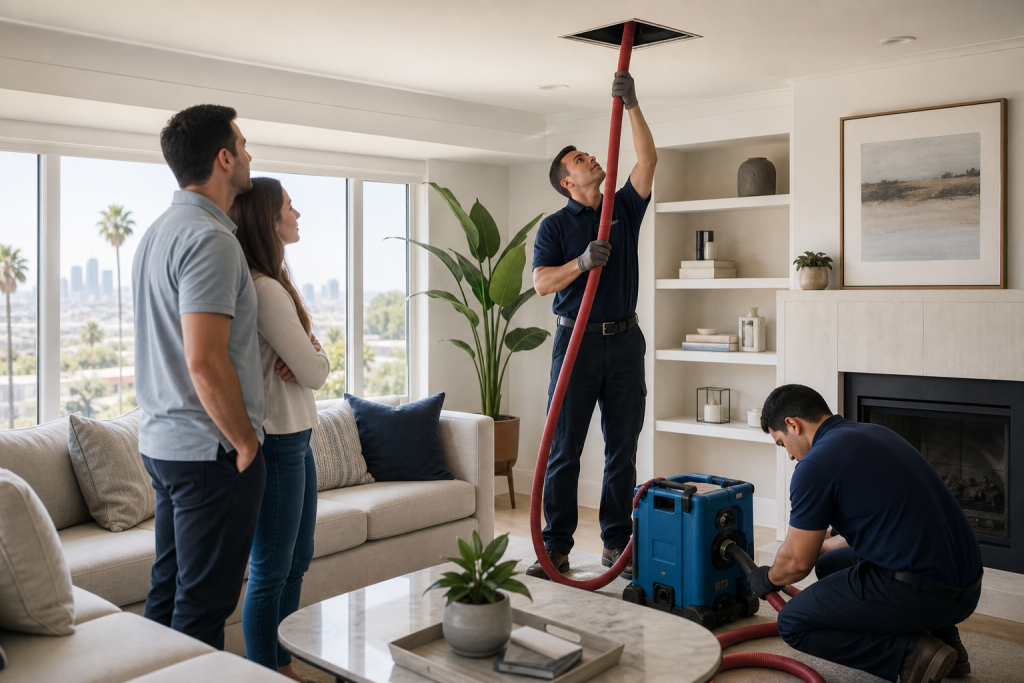
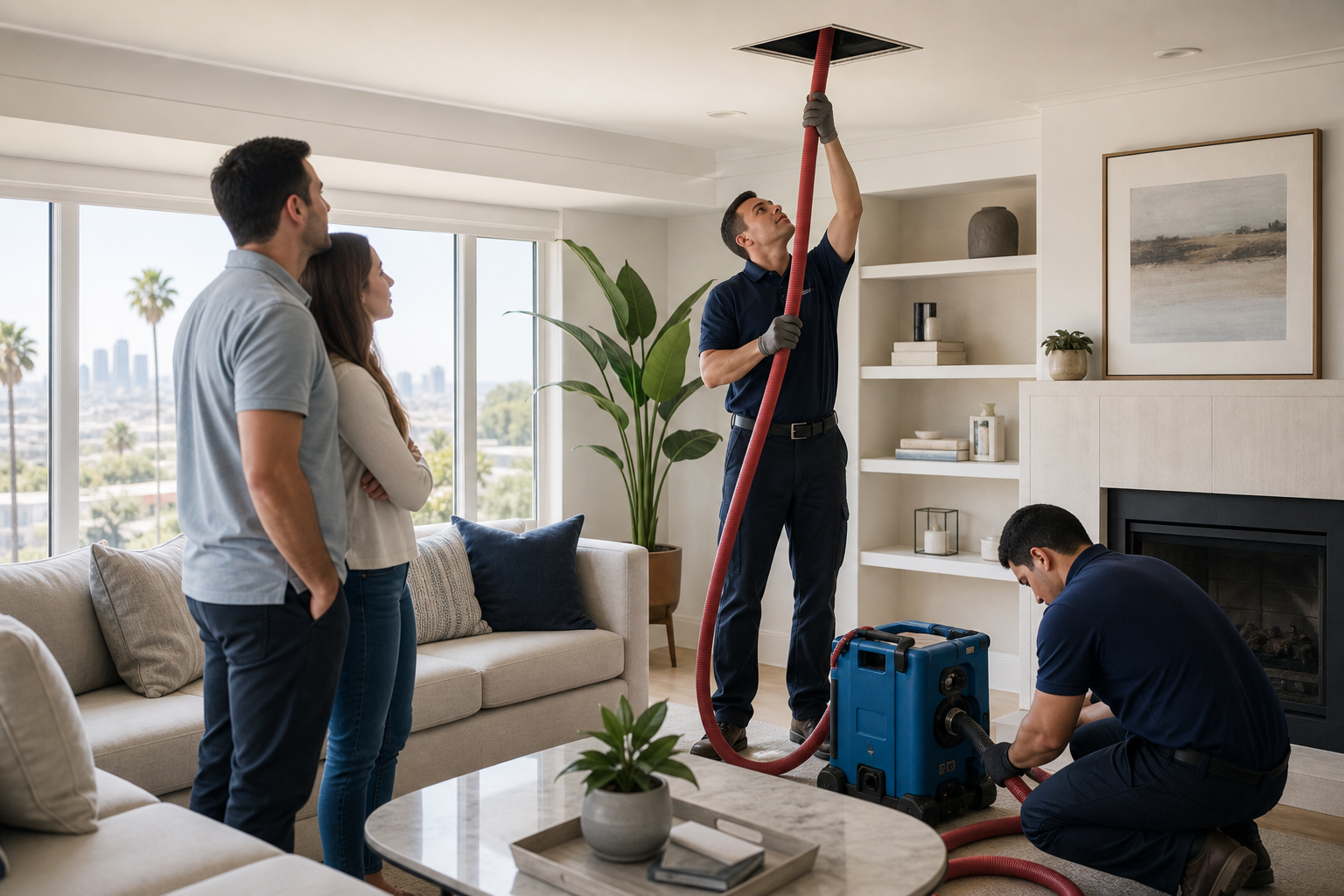
- Mechanical cleaning with Rotobrush or Nikro equipment to remove accumulated debris
- Repair or seal disconnected ducts, using methods appropriate to the duct material
- Sanitizing treatment, applied only to clean, dry surfaces
- Verification with post-cleaning camera inspection
Los Angeles homeowners should be especially wary of fogging treatments marketed as “whole home sanitizing” without mechanical cleaning. The debris remains. The treatment coats it. And in six months, you’re back where you started.
The Evidence on UV-C Lights, Ozone Generators, and Duct-Sprayed Biocides
These three categories generate the most questions we field, and the most oversold promises in the market.
UV-C lights installed in ductwork or at the coil can reduce microbial growth on irradiated surfaces. They do not clean air passing through at residential airflow speeds, the EPA does not certify them as air cleaners, and they require annual lamp replacement that many homeowners forget. We’ve removed dead units from systems in Brentwood and Los Feliz where the lamp burned out three years prior and no one checked.
Ozone generators are actively harmful at concentrations that affect indoor organisms. California banned ozone-generating air purifiers for sale to consumers in 2010. We do not install or recommend them. Any contractor still pitching ozone for occupied spaces is working from outdated or dishonest information.
Duct-sprayed biocides vary enormously in formulation and application quality. The key variables: whether the duct surface was cleaned first, whether the product is registered for that specific use, and whether the applicator followed dwell-time requirements. A rushed application on dirty ducts is worse than none at all, it adds chemical load without solving the underlying problem.
Our position after four decades: these products have narrow, specific applications. They are not the starting point for most Los Angeles homes.
When Filtration, Ventilation, or Humidity Control Solves What Sanitizing Cannot
Some problems need engineering, not chemistry.
HEPA filtration upgrades work when the issue is particulate: wildfire smoke, pollen, urban dust. We specify Honeywell and Aprilaire media filters matched to the system’s airflow capacity. A filter too dense for the blower motor restricts airflow, strains equipment, and can actually worsen distribution. The right filter, properly fitted, captures what sanitizing never touches.
Ventilation changes matter in tight Los Angeles homes retrofitted with new windows and insulation. Older homes in neighborhoods like Highland Park or Eagle Rock breathed through gaps and single-pane glass. Seal those leaks without adding controlled ventilation, and pollutants concentrate. Heat recovery ventilators or energy recovery ventilators bring in filtered outdoor air without the energy penalty of simple exhaust fans.
Humidity control is the overlooked factor in a dry climate that still has moisture pockets. Coastal Los Angeles homes in Venice or San Pedro see marine layer condensation. Inland homes with slab foundations wick ground moisture. Keep relative humidity below 60% and you prevent the conditions that allow microbial growth. Above that threshold, sanitizing is temporary by definition.
We pulled one out of a garage over in Silver Lake last month where the homeowner had run two dehumidifiers continuously for a year, never understanding that the real issue was a disconnected bathroom exhaust dumping moist air into the attic and back through a leaky return. No amount of sanitizing or filtration would fix that. We sealed the duct, reconnected the exhaust, and the humidity normalized in a week.
The Honest Cost Comparison: Cleaning Plus Filtration vs. Ongoing Sanitizing Contracts
Los Angeles homeowners deserve real numbers to compare, not teaser rates that change at the door.
| Approach | Typical First-Year Cost | What It Includes | Recurring Cost |
|---|---|---|---|
| Verified duct cleaning + camera inspection + proper filtration upgrade | $800-$1,800 | Mechanical cleaning, leak sealing, filter upgrade, before/after documentation | Filter replacement every 6-12 months ($40-$120/year) |
| Quarterly sanitizing service contract | $600-$1,200 | Biocide application, often without cleaning | $600-$1,200/year ongoing |
| UV light installation + annual lamp replacement | $800-$1,500 | Fixture, lamp, installation | $100-$200/year lamp replacement |
The cleaning-plus-filtration approach costs more upfront and less over time. It also addresses particles, which sanitizing does not. The quarterly contract model keeps revenue flowing for the service company while the homeowner pays indefinitely for temporary surface treatment.
Our Bellows Air Duct & Vent Co. home pricing is disclosed before we start. No bait coupons, no price changes at the door. We also offer a $89 Seasonal Tune-Up that includes inspection and filter assessment, and a Free Second Opinion on Any Written Estimate if you’ve been quoted work you’re unsure about.
When to Call a Professional in Los Angeles
Call when you can’t identify the source, when symptoms persist after basic measures, or when a contractor is pushing product before diagnosis. Persistent musty odor, visible mold, or family members with unexplained respiratory irritation are signals that the problem may be beyond DIY scope.
We answer calls with a live person, 24 hours a day. Not voicemail, not an app. Our technicians are background-checked and uniformed, and most jobs finish in a single visit. Every job starts and ends with camera inspection, so you see what we see.
Related services in Los Angeles: Air Duct Cleaning in Seymour, Dryer Vent Cleaning in Seymour, HVAC Cleaning in Seymour.
The Bottom Line
The repair-or-replace framing doesn’t fit air quality problems because the solution is rarely a single product or intervention. Start with source identification, then distribution cleaning, then targeted upgrades if needed. Sanitizing has a place, but it’s near the end of the sequence, not the beginning. The homeowners who spend wisely are the ones who diagnose before they buy.
Key takeaways:
- Indoor air quality problems are source-based or distribution-based, rarely both equally
- Sanitizing treats surfaces, not airborne particles, and requires clean ducts to work
- UV-C, ozone, and biocides have narrow applications and are widely oversold
- Filtration, ventilation, and humidity control solve problems that chemistry cannot
- Verified cleaning plus proper filtration typically costs less over time than ongoing sanitizing contracts
If you’re in Los Angeles and need help sorting through what’s actually wrong and what actually fixes it, Bellows Air Duct & Vent Co. offers free estimates. Call (844) 685-6342 and we’ll walk through your situation. If we can’t help, we’ll tell you that too.
Frequently Asked Questions
Most Los Angeles homeowners don’t need equipment replacement, they need source control and duct cleaning, which typically costs $800-$1,800 versus $4,000-$8,000 for full HVAC replacement. The “repair or replace” question usually misidentifies the problem as equipment failure when it’s actually distribution or source contamination. Call (844) 685-6342 for a free assessment of what your home actually needs.
Professional duct sanitizing in Los Angeles ranges from $300-$600 as an add-on to mechanical cleaning, or $600-$1,200 as part of a quarterly service contract. We do not recommend sanitizing without cleaning first, the debris remains and the treatment coats it rather than removing it. For exact pricing on your system, call (844) 685-6342, estimates are free.
No. Sanitizing reduces surface mold in accessible ductwork but does not eliminate the moisture source that allowed growth, nor does it address mold inside walls, crawl spaces, or HVAC components. Permanent mold control requires moisture remediation, which may involve ventilation changes, dehumidification, or building envelope repairs. We camera-inspect to determine whether the problem is in the ducts or beyond them.
UV-C lights reduce microbial growth on irradiated coil and duct surfaces but do not effectively clean air at residential airflow speeds. They require annual lamp replacement, add energy cost, and are not certified by the EPA as air cleaning devices. For most Los Angeles homes, sealed ductwork and proper filtration deliver better results at lower lifetime cost.
Written by the team at Bellows Air Duct & Vent Co., serving Los Angeles since 2012.
Need Air Duct Cleaning Help?
Call Bellows Air Duct & Vent Co. - licensed & insured, here with fast after-hours help in Los Angeles.
(844) 685-6342