
Last updated July 25, 2026
How Long Does Dryer Vent Cleaning Take? Timelines and What to Expect
A dryer vent cleaned in under 20 minutes almost certainly wasn’t cleaned - it was poked. In our 42 years serving Los Angeles homes, from the hillside properties of Pacific Palisades to the compact bungalows of Highland Park, we’ve learned that honest timing reveals honest work. Most homeowners assume this is a quick add-on service, something to squeeze between errands. But the actual time depends almost entirely on your vent’s length, configuration, and what’s hiding inside. This guide breaks down realistic timelines by system type, explains why speed is a warning sign, and shows you what a thorough job actually looks like from arrival to final camera check.
Quick Answer
A thorough residential dryer vent cleaning takes 45 minutes to 2.5 hours depending on vent length, number of bends, and whether the vent exits through a wall, roof, or crawl space. Straight short-run vents in typical Los Angeles ranch homes average 45-60 minutes; long multi-elbow runs through two stories or roof-vented systems in older hillside homes commonly require 90 minutes to 2 hours. Any service claiming completion in under 30 minutes is skipping critical steps.
Table of Contents
- What Factors Determine Dryer Vent Cleaning Time
- Time Breakdown by Vent Configuration
- Step-by-Step: What Happens During a Cleaning
- Why Speed Is a Red Flag, Not a Selling Point
- When Cleaning Reveals a Repair Need
- Same-Day vs. Scheduled Appointments
- Los Angeles-Specific Considerations
- How to Prepare and What to Expect After
What Factors Determine Dryer Vent Cleaning Time
Five variables control how long your cleaning takes. Understanding them helps you evaluate any quote or timeline you’re given.
Vent length and routing. A straight 4-foot run through an exterior wall is a different job than a 25-foot horizontal run with three elbows snaking through a crawl space. Every bend reduces airflow efficiency and creates lint collection points that need individual attention.
Exit point location. Wall vents at ground level are accessible. Roof vents require ladder work, safety protocols, and often two technicians - adding 20-40 minutes. In Los Angeles, many 1960s-1980s homes in the San Fernando Valley and hillside neighborhoods like Echo Park have roof vents installed before current codes discouraged them.
Years since last cleaning. A vent maintained every two years has light, fluffy lint. A vent neglected for eight years may contain compacted, moisture-hardened blockages that require multiple passes with agitation tools. We’ve pulled out material so dense it resembled felted wool.
Dryer type and location. Stackable units in closet installations limit technician maneuverability. Gas dryers require additional safety checks. Second-floor laundry rooms mean longer vertical runs.
Accessibility obstacles. Built-in cabinetry, tight garage configurations, or vents behind appliances that haven’t been moved in a decade all add setup and breakdown time.
Here’s a practical reference for what these variables mean in real homes:
| Factor | Typical Time Impact |
|---|---|
| Straight wall vent, under 10 feet | Baseline: 45-60 min |
| Each additional 90° elbow | +10-15 min |
| Roof vent exit | +20-40 min |
| More than 5 years since cleaning | +15-30 min |
| Second-story or longer vertical run | +15-25 min |
| Compact or obstructed installation | +10-20 min |
Time Breakdown by Vent Configuration
Not all vents are built alike. Los Angeles housing stock spans 1920s Spanish revivals, mid-century ranches, 1980s stucco boxes, and modern builds - each with different venting realities.
Straight Short Runs: 45-60 Minutes
Common in: Post-war ranch homes in the San Fernando Valley, single-story Glendale bungalows, newer construction in Playa Vista.
These vents run 4-12 feet with one or two bends, exiting through a ground-level wall. The technician can access both ends easily. Time breakdown: 10 minutes setup and appliance pull, 20-30 minutes of actual cleaning with Rotobrush or Nikro agitation tools, 10-15 minutes for camera inspection and reassembly. This is the only configuration where sub-60-minute completion is legitimate.
Medium Runs with Multiple Elbows: 60-90 Minutes
Common in: Two-story homes in Pasadena, townhomes in Culver City, additions where the laundry was relocated from original placement.
Each elbow creates a friction point where lint accumulates. The technician must work the tool through each bend methodically, verify airflow at each section, and often perform a reverse pull from the exterior. In our experience, these jobs average 2-4 elbows and 15-25 feet of duct.
Long Runs and Roof-Vented Systems: 90 Minutes-2.5 Hours
Common in: Hillside homes in Los Feliz, Silver Lake, and the Hollywood Hills; older properties in Los Angeles where roof venting was standard practice before the 2003 International Residential Code changes.
These systems demand ladder setup, roof safety protocols, and often a two-person crew. The vertical run creates natural lint compaction from gravity and moisture. We’ve worked on 35-foot runs in Los Angeles hillside homes that required two complete cleaning cycles - one from each end - before the camera showed clear duct.
Commercial and Multi-Unit Configurations: 2-4 Hours
Common in: Small apartment buildings in Koreatown, duplexes in Mid-City, homeowner association laundry rooms.
Multiple dryers sharing a common vent line, or individual vents in stacked configurations, require isolation testing and sequential cleaning. These fall outside standard residential pricing and timing.
Step-by-Step: What Happens During a Cleaning
Knowing the sequence helps you verify that nothing was skipped. At Bellows Air Duct & Vent Co. home, our process hasn’t changed in principle since 1984, though the tools have improved.
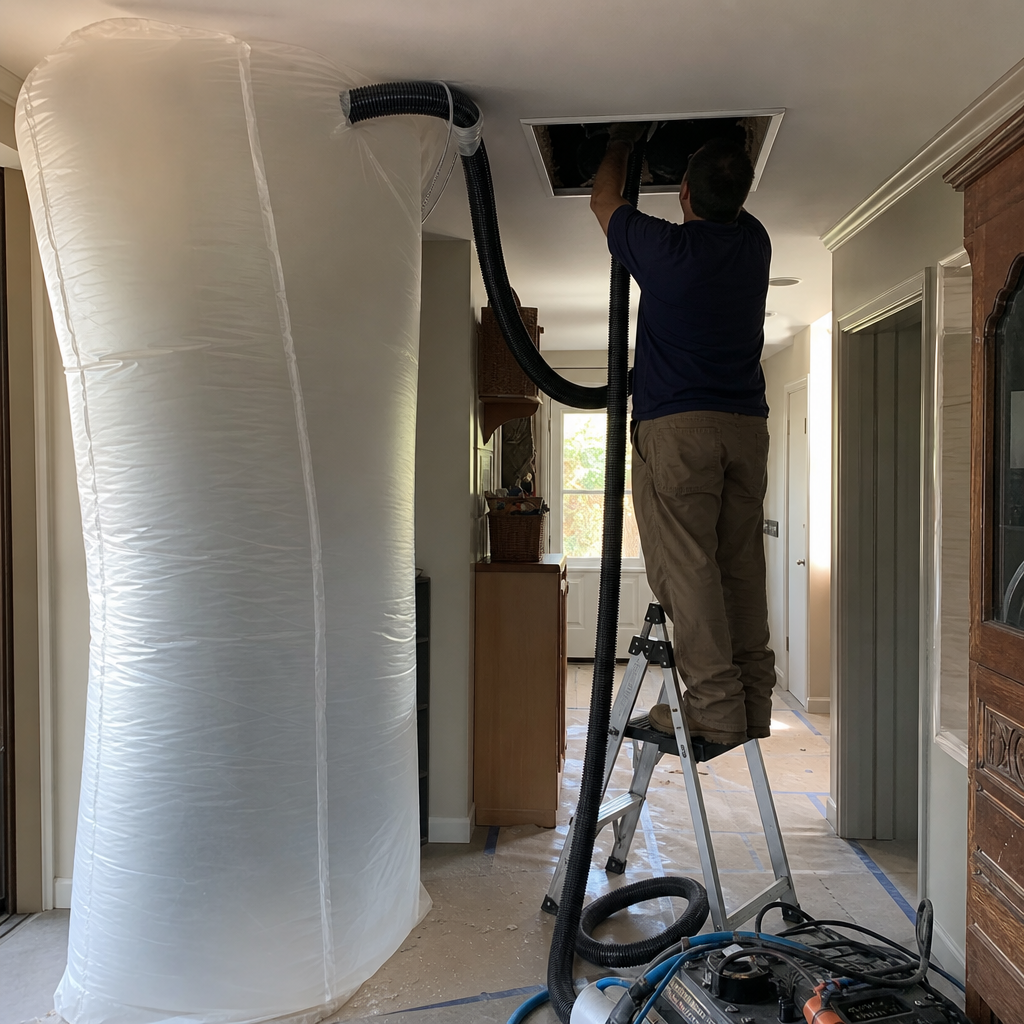
- Arrival and protection. Technicians lay floor protection, review the work area, and confirm the quoted price before touching a tool. No surprises on the bill.
- Camera inspection - before. We feed a camera through the vent line to document existing conditions. This 5-10 minute step reveals blockages, damage, and duct material (transition duct, rigid metal, or dangerous foil/plastic that needs replacement). You see what we see.
- Appliance disconnect and setup. The dryer is carefully moved, the transition duct detached, and our vacuum and agitation equipment connected. Gas dryers get a shut-off check.
- Agitation and extraction. Using Rotobrush or Nikro tools matched to your duct diameter, we scrub the full length while high-powered vacuum extracts dislodged material. This is where rushed jobs cut corners - a quick pass misses caked-on lint.
- Camera inspection - after. The camera runs again. This isn’t optional; it’s how we verify the job before reassembly. The “after” footage is your proof.
- Reassembly and function test. Everything is reconnected, the dryer run-tested for proper airflow and temperature, and the work area cleaned.
- Documentation and guarantee. You receive the before/after camera record and written confirmation of our 90-Day Done Right Promise.
Steps 2 and 5 - the camera inspections - add 15-20 minutes total. Skip them and you’ve saved time but lost verification. We’ve been called to re-clean vents that “professionals” handled in 15 minutes; the homeowner’s dryer still overheated because the middle section was never touched.
Why Speed Is a Red Flag, Not a Selling Point
“In and out in 15 minutes” sounds efficient. It isn’t. It’s physically impossible to complete the seven steps above in that timeframe.
Here’s what rushed jobs actually skip:
- No camera inspection. The technician can’t show you before/after because there isn’t any. You’re trusting a verbal claim.
- Partial-length cleaning. The tool reaches 6-8 feet in from each end, leaving a packed middle section untouched. This is common with cheap coupon services that book six jobs per day.
- No airflow verification. The dryer “runs” after reassembly, but exhaust temperature and velocity aren’t measured. A partially blocked vent still moves some air - just not enough to be safe.
- Compressed lint, not removed lint. Fast operators sometimes push material deeper with aggressive tools, creating a worse blockage two months later. We’ve cleared vents where the “cleaning” actually caused a complete obstruction.
In Los Angeles, where dryer fire risk runs higher than national averages due to year-round use and older housing stock, this matters. The Los Angeles Fire Department responds to hundreds of dryer fires annually. A proper cleaning takes the time it takes. We stand behind it - no paperwork, no arguing - because we know what was actually done.
Our rule: if we can’t show you a clear duct on camera, the job isn’t finished. That standard doesn’t bend for speed.
When Cleaning Reveals a Repair Need
Sometimes the camera shows damage that cleaning alone won’t fix. This extends total time on site and changes the scope.
Disconnected or separated duct sections. Common in older Los Angeles homes with original ductwork. Lint blows into wall cavities or crawl spaces, creating hidden fire hazards. Repair adds 30-60 minutes.
Crushed or damaged rigid duct. Often from previous owners storing items against the vent line in a garage or closet. Replacement with proper gauge metal duct is necessary.
Non-code transition duct material. We still find foil or plastic transition ducts in pre-1990s homes, especially in neighborhoods like Van Nuys and North Hollywood. These are fire hazards and must be replaced with rigid or semi-rigid metal per California building code.
Inadequate vent termination. Missing flapper valves, screen-covered terminations (which trap lint), or improper clearances to gas meters or AC units. Correct termination installation adds time but ensures safe, code-compliant operation.
When we find these issues, we stop and explain. Our no-hassle upfront pricing means you know repair costs before we proceed - the number on the phone is the number on the invoice. No scare tactics. We’ve had homeowners in Los Angeles tell us previous companies “discovered” expensive problems that didn’t exist. Our camera record shows you exactly what we found.
Most repair-inclusive jobs still finish in a single visit. Our trucks carry standard duct materials and Dryer Vent Cleaning in Seymour-grade replacement components from Honeywell and Aprilaire.
Same-Day vs. Scheduled Appointments
Availability depends on season, demand, and your flexibility.
Scheduled appointments offer preferred time windows and full preparation. We recommend these for roof-vented systems, known long runs, or first cleanings after years of neglect. You’ll receive a confirmation call the day before and a technician call 30 minutes out. We’ll be there when we say.
Same-day service is available for urgent situations: dryer overheating, burning smells, or visible lint backup at the exterior vent. In Los Angeles, same-day requests spike during Santa Ana wind conditions when dry air increases static and lint circulation. We maintain capacity for these calls because a dryer you can’t safely use shouldn’t wait.
Same-day jobs aren’t rushed jobs. The same seven-step process applies. However, if your vent configuration typically requires 90 minutes and you’ve booked a late afternoon same-day slot, we may recommend scheduling a full morning window to avoid interruption.
Calls are answered by a live person, 24 hours a day - not a voicemail, not an app. If you need HVAC Cleaning in Seymour coordination or have questions about timing, you’ll speak to someone who can check the schedule and confirm.
Los Angeles-Specific Considerations
Local conditions affect both timing and urgency.
Climate and year-round dryer use. Unlike colder climates where line-drying is seasonal, Los Angeles homeowners run dryers twelve months a year. Lint accumulation is continuous, not concentrated in winter months. We recommend cleaning every 12-18 months for average households, every 6-12 months for families with heavy laundry loads.
Older housing stock and code evolution. Many Los Angeles neighborhoods - Highland Park, Echo Park, parts of the Eastside - have homes built before modern dryer vent codes. Original installations may use improper materials, excessive lengths, or dangerous routing through combustible spaces. These discoveries extend cleaning time but are critical safety corrections.
Hillside construction and extended runs. Homes in the Hollywood Hills, Laurel Canyon, and Pacific Palisades often place laundry rooms on lower levels with roof exits 20+ feet above. Gravity works against these systems; lint settles and compacts. Cleaning takes longer but is more essential.
HOA and multi-unit requirements. Many Los Angeles condominium complexes now require annual dryer vent inspection certificates for insurance compliance. Our documentation - including camera footage and written condition reports - satisfies these requirements.
Air quality considerations. Los Angeles’s particulate load means HVAC and vent systems work harder. Coordinated Air Duct Cleaning in Seymour and dryer vent maintenance improves overall home air handling efficiency.
How to Prepare and What to Expect After
Simple preparation ensures the technician can work efficiently and you get full value from the appointment.
Before arrival:
- Clear a path to the dryer and remove items stored on or around it
- Remove laundry from the drum
- Know your vent exit location (wall, roof, or crawl space) if possible
- Secure pets in a separate area
- Have your dryer manual available if it’s an unusual model
After completion:
- Dryer cycle times should decrease noticeably - often 10-15 minutes per load
- Exterior vent should show strong, warm airflow during operation
- Reduced lint accumulation in the lint trap (because it’s exhausting properly)
- Lower surface temperature on the dryer cabinet during operation
Expect some residual dust in the immediate work area despite our protection measures. We clean as we go, but a quick vacuum of the laundry space after we leave is normal.
The camera footage is yours to keep. Some Los Angeles homeowners forward it to their insurance company or HOA as documentation of maintenance.
Common Mistakes to Avoid
- Hiring by speed claim, not process description. A company advertising “20-minute service” is telling you what they’ll skip. Ask specifically about camera inspection and before/after documentation.
- Ignoring the transition duct. The flexible duct behind your dryer is where most fires start. Many “cleanings” address only the wall vent and ignore this critical 3-foot section. We inspect and clean it every time.
- Using vent cleaning as a standalone judgment of duct health. In Los Angeles homes with original construction, the dryer vent may share pathways with HVAC returns or be improperly routed near gas lines. Our camera inspection catches these hazards; a quick blow-and-go won’t.
- Delaying after warning signs. Clothes taking two cycles, a hot dryer cabinet, or a burning smell mean lint blockage is already significant. Waiting increases fire risk and often turns a standard cleaning into a repair job.
- Accepting “mystery pricing” that changes at the door. The bait-and-switch model: quote $79 on the phone, charge $300 after “discovering” problems. Our no-hassle upfront pricing is disclosed before a single tool is lifted.
- DIY attempts with improper tools. Consumer-grade vent brushes from hardware stores reach only 8-12 feet and often compact lint rather than remove it. They also can’t inspect or verify results. For straight short runs with recent maintenance, they’re marginally useful. For anything else, they create false confidence.
- Neglecting exterior vent maintenance. The flapper or louvered cap outside needs to move freely. Birds, wasps, and accumulated grime in Los Angeles’s dusty climate can block it independently of interior duct condition.
When to Call a Professional
Call when your dryer shows any warning sign: extended drying times, overheating, burning odors, or visible lint at the exterior vent. Call if you don’t know when the vent was last cleaned, or if you’ve purchased a home with unknown maintenance history. Call if your vent exits through the roof, runs more than 15 feet, or has more than two bends - these configurations exceed safe DIY scope.
In Los Angeles, where housing age and variety create unique venting challenges, professional assessment prevents small problems from becoming dangerous ones. Bellows Air Duct & Vent Co. offers free estimates in Los Angeles - call (844) 685-6342. We’ll review your configuration, explain realistic timing, and show you exactly what we find.
Frequently Asked Questions
Most single-family homes in Los Angeles fall in the 45-90 minute range, with straight wall vents on the shorter end and roof-vented or multi-elbow systems on the longer end. Hillside homes with extended vertical runs commonly require 90 minutes to 2 hours for thorough cleaning and verification.
No, not thoroughly. A 30-minute service skips camera inspection, performs partial-length cleaning, and leaves compacted lint in place. The industry term for this is “blow and go” - it moves some debris, verifies nothing, and often makes blockages worse by pushing lint deeper.
Vent configuration differs dramatically even between similar-looking homes. Your neighbor may have a 6-foot straight wall vent; your 25-foot run with three elbows and a roof exit is a fundamentally different job. Time should match complexity, not be artificially uniform.
Yes, roof-vented systems add 20-40 minutes for ladder work and safety protocols. They’re less common in new construction but still prevalent in pre-1990s Los Angeles homes, particularly in hillside neighborhoods where exterior wall placement was impractical. Current code discourages roof venting, so these systems often need evaluation for compliance during cleaning.
We stop, show you the camera footage, and explain options. Common findings include separated duct sections, non-code transition materials, or crushed rigid duct. Repairs are quoted upfront before proceeding - no surprises on the bill. Most repair-inclusive jobs still complete in a single visit.
Every 12-18 months for typical households, every 6-12 months for heavy-use homes with children, pets, or frequent laundry. Los Angeles’s year-round dryer use and older housing stock make regular maintenance more critical than in climates with seasonal line-drying options.
The Bottom Line
Dryer vent cleaning time is a quality signal, not a race. The right duration depends on your specific vent configuration, its condition, and whether the technician verifies work with camera inspection. Straight short runs in Los Angeles ranches need 45-60 minutes of methodical work; complex hillside systems need 90 minutes or more. Anyone promising dramatically faster service is promising dramatically less service. Done right - and backed in writing for 90 days - means taking the time to do what the duct actually requires.
Call (844) 685-6342 for a free estimate. We’ll review your vent configuration, give you an honest timeline, and show you exactly what we find - before, during, and after. A square deal: one honest price, shown before we start.
Written by the team at Bellows Air Duct & Vent Co., serving Los Angeles since 2012.