
Rotobrush Air Duct Cleaning in Los Angeles: A Homeowner’s Guide
A Rotobrush air duct cleaning in Los Angeles runs between $400 and $800 for a typical single-family home and should take 3 to 5 hours when done properly. The machine combines a rotating brush with simultaneous vacuum suction to dislodge and remove debris in one continuous pass. If you’d rather not sort through which companies actually know how to run the equipment, you can call Bellows Air Duct & Vent Co. at (844) 685-6342 for a free estimate.
A Rotobrush unit costs north of $10,000, yet we’ve watched crews in Los Angeles zip through four-bedroom houses in 90 minutes flat. The brush spins, the vacuum hums, the invoice prints - and six months later the homeowner is wondering why their allergies never improved. The tool got the credit. They got shortchanged.
How the Rotobrush Actually Works (And Where Companies Cut Corners)
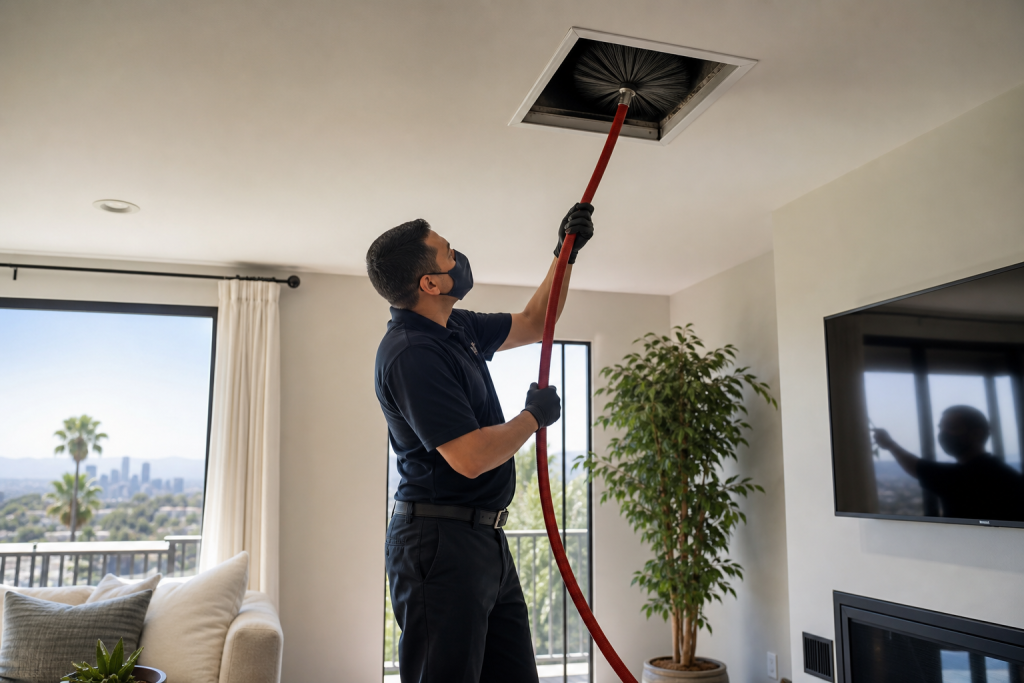
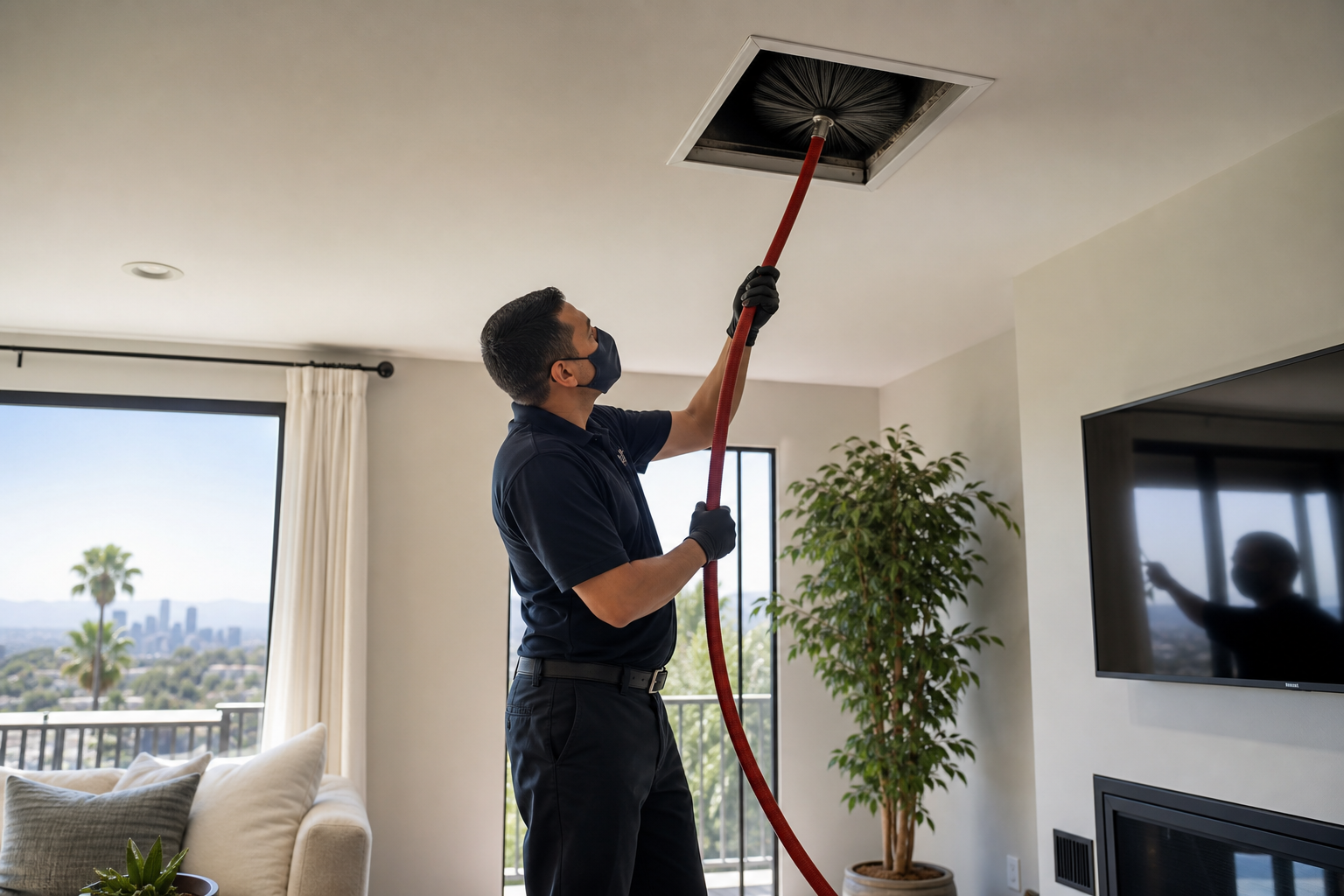
The Rotobrush system is mechanically straightforward, which is partly why it’s so often misused. A flexible cable drives a round brush head that spins at adjustable speed while a vacuum port sits directly behind it. Brush loosens, vacuum captures - ideally in the same moment.
The critical variable is dwell time. Compacted dust in Los Angeles ducts, especially in older neighborhoods like Highland Park or Eagle Rock where homes haven’t been cleaned in decades, doesn’t release on contact. It needs sustained agitation. When a technician rushes the brush through at speed, the bristles skim the surface, the vacuum pulls air past the debris, and the heavy particulate stays put. We’ve pulled inspection cameras behind these “cleaned” ducts and found cakes of gray matter still clinging to the walls.
Proper technique means:
- Matching brush speed to debris type - heavy accumulation needs slower rotation, not faster
- Advancing the cable in short increments, letting the brush work each section before moving on
- Maintaining vacuum suction throughout the entire pass, not just when pulling back
- Running the brush against the direction of the duct run to maximize wall contact
The Los Angeles climate complicates this. Our dry, dusty air plus periodic wildfire ash creates a fine, electrostatically charged particulate that bonds to duct surfaces differently than the heavier, humid-climate grime Rotobrush originally designed around. Technicians who don’t adjust for this - who treat an LA job like a Houston job - leave more behind than they remove.
Why Duct Material Dictates Your Cleaning Method
Not every Los Angeles home has the same ductwork, and the Rotobrush settings that work for one system will damage another.
Sheet metal ducts, common in pre-1980s homes across Pasadena and South Pasadena, can handle aggressive brush contact and higher vacuum pressure. The smooth interior surface releases debris predictably. We typically run a stiffer brush head at medium speed with full suction.
Flexible vinyl ductwork, installed in most tract homes from the 1980s forward, is a different story. The ribbed interior traps debris in valleys between corrugations, but the thin vinyl liner tears if brush pressure is too high or if the vacuum creates excessive negative pressure. We’ve repaired ductwork in Carson and Torrance where previous cleaners punched holes right through the flex line. The homeowner smelled it in the attic before they saw the utility bill spike.
Fiberglass-lined metal ducts, found in some higher-end Los Angeles builds, present their own challenge. The liner is porous and friable. Too much agitation releases fiberglass particles into the airstream - worse than the dust you started with. In these cases, we often pair a gentler Rotobrush pass with a contact vacuum from Abatement Technologies to control debris without destroying the liner.
The point: any company that shows up with one brush setting for every house doesn’t understand the equipment they’re carrying.
Camera Verification: What You Should Actually See
We camera-inspect every duct before we start and after we finish. Not because it’s a nice add-on. Because without it, you’re buying a story.
A proper post-Rotobrush camera pass in a Los Angeles home should show:
- Uniform color change - the duct walls should look consistently lighter, not patchy
- No visible debris accumulation at joint seams or turns where the brush may have skipped
- Clean brush marks on metal surfaces, indicating the bristles made full contact
- Intact duct material - no scoring, tearing, or liner displacement
We had a call last year from a homeowner in Sherman Oaks who’d paid $299 for a “complete Rotobrush cleaning.” Another company. They showed her a single after-photo of one clean-looking vent. We ran our camera through the main trunk and found a half-inch layer of compacted dust still lining the horizontal run. The cheap job cost her twice: once for the service, once for us to do it properly.
If a company won’t show you footage, or shows you still images instead of a continuous video walkthrough, that’s information. Use it.
Rotobrush Clean vs. Blowout: Matching Method to Los Angeles Conditions
Not every duct problem needs a Rotobrush. Sometimes it’s the wrong tool, and honest technicians say so.
A compressed-air blowout - high-pressure air whips dislodging debris while a collection device captures what becomes airborne - works well for light, loose accumulation in straight metal runs. It’s faster and less invasive. For Los Angeles homes that have had regular service every three to five years, this can be sufficient.
But after the 2020 Bobcat Fire and the repeated wildfire seasons since, we’ve seen blowouts fail across the San Fernando Valley and foothill communities. Wildfire ash is ultrafine, thermally altered, and mechanically different from household dust. It compacts. It adheres. A blowout skims it. The Rotobrush, with sustained mechanical agitation and immediate vacuum capture, is the appropriate method for this contamination type.
The diagnostic question is simple: what’s actually in your ducts? We determine that with the pre-cleaning camera inspection, then choose the method. Companies that sell only one approach - “we Rotobrush everything” or “blowouts are all you need” - are selling convenience, not accuracy.
Five Questions That Reveal Whether a Technician Understands the Equipment
Before you book any Rotobrush service in Los Angeles, ask these. The answers tell you whether you’re hiring an operator or a technician.
- “What brush speed and vacuum setting will you use, and why?” A knowledgeable technician explains the variables: duct material, debris type, run length. An operator says “standard setting” or looks confused by the question.
- “How long do you expect this to take?” For a 2,000-square-foot Los Angeles home with a standard duct layout, 3 to 5 hours is realistic. Under 2 hours suggests rush work. Over 6 without explanation suggests inexperience or equipment problems.
- “What does your camera inspection show before and after?” Demand specifics: live video, date-stamped, with narration. Not a single photo. Not “we’ll let you know if we find anything.”
- “How do you handle flex duct differently from metal?” The answer should mention pressure reduction, softer brush heads, or adjusted advance rates. Silence means they treat your ductwork like a test track.
- “What’s your policy if I’m not satisfied?” Look for immediate, no-paperwork recourse. Our 90-Day Done Right Promise means we return at no charge if the work isn’t right. No forms. No escalation to a manager who isn’t there.
Related services in Los Angeles: Air Duct Cleaning in Seymour, Dryer Vent Cleaning in Seymour, and HVAC Cleaning in Seymour.
When to Call a Professional
Rotobrush equipment is available for purchase by anyone with the capital. That doesn’t make the buyer competent. We’ve corrected work from newly licensed operators who had pristine machines and no sense of how air moves through a duct system.
Call a professional when:
- You haven’t had ductwork cleaned in 5+ years, especially in Los Angeles areas with heavy particulate exposure
- You’ve noticed reduced airflow, uneven heating or cooling, or persistent dust accumulation after cleaning
- Your home has mixed duct materials requiring technique adjustments
- You want documentation of results, not just a verbal assurance
- You’ve experienced wildfire smoke infiltration and need verification that ash residue is fully removed
At Bellows Air Duct & Vent Co. home, we run Rotobrush equipment from factory-authorized units, paired with camera systems and the same negative-air machines we use on commercial jobs. Every technician is background-checked and uniformed. Pricing is set before we start - the number on the phone is the number on the invoice. And our 90-Day Done Right Promise covers every job we complete in Los Angeles.
The Bottom Line
The Rotobrush is a capable tool in trained hands and an expensive prop in untrained ones. The difference shows up in dwell time, material-specific technique, camera-verified results, and honest method selection. In Los Angeles, where our air quality challenges are genuinely unusual, those details matter more than the brand name on the machine.
Key takeaways:
- Proper Rotobrush cleaning takes 3-5 hours for a typical home - speed is not a virtue
- Duct material determines brush and vacuum settings; one-size-fits-all damages your system
- Camera verification should be continuous video, not a single after-photo
- Wildfire ash and compacted LA dust often need Rotobrush agitation, not just blowout
- Ask technical questions before booking - the answers separate technicians from operators
If you’re in Los Angeles and want your ductwork cleaned by people who understand the equipment they’re running, Bellows Air Duct & Vent Co. offers free estimates. Call (844) 685-6342. We’ll show you what your ducts look like before we touch them, and we’ll stand behind the work for 90 days after we’re done.
Frequently Asked Questions
Rotobrush air duct cleaning in Los Angeles typically ranges from $400 to $800 for a standard single-family home, depending on duct layout, contamination level, and accessibility. Be cautious of quotes below $300 - they often indicate rushed work or hidden add-ons. Call (844) 685-6342 for an exact quote; our estimates are free and the price we quote is the price you pay.
A thorough Rotobrush cleaning should take 3 to 5 hours for a typical 2,000-square-foot Los Angeles home. Jobs completed in under 2 hours usually mean insufficient dwell time, skipped branch lines, or both. The brush needs time to agitate compacted debris, and the vacuum needs time to capture it. Speed benefits the company, not your air quality.
Rotobrush cleaning is safe for flexible vinyl ductwork only when technicians reduce brush pressure, use softer brush heads, and lower vacuum suction. Aggressive settings tear the thin liner, creating leaks that waste energy and pull attic or crawlspace air into your system. Always confirm your technician adjusts for duct material before work begins.
A Rotobrush uses mechanical agitation with simultaneous vacuum capture to remove compacted, adhered debris. A compressed-air blowout relies on high-pressure air whips to dislodge loose material. For light, recent accumulation in straight metal ducts, blowouts work fine. For compacted Los Angeles dust, wildfire ash, or long-neglected systems, the Rotobrush’s sustained contact is the appropriate method.
Written by the team at Bellows Air Duct & Vent Co., serving Los Angeles since 2012.
Need Air Duct Cleaning Help?
Call Bellows Air Duct & Vent Co. - licensed & insured, here with fast after-hours help in Los Angeles.
(844) 685-6342