
Clothes Take Two Cycles to Dry
What’s Happening
When clothes take two cycles to dry, the cause is almost always a blocked or restricted dryer vent. The dryer can’t push hot, moist air out of the house, so that air stalls inside the drum and your clothes stay damp. This is not a dryer problem – it’s an airflow problem, and in most cases a professional dryer vent cleaning resolves it in a single visit.
The dryer vent is a duct that runs from the back of your machine to an exterior wall cap, sometimes a straight shot and sometimes a longer route through a cabinet, a crawl space, or an attic. Over time, lint – which escapes the lint trap in small amounts on every single load – accumulates along that entire path. The longer the run and the more bends it takes, the faster it clogs. A vent that was perfectly clear five years ago may be nearly sealed today. Wet air has nowhere to go, so the drum stays humid, your clothes come out warm and damp, and the dryer runs a second cycle trying to finish a job it physically cannot finish.
Why It Happens
Lint Buildup in the Vent Line
This is the most common cause by a wide margin. Lint bypasses the screen trap and coats the interior walls of the vent duct on every load. The buildup is gradual enough that most homeowners don’t notice until drying times have doubled. A useful sign: hold your hand near the exterior vent cap while the dryer runs. If you feel very little airflow – or none – the duct is likely packed.
Crushed, Kinked, or Disconnected Ductwork
The flexible foil or plastic transition duct connecting the dryer to the wall can get crushed when a machine is pushed too close to the wall during installation or after a move. A sharp kink in that section cuts airflow almost as badly as a full clog. Pull the dryer out and look at the first foot of duct behind it – a crushed accordion fold or a visible kink is a clear sign this is contributing to the problem.
A Blocked Exterior Vent Cap
The flap or louvered cap on the outside of the house keeps pests out but can itself get clogged with lint, bird nesting material, or mud dauber nests – especially if it hasn’t been inspected in a few years. Walk around to the exterior cap while the dryer runs and watch for the flap to open. If it doesn’t move, or moves sluggishly, the cap is either blocked or the flap is stuck. This is often a secondary problem on top of a vent line that already needs cleaning.
An Oversized Duct Run with Too Many Turns
Building code sets limits on how long a dryer vent run can be and how many 90-degree elbows it can include, because each bend adds friction and slows airflow. In older homes, vent paths were sometimes routed for convenience rather than code compliance. If the dryer has always been a bit slow and the vent line makes several turns before reaching the outside, the total equivalent length of that run may be too long to clear moisture efficiently – even with a clean duct.
What to Do Right Now
- Stop running the dryer until the vent is checked. A blocked vent traps heat inside the cabinet and duct. Lint is combustible. The U.S. Fire Administration attributes thousands of residential fires each year to dryer vents that weren’t maintained – running the machine on a restricted vent raises that risk with every cycle.
- Pull the lint trap and clean it thoroughly. While this alone won’t fix a blocked vent line, a lint-clogged trap adds backpressure. Clean it, and check the trap housing with a flashlight for visible lint packed below the screen.
- Pull the dryer away from the wall and look at the transition duct. Check for visible kinks, crushed sections, or a disconnected joint. If you see a separation, do not reconnect foil tape yourself and assume it’s fixed – photograph it and let a technician confirm the seal is airtight.
- Go outside and locate the exterior vent cap. Watch for airflow while someone runs the dryer. A stuck or sealed flap is easy to spot and worth photographing before a technician arrives.
- Do not attempt to clean the duct yourself with a household vacuum or brush kit. Consumer brush kits can dislodge a partial clog and push it deeper, or detach sections of flexible ductwork inside a wall cavity. A camera inspection before and after is the only way to confirm the line is actually clear – not just partially disturbed.
How We Fix It
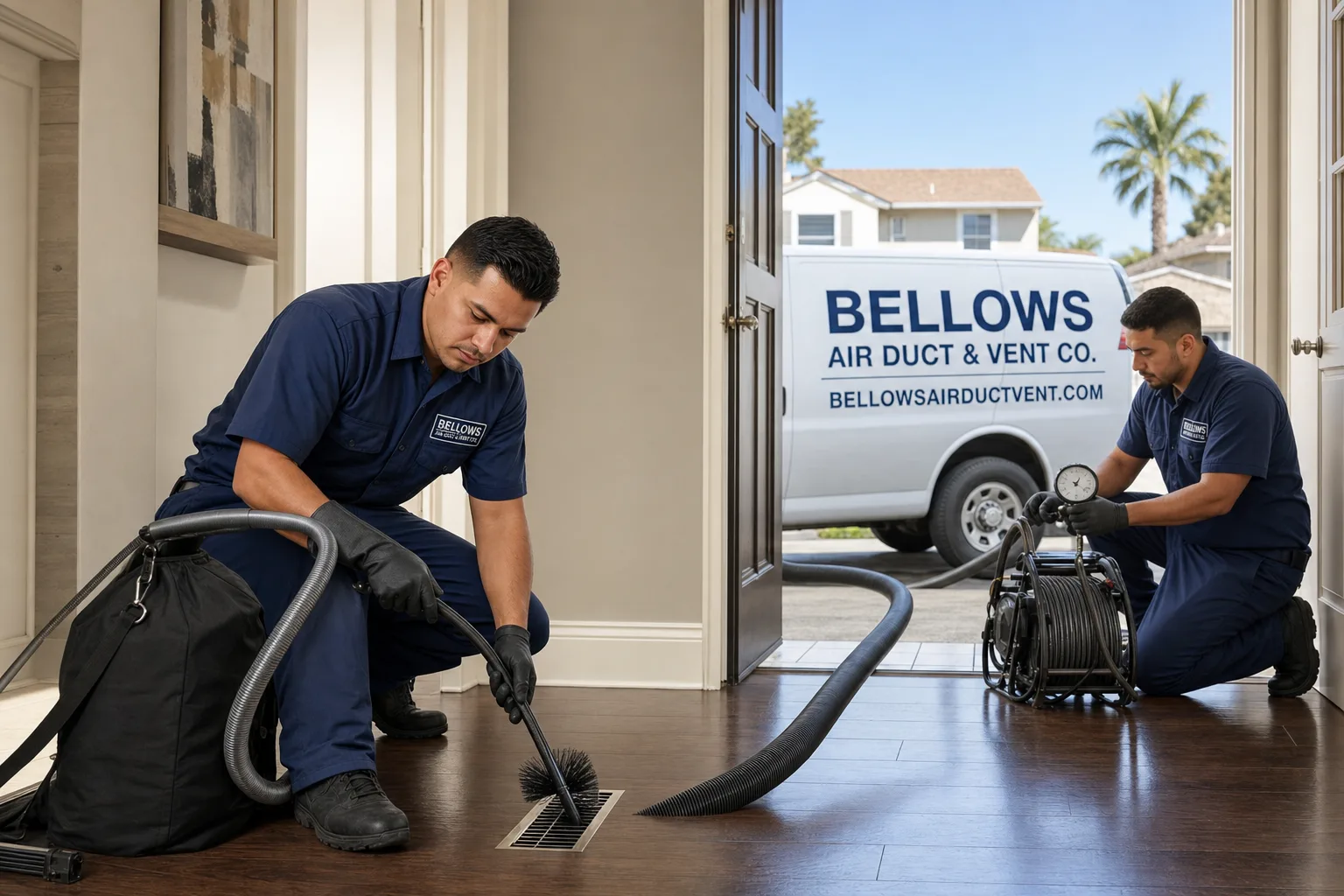
When your local Bellows Air Duct & Vent Co. team arrives, the first thing the technician does is run a camera through the vent line. That inspection tells us exactly where the restriction is, what’s causing it, and whether there is any damage to the duct itself. You see what we see – no guessing, no upselling based on a description you can’t verify.
From there, the technician clears the vent using professional-grade equipment from Nikro and Rotobrush – rotary brush systems designed for this specific job, not improvised from shop supplies. The exterior cap is cleared and tested for proper function. A second camera pass confirms the line is fully open before we pack up.
If the inspection reveals a crushed transition duct, a disconnected joint, or a run that doesn’t meet current venting standards, our duct repair and sealing service addresses that in the same visit when possible. Most jobs are completed in a single visit. Pricing is given to you in writing before a single tool is lifted – no surprises on the bill. And if anything about the result isn’t right within 90 days, we come back. No paperwork, no arguing. That’s our Done Right Promise, and it’s been the way we’ve worked since 1984.
Frequently Asked Questions
A clogged dryer vent is a genuine fire and carbon monoxide hazard, not just an annoyance. Lint is highly flammable, and a blocked vent forces superheated air to linger inside the duct and dryer cabinet instead of exhausting outside. Gas dryers present an additional risk: a restricted vent can cause combustion byproducts to back up toward the living space. Don’t wait on this one. Call (844) 685-6342 and get it looked at before you run another load.
It needs to be done soon. Every load you run on a blocked vent adds more lint to an already restricted line and extends the time the dryer runs at elevated heat. That combination – accumulated lint, high heat, poor exhaust – is how dryer fires start. If you’re already seeing two-cycle drying times, the vent is meaningfully restricted. Call (844) 685-6342 and get a technician out – your local Bellows team answers the phone around the clock, every day of the week.
Your local Bellows Air Duct & Vent Co. team works hard to get to jobs promptly, and the office is staffed by a live person 24 hours a day – not a voicemail, not an automated app. Call (844) 685-6342 and tell us what you’re seeing. We’ll get you scheduled as quickly as our local team’s calendar allows and give you an honest window, not a vague “sometime in the afternoon.”
Dryer age has almost nothing to do with vent condition. The vent is a fixed duct in your home – it was there before the dryer and it will be there after. A new dryer produces just as much lint as a ten-year-old one, and a vent that was never cleaned after the previous machine was replaced can be substantially restricted from day one. The duct, not the appliance, is where the problem lives.
Get It Fixed
Call (844) 685-6342 – a live person answers, any hour of the day. Or book online and your local Bellows Air Duct & Vent Co. team will follow up to confirm. We’ll inspect the vent line with a camera, clear it with professional equipment, and give you a written price before anything starts. One visit. Done right.
Written by Ray Castillo, Owner at Bellows Air Duct & Vent Co., serving local communities since 1984.