
Fast, Reliable HVAC Cleaning Across Chicago
Professional HVAC cleaning in Chicago typically runs $280-$650 for residential systems and $800-$2,400 for commercial units, with most jobs completed in a single visit. Our HVAC Cleaning team serves Chicago homeowners and property managers from the Loop to Pilsen, arriving with equipment sized for both century-old two-flats and modern high-rises. We’re familiar with the heating demands of a Chicago winter, the lake-effect humidity that hits in July, and the ductwork surprises that come with 1920s brick construction. Call (844) 685-6342 for upfront pricing and a free estimate - we’ll be there when we say.
Why Bellows Air Duct & Vent Co. Is Chicago’s Preferred HVAC Cleaning Company
We’ve been in this trade long enough to know that Chicago buildings don’t forgive shortcuts. For over 42 years, Bellows Air Duct & Vent Co. has cleaned ductwork in the kind of structures that define this city: pre-1930 greystones in Kenwood, converted industrial lofts along Fulton Market, and the two-flats and three-flats that pack Bridgeport and Pilsen block by block. Our technicians are background-checked, uniformed, and trained to spot what others miss - asbestos wraps on original gravity ducts, inadequate sealing on retrofit forced-air systems, and mold in basement runs that only shows up when humidity spikes off Lake Michigan.
Every job starts and ends with a camera inspection. You see what we see: the debris before we touch it, the clean passage after we’re done. No claims without proof. Our 90-Day Done Right Promise means if something isn’t right, we return at no charge - no paperwork, no arguing. That’s been our way since 2012.
Calls are answered by a live person, 24 hours a day. Not a voicemail tree. Not an app. A real person who can dispatch a crew to 60605, 60606, 60607, or 60608 today.
Our HVAC Cleaning Services in Chicago
Evaporator Coil Cleaning
Chicago’s summer humidity - especially in lake-adjacent neighborhoods like the Near North Side - pushes evaporator coils hard. When condensation can’t drain properly, coils become a breeding ground for mold and bacteria that circulates through every room. We clean coils with foaming agents from Abatement Technologies and verify airflow restoration with digital manometers. In older buildings with mismatched retrofit systems, we often find coils sized for the original gravity furnace airflow, now starved by undersized returns - a Chicago-specific problem we flag before cleaning begins.
Blower Cleaning
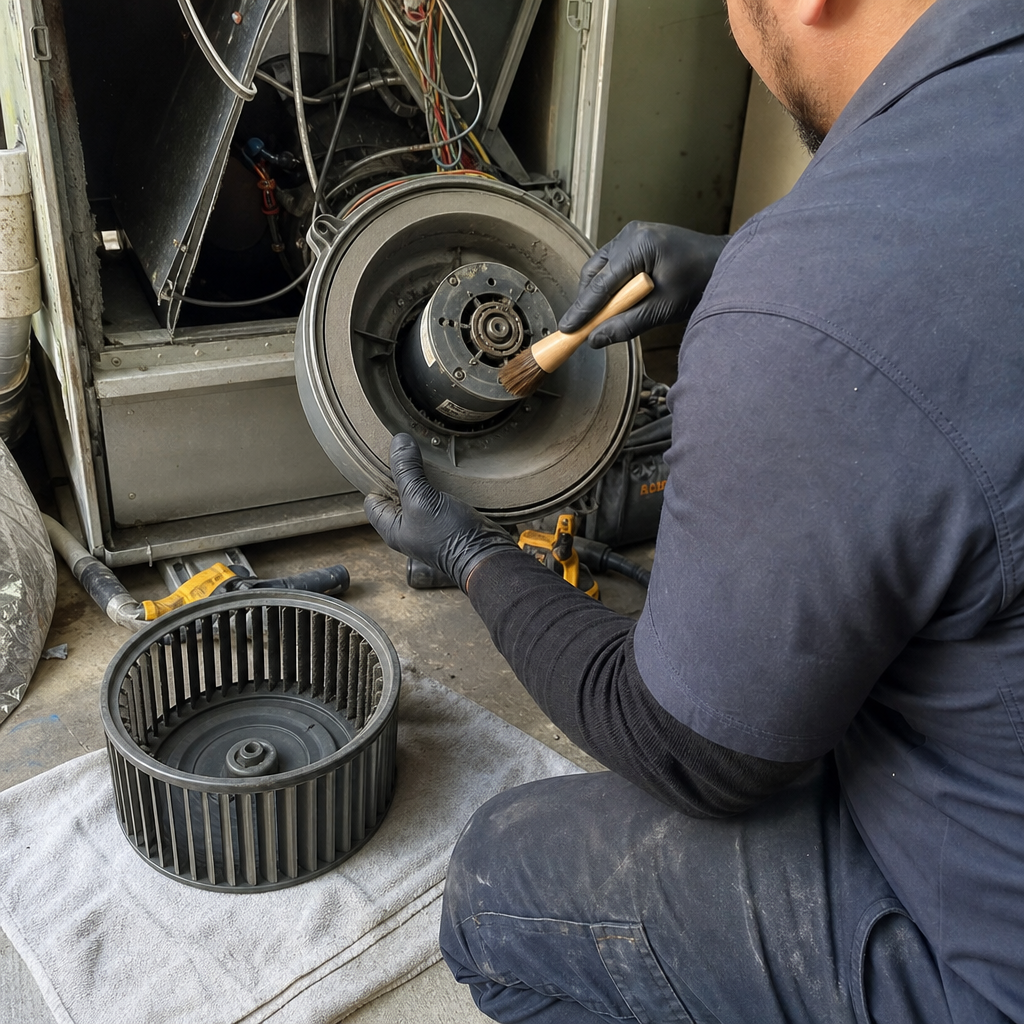
The blower assembly in a Chicago furnace runs almost continuously from October through April. Six months of operation pulls remarkable debris through duct joints that were never properly sealed during the 1950s-70s conversions. We remove the blower housing, clean the wheel and motor, and check amp draw against manufacturer specs. In West Town greystones and Cicero bungalows, we’ve found blower wheels loaded with decades of compacted dust that reduced airflow by 40% before the homeowner even noticed.
Condenser Cleaning
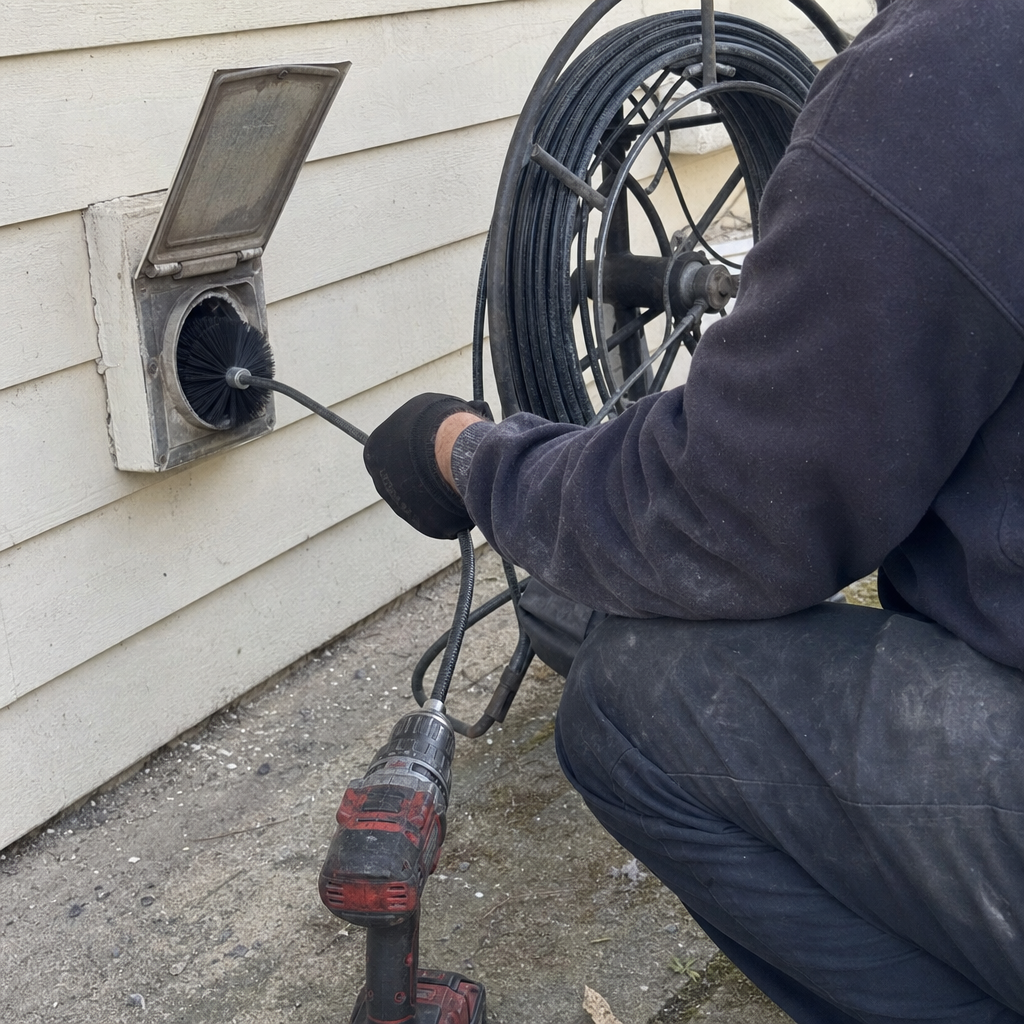
Chicago’s short cooling season means condensers sit idle through long winters, collecting debris from alleyway traffic, construction dust, and spring pollen. We wash coils, straighten fins, and verify refrigerant pressures. For ground-level units common in Belmont Cragin and Cicero, we also check for damage from snowplows and salt corrosion - a maintenance item that doesn’t exist in warmer climates.
Air Handler Cleaning
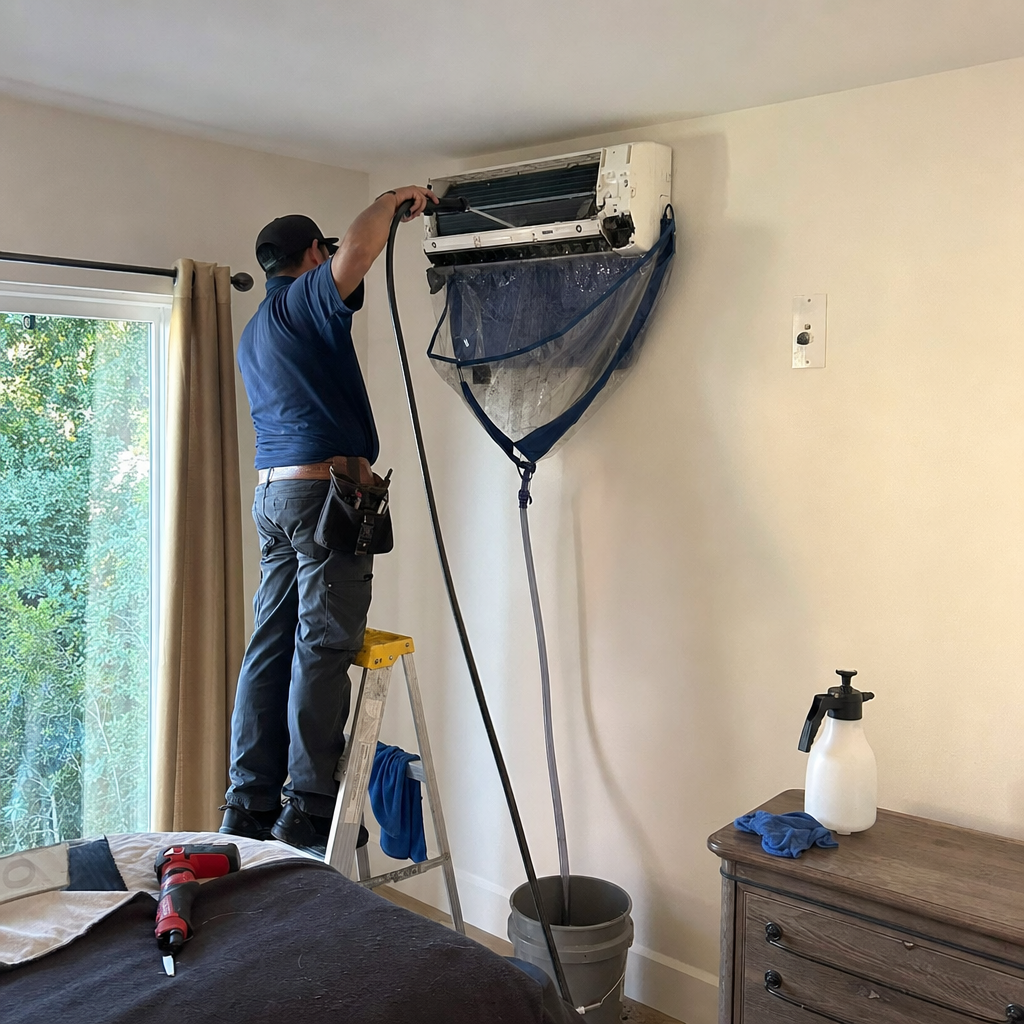
Air handlers in Chicago’s converted commercial lofts and mid-century office buildings present a different challenge than residential equipment. These units move massive volumes through multi-zone systems, and cleaning them requires industrial-grade negative-pressure equipment that residential rigs can’t match. Our technicians carry Rotobrush commercial systems and HEPA-filtered vacuums from Nikro sized for these applications. We document every stage with camera inspection - before, during, and after.
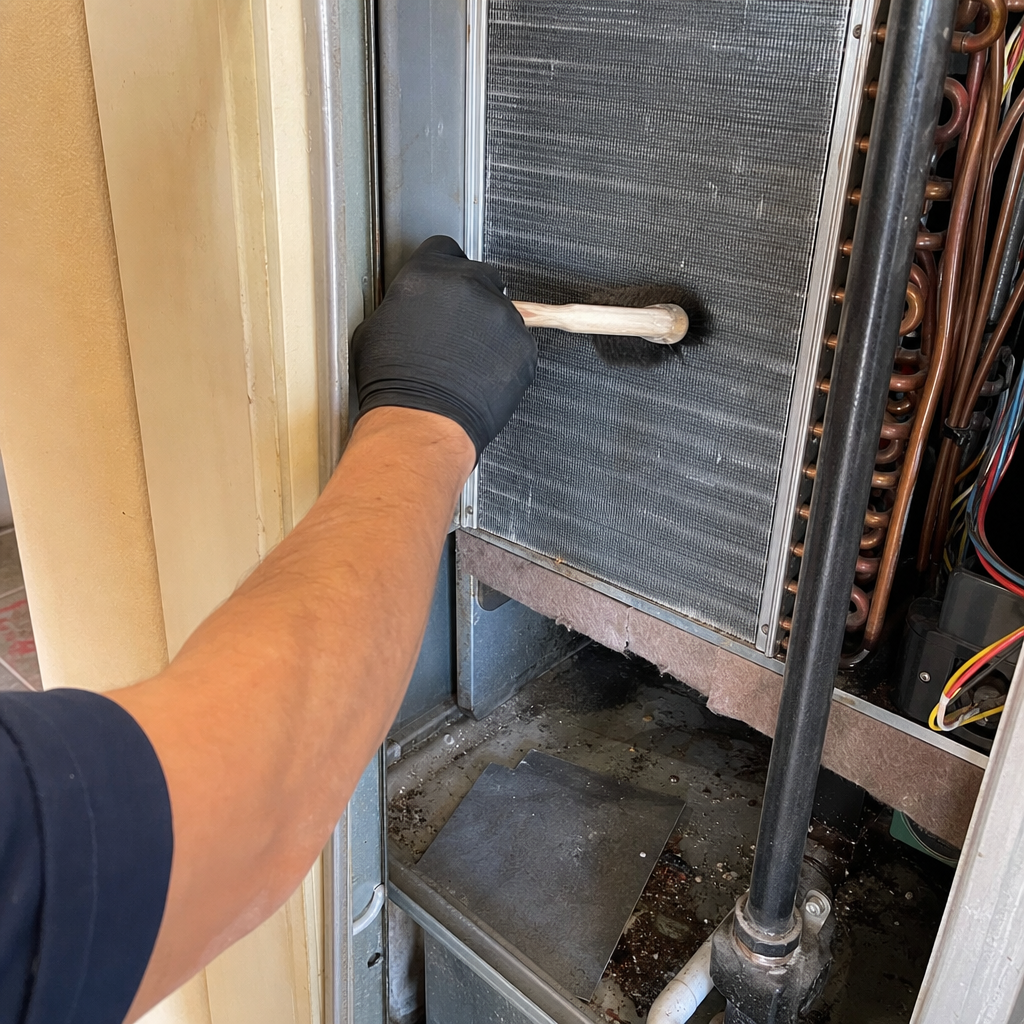
Coil Treatment
After mechanical cleaning, we apply EPA-registered coil treatments that inhibit microbial growth without leaving residue that restricts heat transfer. In Chicago’s humid summer basements, this step prevents rapid recontamination. We use Aprilaire-sanitized protocols on systems where mold has been identified, and we always disclose what we found and what we treated - in writing, with photos.
What happens when you call
- 1
A real person answersNo phone trees - you reach a local pro.
- 2
You get an upfront price rangeHonest numbers before anyone is dispatched.
- 3
A background-checked tech heads outLicensed & insured, dispatched right away.
- 4
You approve before work beginsNothing starts until you say go.
Trusted Brands We Service in Chicago
We maintain equipment from Rotobrush, Abatement Technologies, and Aprilaire - the same brands serious HVAC contractors specify when they install systems in Chicago’s demanding climate. Our vans carry replacement filters, coil cleaners, and sealing materials sized for both residential and commercial applications, so most jobs don’t wait on parts. For specialized components in Loop commercial systems, our Chicago warehouse stocks Honeywell and Guardsman controls and media. If we don’t have it, we source it fast - but we usually do.
Common HVAC Cleaning Problems We See in Chicago Homes
- Asbestos-wrapped gravity ducts in Pilsen and Bridgeport three-flats. The original 12-16 inch galvanized trunks from 1920s coal furnaces remain in service, often wrapped in gray corrugated asbestos insulation that must be assessed and documented before any mechanical cleaning begins. Disturbing this material without proper containment violates EPA regulations and creates serious health exposure.
- Inadequate negative pressure in Loop loft conversions. Pre-WWII commercial buildings converted to residential use have oversized ductwork designed for original forced-air systems, not modern residential equipment. Residential-grade vacuums can’t maintain sufficient airflow to prevent dust redeposition during cleaning.
- Condensation mold in uninsulated basement runs. Chicago’s lake-effect humidity spikes in summer create cold-surface condensation inside poorly insulated ductwork in older buildings. Visual inspection alone misses this - we use borescope cameras and moisture meters to verify.
- Failed retrofit sealing on two-flat forced-air conversions. When gravity furnaces were converted to forced gas in the 1950s-70s, installers often extended existing trunks without proper branch sealing. Decades of vibration have opened gaps that pull debris from wall cavities and basements directly into living spaces.
Air Duct Cleaning in Chicago, Done the Old Craft Way
The lake-effect humidity and freeze-thaw cycles around Chicago Metro mean your ducts work harder than most. Bellows named itself for the oldest air-moving tool there is, and we still treat ductwork like the lungs of the house: camera-inspected before and after, cleaned to the collar, dryer vents cleared to code because lint fires are preventable. One honest price, shown before work starts. No $49 bait coupons that balloon at the door.
Our journeymen are trained through the K.E.Y.S. code: Krafted right, Every time, Your home first, Standing behind it. That’s the Keystone Standard, 90 days in writing. we coordinate through our Chicago Metro service area We’ll be there when we say.
Air Duct Cleaning in Chicago
Chicago Metro summers are thick and humid, winters are dry enough to crack woodwork. Your ducts carry both seasons straight into every room. We inspect with a camera before we touch a thing, clean to the collar, and show you after. Dryer vents get cleared to code. One price, stated up front. No $49 bait that turns into $800 at your door.
Our K.E.Y.S. code means we work in your house the way we’d work in our mother’s. we coordinate through our Chicago Metro service area Senior and veteran discounts are always available. The Keystone Standard backs every job: 90 days, in writing, no arguing. We’ll be there when we say.
Air Duct Cleaning in Chicago
Chicago Metro summers are thick and humid, winters are dry enough to crack woodwork. Your ducts carry both seasons straight into every room. We inspect with a camera before we touch a thing, clean to the collar, and show you after. Dryer vents get cleared to code. One price, stated up front. No $49 bait that turns into $800 at your door.
Our K.E.Y.S. code means we work in your house the way we’d work in our mother’s. we coordinate through our Chicago Metro service area Senior and veteran discounts are always available. The Keystone Standard backs every job: 90 days, in writing, no arguing. We’ll be there when we say.
Air Duct Cleaning in Chicago
Chicago Metro summers are thick and humid, winters are dry enough to crack woodwork. Your ducts carry both seasons straight into every room. We inspect with a camera before we touch a thing, clean to the collar, and show you after. Dryer vents get cleared to code. One price, stated up front. No $49 bait that turns into $800 at your door.
Our K.E.Y.S. code means we work in your house the way we’d work in our mother’s. we coordinate through our Chicago Metro service area Senior and veteran discounts are always available. The Keystone Standard backs every job: 90 days, in writing, no arguing. We’ll be there when we say.
Pricing for HVAC Cleaning in Chicago, IL
A typical residential evaporator coil cleaning in Chicago runs $280-$420. Full air handler cleaning with blower removal and coil treatment ranges $450-$650. Commercial HVAC cleaning in Loop loft buildings starts at $800 and runs to $2,400 depending on system zones and access difficulty.
What moves the number: system accessibility (basement crawl spaces in older buildings take longer), contamination level (heavy debris or mold requires extended containment setup), and whether asbestos assessment is needed before work begins. We disclose every cost before lifting a tool - the price on the phone matches the price on the invoice.
Standing offers: $50 off any repair over $250, free second opinion on any written estimate, $89 seasonal tune-up, and a permanent 5% senior and veteran discount. Call (844) 685-6342 for your exact quote - estimates are free.
We Also Serve Cities Near Chicago
Our crews work throughout Chicago and the immediate surrounding communities, including Near North Side, West Town, Cicero, and Belmont Cragin. Same-day scheduling and upfront pricing apply across all service areas.
Serving Chicago, IL - Our Local Coverage Area
We’re based in the Chicago area and know this community well. Use the map below to see our service coverage - if you’re nearby, we can almost certainly help.
FAQs - HVAC Cleaning in Chicago
We photograph and document any suspected asbestos-containing insulation before touching the duct, then seal damaged wraps with wet methods and EPA-compliant duct tape before proceeding with HEPA-contained mechanical cleaning. We cleaned a 1920s three-flat in Pilsen where the original gravity trunk duct, still wrapped in gray corrugated asbestos insulation, had decades of compacted dust along its bottom seam. After sealing the asbestos wrap with duct tape per EPA guidelines, we used a Rotobrush with HEPA filtration to remove the debris without disturbing the insulation. If insulation is friable or extensively damaged, we stop and refer you to a licensed abatement contractor - no exceptions. Call (844) 685-6342 to schedule an assessment.
The forced-air retrofit on your building likely reused original gravity-furnace trunks without proper branch sealing, and decades of thermal cycling have opened gaps at joints and registers. Cleaning alone won’t fix this - we identify and seal accessible leaks during service, and we’ll show you the camera footage so you understand what’s structural versus what’s contamination. Call (844) 685-6342 for an inspection with upfront pricing.
Yes, though these systems require modified technique. The oversized galvanized trunks move air slowly by modern standards, so we adjust agitation speed and vacuum draw to prevent debris from settling in low-velocity zones. We also assess whether the existing asbestos wrap can be safely worked around or must be abated first. Most Bridgeport three-flat jobs complete in one visit after assessment. Call (844) 685-6342 to discuss your building.
Loop loft buildings have multi-zone commercial HVAC systems with ductwork sized for original office occupancy, not residential conversion. These systems require industrial-grade negative-pressure equipment with higher CFM ratings than residential Rotobrush units, and cleaning must coordinate with building management for system shutdown windows. Our commercial crews carry the right equipment and understand the permitting and notification requirements common to Chicago Class B office conversions.
Yes, particularly in older buildings with uninsulated metal ductwork running through damp basements. Chicago’s July humidity off Lake Michigan creates cold-surface condensation inside ducts that have been cooling all day, and the organic debris accumulated over decades provides growth medium. We find active mold in roughly one of every four basement inspections we perform in pre-1950 buildings during summer months. Camera inspection with moisture measurement confirms whether you’re seeing mold or just dust staining - call (844) 685-6342 for an honest assessment.
Written by Ray Castillo, Owner at Bellows Air Duct & Vent Co., serving Chicago since 2012.