
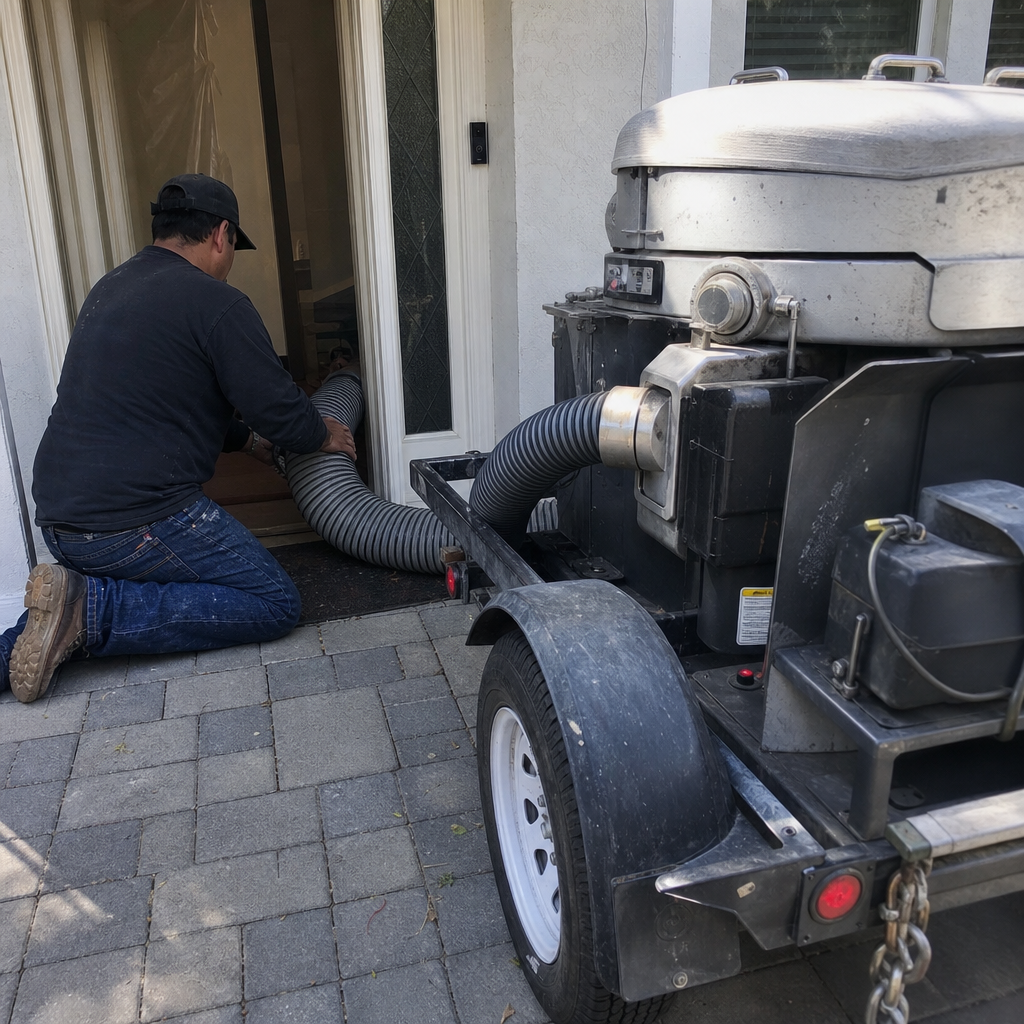
Symptoms of Dirty Air Ducts in Bell, CA - What Homeowners Actually Notice
The most common symptoms of dirty air ducts include visible dust buildup on surfaces shortly after cleaning, worsening allergy or respiratory symptoms when the HVAC runs, musty or stale odors from vents, and visible debris around supply registers. In Bell, many homeowners also notice a faint petroleum-adjacent odor when the system first cycles on, which reflects diesel particulate contamination from the nearby I-710 corridor rather than ordinary household dust. If you’re seeing these signs, our Air Quality & Sanitizing services start with a camera inspection - the only way to know what’s actually inside your ductwork. Call Bellows Air Duct & Vent Co. at (844) 685-6342 for a free, no-pressure assessment in Bell.
The Smell That Doesn’t Fit the Usual Categories
Ray Castillo, our owner, still remembers the first time he walked into a Bell home and the homeowner described it as “like a parking garage, but only for a minute.” She wasn’t wrong. The HVAC had kicked on moments before he arrived, and there it was: not mold, not burning dust, not the damp wool smell of a clogged filter. Something else. Something that didn’t match the symptom lists on generic air quality websites.
That was fifteen years ago, and we’ve since learned to recognize it immediately. In Bell, sitting directly adjacent to Vernon and bisected by the I-710 freight corridor, residential ductwork accumulates a specific contaminant profile that looks and smells different from what homeowners in Pasadena or Torrance experience. The diesel ultrafine particles that drift from heavy truck traffic don’t behave like ordinary dust. They’re smaller, oil-adherent, and they volatilize when heated air first moves through the duct system each cycle.
The result is a symptom most articles about dirty air ducts never mention: a faint, oily or petroleum-adjacent odor that appears only when the HVAC first starts, then dissipates within minutes as the system reaches steady state. Homeowners often describe it as “like standing near a busy road” or “like someone started a lawnmower in another room.” It is not a mechanical problem. It is not dangerous in the immediate sense. But it is a reliable indicator that your ducts are carrying more than pollen and skin cells.
We will take a look at what is actually there, and then we will tell you what we found. That’s been our approach since 1984, and it’s why we camera-inspect every duct system before touching a tool.
Standard Symptoms Every Homeowner Should Know
Before we get deeper into what makes Bell unique, let’s be clear about the baseline. These are the symptoms that apply everywhere, and they apply here too. Don’t let the local angle distract you from recognizing ordinary problems.
- Dust resettles within days of cleaning. You wipe the coffee table Tuesday; by Thursday there’s a visible film. The HVAC is the distribution system for that film.
- Allergy or asthma symptoms worsen when the system runs. Sneezing, congestion, itchy eyes, or breathing difficulty that correlates with the blower cycling on is a classic signal.
- Visible debris at supply vents. Look at the louvers of your ceiling or floor registers. Gray buildup, fuzz, or particles trapped in the fins mean the duct interior is worse.
- Uneven heating or cooling. Restricted airflow from debris accumulation can leave rooms at the end of duct runs consistently under-conditioned.
- Musty or stale odor when the system operates. This typically indicates mold or mildew growth on organic debris inside the ductwork, especially in humid conditions.
- HVAC filters clog faster than manufacturer estimates. If you’re changing a 90-day filter every 30-45 days, the return side is pulling excessive particulate load.
These symptoms matter in Bell as much as anywhere. But if you stop here, you may miss what’s actually happening in your home.
The Bell-Specific Pattern: Dark Deposits and Weekday Morning Timing
Here’s where we depart from the generic advice. Our technicians working Bell homes - ZIP codes 90706 and 90707 - regularly pull debris with a distinctly dark, oily character from duct systems. Not the pale, fluffy dust you’d find in a coastal community. This is a signature mix of diesel exhaust ultrafines from the I-710 corridor and industrial fallout from neighboring Vernon, which sits as California’s most intensively industrialized city.
The visual symptom is specific: dark, smudge-like deposits around supply vent registers, not the light gray coating most homeowners expect. If you run a white cloth across your vent louvers and it comes away with a gray-black residue that feels slightly greasy, you’re not looking at ordinary household dust. You’re looking at combustion particulate that has infiltrated your duct system over years of HVAC operation.
Another pattern we ask Bell homeowners to track: symptom timing relative to weekday mornings. When does your throat feel irritated? When does that faint odor appear? If the answer is consistently Monday through Friday, roughly 6 to 10 a.m., that maps directly to I-710 peak truck traffic serving the Ports of Los Angeles and Long Beach. Your HVAC system is pulling that degraded outdoor air through your ducts, and if those ducts are already coated with accumulated particulate, each cycle re-suspends years of buildup into your living space.
Bell’s geography makes this worse. The city sits deep in the LA Basin without coastal airflow relief. Smog and industrial emissions trap at ground level, particularly during morning inversion layers. HVAC systems run long cooling cycles pulling this air through ducts for much of the year, accelerating the rate of interior coating. Post-WWII bungalows and small multi-unit buildings built between the 1940s and 1960s dominate Bell’s housing stock, and many retain original sheet-metal duct runs never designed for modern filtration loads. Pre-1980 insulated ductwork in these homes may incorporate asbestos-containing duct wrap or duct board, which is why our technicians are trained to identify and handle these materials appropriately before any cleaning begins.
Camera inspection is the only way to confirm what is actually in the duct system. Symptoms alone can’t distinguish between a moderately dusty system and one with years of industrial particulate buildup. We document the difference in footage before touching anything, so you see what we see.
Why Generic “Dusty Duct” Advice Can Mislead Bell Homeowners
Most online articles about dirty air duct symptoms assume a suburban contaminant profile: pollen, pet dander, skin cells, maybe some mold spores. That assumption leads to two specific mistakes for Bell residents.
First, underestimating the problem. If you read that “some dust in ducts is normal” and your symptoms seem mild, you might postpone cleaning for years. But diesel ultrafines and industrial particulates are smaller than typical household dust, more deeply penetrating to lung tissue, and more persistent once deposited. The health threshold for intervention is lower, not higher.
Second, wrong intervention. A basic vacuum-and-brush cleaning that removes loose surface debris won’t dislodge oil-adherent particulate that’s bonded to duct metal, which is why our Air Duct Sanitizing Service in Bell, CA uses stronger methods. Our crews use professional-grade equipment from Rotobrush and Nikro, selected specifically for the contaminant profiles we encounter in southeast LA. The same brands serious HVAC contractors specify, because they have to work the first time.
We’ve also found that homes near the I-710 corridor often benefit from Air Quality & Sanitizing in Bell as a follow-up to mechanical cleaning. This isn’t about adding unnecessary services. It’s about addressing the biological component that can colonize on top of particulate deposits - the mold and bacteria that find purchase in the oily film diesel soot creates.
What a Camera Inspection Actually Shows
Every Bellows job starts with camera inspection, and in Bell the footage often surprises homeowners who expected to see “just some dust.” Common findings include:
- Black, streaked coating on the interior of supply trunk lines, thickest on surfaces facing the direction of airflow
- Thick, felt-like accumulation at duct joints and turns where turbulence drops particles from suspension
- Filter bypass evidence - dark lines around filter racks indicating unfiltered air has been pulled around clogged or poorly fitted filters for extended periods
- In multi-unit buildings, cross-contamination between units through shared return pathways
We show you this footage before we quote, and if you’re wondering how much air quality and sanitizing costs in 2026, we lay that out upfront too. The price we give is the price on the invoice - no bait coupons, no changes at the door. Most jobs are completed in a single visit by background-checked, uniformed technicians. And everything we do is backed by our 90-Day Done Right Promise: if it’s not right, we return at no charge with no paperwork required.
Ray Castillo, who grew up a few blocks from Bell Park and still stops in on slow afternoons, built this company on the principle that neighbors should be able to trust what they’re told about their own homes. Over 14 years, that trust has been the only marketing we’ve needed.
When to Call for Assessment vs. When to Monitor
Not every symptom demands immediate service. Here’s how we advise Bell homeowners to think about timing:
| Symptom | Recommended Action | Typical Bellows Service |
|---|---|---|
| Light dust on vents, no odors, no health changes | Monitor; change filters more frequently | Filter upgrade consultation if desired |
| Persistent musty odor, visible mold near vents | Schedule camera inspection within 1-2 weeks | Full duct cleaning with sanitizing |
| Petroleum-adjacent odor on HVAC startup, dark vent deposits | Schedule camera inspection promptly | Heavy particulate removal with Rotobrush/Nikro equipment, possible air quality sanitizing |
| Worsening respiratory symptoms, especially weekday mornings | Schedule assessment; consider medical consultation in parallel | Comprehensive cleaning with documentation for health provider |
| Uneven heating/cooling, rising energy bills | Schedule inspection to assess airflow restriction | Cleaning plus duct sealing if leaks found |
Our $89 Seasonal Tune-Up is often the right entry point for homeowners who aren’t sure what they’re dealing with. It includes a basic inspection and honest assessment of whether full cleaning is warranted. We also offer a Free Second Opinion on Any Written Estimate if you’ve already been quoted by another company and want verification.
FAQs
Normal dust settles slowly and evenly; dirty ducts redistribute dust rapidly through your HVAC system, create visible debris at vent registers, and often produce odors when the blower cycles on. In Bell, look specifically for dark, smudge-like deposits around vents rather than light gray dust, and note whether symptoms worsen when your HVAC first starts each cycle. Call (844) 685-6342 for a free camera inspection that shows you exactly what’s inside your ducts.
Dirty air ducts can worsen allergy and asthma symptoms, cause throat and eye irritation, and contribute to respiratory discomfort, particularly in children, elderly residents, and those with existing conditions. In Bell, the diesel ultrafine particles and industrial combustion byproducts common in ductwork near the I-710 corridor are smaller and more deeply penetrating than typical household allergens, potentially causing effects even at lower visible dust levels. If your symptoms correlate with HVAC operation, a professional assessment is warranted. Call (844) 685-6342 for a free estimate.
Professional Affordable Air Quality & Sanitizing in Bell, CA typically costs far less than partial or full duct replacement, and properly cleaned ductwork can restore airflow and air quality without the disruption of construction. Replacement becomes necessary only when ducts are severely damaged, corroded, or - in some pre-1980 Bell homes - when asbestos-containing duct wrap requires professional abatement. We camera-inspect first and quote honestly, so you know whether cleaning is sufficient before spending more. Call (844) 685-6342 to discuss your specific situation.
Most manufacturers and the NADCA recommend cleaning every 3 to 5 years for typical homes, but Bell’s proximity to heavy freight traffic and industrial emissions means many local households benefit from more frequent assessment and cleaning every 2 to 3 years. Homes with original post-WWII ductwork, residents with respiratory conditions, or visible dark particulate deposits should consider shorter intervals. Our $89 Seasonal Tune-Up includes an honest evaluation of whether your system is due. Call (844) 685-6342 to schedule.
A Square Deal on Every Job, Documented Before We Start
Bellows Air Duct & Vent Co. has served Bell and surrounding communities since 1984. We’re not the cheapest option, and we don’t try to be. We’re the company that shows you what’s actually in your ducts, quotes one honest price before lifting a tool, and stands behind the work for 90 days in writing. No scare tactics. No bait coupons. No surprises on the bill.
Our standing offers include $50 Off Any Repair Over $250, a Free Second Opinion on Any Written Estimate, our $89 Seasonal Tune-Up, and a permanent 5% Senior and Veteran discount. Calls are answered by a live person 24 hours a day - not a voicemail, not an app. We’ll be there when we say.
If you’d rather have it looked at, Bellows Air Duct & Vent Co. offers a no-pressure assessment in Bell. Call (844) 685-6342 for a free estimate.
Written by Ray Castillo, Owner, Bellows Air Duct & Vent Co. at Bellows Air Duct & Vent Co., serving Bell, CA.