
Last updated July 25, 2026
How Long Does HVAC Cleaning Take? Timelines and What to Expect
A company that quotes you a price before measuring your duct system is guessing at your job. A company that quotes you a time before counting your vents is doing the same. In our 42 years serving Los Angeles homeowners, we’ve learned that legitimate HVAC cleaning follows a predictable rhythm tied to your home’s physical characteristics - not to how fast a crew can move. The “we’ll be done in an hour” promise should make you ask more questions, not feel relief. This guide breaks down real timelines by home size, what happens during each phase, and how to spot a square deal from a bait-and-switch operation.
Quick Answer
A thorough HVAC cleaning for a typical single-system Los Angeles home takes 3 to 5 hours from arrival to final camera verification. Smaller homes with 8-12 vents may finish in 2.5 hours, while larger properties with 20+ vents, dual HVAC systems, or significant debris buildup can extend to 6-8 hours. Any crew claiming completion in under 90 minutes is likely skipping steps, not saving you time.
Table of Contents
- What Determines Your HVAC Cleaning Timeline
- Time Ranges by Home Size and Duct Count
- Phase-by-Phase: What Happens During the Cleaning
- What Extends a Job Beyond the Estimate
- The “Done in an Hour” Red Flag
- What Homeowners Should Do During the Cleaning
- Common Mistakes to Avoid
- When to Call a Professional
- Frequently Asked Questions
- The Bottom Line
What Determines Your HVAC Cleaning Timeline
The time your HVAC cleaning takes is determined by four factors you can verify before anyone arrives: square footage, total vent count, number of HVAC systems, and the condition of your ductwork. These are measurable. They don’t change based on who’s doing the work. A legitimate company builds every quote from these numbers.
Square footage matters because it correlates with total duct length. A 1,200-square-foot bungalow in Eagle Rock has roughly half the ductwork of a 2,800-square-foot home in Encino. More duct means more contact points to clean, more zones to establish negative pressure in, and more footage to camera-inspect.
Vent count is the most direct predictor. Each supply and return vent represents an access point that requires setup, agitation, extraction, and verification. A home with 8 vents is a fundamentally different job than one with 24. We count these during our initial walkthrough, before we name a price or a timeline.
System count is often overlooked. Many Los Angeles homes built after 1985 have dual-zone systems - one for upstairs, one for downstairs, or separate units for original construction versus additions. Each system needs its own negative pressure setup, its own filter change, its own camera run. Two systems rarely mean double the time, but they reliably add 60-90 minutes.
Duct condition is the variable you can’t see until work begins. Heavy accumulation of fine dust, construction debris from pre-1970s builds, or post-wildfire ash intrusion (increasingly common in Los Angeles County since 2017) can slow contact cleaning significantly. So can damaged flex duct, which must be repaired before agitation to avoid tearing.
We don’t guess at these factors. Our technicians measure and count during the pre-work walkthrough, then present both price and timeline before lifting a tool. That’s the Bellows approach - one honest price, shown before we start, with no changes at the door.
Time Ranges by Home Size and Duct Count
Use these ranges to sanity-check any quote you receive. They’re based on single-system homes with standard fiberglass or metal ductwork, using professional-grade equipment from Rotobrush and Nikro with HEPA filtration.
| Home Size | Vent Count | Typical Duration | Notes |
|---|---|---|---|
| Under 1,200 sq ft | 6-10 vents | 2.5-3.5 hours | Compact systems, minimal duct runs |
| 1,200-1,800 sq ft | 10-14 vents | 3-4.5 hours | Most common Los Angeles single-family size |
| 1,800-2,500 sq ft | 14-20 vents | 4-6 hours | Often includes returns in multiple rooms |
| 2,500-3,500 sq ft | 18-26 vents | 5-7 hours | May include dual systems or additions |
| Over 3,500 sq ft | 24+ vents | 6-8+ hours | Typically multi-system; may require second day |
These ranges assume moderate debris levels. Homes with heavy accumulation - common in properties near major Los Angeles thoroughfares like the 405 or I-10, where particulate infiltration is higher - may run 30-60 minutes longer per zone.
Dual-system homes add approximately 1-1.5 hours to these estimates. Homes with Aprilaire or Honeywell whole-house air cleaners integrated into the return plenum add 30-45 minutes for proper removal, cleaning, and reinstallation.
The key point: any company that gives you a firm time without seeing your vent count is operating from a script, not your specific home. At HVAC Cleaning in Seymour, we apply the same measurement-first standard, because the job doesn’t change just because the zip code does.
Phase-by-Phase: What Happens During the Cleaning
A legitimate HVAC cleaning follows a sequence that can’t be rushed without skipping steps. Here’s what happens during a typical 4-hour job on a 1,600-square-foot Los Angeles home with 12 vents and one system.
Phase 1: Pre-Work Walkthrough and Camera Inspection (20-30 minutes)
The technician walks the home with you, counts all supply and return vents, notes system locations, and runs a camera through representative duct sections. This creates your “before” record. In our experience, this is where we spot issues homeowners didn’t know existed: disconnected flex duct in attics, rusted metal at condensate drain points, or evidence of past water intrusion.
We also protect your home during this phase: corner guards, floor coverings, and furniture protection as needed. This isn’t padding the clock. It’s preventing callbacks for scuffed baseboards or tracked debris.
Phase 2: System Setup and Negative Pressure Establishment (30-45 minutes)
The technician connects a vacuum collection unit to your main trunk line, typically at the air handler location. This creates negative pressure throughout the system - the critical difference between a real cleaning and a vent-surface wipe. Without sustained negative pressure, agitated debris simply resettles in your ducts.
For homes with Honeywell electronic air cleaners or Aprilaire media filters, this phase includes proper bypass or removal to protect sensitive components.
Phase 3: Contact Cleaning by Zone (90-150 minutes)
This is the core labor. The technician works through each vent, using compressed air whips or rotary brushes to dislodge debris from duct walls, while negative pressure draws it to the collection unit. Each vent requires:
- Access and sealing of adjacent vents to maintain pressure
- Agitation with appropriate tools for duct material (metal, flex, or fiberboard)
- Extraction verification - visible debris flow through clear vacuum hose
- Zone closure and move to next access point
In Los Angeles, we frequently encounter homes with mixed duct materials: original galvanized steel from 1960s construction, supplemented with flex duct from 1990s additions. Each material demands different agitation pressure and tool selection. Rushing this phase tears flex duct or leaves steel ducts uncleaned.
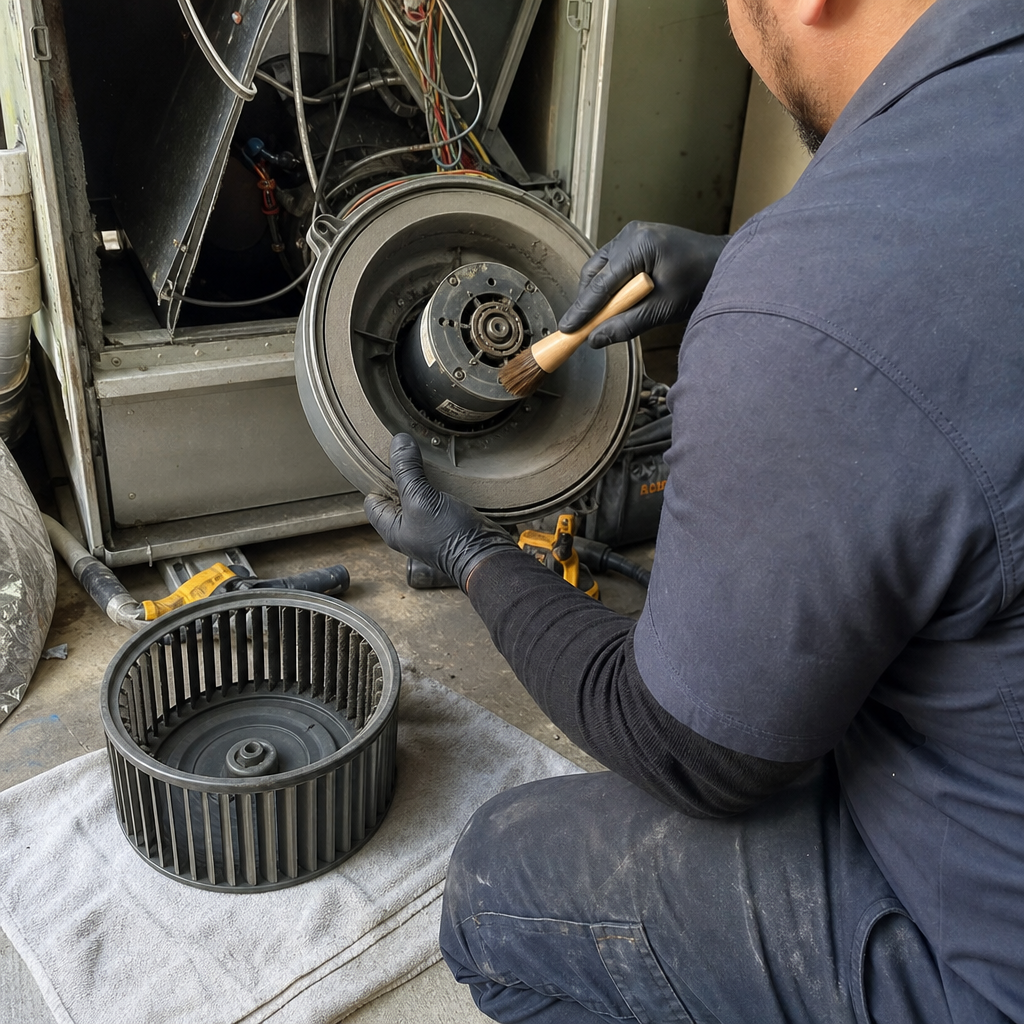
Phase 4: Air Handler and Component Cleaning (30-45 minutes)
The blower motor, evaporator coil (if accessible), and plenum receive attention. This isn’t a full coil replacement or motor rebuild - those are separate services - but surface cleaning of components that interact directly with your airflow.
Phase 5: Final Camera Run and Verification (20-30 minutes)
The camera goes back in. You see the same duct sections from Phase 1, now clean. This is your “after” record, stored with your job file. If debris remains visible, we return to Phase 3 for that zone. No paperwork, no arguing - our 90-Day Done Right Promise starts here.
Phase 6: System Restart and Walkthrough (15-20 minutes)
Filters are replaced (new filters are additional unless you provide your own), registers are reinstalled, the system runs through a complete cycle, and the technician reviews findings with you. Total elapsed time: 3.75-4.5 hours for this typical home.
What Extends a Job Beyond the Estimate
Even with accurate measurement, certain conditions extend timelines. We flag these during the pre-work walkthrough so you’re not surprised.
Excessive debris accumulation. Homes with 15+ years since last cleaning, or properties near active construction or recent wildfire zones in Los Angeles County, may have packed debris requiring multiple agitation passes. We’ve encountered homes in the San Fernando Valley where 2018 Woolsey Fire ash remained in ductwork four years later, bonded with moisture into a clay-like consistency.
Damaged or deteriorated duct sections. Flex duct with torn inner liners, rusted metal duct with pinhole leaks, or failed duct tape seals at joints - these must be addressed before full-system cleaning to prevent further damage or contamination. We carry repair materials for common issues; extensive damage may require scheduling a return visit for duct sealing.
Two-system homes with poor access. A second air handler in a cramped Pasadena attic or a rooftop package unit in Venice with steep ladder access adds setup and transit time between systems.
Integrated air quality components. Whole-house humidifiers, UV-C sterilizers, or advanced filtration systems require careful handling during cleaning. We clean what we can access; complex component service may be quoted separately.
Pet hair and dander saturation. Homes with multiple shedding pets often show hair accumulation at return vents and in flex duct low points. This requires slower agitation and more frequent vacuum filter changes to maintain extraction power.
In every case, we communicate extensions before they happen, with clear explanation. No surprises on the bill - that’s been our standard since 1984.
The “Done in an Hour” Red Flag
If a crew tells you they’ll be in and out within 60-90 minutes, here’s what they’re likely doing - and what they’re skipping.
They’re probably cleaning only vent covers and visible duct openings with a shop vacuum or compressed air. They’re not establishing negative pressure throughout the system. They’re not running contact tools to trunk lines. They’re certainly not camera-verifying results. What they’re selling is a surface treatment, not a system cleaning.
The math doesn’t work otherwise. For a 12-vent home, even moving quickly through our Phase 3 protocol requires roughly 8-12 minutes per vent including setup, agitation, and verification. That’s 96-144 minutes of contact cleaning alone, before walkthrough, setup, air handler work, or final camera run. Add the other phases, and you’re at 3+ hours minimum for competent work.
The “fast” operator banks on you not knowing the difference. They’ll show you a filter full of debris - debris they vacuumed from your vent covers, not your ductwork - and declare the job complete. Six months later, your registers are dusty again because the trunk lines were never touched.
In Los Angeles, where HVAC systems run heavily during Santa Ana wind seasons and summer heat waves, this shortcut costs you in energy efficiency and component lifespan. A blower motor working against restricted airflow fails sooner. An evaporator coil starved for airflow ices up. The “cheap” cleaning becomes expensive fast.
We don’t compete on speed. We compete on never needing to be called back. That’s the 90-Day Done Right Promise, and it’s why our jobs take the time they take.
What Homeowners Should Do During the Cleaning
You don’t need to leave, but you do need to plan around the work. Here’s what to expect and how to prepare.
Access requirements. We need clear paths to every vent, the air handler location, and our equipment staging area - typically a driveway or garage space for the vacuum unit. Please secure pets in a separate room; the equipment noise and unfamiliar people stress animals, and we don’t want a door left open that lets them out.
System downtime. Your HVAC system will be off for the duration. In mild Los Angeles weather, this is rarely an issue. During heat waves, schedule morning appointments when possible; we start at 8 AM to minimize afternoon discomfort. We don’t recommend scheduling during Red Flag warnings or extreme heat days if you have health conditions requiring climate control.
What you can do. Stay available for the initial walkthrough and final review. Between those points, most homeowners work from home, run errands, or handle household tasks. We don’t need supervision. Our technicians are background-checked, uniformed, and trained to respect your space.
What you shouldn’t do. Don’t run the system during cleaning - this defeats negative pressure and can damage equipment. Don’t attempt to “help” by cleaning vents yourself mid-job; this disrupts our zone sequencing. And don’t hesitate to ask questions during the final walkthrough. The camera footage is yours to review, and we explain every finding.
When you can run the system again. Immediately after our final restart and verification. We test operation before leaving, and you’ll have clean filters in place. Some homeowners report a brief “new smell” for 24-48 hours - this is normal off-gassing from disturbed organic material and dissipates quickly with normal airflow.
Common Mistakes to Avoid
- Booking by price alone without timeline discussion. The lowest bid often reflects the shortest time allocation, which means skipped steps. Ask specifically how long the job will take and what phases are included.
- Assuming all “HVAC cleaning” includes the same scope. Some companies clean only ducts. Others include coils, blowers, and registers. Clarify exactly what’s covered before comparing quotes.
- Ignoring vent count in favor of square footage. A 2,000-square-foot home with an open floor plan and 10 vents is a shorter job than a same-size home with compartmentalized rooms and 18 vents. Any quote based only on square footage is imprecise.
- Scheduling during Los Angeles peak heat without backup cooling. If you have window units or portable AC, keep them accessible. For elderly residents or infants, consider staying elsewhere during extreme weather cleanings.
- Accepting verbal promises of “camera inspection” without seeing the footage. A true camera verification produces video you can view. Ask to see before and after footage, or ask for it to be saved to a drive you can review.
- Delaying cleaning until visible dust appears. By the time you see dust at registers, your system has been working harder for months. In Los Angeles, where outdoor particulate levels often exceed EPA guidelines, proactive cleaning every 3-5 years protects efficiency.
- Trying to clean your own ductwork with household tools. Without negative pressure extraction, agitation simply redistributes debris. Worse, damage to flex duct or dislodged connections create leaks that cost more than professional cleaning would have.
When to Call a Professional
Call for HVAC cleaning when you notice uneven airflow between rooms, visible dust accumulation at registers within weeks of cleaning, musty odors when the system runs, or unexplained increases in energy bills. After any home renovation, construction dust infiltrates ductwork and should be professionally extracted before it settles permanently.
In Los Angeles, we also recommend inspection after significant seismic events; duct connections can loosen, and compromised seals admit attic or crawl space contaminants you’d never see from inside your home.
Bellows Air Duct & Vent Co. offers free estimates in Los Angeles - call (844) 685-6342. We’ll measure your system, count your vents, and give you an honest timeline and price before any work begins. No bait coupons, no changes at the door, and every job backed by our 90-Day Done Right Promise in writing.
Frequently Asked Questions
Most single-system homes in the 1,200-2,000 square foot range take 3 to 5 hours for thorough cleaning with camera verification. Larger homes or those with dual systems may require 5 to 8 hours. Call (844) 685-6342 for a free estimate based on your specific vent count and system configuration.
Only if significant steps are skipped. A proper cleaning requires negative pressure establishment, zone-by-zone contact cleaning, and verification - processes that cannot be compressed below their physical requirements without sacrificing results. We don’t offer rushed service because we stand behind our work for 90 days.
Every 3 to 5 years for typical residential use, or more frequently if you have pets, allergies, or live near high-traffic corridors like the 10 or 405 freeways where particulate infiltration is elevated. Post-wildfire seasons may also warrant earlier inspection.
No. Most homeowners remain present, working or handling daily tasks while we work. We do ask that you keep pets secured and avoid running the HVAC system during the cleaning process. The equipment noise is comparable to a running vacuum cleaner.
Cleaning is almost always the more economical option for functional ductwork. Replacement becomes necessary when ducts are extensively damaged, deteriorated beyond repair, or contaminated with substances cleaning cannot address. During our pre-work camera inspection, we identify any sections requiring repair or replacement and discuss options before proceeding. Call (844) 685-6342 for an exact assessment - estimates are free.
Yes. We restart and test your system during our final walkthrough, with new filters in place. Normal operation resumes immediately, though some homeowners notice a brief clean scent for 24-48 hours as disturbed particulates fully clear.
The Bottom Line
The time a legitimate HVAC cleaning takes is determined by your home’s measurable characteristics - square footage, vent count, system count, and duct condition - not by crew efficiency or equipment speed. Any provider quoting time or price without assessing these factors is guessing, and guessing doesn’t produce reliable results. Expect 3-5 hours for typical Los Angeles homes, longer for complex properties, and treat sub-90-minute promises as the red flags they are. Done right, with camera verification and professional-grade equipment from Rotobrush and Nikro, the job takes the time it takes. We don’t rush it because we don’t return to fix shortcuts. That’s been the Bellows standard since 1984.
Written by the team at Bellows Air Duct & Vent Co., serving Los Angeles since 2012.