
Last updated July 25, 2026
Air Duct Cleaning Maintenance Checklist for Los Angeles Homeowners
Most maintenance checklists tell you to change your filter every 90 days. They were written for Minneapolis. In Los Angeles, a single Red Flag Warning event can load your ducts with more particulate matter than six months of normal use. We’ve been cleaning ductwork here since 2012, and we’ve learned that the homeowners who stay ahead of problems don’t follow a calendar - they follow conditions. This guide gives you a checklist built around the actual threats to Los Angeles duct systems: wildfire smoke, coastal salt air, renovation dust, and the specific wear patterns that show up in homes from the Valley to the beach.
Quick Answer
Los Angeles homeowners should inspect HVAC filters monthly, schedule professional duct cleaning every 2-3 years under normal conditions, and trigger an immediate cleaning after any wildfire exposure, major renovation, or rodent activity. Replace filters every 30-60 days during fire season or if you live within 10 miles of active burn zones, and every 60-90 days year-round for coastal homes dealing with salt air corrosion.
Table of Contents
- Why LA Ducts Need a Different Checklist
- The Monthly Visual Inspection: What to Check at Your Registers
- Event-Based Triggers: When to Override Your Schedule
- Filter Logging: How to Track Your Home’s Actual Particulate Load
- Coastal vs. Inland Maintenance Differences
- Preparing for a Professional Appointment: What to Document
- Annual Maintenance Timeline: A Seasonal Checklist
- Common Mistakes to Avoid
- When to Call a Professional
- Frequently Asked Questions
- The Bottom Line
Why LA Ducts Need a Different Checklist
Generic duct maintenance advice assumes a stable environment. Los Angeles doesn’t have one. Our air quality swings from AQIs below 20 to hazardous readings above 200 within a single fire event. The Santa Ana winds that push flames also force particulate deep into duct systems through every gap and seam. Meanwhile, coastal homeowners in Santa Monica, Venice, or San Pedro face a slower threat: salt air that corrodes metal ductwork and degrades flexible duct lining over years, not months.
We’ve cleaned ducts in Los Angeles homes where the filter looked clean but the trunk line was coated in ash from the Woolsey Fire, invisible because the homeowner never looked past the return grille. We’ve also found salt-crusted dampers in Marina del Rey homes where the HVAC ran fine but the airflow had dropped 30% over five years. A checklist that ignores these patterns is worse than useless - it creates false confidence.
The framework below splits maintenance into two tracks: routine tasks you perform yourself, and event-based triggers that should move you immediately to professional inspection. Both matter. Neither replaces the other.
The Monthly Visual Inspection: What to Check at Your Registers
You don’t need tools for this. Five minutes with a flashlight and your phone’s camera gives you data worth keeping. We recommend the first Saturday of each month - same time you check smoke detector batteries if you’re disciplined about it.
Here’s what to look for at each supply and return register:
- Dark buildup on the grille fins. A thin gray film is normal. Thick, fuzzy accumulation that returns within weeks of wiping means your filter isn’t catching enough, or your ducts are shedding old debris.
- Discoloration on the wall or ceiling around the register. This often indicates air bypass - conditioned air leaking between the duct boot and drywall, pulling attic or wall cavity dust with it. Common in older Los Angeles homes with original ductwork from the 1960s-80s.
- Musty or acrid odor when the system first cycles on. In fire season, this can mean smoke particulate has settled in the ducts and re-aerosolizes with each cycle. Year-round, it suggests moisture or organic growth in the trunk line.
- Uneven airflow between rooms. Close all doors, run the system, and feel each register. A register that used to blow strong and now feels weak may indicate a collapsed flexible duct (common in attics where summer heat degrades the material) or a blockage.
- Visible debris inside the duct past the register. Shine your flashlight straight in. If you can see accumulation more than a few inches deep, the trunk line is likely worse.
Document what you find. Snap photos with dates. This baseline becomes valuable if you ever need to compare before and after a cleaning, or if you file an insurance claim after a fire event and need to prove pre-existing duct condition.
Event-Based Triggers: When to Override Your Schedule
Your ducts don’t care about your calendar. These five events should trigger an immediate professional inspection, regardless of when you last cleaned:
- Wildfire smoke exposure. If you smelled smoke indoors, or if your home was within 15 miles of a major fire during active burn, particulate has entered your system. PM2.5 particles from wildfire smoke are small enough to pass through standard filters and deposit throughout the duct network. We inspected a home in Porter Ranch three weeks after the Saddleridge Fire; the filter was new but the trunk line held a visible layer of ash. The homeowner had been running the system continuously, recirculating it.
- Major renovation or remodeling. Drywall dust, sawdust, and insulation particles are abrasive and hygroscopic - they attract moisture and can support microbial growth if left in ducts. Even with contractors using barriers, HVAC systems often run during construction in Los Angeles homes where temporary cooling is essential. We recommend cleaning within two weeks of project completion.
- Rodent or pest activity. Droppings, nesting material, or the smell of urine in ducts are health hazards requiring immediate attention. In hillside neighborhoods like Laurel Canyon or the Hollywood Hills, roof rat access to attic ductwork is common. Don’t attempt cleanup yourself - disturbed droppings can aerosolize hantavirus and other pathogens.
- Water intrusion or flooding. Whether from a roof leak during winter rains or a plumbing failure, moisture in ducts creates conditions for growth within 48-72 hours. Flexible duct with fiberglass lining is particularly vulnerable; once wet, it rarely dries completely in Los Angeles’ mild climate without active intervention.
- New home purchase. Even in new construction, we’ve found construction debris, discarded food containers, and in one case, a worker’s coffee cup in the trunk line. For resale homes in Los Angeles, you have no reliable history of prior maintenance.
After any of these events, replace your filter immediately and call for camera inspection. The visual record matters for insurance documentation and for your own peace of mind.
Filter Logging: How to Track Your Home’s Actual Particulate Load
Your filter is a data source most homeowners ignore. A simple log reveals patterns that help you optimize replacement timing and provides documentation if you ever need to prove environmental damage to an insurer.
Here’s the system we recommend:
- Use the same filter type consistently. Switching between MERV ratings or brands makes comparison meaningless. We suggest Honeywell or Aprilaire pleated filters, MERV 8-11 for most Los Angeles homes. Higher MERV ratings restrict airflow in older systems; lower ratings don’t catch fire particulate effectively.
- Photograph the filter at installation and at replacement. Same angle, same lighting. Date each photo.
- Note the replacement date, the reason (scheduled or triggered), and any events. “Replaced 10/15. Woolsey Fire active 10/8-11/21. Home closed up, system ran continuously. Filter heavily gray despite 45 days use.”
- Rate the used filter: Light, Moderate, Heavy, or Severe loading. Light = visible dust, gray color. Severe = visible debris, reduced airflow felt at registers, odor.
After 12-18 months of logging, you’ll know your home’s actual pattern. Some Los Angeles neighborhoods average Heavy loading every 45 days during fire season; others stay Moderate for 90 days. This data also supports insurance claims. After the 2025 Palisades Fire, several of our customers used their filter logs to document sustained poor air quality and secure coverage for deep cleaning and HVAC component replacement.
Store photos in a dedicated cloud folder. The five minutes per filter change is trivial; the documentation can be worth thousands.
Coastal vs. Inland Maintenance Differences
Los Angeles isn’t one climate. The maintenance needs of a Santa Monica bungalow differ materially from a Pasadena Craftsman or a Woodland Hills ranch.
Coastal homes (roughly west of the 405, plus beach communities):
Salt air is the primary threat. Chloride particles accelerate corrosion of galvanized steel ductwork, which was common in Los Angeles construction through the 1980s. Flexible duct with metalized polyester lining degrades more slowly but still suffers; we’ve replaced duct in Marina del Rey homes where the lining had become brittle and flaky after 15 years of coastal exposure.
Coastal homeowners should inspect the external condition of outdoor-mounted air handlers and condensers quarterly for salt buildup, rinse coils gently if visible accumulation appears, and consider more frequent professional inspection of metal trunk lines - every 2 years rather than 3. Filter changes can often stretch toward 90 days except during fire events, since coastal particulate loads are generally lower than inland.
Inland homes (San Fernando Valley, San Gabriel Valley, downtown-adjacent neighborhoods):
Higher summer temperatures stress flexible duct in attics, where ambient temperatures regularly exceed 140°F. This thermal cycling causes the wire helix in flexible duct to fatigue and the liner to delaminate. We’ve found collapsed sections in Valley homes where the original 1980s ductwork had simply given out after decades of heat exposure.
Inland homeowners should check attic ductwork condition annually if accessible (use caution - attics in August are dangerous), replace filters more aggressively during Santa Ana wind events when dust load spikes, and consider professional inspection every 2 years given the combined thermal and particulate stress.
Fire zone adjacency (Topanga, Malibu, Pacific Palisades, Altadena, foothill communities):
These homeowners need the most aggressive event-based trigger protocol. We recommend keeping a case of filters on hand during fire season, running the system on recirculate (not outside air) when AQIs exceed 100, and scheduling professional inspection within two weeks of any Red Flag Warning period that produced visible smoke.
Preparing for a Professional Appointment: What to Document
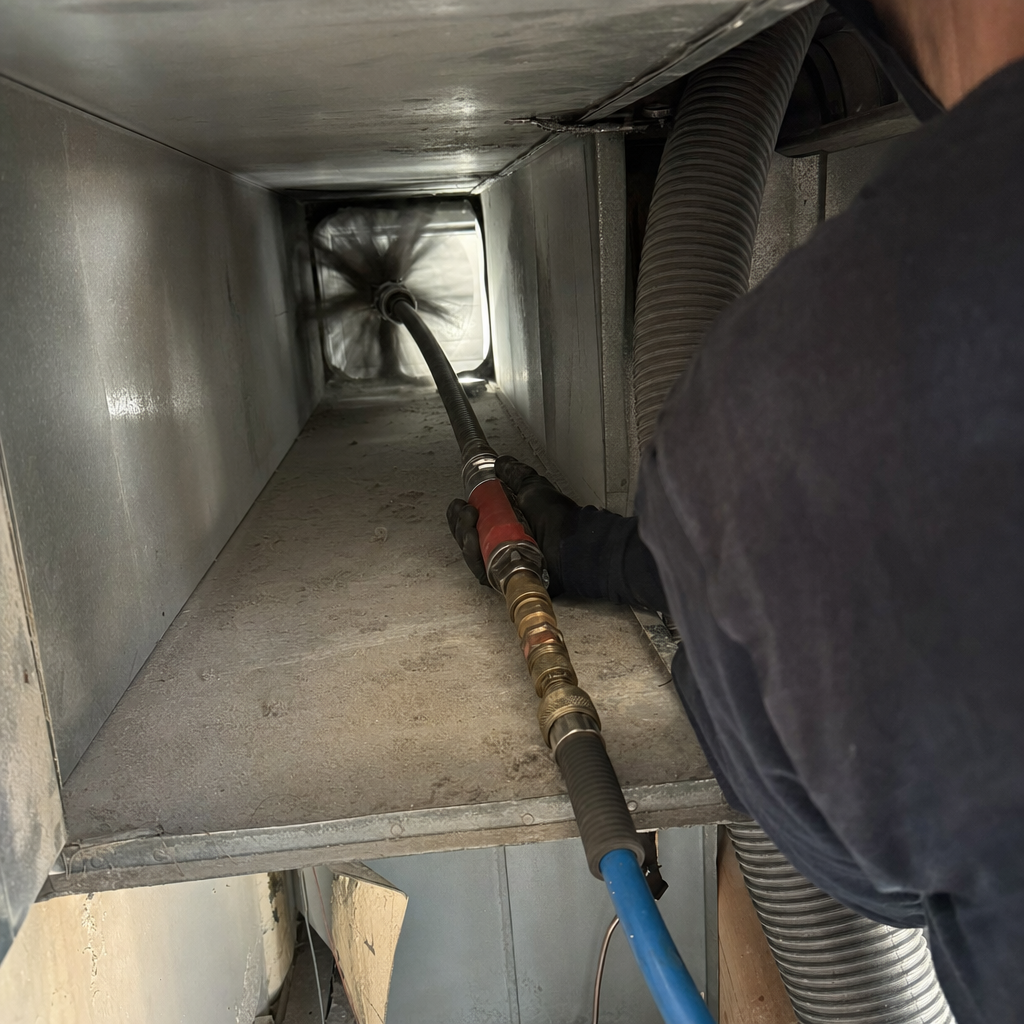
A professional duct cleaning should include camera inspection before and after. At Bellows Air Duct & Vent Co. home, we provide the visual record to every homeowner. But your own documentation makes the before-and-after more meaningful and protects you if results are disputed.
Before your appointment:
- Compile your filter log and photos. This gives the technician context about your home’s particulate load history.
- Walk the house and note problem registers. Which rooms feel stuffy? Which grilles show the heaviest buildup? Mark them with painter’s tape.
- Photograph each register and the visible duct behind it. Same angles you’ll use for after photos.
- List recent events. Fires, renovations, pest activity, water leaks - even if resolved, these affect where technicians should focus.
- Locate and photograph your air handler and filter location. In some Los Angeles homes, especially mid-century ranches, these are in awkward attic or closet locations. Knowing the path saves time and reduces labor cost.
After the appointment, request the camera footage or stills from the technician. Store with your own photos. This combined record establishes a verified baseline for future comparison and supports any warranty or guarantee claims.
Annual Maintenance Timeline: A Seasonal Checklist
This framework integrates routine tasks with Los Angeles-specific seasonal risks. Adjust based on your filter log data and your home’s location.
January – March (Winter rains, lower fire risk):
- Inspect attic and crawl space for water intrusion after storms
- Check outdoor condenser for debris from winter winds
- Schedule professional inspection if any moisture found in ducts
- Replace filter if not changed since November
April – June (Santa Ana winds, rising temperatures):
- Increase filter inspection to every 3 weeks during wind events
- Check attic ductwork for heat damage if accessible safely
- Schedule professional cleaning if due (2-3 year cycle, or triggered)
- Verify condensate drain is clear before summer humidity
July – September (Peak heat, peak fire season):
- Replace filter every 30-60 days depending on fire activity
- Run system on recirculate when AQIs exceed 100
- Keep windows closed during Red Flag Warning periods
- Document any smoke odor or visible haze indoors
October – December (Fire season lingers, cooling begins):
- Post-fire professional inspection if any exposure during season
- Replace filter after final fire event of year
- Review annual filter log for pattern changes
- Schedule any deferred cleaning before holiday guests arrive
Our $89 Seasonal Tune-Up includes filter replacement, visual duct inspection at accessible registers, and airflow measurement. It’s a practical mid-year checkpoint between full cleanings.
Common Mistakes to Avoid
- Waiting for visible dust at registers. By the time you see it, the trunk line is heavily loaded. Registers are the last place debris shows; the main accumulation happens in bends and low-velocity sections you can’t see.
- Using the highest MERV filter available. MERV 13+ filters restrict airflow in older Los Angeles systems, straining motors and reducing comfort. Match the filter to your system’s capacity, or upgrade the system before upgrading the filter.
- Ignoring flexible duct age. Most flexible duct installed before 2000 is nearing or past its service life in Los Angeles attics. Cleaning degraded duct can damage it further. Camera inspection first, always.
- Cleaning only after a home sale. The buyers’ inspector often flags duct condition, and you’re negotiating under pressure. Clean on your own schedule, with your own documentation, before listing.
- Assuming new construction is clean. Construction debris in ducts is routine, not exceptional. We’ve found significant accumulation in homes less than two years old across Los Angeles County.
- Neglecting the dryer vent. Lint accumulation is a fire hazard independent of duct condition, and many Los Angeles homes have long vent runs through walls or roofs that are difficult to inspect. Dryer Vent Cleaning in Seymour follows similar principles - event-based triggers, visual inspection, professional camera verification.
- Accepting cleaning without camera proof. Any reputable company can show you the condition before work begins and the results after. Refusal is a red flag.
When to Call a Professional
Call for camera inspection when you detect persistent odors, visible debris beyond the register, uneven airflow that doesn’t resolve with filter replacement, or after any event-based trigger listed above. If your home has original ductwork from before 1990, professional assessment of material condition should precede any cleaning decision.
Bellows Air Duct & Vent Co. offers free estimates in Los Angeles - call (844) 685-6342. We’ll show you the condition of your ducts before any work is proposed, with upfront pricing that matches the estimate. No bait coupons, no price changes at the door. Our 90-Day Done Right Promise means if anything isn’t right, we return at no charge with no paperwork required.
Frequently Asked Questions
Every 2-3 years under normal conditions, but wildfire exposure, renovation, or rodent activity should trigger immediate cleaning regardless of schedule. Homes within 10 miles of recent burns or in high-particulate areas like the San Fernando Valley often need annual professional inspection. Call (844) 685-6342 for a free estimate to assess your home’s specific timing.
Homeowners can and should perform monthly visual inspections and regular filter changes, but professional cleaning requires equipment that generates sufficient negative pressure to extract debris without releasing it into the home. Consumer-grade vacuums and brush kits often make the problem worse by dislodging material that then recirculates. For safety and effectiveness, professional cleaning with camera verification is the practical standard.
The reliable indicators are odor when the system cycles (musty, acrid, or smoky smell that persists beyond a few minutes), visible gray film on registers that returns quickly after cleaning, and filter loading much faster than your established baseline. If you smelled smoke indoors during an active fire, particulate entered your system - the only question is how much. Camera inspection provides certainty.
Air duct cleaning addresses the supply and return ductwork that distributes conditioned air. HVAC Cleaning in Seymour and equivalent full service includes the air handler, coils, blower, and sometimes the condensate system. For comprehensive maintenance, both matter - contaminated ducts recirculate debris into a clean handler, and a dirty handler deposits material into clean ducts. We assess which your home needs during our free estimate.
Yes. Coastal chloride exposure corrodes galvanized steel ductwork and degrades the metalized layer in flexible duct over 10-20 years. The damage is gradual and often invisible until failure - collapsed sections, separated seams, or liner delamination. Coastal homeowners should request visual inspection of trunk line condition, not just cleaning, during professional service.
It depends on duct material condition. Original asbestos-containing ductwork (common in pre-1980 Los Angeles homes) requires specialized handling and may need replacement rather than cleaning. Original fiberglass-lined flexible duct often degrades to the point where cleaning causes more damage than benefit. Camera inspection first, always - and never from a company that won’t show you what they found. Air Duct Cleaning in Seymour follows the same protocol: assess, document, then recommend.
The Bottom Line
Los Angeles duct maintenance isn’t about calendar discipline. It’s about reading your environment - wildfire smoke, salt air, renovation dust, thermal stress - and responding before small problems become expensive ones. The homeowners we see thriving are the ones who keep a filter log, know their registers’ normal appearance, and call for camera inspection when conditions change, not when symptoms become unbearable. A maintenance checklist only protects you if it matches where you live. This one does.
Written by the team at Bellows Air Duct & Vent Co., serving Los Angeles since 2012.