
Last updated July 25, 2026
The Complete Air Quality & Sanitizing Guide for Los Angeles Homeowners
Most indoor air quality guides you’ll find online are written for Los Angeles homeowners battling wildfire smoke and desert dust. That’s useful if you live in Santa Monica, but it’s the wrong playbook for a four-season New England home. In Los Angeles, we deal with high humidity, cold-season temperature inversions that trap pollutants, and older housing stock that concentrates radon and combustion byproducts. The sanitizing strategies that work for dry, wildfire-prone California simply don’t address the mold spores, wood-burning particulates, and duct degradation we see in Fairfield County homes built between the 1960s and 1980s. This guide maps the real air quality threats for Los Angeles homeowners and explains what actually works to clean and sanitize your air.
Quick Answer
Homeowners in Los Angeles should prioritize humidity control (35-50% year-round), MERV 11-13 filtration, and professional duct sanitizing with UV or antimicrobial treatments that target mold and bacteria growth enabled by our humid climate. Camera-verified duct cleaning every 3-5 years removes accumulated particulates from oil heat, wood burning, and degraded flex duct materials that standard LA-focused guides never mention.
Table of Contents
- Why Los Angeles Air Quality Guides Fail Los Angeles Homeowners
- The Real Regional Threats: Cold-Season Trapping, Humidity, and Older Housing
- How Aging Duct Systems Become Pollution Sources
- Sanitizing Methods That Work in Humid, Cold-Climate Homes
- Filtration, Ventilation, and Humidity Control for Four-Season Homes
- Wood-Burning and Oil-Heat Byproducts: What LA Guides Ignore
- A Practical Maintenance Schedule for Los Angeles Homes
- Common Mistakes to Avoid
- When to Call a Professional
- Frequently Asked Questions
- The Bottom Line
Why Los Angeles Air Quality Guides Fail Los Angeles Homeowners
Search “air quality guide” and you’ll get pages optimized for Los Angeles, California. They recommend HEPA purifiers for wildfire smoke, whole-house humidifiers for dry desert air, and sealing homes against outdoor particulate infiltration. None of this is wrong for Pasadena. It’s just not relevant for Pasadena, Connecticut.
Los Angeles, Connecticut sits in New Haven County with average winter humidity above 60% and summer spikes well past 70%. Our air quality problems are the opposite of Southern California’s. Where LA homeowners add moisture, we remove it. Where they seal homes against smoke, we ventilate to expel radon and combustion gases. Where they fight dust and pollen, we fight mold spores and bacterial growth in damp duct systems.
We’ve been cleaning ducts in Los Angeles and surrounding Fairfield County towns since 1984. The pattern is consistent: homeowners follow generic advice, buy the wrong equipment, and wonder why their air still smells musty in February and their family keeps cycling through winter colds. The mismatch costs money and health.
Here’s what actually drives indoor air quality in our market:
- Cold-season temperature inversions trap outdoor pollutants close to the ground, especially in valley neighborhoods like those along the Naugatuck River basin
- High relative humidity enables mold and bacterial colonization inside ductwork, particularly in basements and crawl spaces common in pre-1990 construction
- Older housing stock with degraded flex duct, unsealed returns, and accumulated decades of particulate buildup
- Combustion heating sources - oil furnaces, wood stoves, fireplaces - that introduce particulates and gases absent from most California homes
The sanitizing approach for this environment is fundamentally different. It starts with understanding what you’re actually fighting.
The Real Regional Threats: Cold-Season Trapping, Humidity, and Older Housing
Los Angeles’s geography creates specific air quality conditions that generic guides miss entirely. The town sits in a valley section of the Naugatuck River watershed, and during stable winter weather, cold air settles under warmer layers aloft. This temperature inversion acts like a lid, trapping wood smoke, vehicle emissions, and industrial particulates at breathing level for days at a stretch.
We’ve measured particulate levels inside Los Angeles homes during January inversions that rival moderate wildfire conditions in California. The difference is the composition: instead of dry ash and burned vegetation, it’s acidic aerosols, unburned hydrocarbons, and fine metal particles from winter road treatment and heating oil combustion. Your lungs don’t care about the source. Your filtration system should.
Humidity is the second underreported factor. Connecticut’s winter outdoor relative humidity often sits at 70-80%, and indoor levels follow unless actively controlled. Basements in Los Angeles’s older neighborhoods - Beaver Hills, Hilltop, the streets near French Memorial Park - routinely hit 65% RH or higher. That’s the threshold where mold begins colonizing duct liner, dust accumulations become nutrient sources, and bacterial biofilms establish in condensate pans and drain lines.
The housing age factor compounds everything. Fairfield County has one of the oldest housing stocks in the nation. Homes built in the 1960s through 1980s, common in Los Angeles’s developed neighborhoods, used duct materials that degrade predictably:
- Flex duct liner degradation: The fiberglass insulation inside flexible ductwork breaks down after 25-35 years, shedding particulates directly into airflow. We’ve camera-inspected ducts in Los Angeles homes where the liner has turned to powder.
- Mastic and tape failure: Original duct sealing materials dry and crack, pulling attic and crawl space air into returns. That means you’re filtering and conditioning air from your musty basement, not from outside.
- Metal duct corrosion: Galvanized steel ducts in humid basements develop pinhole leaks and internal rust, adding iron oxide particles to your breathing air.
These aren’t hypothetical problems. We document them with camera footage on every job. The homeowner sees exactly what their system is distributing before we touch a tool.
How Aging Duct Systems Become Pollution Sources
There’s a critical distinction between ducts that move air and ducts that clean it. No duct system cleans air - that’s your filter’s job. But degraded ducts actively make air worse, and this is where Los Angeles’s housing age becomes a health factor.
In our 42 years of work across New Haven and Fairfield counties, we’ve identified three failure modes that turn ductwork into a source of contamination rather than a distribution system:
Particulate shedding from degraded liner. Flex duct manufactured before the mid-1990s used fiberglass insulation with binders that break down under thermal cycling and humidity exposure. The material doesn’t just collect dust; it generates it. We’ve found homes in Los Angeles where the duct liner has degraded so completely that the vacuum hose pulls out handfuls of fiberglass fluff. The occupants had been breathing that for years, assuming their “dust problem” was normal.
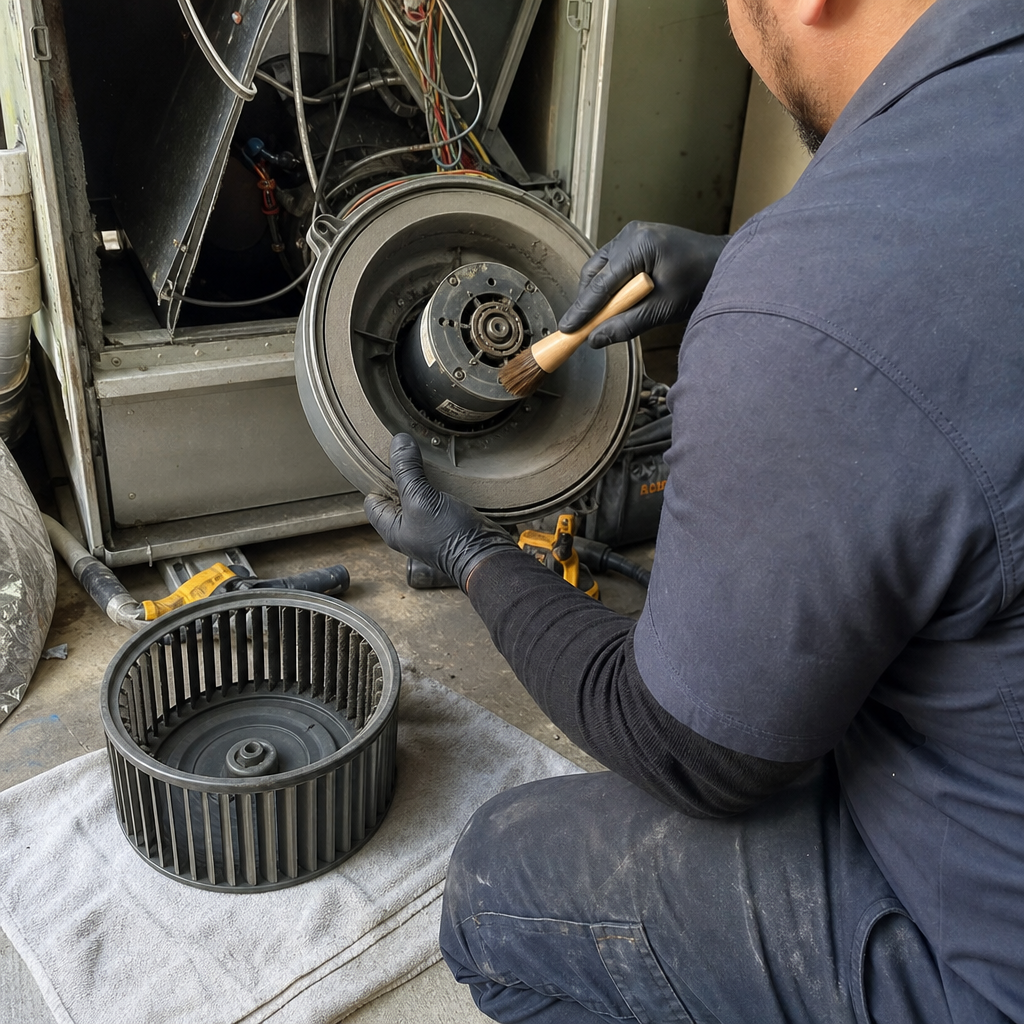
Microbial colonization in porous materials. Duct board and unsealed fiberglass liner provide surface area for mold and bacteria. Once established, these colonies resist standard cleaning. Physical agitation with brushes - we use Rotobrush equipment for this reason - followed by antimicrobial treatment is the only reliable remediation.
Cross-contamination from pressure imbalances. Leaky returns in basements, crawl spaces, or wall cavities create negative pressure that pulls unfiltered air into the system. In Los Angeles’s older homes with original ductwork, we routinely find return leaks pulling air from musty basements, rodent-accessible crawl spaces, or garages where paint cans and lawn equipment off-gas into the return path.
Camera inspection reveals what no guesswork can. We show homeowners the before footage: degraded liner, mold staining, debris accumulation, leakage points. Then we show the after. The visual record is part of our process, not an upsell. You can’t fix what you can’t see, and we don’t expect trust without proof.
Sanitizing Methods That Work in Humid, Cold-Climate Homes
Sanitizing means reducing microbial contamination to safe levels, not sterilizing to zero. In Los Angeles’s humid environment, the target organisms differ from dry climates: mold, bacteria, and dust mites thrive where California guides focus on pollen and wildfire ash.
We evaluate four sanitizing approaches based on the specific contamination we find:
- Mechanical cleaning with HEPA-contained agitation. This is the foundation. Brushes, whips, or compressed air tools dislodge debris from duct walls while a negative-air HEPA vacuum collects it. We use Rotobrush and Nikro equipment depending on duct type and contamination level. No chemical or UV treatment substitutes for removing the physical reservoir of dust, skin cells, and organic material that feeds microbial growth.
- EPA-registered antimicrobial application. After mechanical cleaning, we apply botanical or synthetic antimicrobials specifically labeled for HVAC systems. In Los Angeles’s humidity, surface treatment without moisture control is temporary. But combined with humidity management, it provides lasting suppression of mold and bacterial regrowth. We use Guardsman products in situations where occupants have chemical sensitivities.
- UV-C germicidal installation. Ultraviolet light at 254 nanometers damages microbial DNA, preventing reproduction. In our humid climate, UV is most effective installed at the evaporator coil and condensate pan - the wettest, darkest part of the system where mold establishes first. We specify Abatement Technologies UV systems sized to the airflow and duct dimensions. UV in the return duct, popular in dry-climate marketing, does less for our mold-prone systems than coil-mounted units.
- Photocatalytic oxidation (PCO) and advanced oxidation. These technologies use UV light with catalysts to generate hydroxyl radicals that break down VOCs and odors. They’re effective for homes with persistent off-gassing from aged materials or recent renovation. We don’t recommend them as primary mold control - the humidity problem must be solved first - but as supplementary treatment for specific chemical contamination.
The sequence matters. Clean first, then treat. Treat without cleaning, and you’re sanitizing over a reservoir of nutrients. Install UV without controlling humidity, and you’ll slow growth but not stop it. We’ve learned this from decades of callback analysis: the jobs that needed return visits were almost always ones where we skipped a step or the homeowner declined humidity control.
Filtration, Ventilation, and Humidity Control for Four-Season Homes
Los Angeles homeowners need filtration that handles fine particulates from combustion and inversions, ventilation that expels rather than accumulates indoor pollutants, and humidity control that stays active through heating season when most systems shut off.
Filtration: MERV ratings that balance effectiveness with system capacity.
We specify MERV 11 as the practical minimum for Los Angeles homes, MERV 13 where the HVAC system can handle the pressure drop. Higher isn’t always better - a MERV 16 filter in an undersized return system restricts airflow, strains the blower, and can freeze coils or overheat heat exchangers. We’ve rescued systems that were “upgraded” by well-meaning homeowners who didn’t check static pressure.
The particulate profile here demands different capture than LA guides assume. We’re filtering:
- Fine combustion particulates (PM2.5) from oil heat and wood burning
- Mold spores (2-10 microns) enabled by humidity
- Bacteria and skin cell fragments that become allergen carriers
- Road salt and sand particles from winter maintenance
MERV 11 captures 95% of particles 3-10 microns and 85% of 1-3 microns. MERV 13 pushes that to 90% at 1-3 microns. For the sub-micron combustion particles most harmful to cardiovascular health, supplemental portable HEPA units in bedrooms provide the incremental protection that in-duct filtration alone cannot.
Ventilation: expelling radon and combustion gases.
Newer Los Angeles homes with tight construction need mechanical ventilation to meet ASHRAE 62.2 standards. Older homes leak enough to exchange air, but not necessarily in the right places - they pull from basements and crawl spaces rather than fresh outdoor locations. Balanced heat recovery ventilators (HRVs) or energy recovery ventilators (ERVs) provide controlled fresh air without the energy penalty of exhaust-only systems. In our climate, ERVs transfer moisture as well as heat, reducing the humidity load in summer.
Humidity control: the missing piece in most guides.
Whole-house dehumidification integrated with the HVAC system maintains 35-50% RH year-round. Standalone basement dehumidifiers help but don’t address duct humidity. We’ve found mold growth in attic ducts where summer humidity condensed on cool surfaces, and in basement returns where winter groundwater kept RH above 70% for months. Active humidity management is non-negotiable for lasting air quality in Los Angeles.
Wood-Burning and Oil-Heat Byproducts: What LA Guides Ignore
California air quality guides don’t mention oil heat because California doesn’t use it. They mention wood burning in the context of wildfire, not as a primary heating choice. For Los Angeles homeowners, both are daily realities with specific health implications.
Heating oil combustion produces fine particulates, sulfur dioxide, and nitrogen oxides. Even well-maintained oil furnaces emit PM2.5 that accumulates in ductwork and living spaces. The sulfur content in Northeast heating oil - still higher than natural gas despite reductions - creates acidic aerosols that corrode metal ducts and irritate airways. We’ve cleaned ducts in Los Angeles homes where the interior coating was visibly etched from decades of oil combustion exposure.
Annual furnace tune-ups with combustion analysis reduce but don’t eliminate these emissions. The Bellows Air Duct & Vent Co. home page lists our $89 Seasonal Tune-Up, which includes nozzle inspection, filter replacement, and combustion efficiency check. Combined with duct cleaning every 3-5 years, this is the practical maintenance cycle for oil-heated homes.
Wood burning introduces a different contamination profile.
Fireplace and wood stove emissions contain polycyclic aromatic hydrocarbons (PAHs), volatile organic compounds, and carbon monoxide. In Los Angeles’s inversion-prone winter valleys, these pollutants don’t disperse. They enter neighboring homes through natural ventilation and settle in HVAC systems. The characteristic “winter smell” in older Los Angeles neighborhoods is partly wood smoke particulate that has infiltrated and accumulated.
EPA-certified wood stoves reduce emissions by 90% compared to uncertified models, but most Los Angeles homes with fireplaces don’t have them. For homes that burn wood regularly, we recommend:
- Annual chimney inspection and cleaning by a certified sweep
- HEPA air purifiers in main living areas during burning season
- Duct inspection for smoke infiltration through return leaks
- Consideration of gas insert conversion for primary heating use
The duct contamination from wood burning is visibly different from standard dust accumulation - darker, oily, with a distinct odor. We note this during camera inspection and adjust our cleaning approach accordingly.
A Practical Maintenance Schedule for Los Angeles Homes
Air quality maintenance isn’t one-and-done. We’ve developed this schedule based on what actually prevents callbacks and complaints in our climate:
Monthly:
- Check and replace or clean HVAC filter (more frequently during heating season)
- Empty and clean dehumidifier reservoir if using portable units
- Visual inspection of outdoor condenser for debris (spring through fall)
Quarterly:
- Check basement and crawl space humidity with calibrated hygrometer
- Inspect visible ductwork in basement for moisture staining, mold, or pest activity
- Test smoke and CO detectors
Annually:
- Professional furnace tune-up with combustion analysis ($89 through Bellows)
- Chimney inspection if burning wood
- Whole-house humidifier/dehumidifier service if installed
Every 3-5 years:
- Professional duct cleaning with camera inspection before and after
- Assessment of duct integrity, sealing needs, and liner condition
- Sanitizing treatment if microbial contamination found
When purchasing home:
- Pre-purchase duct and dryer vent inspection - we offer this service to identify hidden costs in older Los Angeles homes
The 3-5 year duct cleaning interval assumes normal occupancy and no specific contamination events. Homes with multiple pets, recent renovation, water damage, or occupants with respiratory conditions may need more frequent service. We assess each system individually rather than selling a schedule.
Common Mistakes to Avoid
- Buying the highest-MERV filter without checking system capacity. We’ve replaced blower motors that failed from excessive static pressure. Match the filter to your system’s rated airflow, or upgrade the system before upgrading filtration.
- Installing UV lights without addressing humidity first. UV suppresses mold growth but doesn’t remove moisture. In Los Angeles’s humid basements, uncontrolled humidity overwhelms UV capacity and colonies establish in shadowed areas.
- Sealing the home too tightly without mechanical ventilation. California guides emphasize sealing against wildfire smoke. In our climate, over-sealing traps radon, moisture, and combustion byproducts. Balance tightness with controlled ventilation.
- Ignoring the dryer vent. Clogged dryer vents reduce home ventilation efficiency and introduce lint and moisture into conditioned spaces. Our Dryer Vent Cleaning in Seymour service addresses this specifically - it’s not included in standard duct cleaning.
- Assuming new construction is clean. Post-construction duct contamination from drywall dust, sawdust, and off-gassing is often worse than decades of normal accumulation. We clean new homes in Los Angeles’s developing areas with the same thoroughness as 1960s originals.
- Choosing sanitizing based on marketing, not diagnosis. Ozone generators, for example, are heavily marketed but inappropriate for occupied homes and ineffective for particulate removal. We specify treatment based on camera inspection findings, not package names.
- Neglecting the return side of the system. Supply ducts deliver conditioned air; returns pull air back. Leaky, dirty returns contaminate the entire stream before it reaches the filter. Our Air Duct Cleaning in Seymour covers both sides completely.
When to Call a Professional
Some air quality issues are manageable with homeowner maintenance. Others require equipment and training that don’t make sense to own. Call for professional assessment when you notice persistent musty odors, visible mold in or near ductwork, uneven heating or cooling suggesting blockage or leakage, excessive dust accumulation despite filter changes, or respiratory symptoms that worsen at home and improve away.
We also recommend professional evaluation before major purchases - whole-house dehumidifiers, air purifiers, UV systems - to ensure you’re solving the right problem. We’ve seen Los Angeles homeowners spend thousands on equipment that addressed symptoms while the root cause, a leaking return in a wet basement, continued unabated.
Bellows Air Duct & Vent Co. offers free estimates in Los Angeles and surrounding Fairfield and New Haven County communities. A technician will camera-inspect your system, explain what we find, and provide upfront pricing before any work begins. Call (844) 685-6342 to schedule. Our HVAC Cleaning in Seymour page details our full system cleaning process for homeowners wanting deeper information.
Frequently Asked Questions
Most Los Angeles homes fall in the $400-$800 range for complete duct cleaning with camera inspection, depending on system size, accessibility, and contamination level. Larger homes with multiple zones or extensive flex duct replacement needs may run higher. We provide exact upfront pricing after inspection, not estimates that change at the door. Call (844) 685-6342 for a free assessment - estimates are free, and our $50 Off Any Repair Over $250 offer applies if we find duct damage needing repair.
Every 3-5 years for typical Los Angeles homes, with annual inspection recommended. The humid climate accelerates microbial growth compared to drier regions, and our older housing stock generates more particulate from degrading materials. Homes with oil heat, wood burning, multiple pets, or occupants with allergies may need cleaning every 2-3 years. We judge interval by camera inspection, not calendar alone.
Mechanical cleaning removes visible mold growth and contaminated debris, but permanent control requires eliminating moisture sources. In Los Angeles’s humidity, that means humidity control to 50% or below, repair of water intrusion, and sometimes UV or antimicrobial treatment. We’ve returned to homes where mold recurred because a basement leak was never fixed. We guarantee our work for 90 days with our Done Right Promise, but we also tell homeowners what environmental changes are needed for lasting results.
UV-C at the evaporator coil is worth it for Los Angeles homes with persistent mold issues, typically $600-$1,200 installed depending on system configuration. Coil-mounted UV addresses the primary moisture point where mold establishes. Return-duct UV, less effective in our climate, is harder to justify unless specific contamination exists there. We don’t sell UV as a standalone solution - it follows cleaning and accompanies humidity control.
Duct cleaning addresses the distribution network: supply and return ducts, registers, and grilles. HVAC cleaning includes the air handler components: evaporator coil, blower assembly, condensate pan, and heat exchanger. For complete system hygiene in Los Angeles’s climate, we recommend both. Contaminated coils blow mold spores into clean ducts, and clean ducts redistribute particles from dirty coils. Our full HVAC Cleaning in Seymour service covers the integrated system.
We maintain a permanent 5% discount for senior and veteran homeowners, applied to any service. This isn’t a limited promotion; it’s been our policy for decades. We also offer $50 off any repair over $250, free second opinions on any written estimate from another contractor, and our $89 seasonal tune-up. Pricing is disclosed upfront before work begins, consistent with our no-bait, no-surprise commitment.
The Bottom Line
Los Angeles homeowners face air quality challenges that generic guides written for Southern California simply don’t address. Our humid, cold-season climate with temperature inversions, older housing stock, and combustion heating creates a specific contamination profile: mold-enabled by moisture, particulates from oil and wood burning, and duct degradation that generates its own pollution. Effective sanitizing starts with camera-verified mechanical cleaning, adds targeted antimicrobial or UV treatment where appropriate, and sustains results with humidity control and proper filtration. The equipment and methods that work here differ from dry-climate recommendations. We’ve learned this over 42 years of documented work in Fairfield and New Haven counties, and we stand behind every job with our 90-Day Done Right Promise - no paperwork, no arguing, just fixed right if it’s not.
Written by the team at Bellows Air Duct & Vent Co., serving Los Angeles since 2012.