
Last updated July 25, 2026
Dryer Vent Cleaning Warning Signs Every Homeowner Should Know
The average house fire caused by a dryer is not caused by the dryer. It’s caused by the vent. The lint is usually visible before the fire is. In Los Angeles, where many homes were built before modern venting codes and where dense neighborhoods pack houses close together, we see this misunderstanding cost homeowners thousands in unnecessary appliance replacements, or worse. Every year, someone in our service area buys a new dryer because their “dying” machine takes two cycles to finish a load, never realizing the real problem is a blocked vent they can’t see. This guide will show you how to read the warning signs your vent is giving you, which ones demand immediate action, and how to tell a simple blockage from a vent that needs repair.
Quick Answer
The most reliable warning signs your dryer vent needs cleaning are: clothes that come out unusually hot at cycle end, drying times that have gradually increased by 20 minutes or more, a musty or burning smell during operation, and an exterior vent flap that barely moves or doesn’t open at all when the dryer runs. In Los Angeles homes, where mild winters mean dryers run year-round and older neighborhoods often have longer vent runs through attics or crawl spaces, these signs typically appear every 12 to 24 months depending on household size and vent configuration.
Table of Contents
- The Physical Signs Your Vent Is Clogged
- When Drying Times Creep Up: The 45-Minute Test
- Hidden Warning Signs Most Homeowners Miss
- Clean It Now vs. Stop Using: Knowing the Difference
- What a Camera Inspection Actually Reveals
- Why Los Angeles Homes Face Unique Vent Risks
- Common Mistakes to Avoid
- When to Call a Professional
- Frequently Asked Questions
The Physical Signs Your Vent Is Clogged
Your dryer vent speaks in symptoms. The trick is learning which symptoms point to the vent and which get misdiagnosed as appliance failure.
Clothes hot to the touch at cycle end. This is the sign we mention first because it’s the most specific. A properly venting dryer exhausts hot, moist air efficiently. When the vent is blocked, that heat has nowhere to go. It backs up into the drum, and your clothes come out feeling like they’ve been sitting in a sauna. Not warm, hot. In our experience across Los Angeles, from Pasadena bungalows to Mid-Century homes in the Valley, this is the sign that converts the fastest. Homeowners feel the difference immediately, and they know something is wrong.
The exterior vent flap barely moves or sits still. Go outside while your dryer is running on high heat. The vent flap should push open firmly and stay open with a steady stream of warm air. If it flutters weakly, opens only partway, or doesn’t move at all, you have a blockage. In Los Angeles, where Santa Ana winds can deposit dust and debris against exterior vents, and where some older homes in neighborhoods like Highland Park still have the original vent hoods from the 1960s, this check is worth doing monthly.
A musty smell in the laundry room or on “clean” clothes. Moisture that can’t escape through the vent condenses inside the ductwork. That dark, warm environment grows mildew. The smell is distinctive, not the clean heat of a working dryer but something closer to a damp basement. If your laundry room smells musty even when the dryer isn’t running, moisture is collecting somewhere it shouldn’t be.
Lint collecting behind the dryer or around the connection hose. The lint trap catches most debris, but not all. In a properly sealed system, what escapes the trap gets carried through the vent and outside. When airflow is restricted, lint backs up and finds the path of least resistance, usually the connection between dryer and wall duct. If you’re vacuuming lint from behind the dryer monthly, your vent is telling you something.
When Drying Times Creep Up: The 45-Minute Test
This is the warning sign that costs homeowners the most money, because it’s gradual and easy to rationalize.
Here’s the concrete version. A standard load of cotton towels or mixed fabrics in a properly functioning vented dryer takes roughly 40 to 50 minutes on medium to high heat. Not 70. Not 90. When we talk to Los Angeles homeowners who’ve lived in the same house for fifteen or twenty years, they often describe how their dryer “got old.” What used to take 45 minutes now takes 75. Two cycles became normal. They started buying smaller loads, or they bought a new dryer.
The appliance wasn’t aging. The vent was clogging.
Lint accumulation is progressive. It doesn’t happen overnight. A vent that was clear at move-in slowly narrows as microscopic lint particles coat the duct walls. Airflow drops by degrees. The dryer compensates by running longer. Because the change happens over months, it feels like normal wear.
We recommend the 45-minute test. Time a medium load of towels on high heat. If you’re consistently crossing 60 minutes, your vent needs attention. If you’re crossing 80, you should stop using the dryer until it’s inspected. The appliance is working harder, drawing more electricity, and running at higher internal temperatures. In Los Angeles, where electricity rates from LADWP and SCE are among the highest in the country, that extra runtime shows up on your bill before it shows up as a fire risk.
The cost math is straightforward. A new mid-range dryer runs $600 to $1,200. A professional vent cleaning runs a fraction of that, and it preserves the appliance you already own. We’ve had customers in neighborhoods like Silver Lake and Culver City tell us their “new” dryer, installed after the old one “failed,” immediately showed the same long drying times. The vent was the problem all along.
Hidden Warning Signs Most Homeowners Miss
Not every warning sign announces itself. Some require paying attention to secondary effects.
Excessive humidity in the laundry room. A vented dryer removes gallons of water from clothes with every load. That moisture belongs outside. When the vent is blocked, it escapes into your home. If your laundry room walls feel damp, if paint is peeling near the dryer, or if you run a dehumidifier you never used to need, the vent is the first place to look. In Los Angeles, where coastal humidity in neighborhoods like Venice or San Pedro already runs higher than inland areas, this sign can be subtle. But a properly venting dryer should not add noticeable moisture to a room.
The dryer feels unusually hot to the touch on the outside. Some warmth on the dryer’s top panel is normal. Heat that makes the cabinet too hot to touch comfortably is not. That heat is backing up from a blocked exhaust path. The thermal fuse inside your dryer is designed to cut power before damage occurs, but that fuse is a last resort, not a maintenance plan.
Lint on the roof or ground near the vent termination. This seems obvious, but homeowners rarely look. If lint is collecting on your roof shingles, on the patio below, or on the siding near the vent hood, airflow is turbulent and insufficient. A clear vent expels lint particles with enough velocity to disperse them. A blocked vent drops them nearby.
Birds or rodents near the vent opening. Animals are drawn to warm, protected spaces. A vent that doesn’t exhaust properly, or one with a damaged hood, becomes attractive nesting territory. We’ve pulled nests from vents in Los Angeles hills neighborhoods where mature trees overhang roofs, and from ground-level terminations in newer construction where landscaping creates cover. The animal activity is a symptom; the underlying vent condition is the disease.
Your energy bill climbs without explanation. A dryer is among the top three energy users in most homes. When run time increases by 50% or more, the kilowatt-hours add up. If your usage patterns haven’t changed but your LADWP or SCE bill has, audit your appliances. The dryer vent is the easiest fix with the fastest payback.
Clean It Now vs. Stop Using: Knowing the Difference
Not every warning sign carries the same urgency. Some mean schedule a cleaning this month. Others mean don’t run another load until a technician checks the system.
Schedule cleaning within the week:
- Drying times increased gradually but haven’t crossed 75 minutes for a standard load
- Clothes are warmer than usual but not scorching
- Musty smell present but no burning odor
- Exterior flap moves weakly but does open
- Lint visible behind dryer but no debris at vent termination
Stop using and call for immediate inspection:
- Any burning smell during operation, even briefly
- Visible smoke or haze in the laundry room
- Dryer cabinet too hot to touch, or automatic shutoff occurring
- Exterior vent flap completely immobile during operation
- Previous dryer fire in the home, even if “minor”
- Vent run is flexible foil or plastic tubing (fire hazard regardless of current symptoms)
The burning smell is the line you don’t cross. Lint is extraordinarily flammable. When it overheats in a restricted duct, it can ignite. In Los Angeles, the LAFD responds to hundreds of dryer fires annually, and the majority originate in the vent, not the appliance. If you smell burning, you’ve moved from maintenance to emergency. Unplug the dryer if safely possible and call for inspection before using it again.
The flexible foil or plastic tubing deserves special mention. These materials are prohibited by current California building code for dryer venting, but they remain in thousands of older Los Angeles homes, particularly in neighborhoods with housing stock from the 1940s through 1970s. They sag, they trap lint in ridges, and they ignite faster than smooth metal ducting. If your vent uses these materials, replacement is not optional, regardless of symptoms.
What a Camera Inspection Actually Reveals
A homeowner can see some warning signs. What you can’t see is what happens inside the duct between the wall and the roof or exterior termination. That’s where the real condition lives.
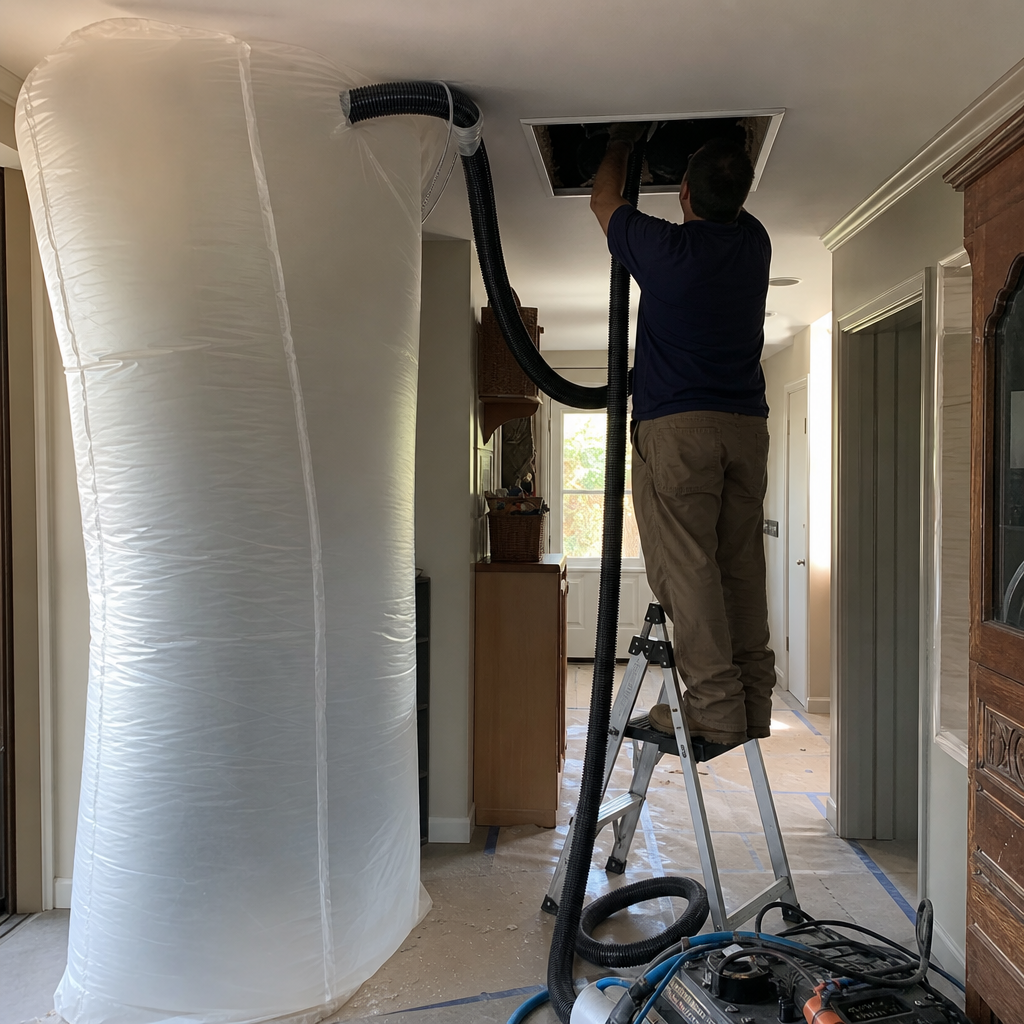
At Bellows Air Duct & Vent Co., we camera-inspect every vent before we clean and after we finish. The difference between the two recordings is your proof of work. But the initial inspection does something more important: it tells us whether you’re looking at a blockage, a damaged duct, or both. These require different solutions, and treating a damaged duct as a simple clog wastes your money and leaves the hazard in place.
What a blockage looks like on camera. Lint accumulation has a distinctive appearance: fibrous, layered, usually densest at bends or where the duct changes direction. It accumulates from the inside out, so the duct walls beneath are typically intact. A rotary brush system from Nikro or Abatement Technologies, paired with high-velocity air, removes it completely. The after-camera shows smooth metal walls with no residue.
What damage looks like on camera. Separated joints, where sections of duct have pulled apart, create lint traps that no amount of brushing will permanently fix. Crushed or kinked ductwork, often from storage in an attic or a contractor stepping on a flexible section, restricts airflow mechanically. Corrosion holes in older galvanized steel ducts let lint escape into wall cavities or attics. Rodent damage chews through flexible materials. These conditions require repair or replacement, not just cleaning.
The distinction matters for cost and for safety. A standard cleaning addresses airflow obstruction. A damaged duct can leak heated, lint-laden air into spaces where it doesn’t belong, creating fire risks even if the main passage is clear. In Los Angeles, where many homes have vent runs of 25 feet or more through attics to reach a roof termination, damage in the middle section is invisible from either end without a camera.
We show you the recording. You see what we see. Then we quote the work, upfront, before a single tool is lifted. No surprises on the bill.
Why Los Angeles Homes Face Unique Vent Risks
Climate, construction era, and density create conditions here that don’t apply uniformly elsewhere.
Mild winters mean year-round dryer use. In colder climates, line-drying is seasonal. In Los Angeles, outdoor drying is practical most months, but many homeowners still prefer the dryer for convenience and for items that need fluffing. The result is consistent, year-round lint production without the seasonal break that might otherwise slow accumulation.
Older housing stock with original vent configurations. Neighborhoods like Los Feliz, Echo Park, and parts of the San Fernando Valley have significant pre-1980 construction. These homes were built before current understanding of dryer vent dynamics, and their original vent runs are often too long, too convoluted, or terminated in now-prohibited locations. A vent that was code-compliant in 1965 is often a hazard by modern standards.
Extended vent runs through attics and crawl spaces. Los Angeles lot sizes and building patterns often push the laundry room to an interior wall, with the vent running 20 to 40 feet to reach an exterior wall or roof. Every foot adds resistance. Every bend adds lint collection points. These long runs require more frequent cleaning and are more prone to damage from foot traffic, pests, or temperature cycling in unconditioned attic spaces.
Santa Ana winds and coastal salt air. Exterior vent terminations in Los Angeles face environmental stress that inland climates don’t match. Wind-driven debris can block hood openings. Salt air corrodes metal components faster. We’ve replaced vent hoods in beach neighborhoods where the original galvanized steel lasted barely ten years against salt corrosion.
Multi-family and ADU conversions. Los Angeles has seen significant accessory dwelling unit construction and garage conversions. These often repurpose existing electrical and venting infrastructure without full evaluation. A dryer vent shared between units, or extended from a garage conversion to an original roof termination, may be operating at the edge of its capacity from day one.
Common Mistakes to Avoid
- Buying a new dryer instead of checking the vent. We see this in Los Angeles regularly. The appliance replacement costs ten to twenty times what a cleaning would, and the new dryer shows the same symptoms because the vent was the problem all along.
- Using a leaf blower or vacuum from the outside. These methods can compact lint into blockages rather than removing them, and they do nothing for the full length of the duct. Worse, they can damage separated joints you can’t see.
- Ignoring the vent because the lint trap is “always cleaned.” The trap catches roughly 60% of lint. The remaining 40% is why vents exist. Trap diligence doesn’t eliminate vent maintenance.
- Installing a screen over the exterior vent to “keep animals out.” Screens trap lint and create blockages. Proper vent hoods use flaps that close when not in use, not mesh that collects debris.
- Assuming a short vent run doesn’t need cleaning. Even a six-foot straight run accumulates lint. The frequency may differ, but the need doesn’t disappear.
- Waiting for a warning sign before acting. By the time symptoms are obvious, the vent is significantly obstructed. Preventive cleaning every 12 to 24 months, depending on household size, is the standard we recommend for Los Angeles homes.
When to Call a Professional
Call when drying times increase, when any burning smell appears, or when your vent hasn’t been inspected in two years or more. Call if you’ve never had the vent camera-inspected and your home is more than twenty years old. Call if you’re buying or selling a home and want documentation of vent condition.
Bellows Air Duct & Vent Co. offers free estimates in Los Angeles. We’ll camera-inspect your vent, show you the condition, and quote the work before we start. No bait coupons, no price changes at the door. Our 90-Day Done Right Promise means if it’s not right, we return at no charge with no paperwork required. Call (844) 685-6342 to schedule.
Frequently Asked Questions
Most standard dryer vent cleanings in Los Angeles range from $150 to $300 depending on vent length, accessibility, and whether repairs are needed. Bellows provides no-hassle upfront pricing before work begins, so the number on the phone is the number on the invoice. Call (844) 685-6342 for an exact quote, estimates are free.
For a typical Los Angeles household doing four to six loads weekly, we recommend professional cleaning every 12 to 18 months. Homes with longer vent runs, larger families, or pets that shed heavily may need service every 9 to 12 months. Annual inspection with camera verification is the safest baseline.
Homeowners can clean the lint trap and the short accessible connection hose behind the dryer. The full duct run, particularly sections through walls, attics, or to roof terminations, requires professional equipment and camera verification to ensure complete cleaning and to identify damage. We do not recommend DIY methods for the full vent system.
Yes. Any burning odor from your dryer or laundry area means stop using the appliance immediately and schedule professional inspection before running another load. Lint ignition temperature is low, and a smoldering blockage can escalate quickly. This is not a wait-and-see situation.
Year-round dryer use, longer vent runs common in Los Angeles construction, and environmental factors like Santa Ana debris and coastal salt air all contribute to faster lint accumulation and component degradation. The mild climate that makes outdoor living pleasant also eliminates the seasonal break from dryer use that colder climates provide.
Every service includes camera inspection before and after cleaning, professional-grade rotary brush and high-velocity air cleaning using equipment from Nikro and Abatement Technologies, exterior vent hood inspection, and a written report of duct condition. Most jobs are completed in a single visit by background-checked, uniformed technicians. Our 90-Day Done Right Promise covers all work in writing.
The Bottom Line
Your dryer vent gives warning signs before it gives you a fire or a failed appliance. The key is reading them correctly: hot clothes, extended drying times, weak exterior airflow, and musty odors point to blockage. Burning smells, automatic shutoffs, and non-moving vent flaps demand immediate cessation of use. Most “dying” dryers are actually suffocating dryers. A camera inspection separates cleaning from repair needs, and professional service preserves both your appliance and your safety. In Los Angeles, where housing age, climate, and construction patterns create specific vent vulnerabilities, preventive maintenance every 12 to 18 months is the square deal that keeps you from replacing equipment you don’t need to replace.
Ready to find out what your vent looks like inside? Call Bellows Air Duct & Vent Co. at (844) 685-6342 for a free estimate. We’ll camera-inspect your vent, show you the condition, and quote the work before we lift a single tool. Our 90-Day Done Right Promise means we stand behind it, no paperwork, no arguing. We’ve been serving Los Angeles homeowners since 2012, and we plan to be here when you need us next.
Written by the team at Bellows Air Duct & Vent Co., serving Los Angeles since 2012.