
Last updated July 25, 2026
How Long Does Air Quality & Sanitizing Take? Timelines and What to Expect
A UV sanitizer installation takes 45 minutes. Confirming it’s actually reducing your mold spore counts to a meaningful degree takes 30 days of monitoring - and most homeowners never do that second part. In Los Angeles, where our dry summers and coastal humidity swings create ideal conditions for biological growth in HVAC systems, we’ve seen too many families plan their lives around an incomplete timeline. This guide breaks the full process into three honest phases: what happens before treatment starts, how long the work itself takes, and the verification period that follows. You’ll know exactly what to expect and how to avoid the false confidence that comes from skipping steps.
Quick Answer
Most air quality sanitizing treatments take 2-6 hours to complete, but the full process - from professional diagnosis through verified results - spans 2-6 weeks. A localized coil sanitizing in a Los Angeles home might be a half-day job with same-day re-occupancy; a whole-system biological remediation including ductwork, coil, and air handler can require a full day of treatment plus a 30-day monitoring window before you know if it worked.
Table of Contents
- The Diagnosis Phase: What Happens Before Treatment Starts
- The Treatment Phase: How Long Different Sanitizing Jobs Take
- The Verification Phase: Why 30 Days Matters
- How Scope of Contamination Multiplies Time
- Re-Occupancy Windows: When It’s Safe to Return
- Los Angeles Climate Factors That Affect Sanitizing Timelines
- Common Mistakes to Avoid
- When to Call a Professional
- Frequently Asked Questions
- The Bottom Line
The Diagnosis Phase: What Happens Before Treatment Starts
Every legitimate sanitizing job begins with diagnosis. Skip this, and you’re treating symptoms without knowing the cause. In our 42 years serving Los Angeles homeowners, the diagnostic phase separates the contractors who solve problems from those who sell products.
A thorough professional assessment takes 1-3 hours in your home. Here’s what that looks like:
- Visual camera inspection of accessible ductwork. We run a camera through the system to document contamination type, location, and severity. Mold, bacterial slime, and dust accumulation look different on camera, and each requires a different approach.
- Coil and air handler examination. The evaporator coil is the most common biological contamination site in Los Angeles homes - our warm, humid shoulder seasons keep it wet for months. A technician needs 20-30 minutes to properly access and assess this component.
- Moisture and humidity mapping. We measure humidity at multiple points to identify where conditions support regrowth. This step is often rushed or skipped entirely by discount operators.
- Air sampling (when warranted). If occupants report respiratory symptoms or visible mold is present, we may recommend spore trap sampling or ERMI dust analysis. Lab turnaround adds 3-7 business days to the timeline. This isn’t always necessary, but when it is, rushing past it means treating blind.
Some Los Angeles homeowners call expecting same-day treatment. That happens only for the simplest, most obvious cases - a dryer vent cleaning or a single-room duct sanitizing where we’ve worked in the home before. For anything involving biological contamination, the diagnostic phase is non-negotiable. We’ve seen too many $199 “sanitizing specials” in the San Fernando Valley that consisted of a technician fogging a mystery chemical into ducts they’d never inspected. The homeowner got a 20-minute treatment and a six-month recurrence.
Diagnostic time also varies by home age and system accessibility. Pre-1970s homes in neighborhoods like Highland Park or Eagle Rock often have original ductwork in cramped crawl spaces or behind plaster. A camera inspection that takes 45 minutes in a newer Playa del Rey home might take two hours there. We build this into our scheduling, and we tell you before we start.
The Treatment Phase: How Long Different Sanitizing Jobs Take
This is where online timelines usually start and stop. The reality is more layered. Here’s how long actual treatments take, broken down by scope:
| Service Type | Typical Duration | Re-occupancy |
|---|---|---|
| Single-room duct sanitizing | 1.5-2 hours | Same day, 2-4 hour ventilation |
| Whole-system duct sanitizing (no mechanical issues) | 3-4 hours | Same day, 4-6 hour ventilation |
| Coil and drain pan sanitizing | 1.5-2.5 hours | Same day |
| Coil + whole duct system sanitizing | 4-6 hours | Same day, 6-8 hour ventilation |
| Air handler cabinet + coil + ducts | 6-8 hours | Next day recommended |
| UV-C installation (as add-on) | 45-90 minutes | Immediate |
| Moderate mold remediation (contained, <10 sq ft) | 1-2 days | 24-48 hours |
| Extensive mold remediation (HVAC-integrated) | 3-5 days | 48-72 hours |
These times assume professional-grade equipment - the Rotobrush and Nikro systems we use, or comparable units from Abatement Technologies - operated by technicians who’ve been trained on proper dwell times and application methods. A fogger from a hardware store and a bottle of consumer-grade disinfectant is not the same job. We’ve been called to Los Angeles homes where a previous “sanitizing” took 45 minutes and left chemical residue on furniture because the technician never sealed returns or warned the homeowner to vacate during treatment.
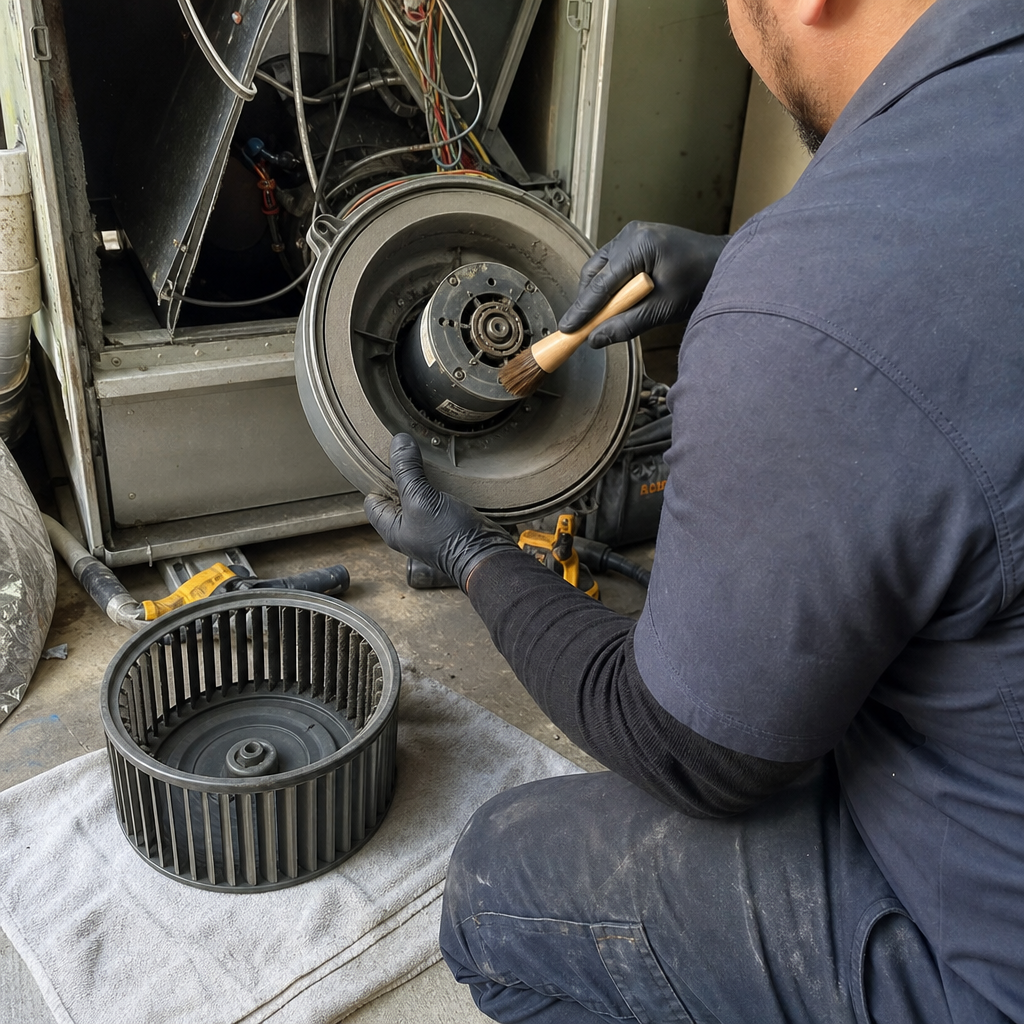
The treatment phase also includes setup and breakdown time that’s rarely mentioned: laying protective covering, sealing registers to prevent cross-contamination, setting negative air machines when required, and post-treatment HEPA vacuuming. For a whole-system job, this adds 45-60 minutes on each end. We don’t charge extra for it, but we don’t skip it either.
The Verification Phase: Why 30 Days Matters
This is the phase almost no one talks about, and it’s the one that determines whether your money was well spent.
Mold spore counts measured 48 hours after treatment almost always show improvement. The chemical is fresh, the surfaces are wet with antimicrobial, and the system hasn’t run through a full operating cycle. But this is theater, not evidence. What matters is whether the contamination stays suppressed after:
- The system has run normally through multiple cooling cycles
- Humidity has fluctuated with weather patterns
- Occupants have resumed normal activity (cooking, showering, door openings)
In Los Angeles, this means your sanitizing needs to survive our characteristic climate pattern: morning marine layer moisture giving way to afternoon dryness, sometimes with coastal fog rolling in overnight. A system treated in March, before our humid season, faces different verification conditions than one treated in August. We typically recommend a 30-day monitoring window before declaring success. For homes with ongoing moisture issues or post-remediation verification, we may extend this to 60 days.
Verification methods include:
- Visual re-inspection with camera. We return and re-run our camera through the same access points, comparing to our before-treatment footage. This takes 30-45 minutes and is included in our standard follow-up.
- Spore trap re-sampling. For homes where air sampling was performed initially, we collect post-treatment samples at 30 days. Lab analysis adds 3-5 business days.
- Humidity and moisture re-check. We verify that conditions supporting biological growth haven’t returned. This is especially critical in Los Angeles canyon homes where microclimates create pockets of persistent moisture.
Rushing this phase produces false confidence. We’ve seen homeowners in Pacific Palisades and Silver Lake celebrate a clean 48-hour test, only to find elevated counts at six weeks because an underlying drainage issue was never addressed. The 30-day window isn’t bureaucracy. It’s the minimum time required to know if the treatment actually solved the problem.
How Scope of Contamination Multiplies Time
The difference between a 2-hour job and a 2-day job isn’t always obvious from the homeowner’s perspective. Here’s how scope affects timeline in practical terms:
Localized contamination (1-2 hours)
A single return duct with surface mold, or a condensate drain pan with bacterial slime. The technician can isolate, treat, and verify in one visit. We see this commonly in Los Angeles condos and townhomes where the HVAC system is compact and the contamination hasn’t spread.
Whole-system biological contamination (4-8 hours)
When mold or bacteria have colonized the evaporator coil, migrated into supply ducts, and established in the air handler cabinet, the job becomes multi-stage. Each component requires different treatment chemistry and application method. The coil needs foaming cleaner with proper dwell time. Ducts need mechanical agitation plus antimicrobial application. The air handler needs hand-cleaning of accessible surfaces. These steps can’t be rushed without cross-contaminating clean areas with dirty ones.
HVAC-integrated mold remediation (1-5 days)
When mold has penetrated duct insulation or established in wall cavities adjacent to the system, sanitizing becomes remediation. This requires containment, negative air pressure, removal of contaminated materials, and reconstruction. Los Angeles building code requires permits for remediation exceeding 10 square feet of visible mold or any disturbance of HVAC components in multi-family buildings. We handle permit coordination, which adds 1-3 days to project start but protects your legal and financial interests.
Scope also affects equipment needs. A whole-system job in a 4,000-square-foot Hancock Park home requires more HEPA filtration capacity, longer hose runs, and potentially a second technician. We don’t send one person to do a two-person job and pretend it’s the same timeline.
Re-Occupancy Windows: When It’s Safe to Return
This question deserves straight answers, especially for households with children, elderly residents, or anyone with asthma, COPD, or immune compromise.
Most professional sanitizing treatments use EPA-registered antimicrobials with specific re-entry intervals. These range from immediate (for UV-C installations and some botanical products) to 4-6 hours (for common quaternary ammonium compounds) to 24-48 hours (for more aggressive remediation chemicals). The product label governs, and any contractor who can’t tell you the specific product and its re-entry interval is operating below professional standard.
But the label interval is a minimum. We recommend additional caution for sensitive occupants:
- Children under 5: Add 2 hours to standard re-entry time, with windows open and system running on fan-only mode for ventilation.
- Pregnant women: Same precaution, or consider temporary relocation for overnight if treatment involved extensive chemical application.
- Respiratory conditions: We coordinate with the treating physician when possible. Some Los Angeles pulmonologists we work with recommend 24-hour absence for patients with severe asthma, regardless of product label.
- Elderly with cardiovascular conditions: Ventilation is critical; these occupants are often most sensitive to volatile compounds released during initial curing.
For whole-system jobs, we typically recommend sensitive occupants plan to be out 6-8 hours, returning to ventilated space with windows open and system running. For remediation-scale work, next-day return is prudent. We tell you this during scheduling, not after treatment is complete.
We’ve also learned that Los Angeles air quality on treatment day matters. A high-Smog Alert day with stagnant air means chemical dissipation takes longer. We monitor AQI and may recommend rescheduling if outdoor conditions will trap treatment residues indoors. This is the kind of local judgment that comes from doing this work in this specific climate for four decades.
Los Angeles Climate Factors That Affect Sanitizing Timelines
Our climate isn’t subtle, and it doesn’t forgive shortcuts. Three local factors consistently extend or complicate sanitizing timelines:
Marine layer humidity (May through September, especially mornings)
Coastal Los Angeles neighborhoods - Venice, Santa Monica, Marina del Rey, San Pedro - experience humidity spikes above 70% many mornings even during our “dry” season. If your home’s dehumidification isn’t maintaining 50-55% relative humidity consistently, any sanitizing treatment is fighting uphill. We see re-contamination timelines compress from a typical 2-3 years to 8-12 months in homes where this isn’t addressed. Before we treat, we check. After we treat, we monitor.
Wildfire smoke residue (July through November, increasingly)
Since 2017, Los Angeles fire seasons have introduced a new contaminant: wildfire smoke particulate that settles in ductwork and provides a nutrient matrix for biological growth. Homes in the foothills - Altadena, La Cañada Flintridge, Topanga, Malibu - are most affected, but we’ve found smoke residue in systems across the basin. If your sanitizing follows a heavy smoke year, we may recommend pre-cleaning to remove particulate before antimicrobial treatment. This adds 2-3 hours but prevents the treatment from bonding to smoke particles rather than biological growth.
Earthquake-related duct damage
Los Angeles homes that have experienced significant seismic activity, even without visible structural damage, often have separated duct seams or cracked plenums. These create pressure imbalances that pull attic or crawl space contaminants into the system. We inspect for this during diagnosis; repairs add time upfront but prevent immediate re-contamination. In older neighborhoods like Los Feliz or Mount Washington, with homes on hillsides and original ductwork, this is a common finding.
Climate-aware contractors adjust timelines and methods. Contractors working from generic playbooks don’t.
Common Mistakes to Avoid
- Accepting a phone quote without inspection. In Los Angeles, we’ve seen $149 “whole house sanitizing” offers that turn into $1,200 upsells at the door - or worse, a 30-minute fogging that accomplishes nothing. No honest timeline can be given without seeing the system.
- Treating without fixing the moisture source. A leaking condensate line or humidifier set too high will re-contaminate treated surfaces in weeks. We won’t sanitize without addressing this; contractors who do are selling you a recurring revenue stream for themselves.
- Skipping the 30-day verification. The homeowner who demands immediate proof of improvement gets a 48-hour test that means little. Insist on the longer monitoring window, or you’re paying for performance theater.
- Confusing deodorizing with sanitizing. Many Los Angeles “air quality” services pump fragrance into ducts and call it done. Real sanitizing reduces biological load; it doesn’t mask it. Ask for before-and-after camera footage, not just a smell test.
- Ignoring re-occupancy requirements for sensitive household members. We’ve been called to homes where a child with asthma had a reaction because the family returned too early. The product label is the floor, not the ceiling, for vulnerable occupants.
- Scheduling treatment during high-humidity periods without dehumidification plan. In Los Angeles, treating in August without ensuring the home can maintain 55% RH afterward is planning for recurrence. We coordinate with your HVAC settings or recommend portable dehumidification.
- Choosing speed over thoroughness for mold-integrated systems. A contractor who promises same-day completion for a job that should take two days is cutting containment, dwell time, or verification. We’ve rebuilt containment barriers in Los Angeles homes where previous contractors “saved time” by skipping them.
When to Call a Professional
Call when you smell mustiness from vents, see visible growth near registers, or when household members experience unexplained respiratory symptoms that improve away from home. Call when you’ve had water intrusion, a roof leak, or a condensate overflow - even if surfaces look dry, biological growth may be established in hidden areas. Call when a previous sanitizing didn’t last, because that usually means the underlying condition was never diagnosed.
Don’t call for a chemical treatment if you haven’t had a camera inspection. Don’t call a company that won’t show you what they found before they treat it. And don’t call anyone who gives you a firm price and timeline without seeing your system - they’re either guessing or planning to change both at your door.
Bellows Air Duct & Vent Co. offers free estimates in Los Angeles. We’ll inspect your system with a camera, explain what we find, and give you an honest timeline before any work begins. Call (844) 685-6342. Calls are answered by a live person, 24 hours a day.
Frequently Asked Questions
The treatment itself takes 2-6 hours for most homes, but the full process from diagnosis through verified results spans 2-6 weeks. A single-room duct sanitizing might be completed same-day with 2-4 hours of ventilation, while a whole-system biological remediation requires a full day of treatment plus a 30-day monitoring window to confirm results. Call (844) 685-6342 for a free estimate and honest timeline based on your specific system.
No, occupants should leave during chemical application and remain out for the re-entry interval specified on the product label, typically 2-6 hours for standard treatments. Sensitive individuals - children, elderly, pregnant women, or those with respiratory conditions - should plan for longer absence, sometimes until the following day for extensive remediation. We discuss your household’s specific needs during scheduling and never treat with vulnerable occupants present.
Same-day “results” measure chemical residue, not biological reduction. A 48-hour test shows temporary suppression; a 30-day monitoring window shows whether the treatment actually solved the problem under normal operating conditions. Companies promising immediate verification are either uninformed or selling convenience over accuracy. We’ve tracked too many Los Angeles homes where “immediate results” turned into recurrence at 60 days.
Yes, particularly in coastal neighborhoods where morning marine layer humidity exceeds 70% even in summer. High humidity extends chemical dwell times needed for effectiveness and accelerates re-contamination if dehumidification isn’t maintained. Homes in Santa Monica, Venice, or San Pedro may need additional moisture control measures built into the treatment plan, adding 30-60 minutes to setup but preventing recurrence.
For accessible, non-porous metal ductwork with surface contamination, sanitizing is typically 60-75% less expensive than replacement. For fiberglass-lined ducts with embedded mold, or flexible duct with internal growth, replacement is often more cost-effective than repeated sanitizing attempts. We show you camera footage of your specific duct type and contamination depth before recommending either approach - no scare tactics, no automatic upsells. Ask about our $50 Off Any Repair Over $250 if replacement is needed.
Request before-and-after camera footage, not just a verbal report. Verify that post-treatment monitoring occurred at 30 days or longer, not 48 hours. Check whether the contractor addressed moisture sources and humidity control, not just applied chemical. If these elements are missing, you likely received incomplete treatment. Air duct cleaning and sanitizing should always include visual documentation; we provide this on every job.
The Bottom Line
Air quality sanitizing timelines that stop at “treatment takes 2-4 hours” are selling you half the story. The honest timeline has three phases: diagnosis that reveals what you’re actually treating, treatment matched to scope, and verification that confirms the problem stayed solved. In Los Angeles, our climate demands additional attention to humidity control and seasonal conditions that affect both treatment effectiveness and recurrence risk. Rushing any phase - especially the 30-day verification - wastes money and invites repeat problems. The contractors who tell you this upfront are the ones worth hiring.
Ready for an honest assessment? Call Bellows Air Duct & Vent Co. at (844) 685-6342 for a free estimate in Los Angeles. We’ll inspect your system with a camera, explain what we find, and give you a timeline that accounts for all three phases - diagnosis, treatment, and verification. Most jobs are completed in a single visit by background-checked, uniformed technicians. Our 90-Day Done Right Promise means if it’s not right, we return at no charge with no paperwork required. A square deal: one honest price, shown before we start.
Written by the team at Bellows Air Duct & Vent Co., serving Los Angeles since 2012.