
How to Improve Indoor Air Quality in Bell, CA - Start With What’s Already Inside Your Ducts
The most effective way to improve indoor air quality in Bell is to remove accumulated contaminants from your ductwork first, then upgrade filtration. Opening windows or installing better filters without cleaning existing ducts simply cycles new air through old pollution. In Bell’s specific conditions near the I-710 corridor, this sequence matters more than in almost any other LA Basin community. Call Bellows Air Duct & Vent Co. at (844) 685-6342 for a camera-inspected assessment and upfront pricing before any work begins.
Why Standard Advice Fails in Bell
Most indoor air quality guides assume the outdoor air you’re diluting with is reasonably clean. In Bell, it isn’t - and that one assumption breaks most of the advice.
We see this on calls throughout the 90706 and 90707 ZIP codes. Homeowners have followed the standard playbook: cracked windows morning and evening, upgraded to MERV-13 filters, maybe added a portable HEPA unit in the bedroom. They’re still waking up congested. Still dusting twice a week. Still smelling that faint, persistent metallic note when the AC kicks on.
The problem isn’t the advice itself. It’s that Bell sits in a pollution geography almost no generic guide accounts for. The I-710 Long Beach Freeway cuts through the city carrying diesel freight to and from the Ports of LA and Long Beach. Adjacent Vernon, California’s most intensively industrialized city, pumps industrial fallout across the property line. Bell’s position deep in the LA Basin, without coastal airflow relief, traps these emissions at ground level - particularly on weekday mornings when truck traffic peaks and a thermal inversion holds everything down.
Opening windows during those peak hours doesn’t dilute indoor pollution. It imports fresh diesel ultrafines and combustion byproducts directly into your living space. A HEPA filter at the return grille can’t intercept what lands on duct surfaces upstream of the filter. Once those ultrafines bond to sheet-metal duct interiors, they become part of your mechanical system, re-aerosolizing with every cycle.
Ray Castillo, who founded Bellows in 1984 after working his way through crawl spaces across southeast LA, put it plainly on a recent call in the area near Bell Park: “We will take a look at what is actually there, and then we will tell you what we found.” That approach matters here because what’s actually there in Bell ducts is visually and texturally different from what we pull in cleaner LA Basin communities.
What Bell Technicians Actually Find in Local Ductwork
Our technicians working Bell homes regularly pull debris with a distinctly dark, oily character - a signature mix of diesel exhaust ultrafines from I-710 and industrial fallout from neighboring Vernon. This isn’t the pale dust-and-allergen buildup common in communities farther from the freight corridor. It’s heavier, more adherent, and it behaves differently in your system.
This contamination bonds to sheet-metal surfaces in a way that passive airflow cannot dislodge. Standard residential filtration, even high-end media filters, operates downstream of the problem once the ductwork itself is coated. The filter cleans the air passing through it, but every foot of contaminated duct downstream re-exposes that air before it reaches your vents.
Bell’s housing stock compounds the issue. The city is dominated by post-WWII bungalows and small multi-unit buildings constructed between the 1940s and 1960s. Many still retain original sheet-metal duct runs that were never designed for modern filtration loads. These decades-old systems have accumulated layered buildup that off-the-shelf air quality products simply cannot reach. Pre-1980 insulated ductwork in these homes may also incorporate asbestos-containing duct wrap or duct board, requiring trained technicians to identify and handle these materials appropriately before any cleaning begins.
HVAC systems in these homes run long cooling cycles for much of the year, pulling degraded outdoor air through ducts that act as reservoirs for everything the LA Basin traps at ground level. The result is a system that actively works against any surface-level air quality fix.
The Load-Sequencing Principle: Why Order of Operations Matters
We never recommend filtration upgrades without first establishing a clean duct baseline. This isn’t upselling - it’s physics.
A dirty duct system re-contaminates clean air on every cycle. Install a premium Aprilaire media filter or Honeywell whole-home air purifier on a contaminated system, and you’ve spent money to push filtered air through polluted passages. The improvement will be partial, temporary, and frustrating.
The correct sequence for Bell homes is:
- Inspect first: Camera inspection of the full duct run to document existing contamination type, depth, and location - before any cleaning claim is made
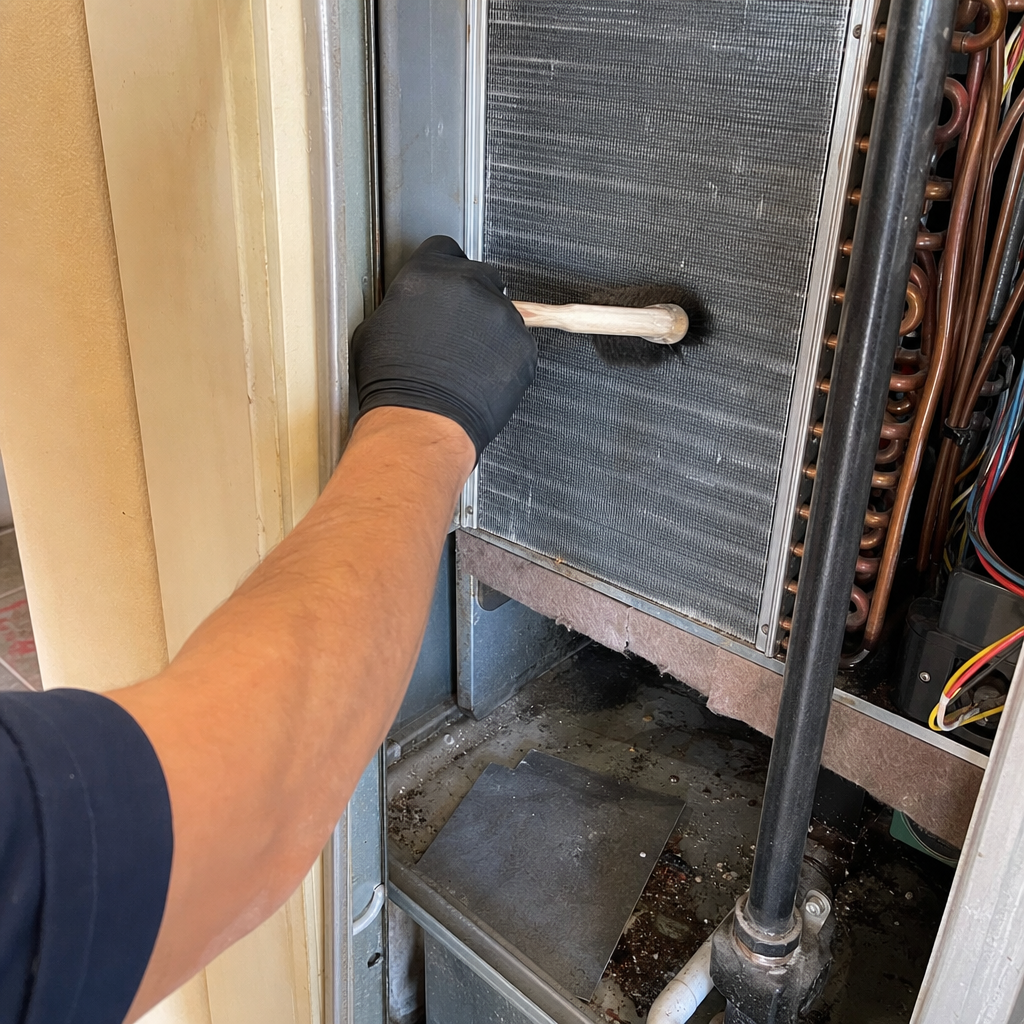
- Clean mechanically: Professional-grade agitation and extraction using Rotobrush and Abatement Technologies equipment to remove bonded ultrafines and industrial particulates from sheet-metal surfaces
- Verify: Post-cleaning camera inspection showing the same duct sections after treatment, giving homeowners a factual visual record
- Upgrade filtration: Only after establishing a clean baseline, install appropriate media filtration or air purification sized to the home’s actual mechanical load
This sequencing protects your investment in filtration equipment and delivers measurable results rather than incremental improvement. Our Air Quality & Sanitizing in Bell service follows this protocol on every job.
What Homeowners Can Check Themselves - And When to Call
There are legitimate first steps a homeowner can take, provided they understand Bell’s specific limitations.
Check your current filter’s condition and MERV rating. A clogged filter restricts airflow and can actually worsen indoor conditions by forcing the system to work harder and cycle longer. Replace it if it’s gray or airflow is visibly reduced. However, understand that no residential filter rating stops ultrafines once they’ve bonded to duct interiors upstream.
Monitor your window timing. If you’re going to ventilate, do so on weekend mornings when I-710 truck volume drops significantly, or during Santa Ana wind events that temporarily clear the basin. Avoid weekday 6-10 AM peak freight hours entirely.
Look for visible dust accumulation at vent registers. Heavy, dark buildup - especially with an oily residue - suggests the contamination type we describe above, not ordinary household dust. Pale, fluffy accumulation is more typical of standard allergen load.
These checks help you understand your situation. They don’t solve a contaminated duct system. Mechanical agitation of decades-old sheet-metal runs requires professional equipment and technician training. For homes with pre-1980 duct insulation, safe handling protocols are non-negotiable.
When you’re ready for an assessment, Bellows provides camera-inspected evaluations with upfront pricing disclosed before any tool is lifted. Our home page outlines our full service range, or call directly to discuss your specific situation.
What Professional Duct Cleaning Costs in Bell
Pricing varies with system size, accessibility, and contamination level, but Bell homeowners should expect the following ranges for legitimate professional work:
| Service | Typical Range |
|---|---|
| Standard residential duct cleaning (single system, up to 12 vents) | $400 - $650 |
| Heavy contamination / industrial particulate loading | $550 - $850 |
| Dryer vent cleaning (recommended concurrent service) | $120 - $180 |
| Camera inspection with documentation | Included with cleaning |
| Duct repair or sealing (as needed post-cleaning) | $200 - $500 per section |
Be wary of offers below these ranges. Discount bait-and-switch operators frequently quote low to enter the home, then discover “unexpected” conditions requiring substantial add-ons. Bellows’ no-hassle upfront pricing means the number discussed on the phone is the number on the invoice. We also offer a Free Second Opinion on Any Written Estimate if you’ve received a quote that doesn’t feel right.
Our $89 Seasonal Tune-Up includes filter replacement and system inspection, a useful maintenance option for homeowners who’ve already completed full duct cleaning. The permanent 5% Senior and Veteran discount applies to all services.
Common Local Scenarios We See in Bell
Over 42 years in this trade, certain patterns repeat in specific geographies. Bell presents a distinct profile.
The multi-generational bungalow: Original 1950s sheet-metal runs, perhaps with one partial retrofit in the 1980s. Decades of layered buildup including the dark, oily contamination our technicians recognize immediately. Often the homeowner has lived there 20+ years and never had ducts cleaned, or had a discount service that agitated without extracting, leaving material more deeply embedded. Camera inspection reveals the actual condition; mechanical cleaning with proper extraction establishes the baseline filtration upgrades need.
The recent filtration upgrade that underperformed: Homeowner invested in a premium media filter or portable HEPA units, saw modest improvement for 2-3 weeks, then returned to baseline symptoms. The filter was doing its job at the return; the ducts were doing theirs downstream. Re-contamination on every cycle. These are frustrating calls because the homeowner spent money in good faith on partial information. We clean first, then assess whether the existing filtration is appropriately sized or needs adjustment.
The window-ventilation worsening: Retired homeowner following standard advice, opening windows early morning for “fresh air.” Symptoms increase rather than decrease. I-710 peak freight hours, thermal inversion, and the home’s position relative to the freeway all contribute. We don’t tell people to seal themselves in - we explain the timing and the mechanical alternative. Clean ducts with proper filtration deliver controlled, conditioned air without importing diesel ultrafines.
The rental unit with unknown history: Small multi-unit building from the 1960s, multiple tenants over decades, no documented duct maintenance. New owner or long-term tenant experiencing persistent air quality issues. Pre-1980 duct wrap requires identification before cleaning. Camera inspection is essential here - both for contamination assessment and material safety.
Our Process: What to Expect
Every Bellows job in Bell follows the same protocol we’ve refined since 1984.
A live person answers your call, 24 hours a day. No voicemail, no app. We’ll schedule at a time that works, and we’ll be there when we say.
Your technician arrives in uniform, background-checked, with professional-grade equipment from Rotobrush, Nikro, Abatement Technologies, and Honeywell. We camera-inspect before touching anything. You see what we see. The before image gives you a factual baseline, not a sales assumption.
We present upfront pricing before lifting a single tool. The number you hear is the number on the invoice. No bait coupons, no price changes at the door.
Most jobs complete in a single visit. We camera-inspect after cleaning. You see the result. The 90-Day Done Right Promise applies automatically - if anything’s not right, we return at no charge with no paperwork required. We stand behind it because we’ve stood behind it for over four decades.
Ray’s daughter handles scheduling now, which he says is the only upgrade the business has ever truly needed. Everything else - the camera verification, the upfront pricing, the written guarantee - has been standard since before most competitors existed.
FAQs
Yes - opening windows during weekday morning peak hours along the I-710 corridor imports diesel ultrafines and industrial combustion byproducts that residential filtration cannot remove once they bond to interior duct surfaces. Weekend mornings and Santa Ana wind events offer safer ventilation windows. If you’re experiencing persistent air quality symptoms despite regular window ventilation, call Bellows at (844) 685-6342 for a camera-inspected duct assessment - estimates are free, and we’ll show you exactly what’s circulating through your system.
No - installing premium filtration on contaminated ductwork wastes money because the ducts re-contaminate filtered air on every cycle. The correct sequence is clean first, then upgrade. We’ve seen homeowners in Bell install Aprilaire media filters and Honeywell air purifiers, then call us six weeks later when symptoms returned. The filter was working; the ducts weren’t. For a proper evaluation of your system’s condition, contact Bellows - we include camera inspection with every cleaning, so you’ll see the before-and-after for yourself.
Given Bell’s proximity to the I-710 freight corridor and adjacent industrial activity, we recommend inspection every 2-3 years and cleaning every 3-5 years for typical residential systems - more frequently for homes with respiratory sensitivities or visible dark, oily vent buildup. The distinctive contamination profile here accelerates accumulation compared to cleaner LA Basin communities. Our $89 Seasonal Tune-Up helps maintain systems between cleanings. Call (844) 685-6342 to schedule an inspection and discuss an appropriate maintenance interval for your specific home.
Professional cleaning is safe when technicians properly identify and handle pre-1980 asbestos-containing duct wrap or duct board before agitation begins - this is standard protocol for Bellows technicians working Bell’s post-WWII bungalow stock. We inspect for these materials during our initial camera survey and follow appropriate handling procedures. Do not attempt DIY duct disturbance in homes built before 1980 without professional assessment. For a safe, documented evaluation of your specific system, call Bellows at (844) 685-6342 - we’ll show you what we’re working with before any work begins.
When You’re Ready for a Square Deal
If you’d rather have it looked at, Bellows Air Duct & Vent Co. offers a no-pressure assessment in Bell - call (844) 685-6342. We’ll camera-inspect, show you what’s actually there, and give you one honest price before any work starts. Done right, and backed in writing for 90 days.
Written by Ray Castillo, Owner, Bellows Air Duct & Vent Co. at Bellows Air Duct & Vent Co., serving Bell, CA.