
Last updated July 25, 2026
The Complete Duct Repair & Sealing Guide for Los Angeles Homeowners
An LA attic in August can reach 150°F. Duct tape - the actual hardware-store kind - fails at around 140°F. That’s not a repair. That’s a placeholder. Los Angeles homeowners who’ve lived through enough summers know the signs: rooms that never cool evenly, utility bills that climb without explanation, dust that reappears hours after cleaning. What fewer people understand is why ductwork fails so persistently here. This guide explains how seismic movement, extreme thermal cycling, and our extended cooling season conspire against your ducts, and what actually works to fix them for good.
Quick Answer
Proper duct repair and sealing in Los Angeles requires materials rated for extreme attic heat (mastic sealant or foil-backed metal tape, never standard duct tape), a pre-repair leakage test to locate all failure points, and repair methods that account for ongoing seismic stress and thermal expansion. Aerosol-based duct sealing (Aeroseal) works well for inaccessible leaks, while accessible connections need mechanical reinforcement plus sealant. Expect to pay $1,200-$3,500 for whole-system sealing, with ROI typically under three years given LA’s eight-month cooling season.
Table of Contents
- Why Ducts Fail Faster in Los Angeles Than Elsewhere
- The Signs Your Ducts Need Attention
- Testing Before Repair: The Duct Blaster and Blower Door
- Repair Methods Compared: Mastic, Metal Tape, and Aeroseal
- The LA-Specific Repair Approach: What Holds Up Here
- The Energy Loss Math: What Leaky Ducts Cost in LA
- Common Mistakes to Avoid
- When to Call a Professional
- Frequently Asked Questions
Why Ducts Fail Faster in Los Angeles Than Elsewhere
Most ductwork nationwide fails from age and corrosion. In Los Angeles, those factors share blame with two regional forces that compound each other: thermal cycling and seismic movement.
Thermal cycling is the repeated expansion and contraction of materials as temperatures swing. A duct run in a San Fernando Valley attic might start a January morning at 45°F and hit 150°F by 3 PM in August. That 105-degree daily range, repeated thousands of times per year, fatigues every connection point. Sheet metal expands roughly 1/16 inch per 10 feet per 100°F change. Over a 30-foot trunk line, that’s nearly 3/16 inch of movement daily. The adhesive on standard duct tape shears under that stress. Mastic without fabric reinforcement cracks. Only materials engineered for thermal movement survive.
Seismic movement adds a second, slower stress. Los Angeles sits on multiple fault systems, and even minor tremors - the 2.5-magnitude events most residents sleep through - transmit vibration through a house’s frame. Flexible duct connections in crawlspaces and attics absorb some movement, but rigid trunk lines and metal collar connections don’t. Over years, this micro-movement loosens screws, separates sleeve joints, and pulls tape away from seams. We’ve inspected ducts in Pasadena homes where connections looked intact until pressure-tested, then leaked 25% of conditioned air into the attic. The visible seam appeared fine; the seal had failed internally.
These forces don’t operate in isolation. Thermal cycling weakens a connection, then seismic movement finishes the separation. A repair that addresses only one stressor - sealing a joint without mechanical reinforcement, for instance - ignores the ongoing environment that caused the failure.
Local building codes have adapted partially. The Los Angeles Department of Building and Safety requires duct sealing in new construction to meet Title 24 energy standards, but existing homes, particularly those built before 1990, operate under no such requirement. Most LA County homes we encounter were built with unsealed ductwork, relying on friction fit and gravity to hold connections. That was never adequate. After four decades of thermal and seismic stress, it’s a system held together by habit.
The Signs Your Ducts Need Attention
Some indicators are obvious. Others masquerade as normal for an older Los Angeles home.
- Uneven cooling. The bedroom over the garage hits 78°F while the living room holds 72°F. This often means a branch duct has separated or a damper has failed.
- Dust accumulation that outpaces cleaning. If you’re dusting twice weekly and still seeing film on surfaces, your return ducts may be pulling attic air through leaks.
- Utility bills rising faster than rate increases. SCE and LADWP rates climb, but not 15-20% annually. A spike usually means your system is working harder to compensate for lost air.
- Musty or chemical odors when the AC runs. Leaky return ducts in crawlspaces draw in rodent droppings, soil gases, or old insulation particles.
- Excessive attic insulation dusting. If your attic insulation looks like it’s been lightly snowed on with gray particles, your supply ducts are blowing conditioned air - and filter-trapped debris - into the attic space.
In our experience across Los Angeles neighborhoods from Silver Lake to Torrance, the most telling sign is the one homeowners normalize: “It always takes a while to cool down.” A properly sealed duct system delivers full airflow to registers within minutes of startup. If your system runs 45 minutes to drop two degrees, leakage is the likely culprit, not unit size.
Testing Before Repair: The Duct Blaster and Blower Door
We don’t guess where ducts leak. We measure. Any legitimate duct repair in Los Angeles should start with quantified testing, and end with verification that the repair worked.
The Duct Blaster test pressurizes the duct system independently of the house. A calibrated fan connects to a return grille or the air handler, and all supply and return registers are temporarily sealed. The fan runs at a standard pressure (25 Pascals), and the airflow required to maintain that pressure reveals total leakage. A 2,000-square-foot home with a 3-ton system should show less than 10% leakage to outdoors. We routinely measure 25-40% in unsealed Los Angeles homes.
The test also locates leaks. With the system pressurized, a technician can feel airflow escaping at seams, use a smoke pencil to visualize leak paths, or deploy an infrared camera to spot temperature anomalies. This matters because not all leaks are equal. A 1-inch gap in a return duct in a crawlspace pulls in contaminated air. A similar gap in a supply duct in an attic wastes energy but doesn’t affect air quality. The repair priority differs.
The Blower Door test measures whole-house airtightness, which contextualizes duct leakage. A house that’s extremely leaky to outdoors will see less pressure differential driving duct leakage, but will have other energy problems. A tight house with leaky ducts faces amplified consequences - there’s no unintended airflow to compensate.
Post-repair, we rerun the same tests. Our standard is leakage reduction to under 10% of system airflow, documented with before-and-after numbers. Without this verification, a homeowner has no proof the work succeeded. We’ve been called to homes in the Hollywood Hills where a previous contractor “sealed” ducts with a visual inspection only, and leakage remained essentially unchanged. Camera inspection before and after every job prevents this. We show you what we found, and we show you what changed.
Repair Methods Compared: Mastic, Metal Tape, and Aeroseal
Not all sealing methods survive Los Angeles conditions. Here’s how the primary options compare, with specific applications for each.
| Method | Best For | LA Durability | Typical Cost Range |
|---|---|---|---|
| Mastic sealant (brush-applied) | Accessible seams, collar connections, trunk lines | Excellent when reinforced with mesh | $150-$400 per repair zone |
| Foil-backed metal tape (UL 181A-P) | Small gaps, temporary reinforcement, tight spaces | Good; must be pressed firmly to activate adhesive | $50-$150 per application |
| Aerosol-based duct sealing (Aeroseal) | Inaccessible leaks, whole-system sealing, finished spaces | Excellent; seals from inside, no attic access needed | $1,500-$3,500 whole system |
Mastic sealant is a thick, paste-like compound that remains flexible after curing. Applied with a brush or glove over seams and connections, it fills irregular gaps and adheres to metal, fiberglass, and flexible duct. For Los Angeles attics, we specify high-temperature mastic rated to 200°F, and we embed fiberglass mesh tape in the application for structural reinforcement. The mesh prevents the cracking that pure mastic suffers under thermal cycling. A proper mastic seal is ugly - it’s gooped on thick, not painted thin - and it lasts 20+ years.
Foil-backed metal tape (not “duct tape,” which is cloth-backed and fails) uses an acrylic adhesive on aluminum foil. UL 181A-P rated tape is code-compliant for flexible duct connections. It works for small, accessible repairs and as a temporary measure, but we don’t rely on it as a primary seal in high-heat locations. The adhesive can soften in sustained 150°F+ conditions. We use it to reinforce mastic applications or for quick fixes in moderate-temperature crawlspaces.
Aeroseal is a proprietary aerosol process that seals leaks from inside the duct system. The ductwork is pressurized with airborne sealant particles, which deposit at leak edges and build up to close gaps up to 5/8 inch. For Los Angeles homes with ducts buried in walls or ceilings - common in mid-century construction around the San Gabriel Valley - Aeroseal reaches leaks no other method can access. The process takes 4-6 hours, requires temporary evacuation of the house, and reduces leakage by 80-90% on average. It’s the most expensive option but often the only viable one for finished homes.
We specify Honeywell and Aprilaire air quality components when sealing integrates with filtration upgrades, and Abatement Technologies containment systems for jobs requiring isolation of work zones. Equipment quality matters as much as technique.
The LA-Specific Repair Approach: What Holds Up Here
Our repair protocol for Los Angeles homes differs from what we’d recommend in Portland or Phoenix. Here’s the sequence we’ve developed over 42 years.
- Pressure-test first. Establish baseline leakage with a duct blaster. Document with photos and video.
- Map the thermal environment. Measure attic temperatures at multiple points and times of day. A west-facing attic in Woodland Hills runs hotter than a shaded crawlspace in Los Feliz. Material selection follows.
- Mechanically secure before sealing. Every connection gets screws or draw bands tightened, not just sealant over a loose joint. Seismic movement will defeat any seal on a moving joint.
- Apply high-temp mastic with mesh reinforcement. Two coats on all metal-to-metal joints, 1/8 inch minimum thickness. No thin spots.
- Strap and support flexible duct. Sagging flex duct kinks and tears at connections. We support every 4 feet maximum with proper strapping, per ACCA standards.
- Insulate repaired sections. Exposed ductwork in attics needs R-6 minimum insulation, R-8 preferred. A perfectly sealed hot duct still loses energy through conduction.
- Pressure-test after repair. Verify leakage reduction. Our standard: under 10% of system airflow, or 90% reduction from baseline, whichever is stricter.
- Camera document. Before-and-after video for the homeowner’s records. No claim without proof.
In neighborhoods with known seismic vulnerability - the soft soil zones of the Westside, the hillside areas of the Hollywood Hills - we add flexible connectors at rigid trunk transitions. These accordion-style metal sleeves absorb differential movement between house frame and ductwork. They’re standard in commercial construction in LA but rarely seen in residential. We’ve found they prevent the recurrence of leaks at the most common failure point: where a rigid trunk line meets a flexible branch.
For homes with original ductwork from the 1960s-1980s, we also assess material degradation. Asbestos duct tape, common in pre-1980 construction, requires abatement protocol if disturbed. Galvanized steel from that era may be nearing the end of its service life, with rust-through in humid crawlspaces. Repairing a failing material is false economy. We tell homeowners when replacement makes more sense than sealing.
The Energy Loss Math: What Leaky Ducts Cost in LA
Every guide mentions that leaky ducts waste energy. Few quantify what that means specifically for Los Angeles’s climate and utility rates.
A typical 2,000-square-foot Los Angeles home with a 3-ton AC system moves roughly 1,200 cubic feet per minute of conditioned air. At 25% duct leakage - common in unsealed systems - 300 CFM never reaches the living space. The system runs longer to compensate, and the homeowner pays for cooling that disappears into the attic.
Here’s the LA-specific calculation:
- LA’s cooling season runs roughly May through October, with heavy use June-September. Call it 1,200 cooling hours annually at design load.
- A 3-ton system draws approximately 3.5 kW while running.
- At 25% leakage, runtime extends roughly 20% to meet thermostat setpoint (the relationship isn’t 1:1 due to reduced efficiency at part load).
- Extra annual consumption: 1,200 hours × 3.5 kW × 20% = 840 kWh.
- At LADWP’s Tier 2 rate of roughly $0.28/kWh (2024, typical for heavy summer users): $235/year in direct waste.
- Add heating season waste for gas furnaces: roughly $80-$120/year for typical LA winter usage.
That’s $315-$355 annually for a 25% leak rate. At 40% leakage, which we measure regularly in older homes, the waste approaches $500/year. A $2,000 whole-system sealing job pays for itself in 4-6 years on energy alone.
But energy isn’t the full cost. The extended runtime accelerates equipment wear. A compressor designed for 15,000 hours of life reaches that threshold years sooner. Replacement of a central AC in Los Angeles runs $5,000-$8,000. Sealing ducts is preventive maintenance against that capital expense.
There’s also the comfort cost that’s harder to price but real: the bedroom that never cools, the guest room that’s unusable in August, the constant thermostat adjustment. Los Angeles home prices being what they are, every room should function as designed.
Common Mistakes to Avoid
- Using hardware-store duct tape. The cloth-backed adhesive fails at 140°F, which an LA attic exceeds regularly. It’s a temporary patch at best, and often makes proper repair harder by leaving residue.
- Sealing without pressure-testing. You can’t fix what you haven’t measured. Visual inspection misses 80% of leakage paths in typical duct systems.
- Ignoring return-side leaks. Supply leaks waste energy; return leaks pull in contaminated air from attics and crawlspaces. Both matter, but return leaks affect health directly.
- Sealing around degraded ductwork. Rusted metal, brittle flexible duct, or asbestos-containing materials need replacement, not sealing. Sealing failing material is money thrown away.
- Neglecting insulation after sealing. A perfectly airtight duct still loses 30-40% of energy through uninsulated walls in a 150°F attic. Seal and insulate, or you’ve done half the job.
- Expecting one repair to last forever without maintenance. Seismic movement continues. We recommend pressure-testing every 5 years in LA, or after any significant earthquake.
When to Call a Professional
Some duct issues are accessible to handy homeowners. Replacing a visible, accessible flex duct run with proper materials is within reach of many. But several scenarios warrant professional assessment:
Pressure-testing requires specialized equipment and interpretation. Sealing in hot attics demands heat-rated materials most homeowners don’t stock. Any work involving asbestos duct tape, gas furnace venting proximity, or electrical wiring near ductwork carries safety risks. And whole-system sealing - the approach that yields real energy savings - is a multi-hour job with quality verification that can’t be eyeballed.
If your home is over 25 years old, has never had duct testing, or shows multiple signs from the list above, a professional evaluation is the right starting point. Bellows Air Duct & Vent Co. offers free estimates in Los Angeles. We’ll pressure-test your system, show you camera footage of what we find, and quote upfront before any work begins. Call (844) 685-6342 to schedule. We also honor any competitor’s written estimate with a free second opinion, and offer $50 off any repair over $250.
Frequently Asked Questions
Whole-system duct sealing in Los Angeles typically ranges from $1,200 for accessible systems with moderate leakage to $3,500 for complex layouts requiring Aeroseal or extensive mechanical repair. Single-zone repairs with mastic run $150-$400. Call (844) 685-6342 for a free estimate with upfront pricing - the number we quote is the number on the invoice.
Accessible flex duct connections can be resealed by a capable homeowner using UL 181A-P foil tape and proper mastic, but pressure-testing to verify results requires professional equipment. For whole-system sealing, attic work in extreme heat, or any system with asbestos materials, hire a professional. The safety risks and complexity exceed typical DIY scope.
Most residential duct sealing jobs are completed in a single visit of 4-6 hours. Aeroseal applications take longer due to setup and cure time. We schedule with a two-hour arrival window and call when en route - we’ll be there when we say.
Yes, measurably. A typical Los Angeles home with 25% duct leakage wastes $315-$355 annually in heating and cooling costs. Sealing to under 10% leakage recovers most of that. In homes with 40%+ leakage, annual savings can exceed $500. The payback period is typically 3-6 years, faster if your system was significantly oversized to compensate for leakage.
Los Angeles combines the longest cooling season of any major US city with extreme attic temperature swings and ongoing seismic movement. Thermal cycling fatigues connections faster than in moderate climates, and minor earthquakes loosen joints over time. A repair that ignores these stresses fails prematurely. Our sealing methods are specified for these conditions.
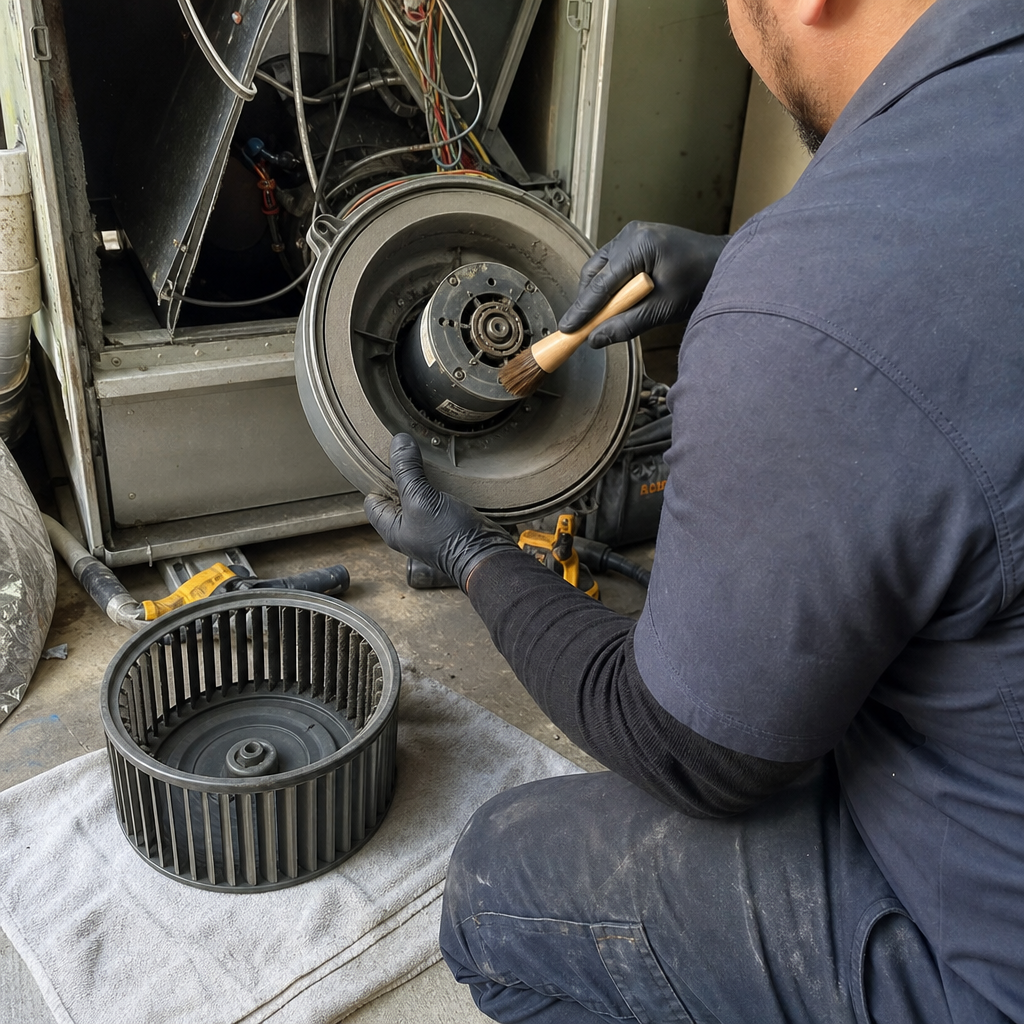
Duct cleaning removes accumulated debris, dust, and biological growth from interior surfaces. Duct sealing closes leaks in the duct walls that allow air to escape or contaminants to enter. They’re complementary services - cleaning without sealing leaves the pathway for recontamination open, and sealing dirty ducts traps debris inside. Air duct cleaning and sealing together address both problems. We also provide dryer vent cleaning and HVAC cleaning for complete system maintenance.
The Bottom Line
Los Angeles ductwork operates in one of the nation’s harshest environments for longevity: extreme heat, dramatic temperature swings, and constant seismic stress. Repairs that work elsewhere often fail here. The path to lasting performance is quantified testing, materials rated for actual attic conditions, mechanical reinforcement against movement, and verification that the work succeeded. Anything less is a placeholder - and this city has too many placeholders already. Done right, duct sealing pays for itself in under six years, delivers every room’s worth of comfort, and protects your HVAC investment for the long haul.
Written by the team at Bellows Air Duct & Vent Co., serving Los Angeles since 2012.