
Last updated July 25, 2026
DIY vs Professional Air Duct Cleaning: What’s Safe to Do Yourself
A shop vac and a dryer brush can clean the first 12 inches of a register opening. But the average residential duct run in Los Angeles is 25 feet long, and contamination concentrates at bends, plenums, and the trunk line - not at the grille where your arm stops. We’ve been in this trade since 1984, and we’ve seen the aftermath of well-meaning homeowners who bought a $40 duct cleaning kit online, pushed it until it got stuck, and ended up with a punctured flex duct and a bill for repairs that cost more than professional cleaning would have. This guide draws an honest line between what you can safely handle yourself and what requires equipment, training, and verification that isn’t available at the hardware store.
Quick Answer
Homeowners can safely clean register grilles, replace filters, inspect return vents, and run a phone camera into accessible duct openings. A thorough duct cleaning that removes accumulated debris from the full length of the system requires professional negative-pressure equipment, rotary brush systems with proper reach, and camera verification. In Los Angeles, where older homes often have original galvanized ductwork and newer builds use flexible duct that punctures easily, the risk of DIY damage often outweighs the savings.
Table of Contents
- What Homeowners Can Safely Do Themselves
- Why Consumer-Grade Duct Cleaning Kits Underperform
- When DIY Maintenance Is Genuinely Sufficient
- When DIY Creates Bigger Problems
- What Professional Equipment Actually Does Differently
- Camera Verification: The Accountability Gap
- DIY vs Professional Cost Comparison in Los Angeles
- Common Mistakes to Avoid
- When to Call a Professional
- Frequently Asked Questions
- The Bottom Line
What Homeowners Can Safely Do Themselves
There’s honest maintenance work you can do without risking your duct system or your health. We encourage it. Clean filters and registers reduce the load on your HVAC system and extend the interval between professional cleanings.
Register and Grille Cleaning
Remove floor and wall registers with a screwdriver. Soak them in warm water with mild detergent, scrub with a soft brush, and dry completely before reinstalling. For registers with built-up grease or nicotine residue - common in older Los Angeles kitchens and in homes where previous owners smoked - a degreaser helps, but avoid anything that leaves a film.
Filter Replacement
This is the single most impactful DIY task. Replace 1-inch pleated filters every 60-90 days in Los Angeles, where dust from the Santa Ana winds and seasonal wildfire particulate load filters faster than in coastal climates. Thicker media filters (4-5 inches) last longer but still need annual inspection. Write the replacement date on the filter frame.
Return Vent Inspection
Return vents draw air back to the system and accumulate the most visible debris. Remove the grille, vacuum the boot (the sheet metal box behind the wall), and look for:
- Excessive dust buildup that returns within weeks of cleaning
- Signs of moisture or water staining
- Musty odors that persist after surface cleaning
- Evidence of pests or rodent activity
Visual Checks With a Phone Camera
Turn on your phone’s flashlight, set it to video mode, and slowly feed it into the duct opening. You’re looking for:
- Visible debris depth - more than a light coating suggests deeper accumulation
- Standing water or damp insulation
- Discoloration that could indicate mold
- Duct damage: disconnected seams, collapsed flex duct, rust holes in metal
What you won’t see with a phone camera: the full length of most duct runs, the trunk line, the plenum, or the buildup at bends where debris concentrates. The camera stops where your arm stops, and that’s rarely past the first elbow.
Why Consumer-Grade Duct Cleaning Kits Underperform
The $30-80 duct cleaning kits sold online and at hardware stores consist of a flexible rod with a brush head, designed to attach to a standard drill. They look plausible. They are not effective for a complete cleaning, and in some duct systems they cause damage we get called to repair.
The Physics Problem: Negative Pressure
Professional duct cleaning relies on negative pressure - a powerful vacuum attached to the system that pulls dislodged debris out through a sealed access point while the cleaning tool agitates it. Without this suction, brushing debris loose simply redistributes it. The particles you knock off the duct wall float in the airstream, resettle downstream, and often clog the filter or coat the evaporator coil.
Consumer kits have no vacuum integration. Some include a shop vac adapter, but a standard shop vac generates roughly 50-80 cubic feet per minute of airflow. Our truck-mounted systems pull 5,000-6,000 CFM. The comparison isn’t close.
The Reach Problem
Most consumer kit rods extend 10-15 feet. The average residential duct run in a Los Angeles single-family home - from the register back to the trunk line - is 20-30 feet. Flex duct systems, common in homes built after 1985 in the San Fernando Valley and Orange County developments, have bends and sags that stop a rigid rod entirely. You clean the first straight section and believe you’re done. The contamination remains.
The Brush Head Problem
Professional rotary brushes use adjustable, calibrated heads sized to the duct diameter. Too small and they don’t contact the wall. Too large and they bind or puncture. Consumer kits offer one or two fixed sizes. In older Los Angeles homes with 6-inch round galvanized duct, a 4-inch brush head skips the upper half of the circumference. In newer homes with 8-inch flex duct, the same head can snag the inner liner and tear it from the wire helix.
When DIY Maintenance Is Genuinely Sufficient
There are circumstances where homeowner maintenance is adequate and professional cleaning provides diminishing returns. We’re straightforward about this when homeowners call us for an opinion.
Newer Homes Without Risk Factors
A home built in the last 10 years with a properly sealed duct system, no pets, no smokers, no recent renovations, and no occupants with respiratory conditions can often maintain adequate air quality with regular filter changes and register cleaning. The ductwork hasn’t had decades to accumulate debris. The original construction dust has long since cleared.
Recently Professionally Cleaned Systems
If your ducts were professionally cleaned within the last 3-5 years and you’ve maintained filters properly, DIY register and filter maintenance likely suffices until the next cycle. The exception: homes in areas with heavy particulate exposure. In Los Angeles, neighborhoods near the 405 freeway, the Port of Long Beach corridor, or downwind of recent wildfire zones see faster reaccumulation.
Rental Properties With Turnover Cleaning
For landlords between tenants, DIY register cleaning and filter replacement meet the basic standard of care unless the previous occupants had pets, smoked, or left visible contamination. Document with photos for your records.
Supplemental Maintenance Between Professional Visits
Even homeowners who schedule professional cleaning every 3-5 years benefit from DIY upkeep. Clean registers reduce the debris that enters the system. Fresh filters protect the equipment. These tasks don’t replace professional cleaning, but they extend its effectiveness.
When DIY Creates Bigger Problems
We’ve repaired duct damage in Los Angeles homes for 42 years. Some of it was caused by homeowners who didn’t know their system type, didn’t recognize warning signs, or used tools that were wrong for the job.
Flex Duct Systems
Flexible duct - the ribbed, insulated tubing common in tract homes from the 1980s forward - punctures with surprising ease. A brush head that binds in a sag or at a sharp bend tears the inner liner. Once torn, the liner flaps in the airflow, creating noise and eventually separating entirely. The fiberglass insulation then sheds into the airstream. We’ve replaced entire flex duct runs in Granada Hills and Northridge homes where a consumer kit caused damage that went undetected for months.
Older Duct Insulation
Homes built before 1980 in Los Angeles often have original duct insulation containing asbestos or early fiberglass formulations. Disturbing this insulation without containment releases fibers into the living space. If your home has original ductwork and you see deteriorating insulation, stop. This is not a DIY situation. Professional assessment with proper protective protocols is required.
Mold Conditions
Visible mold in a duct opening suggests a larger problem. Agitating mold without negative pressure containment spreads spores throughout the system and the house. We’ve been called to homes in Pacific Palisades and the Hollywood Hills where a homeowner scrubbed a moldy register with bleach, pushing spores deep into the trunk line. The remediation that followed cost significantly more than professional duct cleaning would have.
Disconnected or Damaged Ductwork
Phone camera inspections sometimes reveal gaps, rust holes, or disconnected seams. Attempting to push a brush through these areas worsens the damage. A disconnected duct in an unconditioned attic blows conditioned air into dead space, spiking energy bills. Rust holes in galvanized duct admit attic dust and insulation. These conditions need repair, not cleaning.
What Professional Equipment Actually Does Differently
The equipment gap between DIY and professional duct cleaning isn’t about marketing. It’s about engineering designed for the full scope of the job.
Truck-Mounted Vacuum Systems
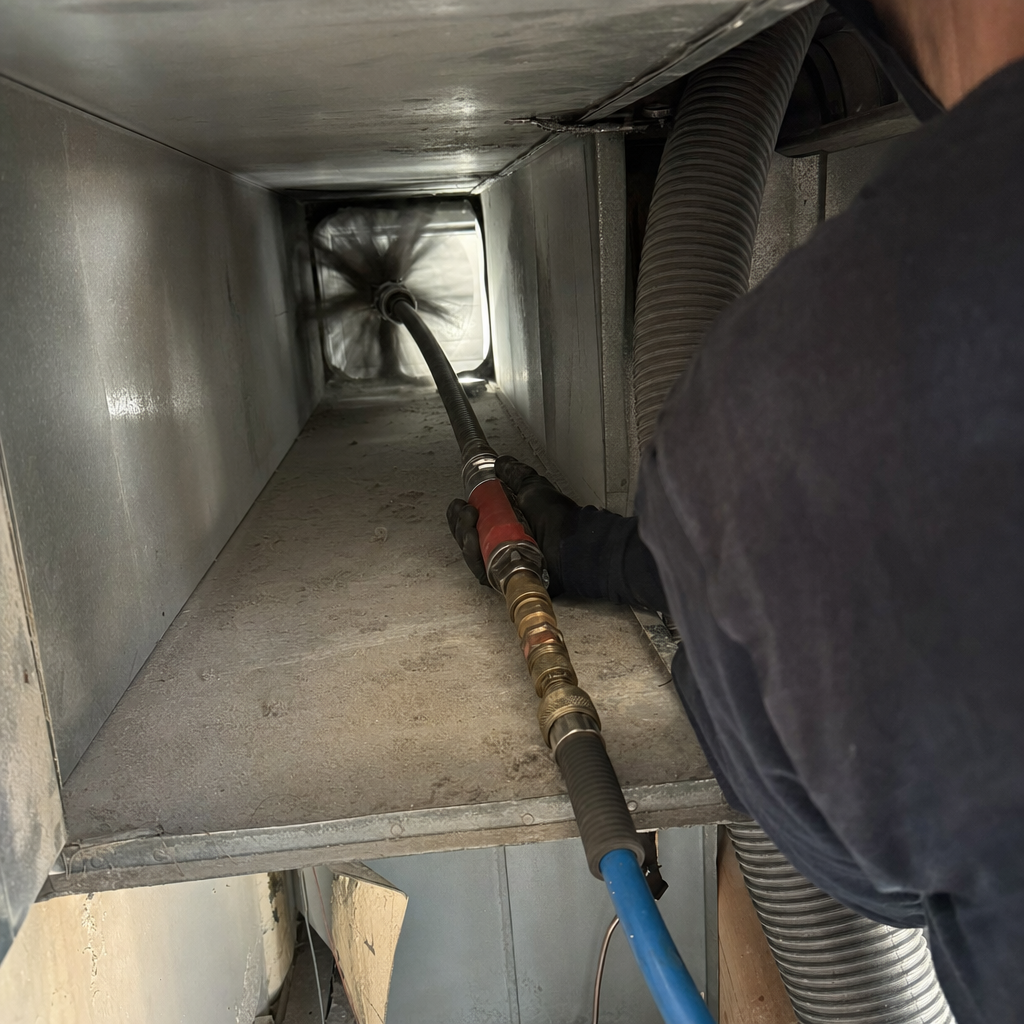
Our vacuum systems, manufactured by companies like Nikro and Abatement Technologies, generate the negative pressure required to extract debris from the entire duct system simultaneously. A typical residential setup creates 5,000+ CFM through a sealed access port while rotary brushes dislodge contamination at the far reaches. The debris never re-enters your home’s air.
Rotary Brush Systems With Proper Reach
Professional rotary systems use powered, flexible cables that navigate bends and transitions while maintaining consistent brush-wall contact. Brush heads are sized and adjusted per duct diameter. In older Los Angeles homes with mixed duct sizes - common in additions and renovations - we change heads multiple times per job.
Compressed Air Tools
For duct runs where brushes can’t navigate, compressed air whips and skipper balls dislodge debris through kinetic impact. These tools require precise pressure calibration. Too low and they’re ineffective. Too high and they damage duct seams. This calibration comes from training and experience, not a manual.
Access Point Creation and Sealing
Professional cleaning requires strategic access points into the trunk line and plenum. We cut and seal these access points to code, restoring system integrity. DIY attempts to create access often leave unsealed openings that leak conditioned air and draw attic or crawl space contaminants into the system.
Camera Verification: The Accountability Gap
This is where the distinction between DIY and professional work becomes clearest. Without verification, any claim about cleaning effectiveness is just that - a claim.
At Bellows Air Duct & Vent Co. home, we camera-inspect every job before and after work begins. The homeowner sees the condition of their ducts on a monitor in real time. We note debris depth, contamination type, and any damage. After cleaning, we run the camera again through the same path. The difference is visible and documented.
No DIY method replicates this. A phone camera shows you the first few feet. It doesn’t show the trunk line where the heaviest accumulation typically sits. It doesn’t show whether your brush actually contacted the full circumference. It doesn’t create a record that holds anyone accountable.
The camera also reveals problems that cleaning alone won’t fix: disconnected ducts, collapsed flex runs, rust-through in galvanized metal, and pest intrusion. We’ve found dead rodents in trunk lines in Los Angeles homes where the homeowner had no odor complaint because the carcass was desiccated. We’ve found contractor debris from original construction - drywall scraps, soda cans, insulation chunks - that had been in place for decades. These findings change the scope of work and protect the homeowner from paying for cleaning when repair is needed.
Without before-and-after verification, a homeowner who spends a Saturday with a consumer kit has no way to know if the job accomplished anything. The registers look cleaner. The ducts beyond the first bend remain unchanged. This false confidence delays proper maintenance and allows problems to worsen.
DIY vs Professional Cost Comparison in Los Angeles
Cost is a fair consideration. Here’s an honest breakdown of what each approach actually costs in the Los Angeles market, including the expenses DIY guides often omit.
| Approach | Upfront Cost | Hidden/Ongoing Costs | Typical Outcome |
|---|---|---|---|
| DIY: Consumer kit + shop vac | $40-120 | Filter replacements ($15-40), potential duct repair ($200-800+), time (4-8 hours) | Surface cleaning of accessible areas; no trunk line or plenum access; no verification |
| DIY: Rental equipment attempt | $150-300/day | Transport, setup time, damage risk, no training on proper use | Variable; often incomplete due to complexity; damage to flex duct common |
| Professional: Standard residential cleaning | $400-800 (Los Angeles market) | None - includes verification, equipment, labor, cleanup | Complete system cleaning with before/after camera documentation |
| Professional with repair needs | $600-1,500+ | Only if pre-existing damage found and approved for repair | Cleaning plus sealed access points, repaired disconnections, restored integrity |
The Los Angeles market runs higher than national averages due to labor costs, permit requirements for duct modifications, and the prevalence of older systems needing repair. A $199 “whole house special” should raise questions. We’ve responded to calls from homeowners who paid a low bid and received a shop-vac-level cleaning with no verification, then called us to do the job properly.
Our pricing is disclosed before work begins - the number on the phone is the number on the invoice. No bait coupons, no price changes at the door. We also offer a Free Second Opinion on Any Written Estimate if you’ve received a quote that seems unclear.
Common Mistakes to Avoid
- Using a standard vacuum hose without sealed access. Without containing the duct opening around the vacuum hose, you pull conditioned air from the house rather than debris from the duct, wasting energy and accomplishing little.
- Brushing without negative pressure. Dislodging debris without simultaneous extraction redistributes it. We’ve found filters completely clogged and evaporator coils coated after DIY brushing attempts in Burbank and Glendale homes.
- Ignoring duct material. Flex duct, fiberglass duct board, and galvanized metal each require different tools and pressures. Using a metal-duct brush in flex duct tears the liner. Using insufficient pressure in fiberglass duct board leaves debris in the porous surface.
- Cleaning around mold without containment. In Los Angeles’s coastal neighborhoods - Santa Monica, Venice, Marina del Rey - higher humidity makes mold more likely. Agitating mold without professional containment spreads spores system-wide.
- Creating access points without proper sealing. Cutting into a trunk line for access and sealing with tape creates a leak point that draws attic air. Code-compliant sealing requires sheet metal patches, mastic, and mechanical fasteners.
- Assuming clean registers mean clean ducts. Registers are the visible tip. The trunk line and plenum hold the majority of accumulated debris. Clean registers improve appearance, not necessarily air quality.
- Delaying professional service based on DIY results. False confidence from surface cleaning leads homeowners to extend intervals beyond what’s healthy for the system, allowing deeper accumulation and potential mold growth.
When to Call a Professional
Call a professional when your phone camera shows debris beyond the first few feet, when you have flex duct or older insulation you’re unsure about, when there’s any indication of mold or moisture, or when it’s been more than 5 years since the last professional cleaning. In Los Angeles, where wildfire smoke, freeway particulate, and Santa Ana dust load systems faster than in many climates, the 5-year maximum is a practical standard, not an arbitrary one.
Call when your energy bills have risen without explanation, when rooms heat or cool unevenly, or when you smell mustiness that persists after register cleaning. These symptoms indicate duct conditions that DIY maintenance won’t address.
Bellows Air Duct & Vent Co. offers free estimates in Los Angeles. We’ll camera-inspect your system, show you what we find, and quote an upfront price before any work begins. If the condition doesn’t warrant professional cleaning, we’ll tell you that too. Call (844) 685-6342.
Frequently Asked Questions
Professional air duct cleaning in Los Angeles typically runs $400-800 for a standard single-family home, with larger homes, complex duct layouts, or pre-existing damage requiring additional work. The Los Angeles market runs above national averages due to labor costs and the prevalence of older systems. Call (844) 685-6342 for a free estimate specific to your home - estimates are free, and our pricing is disclosed before work starts.
A shop vac can clean register grilles, the boot behind the register, and accessible return vent surfaces, but it cannot clean the full length of duct runs or the trunk line without sealed access points and sufficient airflow. Standard shop vacs generate 50-80 CFM; professional systems pull 5,000-6,000 CFM. For surface maintenance, a shop vac helps. For thorough cleaning, it’s not adequate.
The National Air Duct Cleaners Association recommends every 3-5 years for typical homes. In Los Angeles, we suggest the shorter end of that range for homes near major freeways, in wildfire-affected areas, or with pets, smokers, or occupants with allergies or asthma. Homes with recent renovations should be cleaned after construction dust settles. Regular filter replacement and register cleaning extend the interval but don’t eliminate the need for professional service.
DIY duct cleaning is not recommended for flex duct systems, which puncture easily and have internal liners that tear when snagged by brush heads. Flex duct is common in Los Angeles homes built from the 1980s forward, particularly in the San Fernando Valley and Orange County. If you’re unsure of your duct type, remove a register and look: flex duct has a ribbed, flexible appearance; metal duct is rigid and smooth. When in doubt, have a professional assess before attempting cleaning.
Signs include visible debris beyond the first few feet of duct, musty odors that persist after register cleaning, uneven heating or cooling between rooms, rising energy bills, and debris blowing from registers when the system starts. In Los Angeles, excessive dust accumulation within weeks of cleaning, or dust that appears gritty and dark (often freeway particulate or wildfire ash), also indicates deeper contamination that DIY methods won’t reach.
Professional duct cleaning can improve HVAC efficiency when accumulated debris is restricting airflow or when duct leakage is found and sealed during the process. The EPA notes that cleaning alone doesn’t guarantee efficiency gains, but in systems with significant buildup, removing that restriction reduces the workload on the blower motor and can improve airflow to distant rooms. We document before-and-after airflow measurements on request, so homeowners see actual results, not just claims.
Every Bellows job includes camera inspection before and after, complete cleaning of supply and return ductwork, trunk line, and plenum using truck-mounted negative pressure and rotary brush systems, sealed access points cut to code and properly closed, and cleanup of the work area. Most jobs are completed in a single visit by background-checked, uniformed technicians. Our 90-Day Done Right Promise covers every job: if it’s not right, we return at no charge with no paperwork required.
The Bottom Line
Honest maintenance - register cleaning, filter replacement, visual inspection - belongs in the homeowner’s toolkit and reduces the burden on your system between professional services. But the equipment, reach, and verification required for thorough duct cleaning aren’t available for DIY purchase or rental. In Los Angeles, where duct systems range from 1940s galvanized metal to modern flex duct, and where environmental particulate loads systems heavily, the risk of DIY damage or incomplete work often costs more than professional service.
The square deal is knowing what you can do, what you shouldn’t, and having a clear record of what was actually accomplished. Camera verification provides that record. Upfront pricing provides that clarity. A written guarantee provides that accountability. These aren’t luxuries. They’re the minimum standard for work that affects the air you breathe.
For a free estimate in Los Angeles, call Bellows Air Duct & Vent Co. at (844) 685-6342. We’ll show you what your ducts actually look like, quote an honest price before we start, and stand behind the work for 90 days - no paperwork, no arguing.
Written by the team at Bellows Air Duct & Vent Co., serving Los Angeles since 2012.