
Last updated July 25, 2026
DIY vs Professional Air Duct Cleaning: The Los Angeles Homeowner’s Decision Guide
Here’s something most duct cleaning companies won’t say out loud: a homeowner with a shop vac and a dryer vent brush can absolutely clean the last 18 inches of a duct run. In many Los Angeles homes, that’s actually sufficient for routine register maintenance. But that same homeowner cannot simultaneously clean the entire system under negative pressure, cannot inspect the full trunk line with a camera, and cannot contain hazardous debris if the system has been compromised by wildfire ash or rodent activity. Those are not the same job. This guide draws that line honestly. We’ll cover what you can handle yourself, what requires professional equipment, how to tell the difference, and how to verify that any professional you hire actually delivered what DIY couldn’t.
Quick Answer
DIY air duct cleaning in Los Angeles is practical only for surface-level dust on accessible registers and the immediate duct opening. Professional cleaning is necessary for whole-system debris removal, mold or rodent contamination, post-wildfire ash recovery, and any home with flex ductwork installed between 1970 and 1999. The dividing factor is not skill; it’s containment capability and negative-pressure equipment.
Table of Contents
- What DIY Can Actually Accomplish
- What Professional Cleaning Actually Does
- Los Angeles-Specific Risks That Rule Out DIY
- The Hidden Danger in Older Flex Duct Systems
- How to Verify Whether a Professional Job Worked
- Decision Tree: Four Questions to Decide Your Path
- Cost Comparison: DIY Supplies vs. Professional Service
- Common Mistakes to Avoid
- When to Call a Professional
- Frequently Asked Questions
- The Bottom Line
What DIY Can Actually Accomplish
Let’s start with what you can do yourself, because there’s plenty.
A homeowner with basic tools can maintain supply registers, return air grilles, and the visible portions of duct boots. This is legitimate maintenance, not a compromise. In our experience across Los Angeles, from Sherman Oaks to Silver Lake, the dust that visibly accumulates on registers is often the primary complaint. Addressing it directly solves the perceived problem.
Here’s what falls squarely in DIY territory:
- Register and grille cleaning. Remove floor and wall registers, wash with warm soapy water, dry completely, and replace. This takes 30 minutes for a typical 1,500-square-foot home.
- Visible duct boot vacuuming. Using a vacuum with a hose extension and brush attachment, clean the first 12 to 18 inches inside the duct opening. This removes loose surface debris before it migrates deeper.
- Filter replacement. The single most effective DIY action. A fresh MERV 8 to 13 filter, changed every 60 to 90 days during Los Angeles peak seasons, prevents more buildup than any cleaning method.
- Return air pathway clearing. Ensure the return grille isn’t blocked by furniture, and vacuum the filter housing area if accessible.
Where DIY stops: the moment you need to address anything beyond arm’s reach. The typical residential duct system in Los Angeles has 150 to 300 linear feet of ductwork, much of it concealed in walls, attics, or crawl spaces. Your shop vac has neither the reach nor the containment to clean this without redistributing debris into living spaces or, worse, into the air handler itself.
We’ve also seen homeowners in neighborhoods like Encino and Burbank attempt to use compressed air to “blow out” ducts. This dislodges debris but provides no extraction path. The particulate resettles, often deeper in the system, and can overwhelm the filter. It’s the ductwork equivalent of sweeping dirt under a rug.
What Professional Cleaning Actually Does
Professional duct cleaning operates on a fundamentally different principle: simultaneous agitation and extraction under controlled negative pressure.
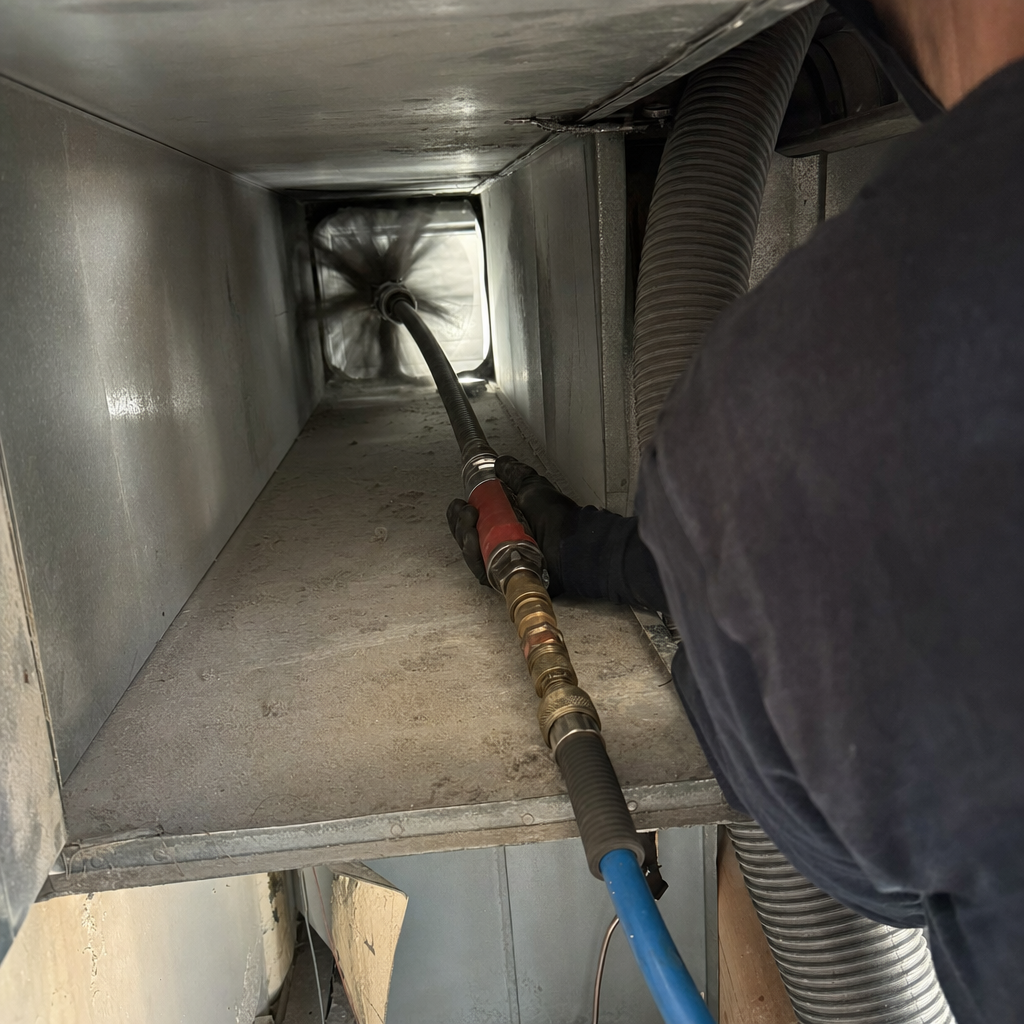
A truck-mounted or portable system, such as those from Rotobrush or Nikro, creates negative pressure throughout the duct network. This means debris is dislodged by mechanical brushes or compressed air tools and immediately drawn into a sealed collection system. Nothing resettles. Nothing escapes into your home.
The standard professional process includes:
- System inspection, typically with a camera, to assess contamination type and locate access points
- Sealing of the system to isolate the work area from living spaces
- Negative-pressure setup, with the collection unit attached at the air handler or a main trunk line
- Agitation of each branch line with powered brushes or air whips
- Trunk line cleaning, often the dirtiest section due to cumulative debris from all branches
- Air handler and coil inspection, with cleaning recommendations if needed
- Post-cleaning camera verification to document results
- System rebalancing and filter installation
The equipment matters. A Rotobrush system with HEPA filtration can capture particles down to 0.3 microns. For context, wildfire smoke particles range from 0.4 to 0.7 microns. Standard shop vacuums, even those labeled “HEPA,” rarely achieve true sealed-system performance at this scale.
Professional-grade equipment also addresses what homeowners cannot see. In a typical Los Angeles attic, summer temperatures exceed 140 degrees. Duct tape degrades. Seams separate. Rodents access. A camera inspection reveals these conditions; a shop vac does not.
Los Angeles-Specific Risks That Rule Out DIY
Los Angeles presents three contamination categories that make DIY duct cleaning not merely insufficient but potentially hazardous: wildfire ash, rodent activity, and mold growth amplified by coastal moisture patterns.
Wildfire ash and smoke residue. The 2025 Eaton and Palisades fires deposited ash across vast areas of Los Angeles County, including regions not directly in burn zones. Ash particles are alkaline, corrosive to metal ductwork, and microscopic. They penetrate deep into systems. More critically, ash contains combustion byproducts including polycyclic aromatic hydrocarbons. Disturbing this material without sealed negative-pressure containment releases it into living spaces. We’ve cleaned systems in Altadena and Pasadena where ash had penetrated the entire trunk line. No homeowner equipment can safely extract this.
Rodent contamination. Los Angeles has a well-documented roof rat population, particularly in hillside neighborhoods like Los Feliz, Mount Washington, and the Hollywood Hills. Rats enter attics through gaps as small as half an inch, travel ductwork for nesting material, and leave droppings, urine, and parasites. Hantavirus, though rare, is present in Southern California rodent populations. DIY cleaning of contaminated ducts without proper PPE and containment is a genuine health risk. The CDC recommends professional remediation for any rodent contamination in HVAC systems.
Mold in coastal moisture zones. Homes within five miles of the Pacific, from Santa Monica to San Pedro, experience higher ambient humidity. When combined with air conditioning condensation in ductwork, this creates mold-conducive conditions. Visible mold on registers often indicates concealed growth deeper in the system. DIY cleaning spreads spores. Professional remediation requires not just cleaning but moisture-source identification, often involving duct sealing or insulation repair.
These three categories share a common requirement: containment. Not cleaning power. Containment. Only professional negative-pressure systems provide this.
The Hidden Danger in Older Flex Duct Systems
From approximately 1970 through the late 1990s, Los Angeles construction heavily utilized flexible ductwork: wire-reinforced plastic with fiberglass insulation. It’s still present in thousands of homes across the San Fernando Valley, the Westside, and older Pasadena neighborhoods.
Flex duct degrades. The inner liner becomes brittle. Insulation compacts. The wire spiral corrodes. Here’s the specific risk for DIY cleaning: aggressive brushing or high-pressure air dislodges the inner liner or breaks the wire spiral, creating obstructions or breaches that leak conditioned air into attics.
We’ve responded to calls in Northridge and Van Nuys where homeowners used rotary brush kits purchased online, only to find their ducts now had gaps they couldn’t locate. The brush had torn the liner at a joint 20 feet from the access point. Repair required full section replacement.
Older flex duct also accumulates debris differently than metal ductwork. The ribbed interior traps particles. Standard agitation without controlled extraction can pack debris tighter rather than removing it. Professional systems adjust brush stiffness and air pressure based on duct material, something a fixed DIY tool cannot do.
If your Los Angeles home was built between 1970 and 1999 and has never had ductwork replacement, assume flex duct is present. A camera inspection, which any reputable professional provides, confirms material type and condition before cleaning begins. This alone justifies professional assessment before any DIY attempt.
How to Verify Whether a Professional Job Worked
This is where the industry has historically failed homeowners. A clean register proves nothing. A fresh smell proves nothing. The only valid verification is visual documentation of the full system, before and after.
At Bellows Air Duct & Vent Co. home, we camera-inspect every job. Homeowners see the condition of their trunk lines, branch ducts, and air handler components. After cleaning, they see the same views. This isn’t marketing; it’s the only method that closes the accountability loop.
If you’re evaluating a professional service in Los Angeles, demand this specifically:
- Pre-cleaning video or still images of representative duct sections, dated and labeled
- Post-cleaning images of the identical sections
- Air handler and coil images, if accessible
- Written summary of any damage, leaks, or conditions requiring repair
Without documentation, you’re purchasing a claim, not a service. The discount operators who blanket Los Angeles with coupon mailers rarely provide this. Their business model depends on volume and minimal time on site. Camera work takes time. It’s incompatible with the $49 whole-house special.
For homeowners who did attempt DIY first, documentation provides the comparison point. We can show exactly what remained after your best effort. In most cases, the trunk line and branch interiors still contain substantial debris. There’s no shame in this; the tools are simply different.
Documentation also protects your investment if problems arise. Our 90-Day Done Right Promise is straightforward: if the work isn’t right, we return at no charge with no paperwork required. But “right” is defined by the camera record, not subjective impression.
Decision Tree: Four Questions to Decide Your Path
Before spending money on either DIY supplies or professional service, answer these four questions honestly. Your answers determine the appropriate path.
Question 1: What prompted you to consider cleaning?
If the answer is visible dust on registers or reduced airflow at a single vent, DIY maintenance is likely sufficient. If the answer is persistent odors, allergy symptoms, post-fire conditions, or evidence of pests, proceed to professional assessment.
Question 2: When was your ductwork last professionally inspected with a camera?
Never, or more than 10 years ago? You don’t know what’s in there. A camera inspection, which we provide as part of our standard assessment in Los Angeles, reveals material type, contamination level, and any damage. This information changes the cleaning approach entirely.
Question 3: Is any portion of your home’s ductwork inaccessible without tools or protective equipment?
Attic work in Los Angeles summer heat, crawl space access, or roof-mounted equipment all present safety considerations beyond the cleaning itself. Professional technicians are equipped for these environments. Homeowners need not risk injury.
Question 4: Are you prepared to verify results, or do you need the assurance of documentation?
If you need accountability, only professional service with camera verification provides it. If you’re comfortable with “good enough” for surface maintenance, DIY is reasonable.
Scoring: Four “professional” answers mean professional service is appropriate. Mixed answers suggest starting with a professional inspection, which you can then use to inform your decision. All “DIY” answers mean proceed with register maintenance and filter changes, but schedule a camera inspection within two years.
Cost Comparison: DIY Supplies vs. Professional Service
Honest pricing means showing the numbers. Here’s what each path actually costs in the Los Angeles market.
DIY supply costs:
- Shop vacuum with hose extension: $80 to $200 (or owned already)
- Register cleaning brushes: $15 to $30
- Microfiber cloths and cleaning solution: $10 to $20
- Replacement filters (annual): $60 to $120
- Online rotary duct cleaning kit (not recommended for flex duct): $50 to $150
- Total first-year DIY investment: $215 to $520
Professional service costs in Los Angeles:
- Whole-house duct cleaning (typical 2,000 sq ft home): $400 to $700
- Camera inspection alone: $150 to $250
- Dryer vent cleaning (recommended simultaneously): $120 to $200
- Air handler and coil cleaning: $200 to $350
- Combined duct and dryer vent service: $500 to $850
The professional cost includes equipment, labor, disposal, documentation, and guarantee. The DIY cost assumes your time has no value and carries no recourse if something goes wrong.
Consider frequency. NADCA, the industry association, recommends professional cleaning every three to five years for typical residential systems, or more frequently with pets, allergies, or post-construction. Annual DIY register maintenance between professional services is appropriate and cost-effective.
Bellows offers a $89 Seasonal Tune-Up that includes filter change, register cleaning, and basic system inspection. For homeowners unsure whether full service is needed, this provides professional assessment without full-service commitment. We also provide free second opinions on any written estimate from another company.
Common Mistakes to Avoid
- Using a standard vacuum without HEPA filtration. This redistributes fine particulate through the exhaust. Los Angeles air quality is already challenged; don’t add to it indoors.
- Cleaning only visible registers while ignoring the return air system. The return side is typically dirtier, as it draws air (and debris) from the entire house. It’s also where the filter sits, making it the logical starting point.
- Attempting to clean ducts after wildfire exposure without containment. We’ve seen homeowners in Glendale and Burbank trigger respiratory issues by disturbing ash-laden systems. This is genuinely dangerous.
- Using rotary brushes in older flex duct. The wire spiral tears, the liner separates, and you now have a repair rather than a maintenance task. Camera inspection first prevents this.
- Hiring based on lowest price without verifying equipment and documentation. The $99 whole-house special in Los Angeles typically involves a shop vac on a truck and 45 minutes on site. You could have done that yourself.
- Ignoring the air handler and coil. Clean ducts with a dirty coil recirculate contamination immediately. Professional service includes assessment; insist on it.
- Assuming clean registers mean clean ducts. Registers are the visible 5 percent. The trunk line is the hidden 95 percent. Don’t confuse appearance with system condition.
When to Call a Professional
Call a professional when any of the following apply: your home was built before 2000 and has original flex duct; you’ve experienced wildfire smoke exposure or live within 20 miles of recent burn zones; you’ve found rodent evidence in or near ductwork; you smell persistent musty or chemical odors from vents; family members have unexplained respiratory symptoms; or you’ve completed DIY register cleaning and still notice reduced airflow or dust accumulation.
Professional assessment costs nothing beyond your time if you choose a company that offers upfront pricing with no obligation. At Bellows Air Duct & Vent Co., we disclose our full pricing before any work begins. The number on the phone is the number on the invoice. We’re not the cheapest option in Los Angeles, and we don’t try to be. We’re the company you call once, then never need to call again for the same problem.
We also answer our phones 24 hours a day with a live person, not voicemail or an app. For a free estimate in Los Angeles, call (844) 685-6342.
Frequently Asked Questions
Whole-house duct cleaning for a typical 2,000-square-foot Los Angeles home ranges from $400 to $700, with combined duct and dryer vent service running $500 to $850. Prices vary based on system accessibility, contamination type, and whether air handler cleaning is included. Call (844) 685-6342 for an exact quote; estimates are free.
You can clean registers, grilles, and the first 12 to 18 inches of duct openings with a shop vac and brush attachment. This is legitimate maintenance for surface dust. You cannot safely clean the full system, trunk lines, or address contamination like mold, ash, or rodent debris without negative-pressure professional equipment.
Every three to five years for typical residential systems, or more frequently with pets, allergies, recent construction, or wildfire exposure. Homes near the coast or in canyon areas with higher dust and pollen loads may benefit from more frequent assessment. Annual filter changes and register maintenance should happen regardless of professional cleaning schedule.
Mold occurs in coastal and hillside neighborhoods where humidity and temperature differentials create condensation in ductwork. Pacific Palisades, Santa Monica, and San Pedro see higher incidence. It’s not universal, but it’s common enough that any musty odor warrants professional camera inspection. DIY cleaning spreads spores; professional remediation contains them.
The primary risk is damage to flex duct systems installed from 1970 to 1999, which comprise a significant portion of Los Angeles housing stock. Rotary brushes tear the inner liner and break wire spirals. Secondary risks include redistributing hazardous debris and creating air handler contamination by dislodging debris without extraction capability.
Demand dated, labeled camera images of your specific ductwork before and after cleaning. Compare the same locations. Verify the company used negative-pressure equipment, not just a vacuum. Check that registers were removed and cleaned separately, not just wiped in place. A reputable company provides this documentation without request; at Bellows, it’s standard on every job.
The Bottom Line
DIY air duct cleaning in Los Angeles has its place: register maintenance, filter changes, and surface vacuuming are reasonable homeowner tasks that improve day-to-day air quality. But the full system, hidden contamination, and hazardous materials require professional negative-pressure equipment, containment, and camera-verified documentation. The honest dividing line is containment, not ambition. Know which side your situation falls on before spending money or risking damage. And when you hire professional service, verify the results with your own eyes, not a salesman’s promise.
Written by the team at Bellows Air Duct & Vent Co., serving Los Angeles since 2012.