
Last updated July 25, 2026
DIY vs Professional Air Quality & Sanitizing: What’s Safe to Do Yourself
Fogging a room with antimicrobial spray when the contamination source is inside the duct system is like spraying air freshener into a running fan - you’re treating the air that’s already been replaced, not the source. In Los Angeles, where we run our HVAC systems through long cooling seasons and occasional Santa Ana wind events that drive dust and pollen indoors, homeowners spend an estimated $1.2 billion annually on air quality products. Much of that money treats symptoms while the underlying problem keeps circulating. This guide will show you which air quality tasks are genuinely worth doing yourself, which ones waste money or create new problems, and which situations require professional equipment and training to handle safely.
Quick Answer
Homeowners can safely handle HEPA vacuuming of registers and grilles, scheduled filter replacements, dehumidifier operation in humid months, and surface wiping of accessible coil panels. UV lamp installation, chemical fogging, and any treatment targeting contamination inside sealed ductwork should be left to professionals. Mold remediation, post-rodent sanitizing, and pressurized system treatments carry health and liability risks that make professional handling the only reasonable choice.
Table of Contents
- The DIY Wins: What Actually Works
- The Risky Middle Ground: Well-Intentioned Mistakes
- The Problem with Consumer Chemical Sanitizers
- UV Lamps: Why DIY Installation Often Fails
- When Professional Equipment Is Non-Negotiable
- The Self-Assessment Every Homeowner Should Run
- Common Mistakes to Avoid
- When to Call a Professional
- Frequently Asked Questions
- The Bottom Line
The DIY Wins: What Actually Works
Some air quality tasks deliver real results with minimal risk and modest cost. These are the ones we encourage homeowners to stay on top of, because they address either the entry points of contamination or the conditions that allow it to thrive.
1. HEPA Vacuuming of Registers and Grilles
Your supply and return registers are the visible endpoints of your duct system, and they collect what the rest of your home sheds. Pet hair, skin cells, cooking residue, and dust settle on these surfaces and can be pulled back into the system when the fan cycles on.
Use a vacuum with a true HEPA filter (not “HEPA-type” - that distinction matters) and a brush attachment. Work the bristles into the louvered openings of floor registers, where debris packs down from foot traffic. In Los Angeles, where many homes in neighborhoods like Sherman Oaks and Encino have wall-mounted returns at ceiling height, use a step stool and work methodically across each slat. We see homeowners skip the return grilles because they look cleaner, but returns pull air inward and often harbor more buildup than supplies.
Frequency: Monthly in homes with pets or heavy foot traffic; quarterly otherwise.
2. Filter Replacement on Schedule
This is the single highest-impact routine a homeowner can perform. A clogged filter restricts airflow, strains the blower motor, and can cause the evaporator coil to ice over in cooling mode. Worse, a saturated filter can collapse or bypass, dumping unfiltered air directly into the ductwork.
Los Angeles presents a specific challenge here: wildfire season. During major events like the 2025 Palisades fire or earlier Woolsey and Creek fires, standard pleated filters load with fine particulate in days rather than months. We recommend homeowners in fire-prone areas keep a case of filters on hand and check them weekly during active burn periods.
For standard conditions:
- 1-inch pleated filters: every 60-90 days
- 4-5 inch media filters: every 6-12 months
- Washable electrostatic filters: clean monthly, replace every 3-5 years
Write the installation date on the filter frame with a marker. The “30 days” mental estimate stretches to 90 faster than most people realize.
3. Dehumidifier Operation in High-Humidity Months
Los Angeles is not a humid city by national standards, but coastal neighborhoods like Venice, Playa del Rey, and San Pedro see summer dew points that support mold growth in poorly ventilated spaces. Basements and crawl spaces in older homes from the 1940s-1960s, common in the Mid-City and Silver Lake areas, are particularly vulnerable.
A properly sized dehumidifier - not a moisture absorber bucket, but a compressor-driven unit with a drain hose - keeps relative humidity below 60%, the threshold where mold spores germinate on organic surfaces. Size it to the square footage of the space, and run it continuously during June through October in coastal zones.
4. Surface Wiping of Accessible Coil Panels
The indoor evaporator coil sits inside your air handler, typically in the attic, closet, or garage. Many units have an access panel that a homeowner can remove after shutting power to the furnace or air handler. The panel surface and the immediate surrounding area can be wiped with a damp microfiber cloth to remove dust that would otherwise be drawn into the coil fins.
Do not reach into the coil itself. The aluminum fins bend easily and are difficult to straighten without a fin comb. Do not spray any liquid into the cabinet. This is surface maintenance only, and only on powered-down equipment.
The Risky Middle Ground: Well-Intentioned Mistakes
Between the clear DIY wins and the professional-required category sits a zone of products and practices that seem reasonable but often deliver poor results or create secondary problems. These are the decisions we see homeowners regret.
Consumer-Grade Air Quality Monitors
A $200 particulate sensor can tell you that your air has particles in it. What it cannot reliably tell you is where those particles originate, whether they are biologically active, or what action will reduce them. We’ve visited Los Angeles homes where homeowners chased PM2.5 readings for months, running purifiers on high and replacing filters weekly, when the actual source was a disconnected return duct in the attic pulling fiberglass and rodent debris into the system. The monitor treated the symptom as the problem.
Use monitors as a trigger for investigation, not as a diagnostic tool. A sustained elevation in readings warrants a camera inspection of the ductwork, not more filtration.
Over-the-Counter Duct Cleaning Kits
The rotary brush kits sold at hardware stores attach to a standard drill and feed into a vent opening. They can dislodge surface debris near the register, but they cannot navigate the full duct run, they lack vacuum extraction at the point of agitation, and they risk damaging flexible ductwork or knocking loose connections in older systems. In our experience, these kits leave homeowners with a false sense of completion and a pile of dust that resettles within days.
Plug-In Ionizers and Ozone Generators
Ozone is a lung irritant at concentrations above 0.05 ppm, and California law restricts the sale of ozone-generating air purifiers for residential use. Some units marketed as “ionizers” or “plasma air purifiers” produce ozone as a byproduct. The ARB (California Air Resources Board) maintains a list of certified clean air devices for a reason. If a product is not on that list, do not bring it into your Los Angeles home.
The Problem with Consumer Chemical Sanitizers
The DIY air quality market is saturated with antimicrobial foggers, duct sprays, and “mold bombs” that promise hospital-grade results from a pressurized can. The reality is more complicated and often less effective than the packaging suggests.
The Film Trap
When a chemical sanitizer is applied to a dirty surface - whether that’s a duct wall coated in dust or a coil covered in biofilm - the active ingredient cannot reach the biological material it is meant to kill. Instead, it dries on top of the debris layer, creating a sealed film. The contaminants underneath remain viable, and the new surface can actually support different microbial growth adapted to the chemical residue.
We’ve opened duct systems in Los Angeles homes where homeowners had fogged annually for years, believing they were maintaining cleanliness. Camera inspection revealed thick, stratified layers of dust bonded with dried sanitizer, reducing effective duct diameter and creating a chronic source of particulate every time the system cycled.
Component Damage
Consumer foggers are not formulated with HVAC materials in mind. The same quaternary ammonium compounds that disinfect hard surfaces can corrode aluminum coils, degrade rubber gaskets, and coat flame sensors in furnaces. A coated flame sensor can cause intermittent ignition lockouts - a service call that costs far more than any savings from DIY treatment.
Occupant Exposure
Los Angeles has some of the highest asthma rates in California, particularly in the San Fernando Valley where temperature inversions trap pollutants. Introducing volatile compounds into a sealed home environment, even at levels labeled “safe” by the manufacturer, can trigger respiratory symptoms in sensitive individuals. Children, elderly residents, and anyone with reactive airway disease are disproportionately affected.
The professional alternative: At Bellows Air Duct & Vent Co. home, we use EPA-registered products applied with controlled-volume equipment after mechanical cleaning has removed the debris layer. The system is then run through a purge cycle before occupants re-enter. This is not a process that replicates well with a hardware store fogger and good intentions.
UV Lamps: Why DIY Installation Often Fails
UV-C lamps for HVAC systems are legitimate tools when specified and installed correctly. They are also one of the most commonly misapplied products we encounter in Los Angeles homes.
The Position Problem
A UV lamp must be positioned to irradiate the surface where microbial growth occurs. For most systems, this means within line-of-sight of the evaporator coil, where condensation creates a persistent damp environment. Lamps mounted in the wrong location - downstream of the coil, or in a return plenum where airflow is too fast for adequate dwell time - provide negligible biological control while consuming electricity and degrading plastics in the line of exposure.
The Bulb Reality
UV-C output degrades with use, not just with visible failure. A lamp that still glows violet may have lost 50% or more of its germicidal output after 9,000 hours of operation. Most manufacturers specify 12-month replacement; we see DIY installations with bulbs that have been glowing for three or four years, providing essentially decorative function.
The Wrong Wavelength
True germicidal UV operates at 254 nanometers. Some consumer products marketed for HVAC use emit at 185 nm, which generates ozone as a byproduct. In the confined space of a duct system, ozone concentrations can exceed safe levels quickly. We remove these units when we find them.
Proper UV installation requires assessment of airflow patterns, coil geometry, and lamp intensity at specified distances. Honeywell and Aprilaire both manufacture UV systems designed for integration with their air handlers, but even these require correct placement to perform as specified.
When Professional Equipment Is Non-Negotiable
Some air quality situations carry health, legal, or financial risks that place them firmly outside DIY scope. These are not matters of convenience or cost savings. They are matters of proper containment, documentation, and liability.
Active Mold Growth Inside Ductwork
Surface mold on a register can be wiped. Mold growing on the interior surfaces of rigid or flexible ductwork, or on the blower assembly and evaporator housing, requires professional remediation. The EPA and California Department of Public Health both recommend professional assessment for contamination exceeding 10 square feet in an HVAC system.
Why: Disturbing mold colonies without containment disperses spores throughout the home. Without negative air pressure and HEPA filtration during the removal process, a localized problem becomes a whole-house exposure. Post-remediation, the cause of moisture must be identified and corrected, or regrowth is guaranteed within one to two cooling seasons.
Post-Rodent Sanitizing
Rodent activity in ductwork - common in Los Angeles hillside homes in areas like Laurel Canyon, Beachwood Canyon, and the Hollywood Hills - leaves behind urine, feces, and nesting material that can harbor hantavirus, leptospirosis, and salmonella. Vacuuming this material with standard equipment aerosolizes pathogens. Proper sanitizing requires PPE, HEPA-contained extraction, and registered disinfectants applied with dwell time adequate for the specific organisms present.
Pressurized System Treatments
Duct sealing with aerosolized polymers, antimicrobial fogging at system volume, and certain coil cleaning chemistries require the HVAC system to be shut down, isolated, and in some cases pressurized to distribute treatment evenly. These procedures carry risks of chemical overexposure, equipment damage from pressure differentials, and fire hazard if ignition sources are not properly controlled.
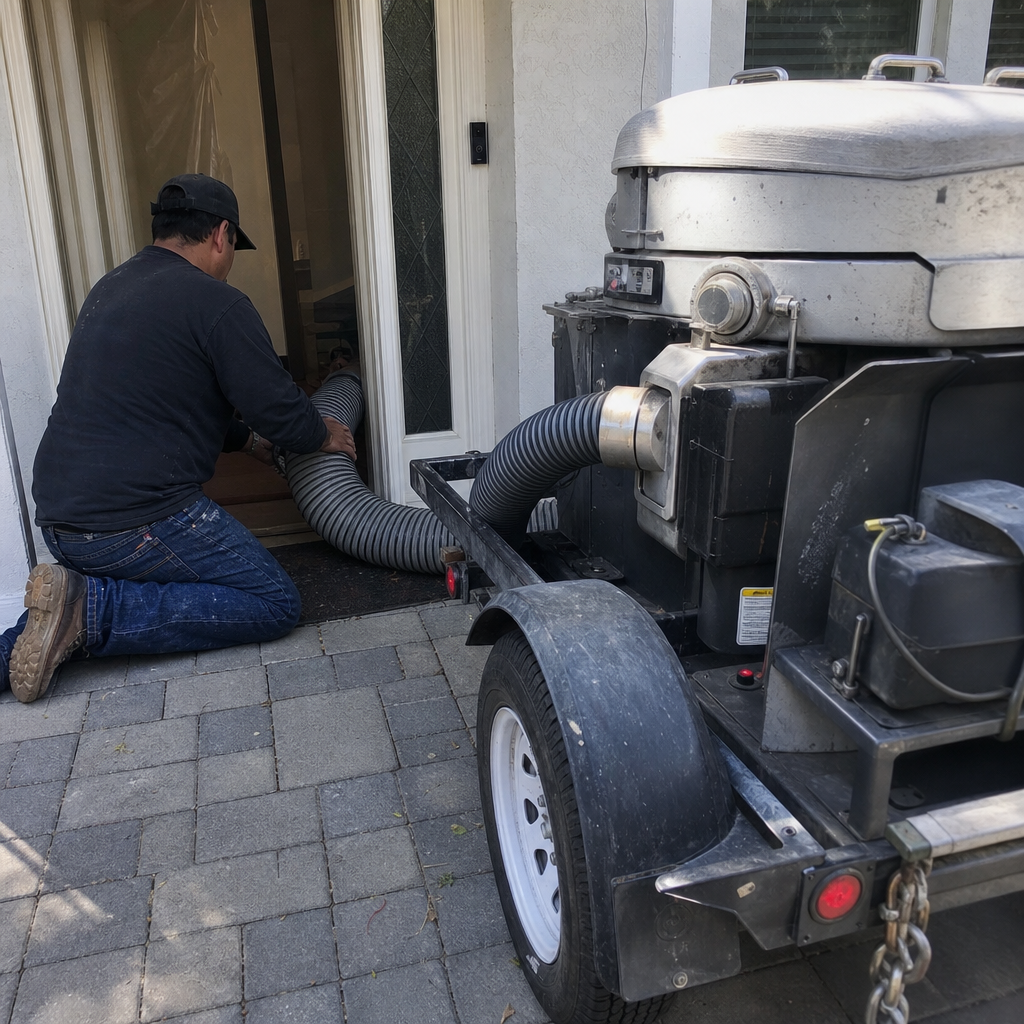
At Air Duct Cleaning in Seymour, we’ve built our process around camera-verified results using Rotobrush and Nikro equipment - the same brands specified by serious HVAC contractors. Every job is inspected before and after work begins, with visual documentation provided to the homeowner. Most jobs are completed in a single visit by background-checked, uniformed technicians.
The Self-Assessment Every Homeowner Should Run
Before purchasing any air quality product or planning any treatment, ask this single question:
Am I treating a known, visible, accessible source, or am I treating a symptom I cannot trace?
If the answer is the former - a dusty register, a humid basement, a filter that has gone six months past replacement - proceed with the appropriate DIY action from the list above.
If the answer is the latter - persistent odors with no obvious source, recurring dust accumulation despite frequent cleaning, family members with unexplained respiratory symptoms, or visible mold in one area that suggests hidden growth elsewhere - stop treating and start diagnosing.
Professional diagnostic work should precede any treatment, DIY or professional. At Bellows Air Duct & Vent Co., our camera inspection is designed for exactly this purpose. We show you what your system contains before recommending any action. No bait pricing, no scare tactics, no treatment without verification.
The standing offers we maintain for Los Angeles homeowners include: $50 Off Any Repair Over $250, a Free Second Opinion on Any Written Estimate, our $89 Seasonal Tune-Up, and a permanent 5% Senior and Veteran discount. Pricing is disclosed before a single tool is lifted - the number on the phone is the number on the invoice.
Common Mistakes to Avoid
- Treating every room equally. Focus effort where the problems actually occur. A bedroom with no pets and minimal traffic does not need the same intervention as a return grille in a kitchen with gas cooking. In Los Angeles, where many homes have open floor plans, the central return often bears the load of multiple activity zones.
- Buying capacity without measuring need. A dehumidifier rated for 4,500 square feet in a 900-square-foot basement runs inefficiently and cycles too frequently to maintain stable humidity. Size to the space, not to the marketing claim.
- Ignoring the condensate line. A clogged condensate drain pan overflows, damages ceilings, and creates the exact wet environment that supports mold growth. Pour a cup of white vinegar through the line twice yearly during cooling season. This is a 5-minute task that prevents thousand-dollar problems.
- Using the wrong filter MERV rating. High-MERV filters capture more particles but restrict airflow. Residential systems are typically designed for MERV 8-11. Installing a MERV 13 filter in a system with a PSC blower motor can reduce airflow by 20% or more, causing coil freeze-ups and compressor damage. Check your equipment documentation or ask your HVAC technician for the maximum recommended rating.
- Assuming new construction is clean. Los Angeles has seen extensive infill development and ADU construction. New duct systems often contain construction debris, drywall dust, and even fast-food wrappers left by installers. We recommend camera inspection of new ductwork before occupancy, not after symptoms appear.
- Neglecting the dryer vent. A clogged dryer vent restricts airflow, extends drying times, and creates fire hazard from lint accumulation. Dryer Vent Cleaning in Seymour is often bundled with duct cleaning for a reason - the same airflow principles apply, and the same neglect causes similar problems.
- Believing that more treatment equals better results. The air quality industry sells products on the assumption that maximum intervention is optimal. In practice, targeted, verified action consistently outperforms blanket treatment. A clean system with a fresh filter and proper humidity control needs no additional intervention for most Los Angeles homes.
When to Call a Professional
Call when you cannot see or access the source of the problem. Call when the situation involves biological contamination, chemical handling, or pressurized system work. Call when you’ve performed the DIY basics and symptoms persist.
Specific triggers: visible mold inside duct openings, rodent evidence in or near the system, persistent musty or chemical odors, water damage history with no documented duct inspection, or any respiratory symptoms that worsen when the HVAC runs.
Bellows Air Duct & Vent Co. offers free estimates in Los Angeles - call (844) 685-6342. A live person answers 24 hours a day, not a voicemail or app. We’ll schedule a camera inspection, show you exactly what your system contains, and provide upfront pricing before any work begins. Our 90-Day Done Right Promise means if it’s not right, we make it right with no paperwork and no arguing. We’ve stood behind that since 1984.
Frequently Asked Questions
Professional duct sanitizing in the Los Angeles market typically ranges from $400 to $900 for a standard single-system home, depending on system size, accessibility, and whether prior cleaning is required. Sanitizing without cleaning first is not a service we recommend or provide, as it traps contaminants under chemical film. Call (844) 685-6342 for an exact quote - estimates are free, and pricing is confirmed before work begins.
A shop vac can remove loose debris near register openings, but it cannot navigate duct runs, maintain negative pressure during agitation, or extract fine particulate that has adhered to duct walls. Without a rotary brush system and HEPA-contained extraction, you’re moving surface dust, not cleaning the system. For homeowners in Los Angeles with flexible ductwork common in post-1970s construction, shop vac attachments also risk puncturing or disconnecting ducts.
Consumer UV lamps are safe only if they are ozone-free, correctly positioned relative to the coil, and replaced on schedule. Most DIY installations fail on at least one of these criteria. We’ve removed units that were irradiating plastic components, generating ozone, or simply glowing uselessly in the wrong location. If you want UV protection, have it specified and installed by a technician who will document placement and set a replacement reminder.
For most Los Angeles homes, every 3 to 5 years with routine filter maintenance. Homes with pets, recent construction, wildfire smoke exposure, or occupants with respiratory conditions may need more frequent service. Coastal homes in Santa Monica, Marina del Rey, or San Pedro may also need shorter intervals due to higher humidity and salt air corrosion of metal components. A camera inspection is the only reliable way to determine your specific need.
No. Rodent waste in ductwork requires HEPA-contained removal, registered disinfectants with adequate dwell time, and often replacement of contaminated insulation or flexible duct sections. Vacuuming or spraying without containment aerosolizes pathogens. This is a professional-required category for health and liability reasons. We also recommend exclusion work to prevent re-entry, which we can coordinate.
Cleaning is mechanical removal of debris - dust, hair, construction residue, and particulate buildup - using agitation and vacuum extraction. Sanitizing is the application of an antimicrobial agent to surfaces that have already been cleaned. Sanitizing without cleaning is ineffective; cleaning without sanitizing is often adequate for non-biological contamination. We assess each system to determine whether sanitizing is warranted, rather than selling it as an automatic add-on. HVAC Cleaning in Seymour covers both processes as needed.
The Bottom Line
The DIY air quality market profits from the assumption that treatment is always better than observation. The truth is more specific: know your problem, match your action to its source, and recognize when the source is hidden, hazardous, or beyond your tools. HEPA vacuuming, filter changes, dehumidification, and surface wiping are genuine homeowner wins. Chemical fogging, UV installation, and any work inside sealed ductwork belong to trained technicians with proper equipment and accountability. When symptoms persist after the basics are done, diagnostic work comes before any additional treatment. That’s the square deal: right action based on verified need, not product marketing.
Written by the team at Bellows Air Duct & Vent Co., serving Los Angeles since 2012.