
Last updated July 25, 2026
DIY vs Professional HVAC Cleaning: What’s Safe to Do Yourself
Here’s a truth most homeowners in Los Angeles don’t hear until it’s too late: running a shop vac at your vent register doesn’t clean your ducts. It cleans the six inches of duct behind that register and pushes everything else deeper into the system. We’ve been called to homes in Silver Lake and Sherman Oaks where a well-meaning weekend project turned a dusty duct into a clogged duct, and the repair cost more than a professional cleaning would have from the start. In this guide, we’ll show you exactly which two tasks genuinely help your air quality, why consumer equipment hits a hard physical limit, and how to spot a real cleaning from a bait-and-switch operation.
Quick Answer
Homeowners can safely replace HVAC filters, wipe vent grilles, and clear dryer lint traps themselves. Everything else, including duct vacuuming, coil cleaning, and mold treatment, requires professional negative-pressure equipment and should not be attempted with consumer tools. Attempting full duct cleaning with a shop vac or brush kit risks damaging flex duct, loosening connections, and pushing debris deeper into the system.
Table of Contents
- The Two DIY Tasks That Actually Help Air Quality
- Why a Shop Vac Can’t Clean Your Ducts: The Physics
- The Real Risks of DIY Duct Cleaning Attempts
- What Professional Equipment Actually Does Differently
- One Question to Ask Any Duct Cleaning Company
- Los Angeles Climate Factors That Affect Your HVAC System
- Common Mistakes to Avoid
- When to Call a Professional
- Frequently Asked Questions
The Two DIY Tasks That Actually Help Air Quality
After forty-two years in this trade, we’ve narrowed it down to three simple maintenance tasks that reward a homeowner’s time without risking the system. Two of them directly improve air quality. The third prevents a common fire hazard.
1. Replace Your HVAC Filter on Schedule
This is the single most impactful thing you can do yourself. A clogged filter restricts airflow, strains your blower motor, and lets recirculated dust bypass the filter entirely. In Los Angeles, where we run AC heavily from May through October and heating during desert-cold winter nights, filters load up faster than in milder climates.
Check your filter monthly. Replace it when you can’t see light through it, or on the schedule your system manufacturer recommends. For standard one-inch pleated filters in Los Angeles homes, that’s typically every 60-90 days during heavy use seasons. Higher-MERV filters catch more particles but clog faster, so they need more frequent attention.
Use the exact size printed on your existing filter’s cardboard frame. A 16x25x1 filter jammed into a 20×25 slot lets unfiltered air whistle around the edges. We’ve found homeowner-installed filters wedged in backwards, upside down, or with the pleats collapsed from forcing the wrong size.
2. Clean Vent Grilles and Registers
Dust collects on the visible grille, not because the duct behind it is dirty, but because the grille is where moving air deposits particles. Wiping it with a damp microfiber cloth removes this buildup and improves appearance. For metal grilles, remove the screws, soak in warm soapy water, dry thoroughly, and reinstall. Plastic grilles can warp in hot water, so stick to surface wiping.
Check the grille’s damper blades while it’s off. Many Los Angeles homes built in the 1960s-1980s have painted-shut dampers or broken linkages. A grille that won’t open or close properly creates pressure imbalances that strain your system.
3. Clear Your Dryer’s Lint Trap (Bonus Safety Task)
This doesn’t improve HVAC air quality, but it belongs here because homeowners often conflate it with duct maintenance. Clean the lint trap before every load. Once a year, or if clothes take longer to dry, check the exterior vent hood for lint buildup. If you can reach the first few feet of flex duct behind the dryer and see heavy lint, that’s your warning sign. The full dryer vent run, which extends through walls or to roof terminations in many Los Angeles homes, needs professional cleaning with rotary brushes and high-velocity air.
Our Dryer Vent Cleaning in Seymour service addresses the full run with camera verification, but the lint trap itself is squarely in the homeowner’s lane.
Why a Shop Vac Can’t Clean Your Ducts: The Physics
The fundamental problem isn’t effort or intention. It’s airflow physics that consumer equipment cannot overcome.
A typical residential duct system in a Los Angeles home contains 150-300 linear feet of ductwork, branching through walls, floors, and ceilings. To extract debris from this entire network, you need sustained negative pressure throughout every branch simultaneously. Professional truck-mounted systems generate 10,000-15,000 cubic feet per minute (CFM) of vacuum airflow. The most powerful consumer shop vacs peak around 200 CFM.
That gap isn’t incremental. It’s the difference between a fire hose and a drinking straw.
Here’s what happens when you insert a shop vac hose into one vent register:
- The vac pulls from the path of least resistance. That’s the six inches directly behind the grille, plus any nearby gaps or leaks. It does not pull from the far reaches of the branch duct or from adjacent branches.
- Without sealed access ports at multiple points, the vacuum cannot establish negative pressure throughout the system. Air simply enters through other registers, neutralizing suction at the source.
- Agitation is missing. Debris adheres to duct walls through static, moisture, and time. Professional cleaning uses mechanical brushes, air whips, or compressed-air tools to dislodge material before vacuum extraction. A shop vac has no agitation capability.
- Directional airflow works against you. Without a containment strategy, dislodged debris travels toward the blower fan or gets pushed into previously clean sections. We’ve opened systems where DIY attempts deposited a decade of lint against the evaporator coil.
The brush kits sold online compound the problem. Their flexible rods with nylon bristles can snag on screw heads, damper hardware, or damaged duct lining. In flex duct common in Los Angeles tract homes from the 1970s onward, aggressive brushing tears the inner liner or detaches the duct from its collar.
The Real Risks of DIY Duct Cleaning Attempts
Some home improvement projects fail benignly. This one doesn’t. We’ve documented specific damage patterns from DIY duct cleaning attempts across Los Angeles County.
Displaced Insulation in Flex Duct
Flex duct has a wire coil supporting fiberglass insulation between an inner and outer liner. Consumer brush kits catch on the wire helix, bunching insulation or tearing the inner liner. Once the inner liner is compromised, fiberglass particles enter your airstream. In Los Angeles homes with original flex duct from the 1980s or 1990s, the liner has already aged and become brittle. Gentle handling matters, and consumer tools aren’t designed for it.
Loosened Duct Connections
Duct joints rely on mechanical fasteners, mastic sealant, or tape. The vibration and torque from forced brush rods can break these seals. A disconnected duct in an attic or crawl space pressurizes that space with conditioned air and pulls unconditioned, often dusty air into the return side. In Los Angeles, where attics routinely reach 140°F in summer, a disconnected supply duct wastes enormous energy while the system works harder to cool occupied space.
Disturbed Mold Colonies
Visible mold near a vent register often indicates a larger problem upstream, typically where cold duct surfaces meet humid air. Disturbing mold without containment spreads spores throughout the system. Professional remediation requires HEPA filtration, negative air machines, and often antimicrobial treatment. A homeowner with a brush kit and good intentions becomes a distribution system for spores.
Electrical and Component Damage
We’ve found brush rods wedged in blower housings, shop vac hoses melted against heat exchangers, and filter slots damaged from forced tool insertion. The blower assembly in a modern furnace is a precision-balanced component. Foreign objects cause vibration, bearing wear, and premature failure.
What Professional Equipment Actually Does Differently
Understanding the professional approach helps you evaluate any company you consider hiring. Here’s how legitimate duct cleaning works, and what separates it from surface-level service.
Truck-Mounted Vacuum Systems
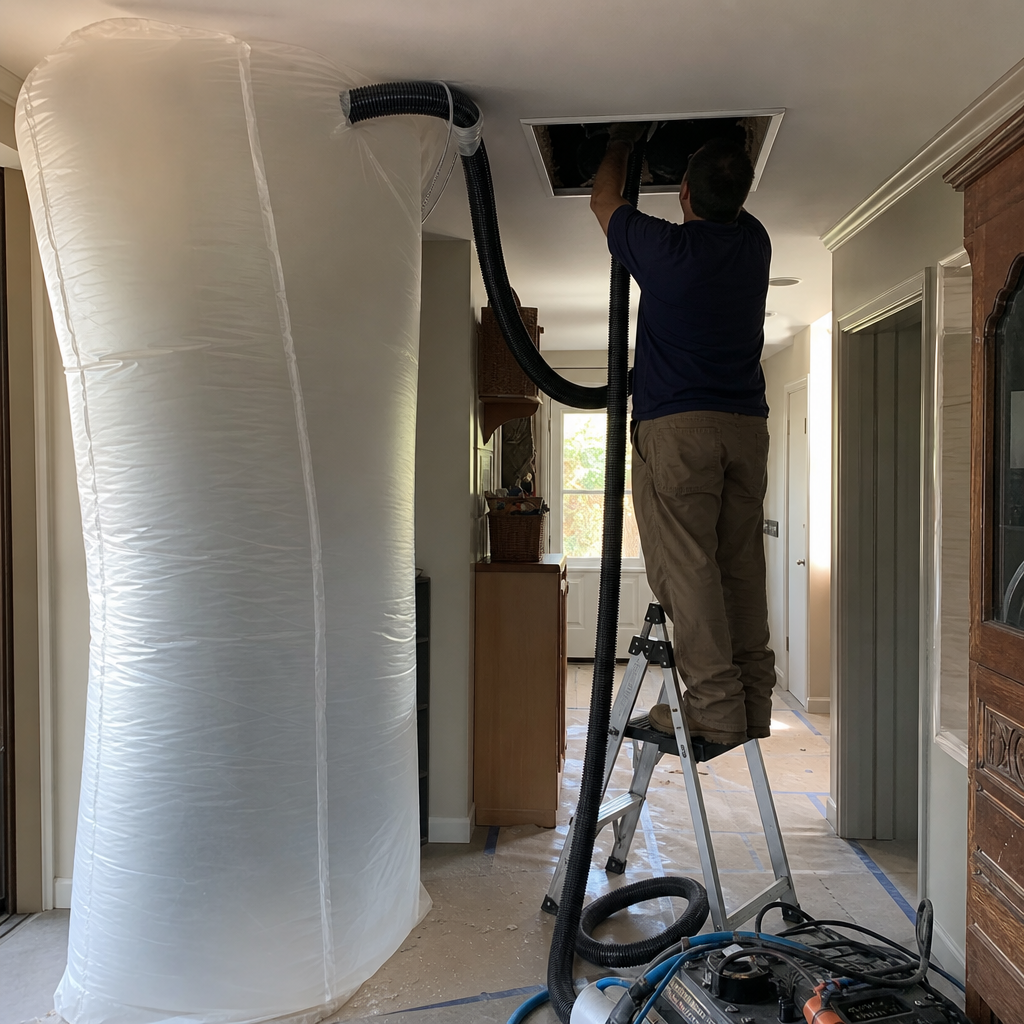
Professional units like those from Nikro and Rotobrush mount directly to service vehicles with dedicated power plants. These systems create the sustained CFM needed to pull debris from entire branch lines while maintaining negative pressure. The vacuum connects to your duct system through a sealed access port, typically cut into the main trunk line, with all registers sealed to force airflow through the intended path.
Mechanical Agitation Tools
Compressed-air whips, skipper balls, and motorized brushes travel through ductwork on flexible cables, dislodging adhered debris without damaging duct walls. The tools are sized to duct diameter and material. In sheet metal duct common in pre-1970 Los Angeles homes, stiffer brushes work effectively. In flex duct, softer tools with controlled torque prevent liner damage.
Contact Cleaning for Coils and Components
The evaporator coil, blower assembly, and heat exchanger surfaces require direct cleaning, not duct vacuuming. Professional service includes chemical-free foaming cleaners for coils, hand cleaning of blower blades, and inspection of secondary drain pans. In Los Angeles, where coastal salt air corrodes components and inland dust loads filters rapidly, this component-level attention extends system life measurably.
Camera Verification
At Bellows Air Duct & Vent Co. home, we camera-inspect ductwork before and after every cleaning. Homeowners see the condition we found and the results we achieved. This isn’t marketing language. It’s a visual record that prevents disputes and demonstrates value. Any company unwilling to show you your own ducts before and after is telling you something about their confidence in the work.
Containment and Protection
Professional cleaning protects your home with vent covers, floor protection, and HEPA-filtered exhaust. The negative pressure system contains dislodged debris; it doesn’t release it into living spaces. Technicians wear protective equipment not for show, but because disturbed decades-old dust contains genuine respiratory hazards.
One Question to Ask Any Duct Cleaning Company
Most homeowners ask about price, which is understandable. But price answers tell you almost nothing about what you’ll actually receive. Ask this instead:
“Will you show me camera footage of my ducts before and after cleaning, and what CFM vacuum capacity does your equipment generate?”
A legitimate operator answers immediately with specific numbers and confirms camera documentation. We’ve seen companies in the Los Angeles market arrive with nothing more than a shop vac in a van and a brush kit from an online retailer. Their “cleaning” takes forty-five minutes and leaves the system fundamentally unchanged.
The camera question is particularly important because it can’t be faked. Either they have the equipment and the footage, or they don’t. At Bellows, our before-and-after documentation is part of every job file, available to the homeowner on request.
Also ask whether pricing is disclosed fully before work begins. Our no-hassle upfront pricing means the number we discuss on the phone is the number on the invoice. No equipment surcharges, no “discovered” contamination fees, no mandatory add-ons at the door. We’ve been in business since 1984 on this principle.
Los Angeles Climate Factors That Affect Your HVAC System
Local conditions in Los Angeles create specific maintenance needs that generic advice misses.
Coastal corrosion: Homes within five miles of the Pacific experience salt air infiltration that corrodes coil fins, blower housings, and duct fasteners. Annual professional inspection catches corrosion before it causes refrigerant leaks or structural failure.
Inland dust loading: The San Fernando Valley, San Gabriel Valley, and inland empire communities face Santa Ana wind events that load filters and ducts with fine particulate. After major wind episodes, check filters immediately even if they’re not due for scheduled replacement.
Earthquake flex and seal damage: Los Angeles seismic activity gradually loosens duct connections, particularly in rigid sheet metal systems. Professional inspection includes physical testing of connections that homeowners cannot access.
Wildfire smoke infiltration: Recent fire seasons have introduced unprecedented particulate loads. Standard filters don’t capture the smallest smoke particles. After significant smoke events, professional duct cleaning and coil inspection are warranted even outside normal schedules.
Code and permit context: Los Angeles County and incorporated cities require permits for duct system modifications, including material changes and routing alterations. Cleaning doesn’t require permitting, but repairs to earthquake-damaged or fire-damaged ductwork may. A professional service notes conditions that trigger code compliance requirements.
Our HVAC Cleaning in Seymour service addresses these regional factors with inspection protocols developed from decades of local experience.
Common Mistakes to Avoid
- Using a shop vac with a long hose attachment as “duct cleaning.” This cleans the boot behind the register and deposits debris deeper into the system. We’ve cleared compacted lint in Glendale homes where this exact approach created a complete blockage.
- Spraying household cleaners or disinfectants into registers. Liquid introduced into ductwork wets existing dust, creating a paste that adheres to duct walls. Some cleaners corrode metal components or off-gas into living spaces when the system restarts.
- Ignoring the return side of the system. Supply ducts push conditioned air to rooms. Return ducts pull air back to the unit, and they’re typically dirtier because they lack filter protection. DIY efforts almost always focus on visible supply grilles while the return system accumulates debris.
- Brushing visible mold without identifying the moisture source. Mold regrows within weeks if humidity or condensation issues aren’t resolved. Professional remediation includes source identification, not just surface treatment.
- Cleaning ducts without addressing the underlying cause. Excessive dust accumulation signals filter problems, duct leakage pulling attic air, or system imbalance. Cleaning alone without diagnosis guarantees rapid recontamination.
- Hiring based on the lowest coupon without verifying equipment. The Los Angeles market includes operators who advertise low prices, arrive with inadequate tools, and upsell aggressively on arrival. Our Free Second Opinion on Any Written Estimate protects homeowners who’ve received suspiciously low quotes.
When to Call a Professional
Call a professional when you notice visible dust emission from registers, persistent musty odors when the system runs, uneven heating or cooling across rooms, or after any renovation that generated construction dust. If your home is twenty years or older and has never had professional duct cleaning, inspection is warranted regardless of visible symptoms.
Specific red flags that need immediate professional attention include water stains near registers (indicating condensation or leak issues), rodent droppings or evidence in ductwork, and any burning smell from the system. These conditions indicate problems beyond cleaning scope.
Bellows Air Duct & Vent Co. offers free estimates in Los Angeles. Call (844) 685-6342 to schedule. We’ll camera-inspect your system, show you exactly what we find, and provide upfront pricing before any work begins. Most jobs complete in a single visit by background-checked, uniformed technicians. Our 90-Day Done Right Promise means if anything isn’t right, we return at no charge with no paperwork required.
Frequently Asked Questions
No. A shop vac lacks the CFM capacity to create negative pressure throughout a residential duct system, and without sealed access ports and mechanical agitation, it cannot extract adhered debris from duct walls. The attempt typically pushes debris deeper and risks damaging flex duct or loosening connections. For actual duct cleaning in Los Angeles, professional truck-mounted equipment is required. Call (844) 685-6342 for a free estimate.
Professional air duct cleaning for a typical Los Angeles home ranges from $400-$800 depending on system size, duct material, and accessibility. Whole-system HVAC cleaning including coils and components runs higher. Bellows provides no-hassle upfront pricing before work begins, and we honor our $89 Seasonal Tune-Up for maintenance-focused service. Call for exact pricing based on your specific system.
The National Air Duct Cleaners Association recommends every 3-5 years for typical residential systems. In Los Angeles, we recommend closer to every 3 years due to heavier particulate loading from traffic, wildfire events, and Santa Ana winds. Homes with pets, recent renovations, or occupants with respiratory conditions benefit from more frequent service. Our technicians assess accumulation during camera inspection and recommend schedules based on actual condition, not calendar alone.
Legitimate duct cleaning with proper equipment produces measurable results, but the industry has genuine bad actors. The scam is not duct cleaning itself; it’s inadequate equipment, bait pricing, and upselling. Verify that any company uses truck-mounted vacuum systems with verified CFM capacity, provides camera documentation, and discloses full pricing before work starts. Our 90-Day Done Right Promise exists specifically because we stand behind documented, verifiable results.
We don’t recommend it. Evaporator coils are delicate aluminum fins that bend easily and require specific cleaning agents that won’t corrode metal or leave residue. Improper cleaning reduces heat transfer efficiency, increases energy consumption, and can cause refrigerant leaks. The coil sits in a plenum that requires partial system disassembly to access safely. This is firmly in professional territory.
Duct cleaning addresses the distribution network: supply and return ducts, registers, and grilles. Full HVAC cleaning adds the air handler components: evaporator coil, blower assembly, heat exchanger inspection, and drain pan treatment. In Los Angeles, where systems run heavily year-round, component cleaning extends equipment life and restores efficiency that duct cleaning alone cannot address. Our Air Duct Cleaning in Seymour page details service tiers, or call (844) 685-6342 to discuss which level your system needs.
The Bottom Line
Replace your filter, wipe your grilles, and clear your lint trap. These three tasks reward your effort without risk. For everything beyond them, the physics of airflow, the construction of your duct system, and the hazards of disturbed contamination draw a clear line. Professional duct cleaning requires professional equipment, professional training, and professional accountability. The cost of learning this through a damaged system, a failed component, or a health hazard from disturbed mold far exceeds the investment in doing it right the first time. We’ve built our business in Los Angeles for over forty-two years on homeowners who tried it themselves, learned where the line sits, and called us to finish the job properly. We’re here when you’re ready.
Written by the team at Bellows Air Duct & Vent Co., serving Los Angeles since 2012.