
Last updated July 25, 2026
The Complete HVAC Cleaning Guide for Los Angeles Homeowners
Most homeowners in Los Angeles assume their HVAC system only needs attention when something breaks. But in our 42 years of work, we’ve found the opposite is true: the homes with the cleanest ducts and the fewest emergency calls are the ones where owners treat HVAC cleaning as routine maintenance, not a reaction to failure. LA’s unique combination of wildfire smoke season, Santa Ana wind events, and decades-old slab construction creates contamination patterns that standard cleaning advice from national websites simply doesn’t address. This guide covers what actually matters for keeping your system clean and your air breathable in this specific climate.
Quick Answer
Complete HVAC cleaning for Los Angeles homeowners means servicing the full air path: ductwork, evaporator coils, blower motor, and registers, with special attention to wildfire smoke residue and Santa Ana wind-borne particulates. In LA’s climate, most systems need professional cleaning every 3 to 5 years, with filter upgrades and register wiping done by the homeowner every 60 to 90 days. After a major smoke event, immediate duct inspection is recommended regardless of schedule.
Table of Contents
- How LA’s Climate and Geography Affect Your Ducts
- Wildfire Smoke and Your HVAC System: What Standard Cleaning Misses
- Santa Ana Winds and Duct Leakage: The Hidden Entry Point
- Coastal vs. Inland vs. High-Altitude: Different LA, Different Needs
- Older LA Construction: Slab Foundations and Attic Ductwork
- What Complete HVAC Cleaning Actually Covers
- Your Pre- and Post-Cleaning Checklist for LA Homes
- What HVAC Cleaning Costs in Los Angeles
How LA’s Climate and Geography Affect Your Ducts
Los Angeles is not one environment. It’s a patchwork of microclimates, each with its own pattern of what ends up in your ductwork.
The basin geography traps particulates. Warm air rises inland, draws cooler marine air through the coastal gaps, and creates circulation patterns that keep fine particles suspended for days. Your HVAC system doesn’t just move conditioned air; it’s a collector for everything that stays aloft in that basin. In the San Fernando Valley, we regularly see systems caked with a fine alkaline dust that combines construction debris from ongoing development with natural desert particulates carried on easterly winds. In Venice or Santa Monica, the salt air corrodes register fins and creates a sticky film inside ducts that standard brushes struggle to remove.
Seasonal patterns matter too. June gloom brings moisture that can activate mold spores in poorly maintained systems. September and October heat waves push air conditioners to continuous operation, compressing debris onto coils. And January through March, when homeowners switch to heating after months of cooling, accumulated dust burns off and circulates through the house.
What this means practically: your cleaning schedule should match your location, not a national average. A home in Pasadena, backed against the San Gabriel Mountains, accumulates different debris at different rates than an identical home in Torrance.
Key factors specific to Los Angeles:
- Extended cooling season (often March through November) means more continuous blower operation and faster filter loading
- Basin topography traps wildfire smoke and vehicle emissions, creating higher baseline particulate levels than coastal or mountain cities
- Low annual rainfall means less natural flushing of outdoor contaminants
- High UV exposure degrades flexible duct liner and creates particulate shedding over time
- Earthquake history has shifted and cracked duct seams in pre-1990s construction, creating infiltration points
Wildfire Smoke and Your HVAC System: What Standard Cleaning Misses
After the 2025 Palisades and Eaton fires, we inspected dozens of systems in homes that had never burned but sat within the smoke plume for weeks. The contamination pattern was consistent and invisible to standard cleaning protocols.
Wildfire smoke isn’t wood ash. It’s a complex mixture of partially combusted vegetation, building materials, plastics, and chemical treatments. The particles are sub-micron, meaning they pass through standard HVAC filters and deposit throughout the system. More critically, they carry electrostatic charge that causes them to adhere to duct surfaces with tenacity that standard brushing won’t dislodge.
Standard duct cleaning uses mechanical agitation: brushes, whips, compressed air. For routine dust and pollen, this works. For wildfire smoke residue, it’s insufficient. The particulates require HEPA-contact vacuuming at the point of agitation, not just downstream collection. Without it, you’re redistributing contaminated material rather than removing it.
In our work across Los Angeles after major smoke events, we’ve developed a specific protocol:
- Pre-inspection with camera. We document baseline contamination before touching anything. This isn’t for marketing; it’s to identify smoke residue patterns versus normal dust accumulation.
- Sealed negative-pressure extraction. The system is isolated section by section, with Abatement Technologies HEPA filtration maintaining negative pressure so dislodged particles are captured, not released into the home.
- Contact vacuuming of all surfaces. Rotobrush and Nikro equipment with HEPA-sealed collection, operated at reduced speed to maintain particle capture rather than aerosolizing fine material.
- Coil and blower cleaning with appropriate chemistry. Smoke residue is alkaline; neutralizing cleaners prevent corrosion while removing adhered film.
- Post-cleaning verification. Camera inspection confirms removal, and we recommend specific filter upgrades based on the contamination level found.
After significant smoke exposure, standard MERV 8 filters are inadequate. We typically recommend MERV 13 or higher with activated carbon layer for the first two to three filter cycles, then reassess based on visual inspection of the replacement filter.
The homes that fared best in our post-fire inspections had two things in common: they had been professionally cleaned within the previous 18 months, and they had upgraded to MERV 11 or higher filters at the start of fire season. The cleaning history mattered because less baseline debris meant less surface area for smoke particles to adhere to.
Santa Ana Winds and Duct Leakage: The Hidden Entry Point
The Santa Ana winds don’t just make fire conditions dangerous. They force outdoor air into your duct system through leaks that normal operation never exposes.
Most duct leakage is measured during blower operation: supply leaks lose conditioned air, return leaks draw in attic or crawl space air. But Santa Ana conditions create positive pressure differentials even when the system is off. Hot, dry air at 40+ mph finds every seam, every unsupported flex run, every connection that has loosened since installation. And it carries fine desert particulates, pollen, and during fire season, ash.
In the inland valleys of Los Angeles, Santa Ana events occur 10 to 25 times per year, typically October through March. Each event can last two to three days. That’s 30 to 75 days annually where your ducts are being pressurized from outside, not from your air handler.
What we’ve found inspecting systems in Glendale, Burbank, and the eastern San Fernando Valley:
- Return plenum leaks are the primary entry point during positive pressure events
- Flex duct with damaged or missing insulation allows direct particulate infiltration
- Older mastic seals become brittle and crack, creating leak paths invisible from the outside
- Systems in homes built 1960 to 1985 often have unsealed wall cavities used as return pathways, offering no filtration at all
Complete HVAC cleaning in Santa Ana-affected areas must include leak identification, not just debris removal. We use camera inspection to locate visible gaps, and smoke pencil testing at registers to identify pressure imbalances that indicate hidden leaks. Sealing with proper mastic or mechanical connections is part of the service, not an add-on.
The permanent solution is duct sealing, either mechanical repair or aerosol-based duct sealing for systems with extensive leakage. In our experience, Los Angeles homes built before 1990 average 25 to 40 percent duct leakage. After proper sealing and cleaning, that drops below 5 percent, and the difference in indoor particulate levels is measurable.
Coastal vs. Inland vs. High-Altitude: Different LA, Different Needs
Los Angeles spans elevations from sea level to over 5,000 feet in the mountain communities. The HVAC cleaning needs vary accordingly.
Coastal zones (Santa Monica, Venice, San Pedro, Palos Verdes): Salt air corrosion affects metal ductwork and register hardware. We regularly find rust flakes in coastal systems that have been mistaken for mold. The marine layer moisture can support microbial growth in fiberglass-lined ducts if the liner is damaged. Cleaning frequency can stretch toward the 5-year end of the range if the home doesn’t use heating heavily, but corrosion inspection should happen every 3 years.
Basin and inland valleys (Downtown, Koreatown, Hollywood, Pasadena, Burbank, Glendale, Van Nuys): Highest particulate load, longest cooling season, most significant wildfire smoke exposure. These systems need the most aggressive cleaning schedule, every 3 years for full service, with filter changes every 60 days during high-use months. The combination of traffic emissions, construction dust, and fire season creates layered contamination that standard brushing won’t fully address.
Foothill and high-altitude communities (La Cañada Flintridge, Altadena, Topanga, parts of the Santa Monica Mountains): Wildfire risk is highest here, and evacuation patterns mean systems may sit idle for days or weeks with smoke residue inside, then restart and distribute it. Rodent intrusion into attic ductwork is more common in these areas. Cleaning must include inspection for biological contamination, and sealing is critical because these homes often have extensive flex duct runs in unconditioned attics that experience wider temperature swings.
We’ve cleaned systems in all three zones. The tools are similar; the focus differs. Coastal work emphasizes corrosion assessment and moisture management. Inland work prioritizes particulate removal and filtration upgrades. Mountain and foothill work requires the most thorough inspection for non-particulate contamination and the most attention to sealing against both infiltration and rodent entry.
Older LA Construction: Slab Foundations and Attic Ductwork
Much of Los Angeles housing stock was built between 1945 and 1985, and the construction methods of that era create specific challenges for HVAC cleaning access.
Slab foundations are standard. There’s no crawl space beneath the first floor. Supply ducts run through walls, ceilings, or attic spaces. Return pathways are often wall cavities or joist bays, not dedicated ductwork. This means:
- Return-side cleaning is limited to what can be reached from registers and the central return grille
- Wall cavity returns cannot be mechanically brushed; they require contact vacuuming and, if contaminated, may need access panels cut
- Attic ductwork in these homes is often flex duct laid directly on insulation, where it degrades faster and is harder to access for cleaning
Unconditioned attics in Los Angeles reach 140°F regularly in summer. Flex duct with standard vinyl outer layer degrades in these conditions. The inner liner sheds particles. The insulation compresses. By the time a homeowner notices reduced airflow, the duct may be 30 percent restricted by collapsed or delaminated sections.
When we clean systems in these homes, camera inspection is essential because we can’t assume the duct path is intact. We’ve found completely disconnected runs in attics where the homeowner had been heating and cooling the attic space for years, not the room below. In a 1970s ranch home in Woodland Hills last year, we found a 12-foot section of supply duct that had separated at a connection point, blowing conditioned air into the attic insulation. The bedroom it served had been uncomfortable for a decade; the owner had replaced the window, added insulation, and finally called us about “weak airflow.”
The cleaning process for older LA homes requires patience and willingness to create access where none exists. We cut inspection ports in ductwork where camera access is needed, seal them after work is complete, and document everything. Done right - and backed in writing for 90 days - means not leaving until we’ve verified the full system path is intact and clean.
What Complete HVAC Cleaning Actually Covers
“HVAC cleaning” is used loosely in the industry. Some companies mean registers and visible duct runs. Others include only the air handler. Complete service covers the full air path.
Components we service on every full cleaning:
- Supply and return ductwork. Mechanical agitation with brush or whip systems, simultaneous HEPA vacuum extraction. In Los Angeles, we pay special attention to smoke residue adhesion and salt corrosion in coastal systems.
- Evaporator coil. Located above the furnace or in the air handler, this is where moisture condenses and biological growth can establish. We use foaming cleaners appropriate to the coil metal (aluminum or copper) and rinse carefully to prevent drain pan overflow.
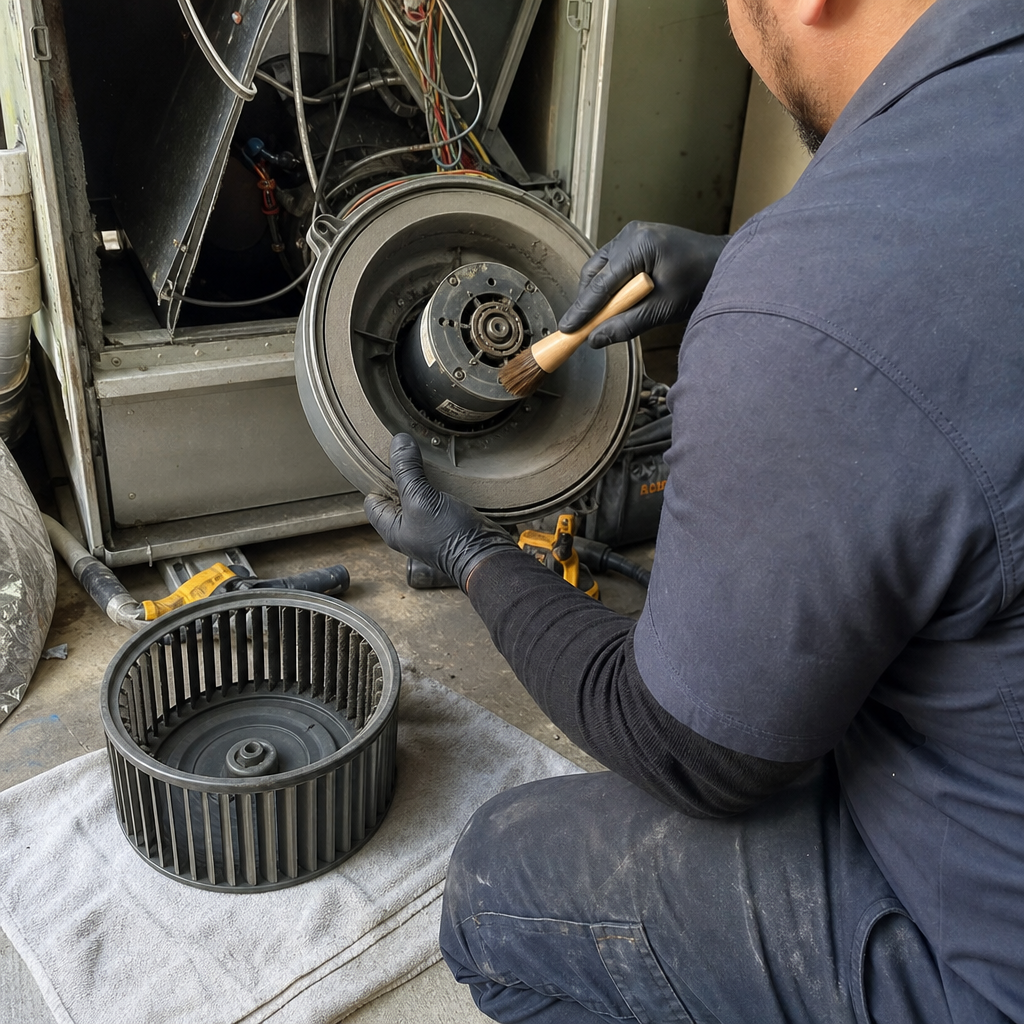
- Blower motor and housing. The blower wheel accumulates debris that reduces airflow and unbalances the assembly. We remove, clean, and reinstall, checking amp draw before and after to verify performance restoration.
- Registers and grilles. Removed, cleaned in place or off-site, and reinstalled. We check for proper fastening and seal with the wall or ceiling surface.
- Filter housing and return plenum. Vacuumed and wiped, with inspection for leaks or damage that would bypass filtration.
- Condensate drain and pan. Cleared of obstruction, treated to prevent biological growth, tested for proper drainage.
Camera inspection before and after is standard on every job. The homeowner sees what we see. No claim without verification.
What we don’t do: apply “sanitizing” chemicals without specific need identified through inspection. The EPA regulates antimicrobial treatments in HVAC systems, and blanket application without cause is both non-compliant and unnecessary. If we identify biological contamination through camera inspection or testing, we discuss specific treatment options with the homeowner before application. Guardsman products are available when appropriate, but we don’t sell fear to sell chemistry.
Most complete cleanings take 4 to 6 hours for a single-system home. Two-system homes with attic and basement units run longer. We schedule realistically and stay until it’s done right.
Your Pre- and Post-Cleaning Checklist for LA Homes
Preparation and follow-through make the difference between a cleaning that lasts and one that needs repeating too soon.
Before your appointment:
- Clear 3 feet of space around the air handler, furnace, and all registers. We need room for equipment and access.
- Note any rooms with weak airflow, unusual odors, or temperature differences. Point these out when we arrive; they’re diagnostic clues.
- If you’ve experienced a recent wildfire smoke event, tell us when and for how long you smelled smoke indoors. This affects our protocol.
- Locate your filter size and current MERV rating. We’ll recommend an upgrade if appropriate.
- Secure pets in a separate room. The equipment is loud and we’ll be opening access points.
After cleaning is complete:
- Run the system for 30 minutes and check each register for balanced airflow. Note any exceptions for our technician before we leave.
- Install the filter upgrade we recommend. For LA homes, this typically means MERV 11 minimum, MERV 13 if anyone in the home has respiratory sensitivity, with activated carbon layer for the first two cycles after smoke exposure.
- Mark your calendar for filter replacement: 60 days for standard MERV 8 to 11, 90 days for MERV 13 and higher (they load faster due to finer filtration).
- Schedule duct sealing if we identified significant leakage. The cleaning benefit degrades quickly if unfiltered air continues entering the system.
- After the next Santa Ana event or wildfire smoke plume, check your filter early. If it’s visibly darkened, replace it regardless of schedule.
Filter recommendations by LA zone:
- Coastal: MERV 11, standard pleated, changed every 90 days; inspect for salt corrosion on metal components annually
- Inland/basin: MERV 13, changed every 60 days; upgrade to MERV 13 with carbon after smoke events
- Foothill/high-altitude: MERV 13 with carbon, changed every 60 days; inspect for rodent damage to filter housing annually
What HVAC Cleaning Costs in Los Angeles
Pricing in the Los Angeles market varies with system complexity, accessibility, and contamination level. These are the ranges we see for legitimate, thorough service:
- Single-system home, standard access: $400 to $700
- Two-system home or complex attic/basement access: $700 to $1,200
- Smoke damage remediation requiring specialized protocol: $800 to $1,500
- Duct sealing (aerosol or mechanical, separate service): $1,200 to $2,500 depending on system size
What affects price legitimately: number of registers, linear feet of ductwork, accessibility (crawl space vs. attic vs. basement), presence of biological contamination requiring specialized treatment, and whether the system has been maintained or neglected.
What shouldn’t affect price: whether you mention a competitor’s coupon, how urgently you need service, or whether you “qualify” for a special rate. A square deal means one honest price, shown before we start. The number on the phone is the number on the invoice.
Standing offers that apply: our $89 Seasonal Tune-Up covers inspection and basic maintenance, not full cleaning, but it’s a starting point if you’re unsure what you need. For repairs identified during service, we offer $50 off any repair over $250. Senior and veteran homeowners receive a permanent 5% discount. And if you have a written estimate from another company, we’ll provide a free second opinion.
Common Mistakes to Avoid
- Accepting a $99 whole-house special. In the Los Angeles market, this is universally a bait price. The technician arrives, finds “mold” or “dangerous buildup,” and the final invoice runs to $800 or more. We’ve responded to dozens of these calls for second opinions; the initial “cleaning” was superficial or never performed.
- Ignoring smoke odor after a fire event. If you smell smoke when the system runs, particulates are present. Standard filter changes won’t remove adhered residue from duct surfaces. Delayed cleaning allows deeper embedding and can permanently stain porous materials.
- Using the cheapest filter that fits. Fiberglass panel filters (MERV 1 to 4) protect equipment from large debris but remove virtually nothing that affects air quality. In LA’s particulate environment, they’re inadequate for occupied spaces.
- Cleaning only registers and visible duct. The blower wheel and evaporator coil are where the most significant accumulation occurs. Surface cleaning without addressing these components leaves the source of redistribution intact.
- Sealing ducts without cleaning first. Aerosol sealant sprayed over debris encapsulates it permanently. Clean first, seal second, in that order.
- Skipping post-cleaning verification. Without camera documentation, you have no proof the work was thorough. We provide before-and-after imagery on every job; any reputable company should.
- Waiting for visible dust at registers. By the time dust is visible, the system is heavily loaded. Schedule based on time and events, not appearance.
When to Call a Professional
Some situations require immediate professional attention rather than scheduled maintenance. Call for service if you smell smoke or burning when the system operates, notice visible mold on registers or in duct openings, experience sudden airflow reduction in multiple rooms, find rodent droppings or evidence in or near ductwork, or have never had the system cleaned and have lived in the home more than 5 years.
After any major wildfire smoke event in your area, schedule inspection regardless of when your last cleaning occurred. The electrostatic nature of smoke particulates means they adhere immediately and become harder to remove with time.
Bellows Air Duct & Vent Co. offers free estimates in Los Angeles. We’ll inspect your system with camera documentation, explain what we find, and provide upfront pricing before any work begins. Call (844) 685-6342 to schedule. Calls are answered by a live person, 24 hours a day.
Frequently Asked Questions
Every 3 to 5 years for routine maintenance, with filter changes every 60 to 90 days depending on your zone and filter type. After wildfire smoke exposure, schedule inspection regardless of elapsed time. Homes in inland Los Angeles with longer cooling seasons typically need the 3-year interval; coastal homes with less particulate load can extend toward 5 years if corrosion is monitored.
Smoke residue itself doesn’t typically damage metal components, but it can permanently stain porous materials like fiberglass duct liner and degraded flex duct insulation. The longer residue remains, the deeper it penetrates. Immediate cleaning after smoke events prevents permanent odor retention and protects sensitive electronic components in modern air handlers. Call (844) 685-6342 for smoke-specific inspection - estimates are free.
Rapid re-dusting usually indicates duct leakage, not inadequate cleaning. If your supply ducts leak, you’re losing conditioned air and creating negative pressure that draws in attic or wall cavity dust. If return ducts leak, you’re pulling unfiltered air directly into the system. In Los Angeles, Santa Ana winds exacerbate this by pressurizing the building envelope. Cleaning without sealing solves the symptom temporarily; sealing addresses the cause.
Air duct cleaning addresses the distribution network: supply and return ducts, registers, and grilles. HVAC cleaning includes the full system: ducts plus the air handler components - evaporator coil, blower motor, housing, and often the condensate system. For complete results, especially in Los Angeles where coils accumulate significant debris during long cooling seasons, full HVAC cleaning is the appropriate service.
No. Our equipment is HEPA-sealed and operates under negative pressure, so dislodged debris is captured at the source, not released into your home. The process is loud, so some homeowners prefer to step out, but it’s not required for safety. We do ask that pets be secured in a separate room during service.
Demand before-and-after camera documentation of the full system path, not just accessible register lines. Verify that blower and coil cleaning were included, not just duct brushing. Check that registers were removed and cleaned, not just wiped in place. In Los Angeles, ask specifically about wildfire smoke protocol if relevant - standard brushing is insufficient for smoke residue. At Bellows, camera verification is standard on every job, and we review findings with you before we leave.
The Bottom Line
Los Angeles homeowners face a specific set of HVAC contamination challenges: wildfire smoke with sub-micron particulates that standard cleaning won’t remove, Santa Ana winds that force unfiltered air through leaky ducts, and construction patterns that limit access and accelerate degradation. Generic cleaning advice doesn’t account for these factors. Effective maintenance requires zone-appropriate scheduling, proper filtration upgrades after smoke events, and thorough service that includes the full air path, not just visible duct runs. The homes that stay cleanest and perform best combine professional cleaning every 3 to 5 years with consistent filter maintenance and duct sealing where leakage is found.
If you’re unsure what your Los Angeles home needs, HVAC Cleaning in Seymour follows similar principles in a different climate context. For local service, call Bellows Air Duct & Vent Co. at (844) 685-6342 for a free estimate. We’ll inspect your system, show you what we find, and give you one honest price before any work begins. No bait coupons, no scare tactics, no surprises on the bill. We’ve worked this way since 1984, and we stand behind it - no paperwork, no arguing - for 90 days on every job.
Written by the team at Bellows Air Duct & Vent Co., serving Los Angeles since 2012.