
Last updated July 25, 2026
Air Duct Cleaning Emergency Preparedness Guide for Los Angeles Homes
Most Los Angeles families have an earthquake kit, a go-bag, and a wildfire evacuation plan. What they don’t have is a protocol for their HVAC system. Here’s the counterintuitive part: the first thing many homeowners do after a wildfire evacuation is walk through the door and turn on the air conditioning to cool down a stuffy house. In those first 20 minutes, the system pulls in ash-laden outside air and drives it through every room via the ductwork. That single decision can turn a surface cleanup into a $3,000-$7,000 full-duct restoration. This guide covers the specific, duct-level decisions that belong in your LA emergency plan, before you ever need them.
Quick Answer
Los Angeles homeowners should shut down their HVAC system immediately upon wildfire warning or earthquake impact, seal return vents with painter’s tape and plastic sheeting, and avoid restarting the system until a camera inspection confirms duct integrity. Post-disaster duct cleaning costs in LA typically range from $450 for localized cleaning to $3,200 for whole-system restoration after wildfire smoke infiltration, and proper pre-event documentation improves insurance recoverability.
Table of Contents
- The Wildfire Shutdown Protocol: What to Do in the First 10 Minutes
- Post-Earthquake Duct Inspection: What Separations and Tears Actually Mean
- Documenting Pre-Event Duct Condition for Insurance Recovery
- What AQI ‘All-Clear’ Does and Doesn’t Tell You About Your Ducts
- The Safe Reopening Sequence for Your LA Home
- How to Find a Legitimate Emergency Duct Contractor Without Getting Price-Gouged
- Common Mistakes to Avoid
- When to Call a Professional
- Frequently Asked Questions
The Wildfire Shutdown Protocol: What to Do in the First 10 Minutes
When the LA County Fire Department issues an evacuation warning or you see the orange glow on the horizon, your HVAC system should be the second thing you shut down after the gas line. Here’s why: modern central air systems in Los Angeles homes move 1,000-1,400 cubic feet of air per minute. That’s enough to pull in fine particulate matter through every gap in your building envelope and distribute it evenly through supply ducts, return plenums, and the evaporator coil.
We’ve been called to homes in Porter Ranch after the Saddleridge Fire and in Pacific Palisades after recent events. The pattern is consistent. Homeowners who left their systems running during evacuation returned to find gray dust coating the interior of duct runs that had been cleaned two years prior. Those who shut down before leaving had surface ash on registers, but the duct interiors were largely intact.
Step-by-Step Shutdown Sequence
- Turn the thermostat to OFF, not just a higher temperature. Cooling mode still runs the fan periodically. Full shutdown stops all air movement.
- Switch off the breaker at the electrical panel. Prevents automatic restart if power fluctuates during the event.
- Cover return vents with painter’s tape and plastic sheeting. Returns are the largest openings and pull air inward. Use 3-mil plastic and seal the perimeter completely. Do not use duct tape; it leaves residue and fails in heat.
- Cover supply registers if time permits, but prioritize returns. Supplies push air out, so they’re less vulnerable to infiltration.
- Close exterior doors and windows, then tape gaps with painter’s tape. This isn’t airtight, but it reduces pressure differentials that drive infiltration.
The order matters. In the Granada Hills and Chatsworth areas, where Santa Ana winds create significant positive pressure on the windward side of homes, sealing the building envelope before shutting the system can actually force contaminated air through duct leaks. System off first, then seal.
After the event, do not restart the system until you’ve completed the inspection sequence outlined below. The instinct to cool down or filter the air is understandable, but running the system before verification risks embedding contamination in porous duct liner or driving it past a damaged filter rack.
Post-Earthquake Duct Inspection: What Separations and Tears Actually Mean
Los Angeles sits on multiple fault systems, and even a moderate seismic event can shift ductwork in ways that aren’t immediately visible. The 1994 Northridge earthquake taught us plenty about structural damage, but less attention went to the duct separations that pulled unconditioned attic air, rodent droppings, and fiberglass insulation directly into living spaces for months afterward.
In our work across the San Fernando Valley and Westside, we regularly find earthquake-damaged ducts that homeowners never connected to their ongoing respiratory issues, elevated energy bills, or persistent dust problems.
What to Check Before Restarting Your System
- Metal duct separations at joints: Look for gaps where round branch lines connect to the main trunk, especially at flex-to-metal transitions. Even a 1/2-inch gap pulls significant unfiltered air.
- Flex duct tears and kinks: The flexible duct common in LA homes from the 1970s through 1990s tears at stress points after seismic movement. A tear in an attic run pulls 140-degree summer air and whatever’s in the insulation layer.
- Duct liner degradation: Older lined metal duct, still present in many Mid-Century and Ranch-style homes from Sherman Oaks to Pasadena, can delaminate after vibration. The liner itself becomes a contaminant source.
- Filter rack and return air pathway integrity: Check that the filter sits squarely in its track and that the return plenum hasn’t pulled away from the air handler. A compromised return path bypasses filtration entirely.
- Condensate drain and pan: Earthquake movement can crack condensate pans or dislodge drain lines. Running the system with a cracked pan risks water damage and mold amplification in the duct system.
Connection separations are the most common and most consequential issue. A separated return duct in a crawl space doesn’t just waste energy; it pulls in soil gas, moisture, and whatever pests have been active below the floor. In coastal LA neighborhoods like Venice and San Pedro, where crawl spaces tend to be damp, this can trigger rapid microbial growth on the coil and in the plenum.
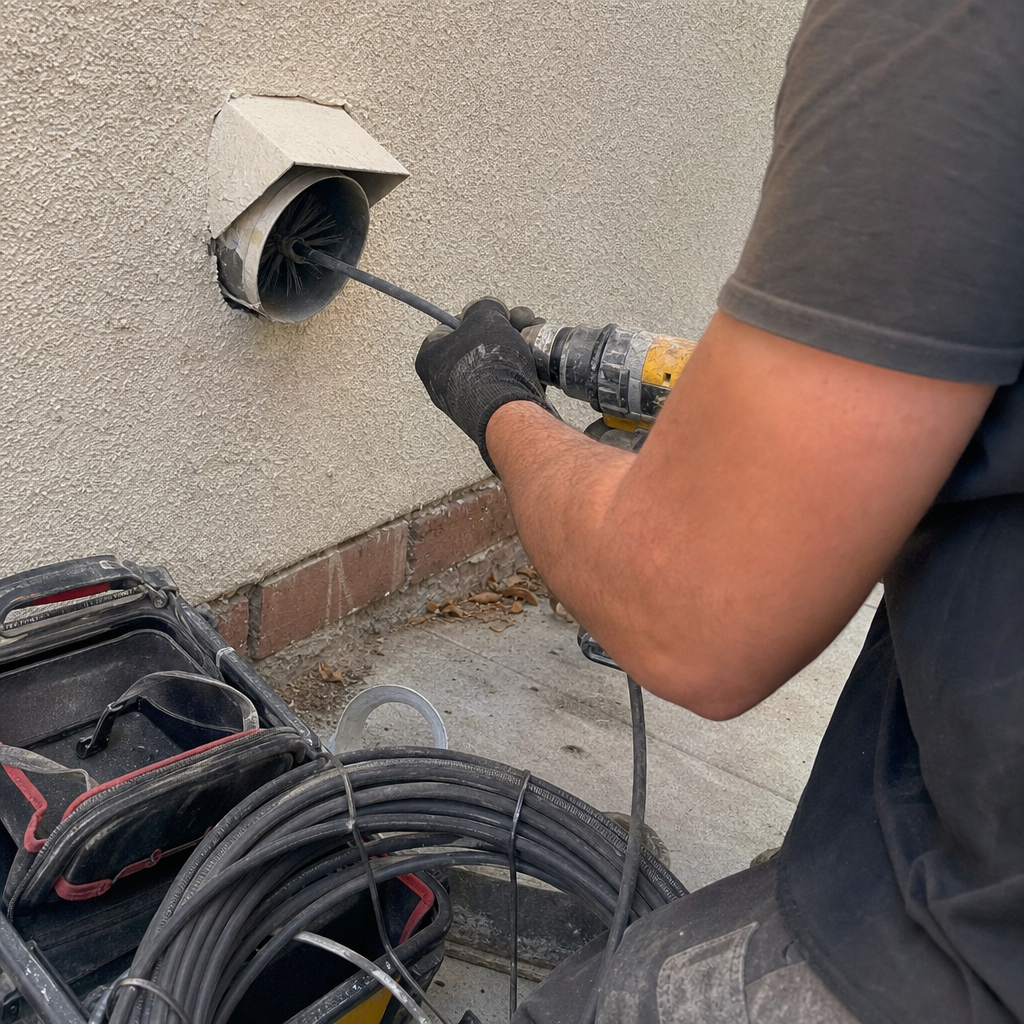
We use Rotobrush camera systems to inspect these areas because visual access is typically limited. A camera run through the main trunk and branch lines reveals separations, standing water, liner damage, and post-event contamination that a flashlight and mirror simply cannot.
Documenting Pre-Event Duct Condition for Insurance Recovery
Here’s something most Los Angeles homeowners learn too late: standard homeowner’s insurance may cover post-disaster duct cleaning, but only if you can demonstrate that the condition resulted from the covered event. Without pre-event documentation, insurers routinely classify duct contamination as “maintenance” or “pre-existing” and deny the claim.
The documentation protocol is straightforward and takes about 30 minutes. Do it now, before you need it.
Pre-Event Documentation Checklist
- Photograph every register and return grille with a dated newspaper or phone timestamp visible. Capture the interior of the duct through the opening if possible.
- Photograph the air handler, filter, and filter rack with the current filter in place and the date visible.
- Retain invoices for any professional duct cleaning or HVAC service from the past five years. These establish maintenance history and pre-event condition.
- Request a camera inspection with video file delivery from a qualified contractor. The video file itself, with metadata intact, is stronger evidence than still photos.
- Store copies in cloud storage and physical off-site location. Your earthquake kit or a safe deposit box works.
In the Los Angeles market, we’ve seen post-wildfire duct cleaning claims range from $1,800 to $6,400 depending on system size and contamination severity. Insurers who accepted claims had clear pre-event documentation showing clean ducts before the fire. Those who denied claims typically cited lack of evidence that the condition wasn’t pre-existing.
One note on documentation timing: if you’re reading this during fire season and haven’t documented yet, do it this week. October through December is peak Santa Ana wind and wildfire risk in Southern California. The Bellows Air Duct & Vent Co. home page has scheduling for camera inspections if you need professional documentation with video files suitable for insurance submission.
What AQI ‘All-Clear’ Does and Doesn’t Tell You About Your Ducts
After a wildfire, Angelenos watch Air Quality Index readings religiously. When AQI drops back below 100, then below 50, there’s understandable relief. But AQI measures ambient outdoor air. It says nothing about what’s inside your ductwork.
Here’s the distinction that matters. AQI is calculated from ground-level monitoring stations measuring PM2.5, PM10, ozone, and other criteria pollutants. Your ducts are a closed (or semi-closed) system. If they pulled in smoke-laden air while the system was running, that contamination doesn’t dissipate when outdoor AQI improves. It sits in the duct interior, on the coil, in the plenum, and on the blower wheel. Every subsequent system cycle re-suspends a portion of it.
We’ve inspected ducts in Calabasas and Thousand Oaks two weeks after wildfire AQI had returned to “Good.” Camera footage showed thick, oily residue on duct walls, the characteristic signature of wildfire smoke that had condensed inside the system. The homeowners had been running their systems normally, assuming the air was clean because the app said so.
What AQI All-Clear Actually Means
- Outdoor air has returned to acceptable particulate levels
- New infiltration through windows and doors is less hazardous
- It does NOT mean your ducts are clean
- It does NOT address smoke residue that has adhered to duct surfaces
- It does NOT indicate whether your filter captured the event or was overwhelmed
The safe approach: treat AQI all-clear as a signal to begin your verification process, not to resume normal operation. This means visual register inspection, filter replacement, and ideally a camera inspection of the main trunk before restarting full operation. In areas with heavy smoke exposure, like the hills above Glendale or Burbank where fires tend to stall and linger, we recommend full professional assessment even when AQI has been green for a week.
Professional-grade assessment uses equipment from manufacturers like Nikro and Honeywell for particulate measurement and video documentation. A handheld particle counter at the supply register, compared to ambient indoor readings, will tell you immediately whether your ducts are re-suspending contamination. We’ve seen differentials of 400% or more in post-fire systems that “looked fine” to the homeowner.
The Safe Reopening Sequence for Your LA Home
Returning home after evacuation is emotional. You want normal back. The structured reopening sequence below protects your duct system from the decisions that cause lasting damage.
Phase 1: Exterior and Utility Assessment (Before Entering)
- Check for structural damage, gas odor, or electrical hazards from the exterior. Do not enter if present.
- Verify gas meter and electrical service are intact. If the gas was shut off at the meter, leave it off until the gas company inspects.
- Check the outdoor condensing unit for physical damage, debris accumulation, or ash buildup on coils. Do not power on if damaged.
Phase 2: Interior Walk-Through Without HVAC
- Enter with N95 or better respiratory protection if ash is visible.
- Open windows and doors to cross-ventilate with outdoor air. Yes, even if AQI isn’t perfect. You want to flush the building envelope before closing it up and running mechanical systems.
- Remove plastic sheeting from returns and registers. Inspect visible duct openings for ash accumulation, water staining, or physical damage.
- Replace the HVAC filter with a new, properly-sized pleated filter. Do not use the highest MERV rating available; overspecified filters strain blowers and can fail to seat properly in damaged racks. MERV 8-11 is appropriate for post-event use until full inspection.
Phase 3: Controlled System Test
- Turn the thermostat to FAN ONLY, not cooling or heating. This tests blower operation and air movement without engaging the coil or heat exchanger.
- Run for 15 minutes while monitoring for unusual odors, sounds, or visible dust emission from registers.
- Shut down and inspect the new filter. Heavy loading or discoloration indicates significant duct contamination.
- If the filter is clean and operation seems normal, proceed to cooling or heating mode for a 30-minute test, then re-inspect.
In the Hollywood Hills and Silver Lake areas, where many homes have been renovated multiple times with additions and system modifications, the controlled test is especially important. We’ve found undocumented duct additions, unsealed return pathways, and even disconnected flex runs in renovated homes that performed adequately under normal conditions but failed catastrophically under post-event stress.
If any phase reveals contamination, damage, or abnormal operation, stop and schedule professional inspection before proceeding. The cost of a service call is negligible compared to embedding contamination deeper or damaging equipment through continued operation.
How to Find a Legitimate Emergency Duct Contractor Without Getting Price-Gouged
Disaster events attract operators who see opportunity in chaos. After the Woolsey Fire, we heard from homeowners in Malibu and Agoura Hills who paid $800-$1,200 for “emergency duct sanitizing” that consisted of a fogger application through the registers with no mechanical cleaning, no camera inspection, and no verification. The contamination remained; the invoice was real.
Here’s how to distinguish legitimate emergency-response contractors from opportunists in the Los Angeles market.
What to Ask Before Hiring
- “Can you show me camera footage of my ducts before you quote work?” A legitimate contractor has the equipment and will use it. Refusal is a red flag.
- “What does your price include, specifically?” Get line items: number of vents, trunk line cleaning, coil cleaning, blower service, sanitizer application if any. Vague scope invites add-ons.
- “Are you licensed by the California State License Board, and what’s your classification?” Duct cleaning falls under C-20 (Warm-Air Heating, Ventilating and Air-Conditioning) or B (General Building) with appropriate specialty. Verify at cslb.ca.gov.
- “Do you carry general liability and workers’ compensation insurance?” Ask for certificate of insurance. Uninsured contractors working in your attic or crawl space expose you to liability.
- “What equipment do you use for mechanical agitation and extraction?” Look for specific brand names and methods: Rotobrush contact cleaning, Nikro HEPA vacuums, Abatement Technologies negative air systems. “We use professional equipment” is not an answer.
- “Can you provide a written estimate before work begins, with no price change at the door?” The estimate should match the final invoice. Period.
What to Refuse
- Same-day “sanitizing” without mechanical cleaning or inspection
- Pressure to decide immediately due to “emergency pricing”
- Quotes given over the phone without site visit or camera inspection
- Requests for large cash deposits or payment to individual rather than company
- Coupons or discounts that require immediate commitment to redeem
The legitimate emergency-response contractor in Los Angeles will answer your call with a live person, schedule inspection within 24-48 hours of major events, provide camera documentation, and present upfront pricing with no variation. We’ve operated this way for over 42 years because it’s the only way that doesn’t require calling customers back to fix problems we created.
Standing offers remain available even after events: $50 Off Any Repair Over $250, Free Second Opinion on Any Written Estimate, $89 Seasonal Tune-Up, and the permanent 5% Senior and Veteran discount. These don’t change because of smoke in the air.
Common Mistakes to Avoid
- Running the system to “clear the air” after wildfire return. This is the single most damaging post-event decision. The system doesn’t clear air; it distributes contamination. Use window ventilation first, mechanical systems only after verification.
- Assuming a new filter fixes everything. Filters protect the equipment and catch some particulate. They do not clean duct walls, coils, or blower components where smoke residue adheres.
- Ignoring flex duct in older LA homes. The orange or gray flex duct common in 1970s-1990s construction degrades faster than metal and is more vulnerable to seismic damage. It needs specific inspection, not assumption.
- Waiting for visible dust at registers. By the time contamination is visible at supply registers, it’s heavily distributed throughout the system. Early camera inspection catches problems before they propagate.
- Accepting “sanitizing” as equivalent to cleaning. Fogging or UV treatment without mechanical removal of contamination is cosmetic. The particulate remains; the odor is merely masked temporarily.
- Failing to document for insurance before the next event. The time to photograph and video your ducts is now, when they’re clean and undamaged. After the event, it’s too late to prove pre-existing condition.
- Hiring based on who shows up first after a disaster. Speed matters, but verification matters more. A 48-hour wait for a qualified contractor beats immediate service that makes the problem worse.
When to Call a Professional
Call for professional assessment if your home was in an evacuation zone, if you ran your HVAC system during or immediately after a wildfire, if you feel unusual vibration or hear new noises from ductwork after seismic activity, or if you detect persistent odors, elevated dust, or respiratory irritation when the system operates. These symptoms indicate duct-level contamination or damage that DIY inspection cannot fully assess.
Specific scenarios that warrant immediate professional attention: visible ash or soot at multiple registers; water staining around ceiling registers after earthquakes; musty or smoky odors when the fan cycles; temperature inconsistency between rooms that developed after an event; or any indication that unconditioned air is entering the system from attic, crawl space, or wall cavities.
Bellows Air Duct & Vent Co. offers free estimates in Los Angeles. Our technicians arrive with camera inspection equipment, provide video documentation you can keep, and present upfront pricing before any work begins. Call (844) 685-6342 to schedule. Calls are answered by a live person 24 hours a day, and most inspections are completed in a single visit.
Frequently Asked Questions
Post-wildfire duct cleaning in Los Angeles typically ranges from $450 for localized register and trunk cleaning in small homes to $3,200 for whole-system restoration including coil, blower, and sanitizer application in larger homes with heavy smoke infiltration. The variation depends on system size, contamination severity, and whether the system was operated during the event. Call (844) 685-6342 for an exact quote - estimates are free.
Homeowners can replace filters, vacuum register surfaces, and seal visible gaps with mastic or metal tape, but interior duct cleaning requires professional equipment with HEPA containment and mechanical agitation. More importantly, post-event inspection with a camera system is necessary to identify separations, liner damage, or contamination that isn’t visible from registers. For safety and insurance documentation, professional assessment is the sound approach.
Many California policies cover post-wildfire duct cleaning as part of smoke damage restoration, but coverage depends on demonstrating that the condition resulted from the covered event. Pre-event documentation, including dated photos, service invoices, and camera inspection video, significantly improves claim success. Without documentation, insurers often classify duct contamination as maintenance. We recommend reviewing your specific policy with your agent and maintaining annual documentation.
Wait until you’ve completed visual register inspection, replaced the filter, and ideally had a camera inspection of the main trunk line. In the Los Angeles area, where wildfire smoke can be particularly oily and adhesive due to vegetation type and structure combustion, we recommend professional verification before resuming normal operation. The outdoor AQI reading alone is not sufficient indicator of duct safety.
Common earthquake damage includes separated joints where round branch lines meet the main trunk, tears or kinks in flexible duct runs, delamination of internal duct liner in older metal ducts, and separation of return plenums from air handlers. In Los Angeles homes with raised foundations or crawl spaces, seismic movement often affects the return pathway more severely than supply lines. Camera inspection is the only reliable detection method for most of these conditions.
Verify California State License Board registration, request a certificate of insurance, insist on camera inspection before quoting, demand written upfront pricing with no door changes, and ask for specific equipment brands and methods. Legitimate contractors answer calls with live people, schedule inspections promptly without pressure, and provide documentation you can keep. Refuse operators who demand immediate cash payment, quote by phone without seeing the system, or offer “sanitizing” as a standalone solution without mechanical cleaning.
The Bottom Line
Your HVAC system is the respiratory system of your home. In Los Angeles, where wildfire and earthquake risks are not theoretical, protecting that system belongs in your emergency plan alongside water, flashlights, and evacuation routes. The critical actions are simple: shut down immediately, seal returns, document pre-event condition, verify before restarting, and hire based on verification capability rather than speed or price. The cost of preparation is modest. The cost of getting it wrong, in dollars and in health, is not.
Written by the team at Bellows Air Duct & Vent Co., serving Los Angeles since 2012.