
Last updated July 25, 2026
Air Quality & Sanitizing Maintenance Schedule: What to Do and When
Changing your air filter on schedule but never cleaning the coil it feeds is like changing your engine oil without ever changing the oil filter. You’re maintaining one part of a system while letting the adjacent part degrade. In Los Angeles, where we run cooling systems eight months of the year and heating through brief but sharp winter nights, this kind of partial maintenance shows up as higher energy bills, musty airflow, and the kind of dust that resettles within hours of cleaning. This guide maps the full layered system: filtration, coil and drain pan, duct interior, and humidity control, with specific tasks tied to Connecticut’s four seasons and the event-triggered cleanings most homeowners forget.
Quick Answer
A complete air quality and sanitizing maintenance schedule for a Los Angeles home includes four synchronized layers: replace or clean filters every 1-3 months depending on type; inspect and clean the evaporator coil and condensate drain pan annually; have the full duct system professionally cleaned and sanitized every 3-5 years; and service humidifiers, dehumidifiers, and ventilation equipment annually. In Los Angeles’s dry-summer, damp-winter climate, spring and fall are the critical pivot seasons when the full system should be inspected before heavy cooling or heating demand begins.
Table of Contents
- Why Air Quality Maintenance Fails
- The Four-Layer System
- Season-by-Season Schedule for Los Angeles
- Event-Triggered Cleanings Homeowners Forget
- The Filter Upgrade Trap
- The Documentation Habit
- Common Mistakes to Avoid
- When to Call a Professional
Why Air Quality Maintenance Fails
Most homeowners we meet in Los Angeles neighborhoods like Silver Lake, Pasadena, and the San Fernando Valley are not neglectful. They’re busy, and they’ve been sold a fragmented story. One company sells them a fancy filter subscription. Another pitches duct cleaning every spring. Their HVAC contractor mentions coil cleaning as an add-on during a repair call. Nobody connects these into a single system that breathes together.
The result is predictable. A homeowner installs a MERV 13 filter in March, proud of the upgrade, and by August the evaporator coil is choked with restriction-forced debris because the air handler was never designed for that density. Or the ducts were cleaned beautifully in 2019, but the condensate pan has been growing microbial film ever since, sending spores through those same clean ducts every cooling cycle. In our 42 years, we’ve returned to homes where the ducts were spotless but the air smelled stale because the maintenance was layered in isolation, not integration.
The fix is a single schedule that treats filtration, coil and drain, duct interior, and humidity control as interdependent. What follows is that schedule, built for Los Angeles’s specific climate demands and the real rhythms of homeownership.
The Four-Layer System
Think of your home’s air quality as a stack. Each layer protects the one below it. When any layer falls behind, the others compensate until they fail.
Layer 1: Filtration (Monthly to Quarterly)
Filters are your first and most frequent line of defense. In Los Angeles, where Santa Ana winds can drive pollen and dust through older window seals, and where wildfire smoke has become a recurring summer concern, filter attention is not optional.
- 1-inch fiberglass or pleated disposable filters: check monthly, replace every 1-2 months during heavy use seasons
- 4-5-inch media filters (often in dedicated cabinets): inspect quarterly, replace every 6-12 months depending on load
- Washable electrostatic filters: clean monthly with gentle water flow, allow full drying before reinstalling
- HEPA or high-MERV upgrades: see the filter trap section below before installing
The critical habit is not just replacement but observation. Note the color and density of debris when you remove a filter. A filter that clogs in three weeks instead of three months signals a problem upstream (duct leakage pulling attic dust) or downstream (coil degradation forcing longer run times).
Layer 2: Coil and Drain Pan (Annual)
The evaporator coil sits in your air handler or furnace plenum, and it is the most neglected component in residential HVAC. In Los Angeles, where cooling runs hard from May through October, this coil stays wet for months. A wet surface with slow airflow breeds biofilm, the slimy microbial layer that no filter can stop because it grows after the filter.
Annual professional cleaning of the coil and treatment of the condensate drain pan is the standard. Between professional visits, pour a cup of white vinegar down the condensate drain line every spring to suppress algae. If you notice water pooling below the air handler or smell mustiness at startup, the pan or drain is already compromised.
We use Nikro and Abatement Technologies equipment for coil access and cleaning, because proper reach into a residential plenum requires tools most homeowners do not own. The camera inspection we perform before and after shows the difference: a clean coil reflects light evenly, a dirty one shows darkened fins and buildup between rows.
Layer 3: Duct Interior (Every 3-5 Years)
Ducts are not self-cleaning. Over years, the fine particulate that passes filters settles in low-velocity sections: the long horizontal runs, the drops to floor registers, the return plenum where air slows before entering the filter. In Los Angeles’s older neighborhoods, homes built before 1980 often have unlined metal ductwork with decades of accumulated residue, while post-1990 homes may have flex duct that degrades internally if moisture ever entered the system.
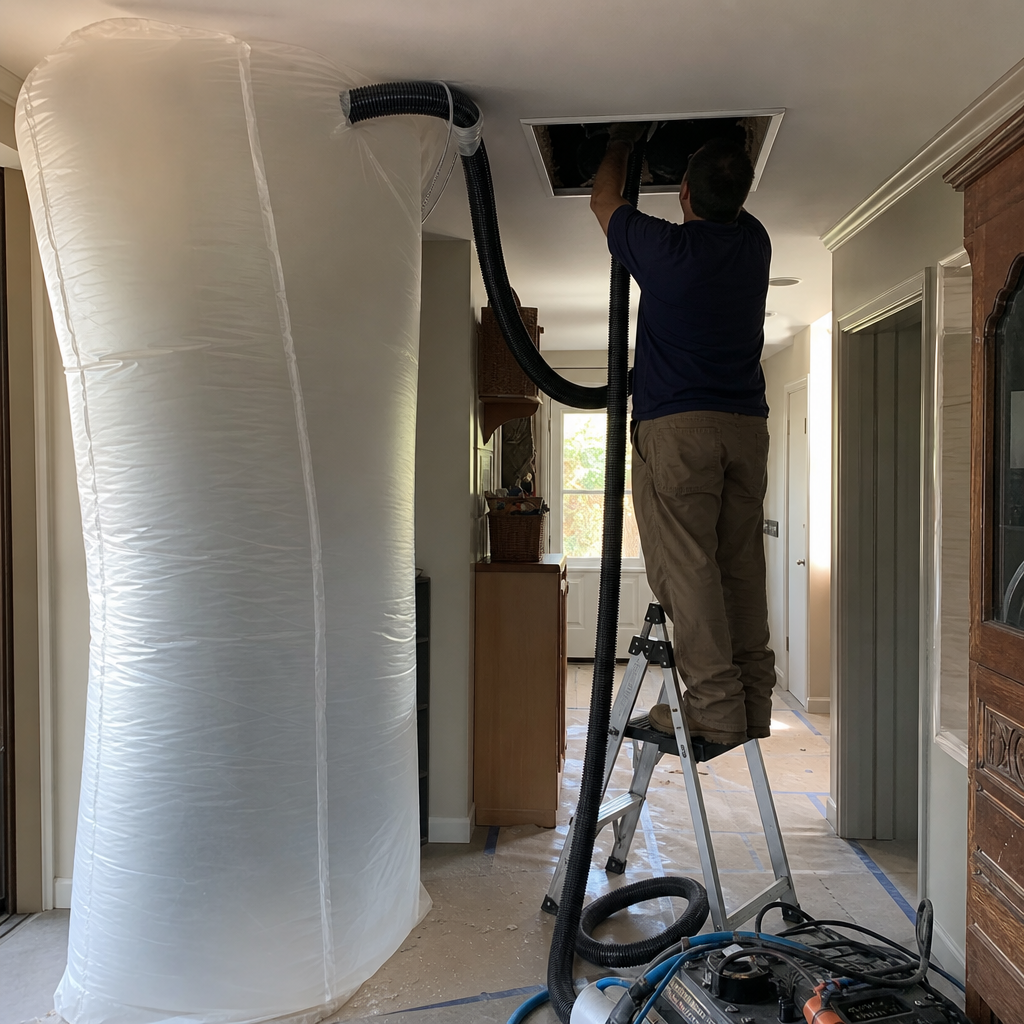
Professional duct cleaning with rotary brush systems and HEPA-filtered negative air machines removes this accumulation. Sanitizing, applied after mechanical cleaning, addresses microbial growth that mechanical agitation alone cannot eliminate. The 3-5 year interval assumes normal occupancy and no exceptional events. Homes with pets, recent renovations, or occupants with respiratory sensitivity may need more frequent service.
Air Duct Cleaning in Seymour follows this same layered protocol, adapted to local conditions.
Layer 4: Humidity and Ventilation (Annual)
Los Angeles’s climate is drier than much of the country, but the pattern matters. Summer outdoor humidity often drops below 30%, while winter rains and marine layer push indoor humidity above 60% in poorly ventilated homes. Whole-house humidifiers attached to furnaces need pad or steam canister replacement and scale removal annually. Dehumidifiers in basements or crawl spaces need coil cleaning and drain verification. Energy recovery ventilators (ERVs) and heat recovery ventilators (HRVs) need filter and core inspection.
Humidity control is where air quality and building durability intersect. Too dry in winter: wood cracks, static builds, respiratory membranes suffer. Too damp in winter: mold colonizes, dust mites proliferate. The equipment that manages this is out of sight and often out of mind until it fails.
Season-by-Season Schedule for Los Angeles
Los Angeles’s Mediterranean climate gives us distinct seasonal demands. Aligning maintenance to these transitions prevents the emergency calls that come when neglected systems break under first heat wave or first cold snap.
Spring (March-April): Startup Inspection
- Replace all filters before the first cooling cycle
- Inspect outdoor condenser coils for debris from winter storms; clear vegetation to 18 inches
- Test condensate drain flow with a cup of water
- Schedule professional coil and pan cleaning if not done in the previous 12 months
- Verify thermostat programming and consider whether summer wildfire season demands higher-grade filtration
Spring in Los Angeles brings the last of the winter rains and the first Santa Ana wind events. Pollen from valley oaks and urban landscaping peaks in April. A clean system starting this season handles the load without strain.
Summer (May-September): Humidity Monitoring and Filter Vigilance
- Check 1-inch filters monthly; 4-inch media filters at 60-day intervals
- Monitor indoor humidity: target 30-50%
- After wildfire smoke events, inspect filters immediately and replace even if early in cycle
- Listen for changes in blower tone or extended run times, which signal coil restriction
- Verify that condensate drain remains clear through peak cooling load
Los Angeles summers are long and dry, but coastal neighborhoods like Venice and San Pedro see marine layer humidity that stresses systems differently than the San Fernando Valley’s dry heat. The maintenance task is the same; the observation points differ.
Fall (October-November): Pre-Heating Transition
- Replace filters before heating season begins
- Inspect furnace burners and heat exchanger area for dust accumulation
- Test humidifier operation if equipped; replace pads or clean steam canisters
- Schedule duct inspection if 3-5 years have passed since last cleaning
- Verify carbon monoxide detectors and consider combustion safety review
Fall is the forgotten season in Los Angeles. We coast through September heat, then a November cold snap reminds us the furnace exists. Systems that start cold after six months of disuse are the ones that fail conspicuously.
Winter (December-February): Combustion Safety and Ventilation
- Monitor filter condition; heating airflow is lower velocity and less forgiving of restriction
- Verify that humidifier maintains 30-40% without overloading
- Inspect bathroom and kitchen exhaust fans for airflow degradation
- After rain events, check for any water intrusion near ductwork or air handler location
- Schedule any deferred maintenance before spring demand returns
Los Angeles winters are mild but punctuated by sharp cold nights when heating runs continuously for 48 hours. Systems marginal in fall fail under this load. The combustion safety review, checking for proper venting and heat exchanger integrity, is the task that protects against the hazards winter can bring.
Event-Triggered Cleanings Homeowners Forget
Beyond the seasonal rhythm, specific events should trigger immediate additions to your maintenance schedule. These are the ones that separate homes with consistently clean air from those that cycle through mysterious problems.
Post-Renovation Cleaning
Drywall dust is the enemy of HVAC systems. The gypsum particulate is fine enough to pass standard filters in the first weeks after construction, then it settles in ducts and on coils where moisture converts it to a cement-like film. In Los Angeles’s active renovation market, we’ve cleaned systems in homes where a kitchen remodel three years prior was still showing in the duct camera. The rule: professional duct and coil cleaning within 30 days of substantial renovation completion, before the dust has fully migrated.
Post-Pest-Activity Sanitizing
Rodents in attics or crawl spaces leave more than droppings. They establish scent trails and pheromone markers that attract subsequent pests. Standard duct cleaning removes debris; sanitizing with appropriate agents breaks these biological signals. In Los Angeles, where roof rats are a documented urban problem from Highland Park to the Westside, this is not a rare scenario. If you’ve had pest activity anywhere near ductwork, schedule cleaning and sanitizing before sealing entry points, or you’re trapping the problem inside.
Post-Flooding Protocol
Water in a duct system, from roof leaks, plumbing failures, or the rare but real Los Angeles flash flood, creates immediate microbial risk. Do not restart the HVAC system until the affected ductwork has been opened, dried, and inspected. Running air through wet ducts distributes contaminants throughout the home. This is non-negotiable: water plus darkness plus organic material equals growth within 48-72 hours.
New Occupancy
Moving into a home with unknown maintenance history? Treat it as a post-event scenario. Schedule full system inspection, duct camera review, and coil assessment before relying on the previous owner’s schedule, which may not exist.
The Filter Upgrade Trap
This is the mistake we see most often, and it is well-intentioned. A homeowner reads that MERV 13 filters capture virus particles and wildfire smoke particulate. They install one in a 15-year-old air handler never designed for that restriction. Six months later, the blower motor is straining, the coil is icing in summer, and the energy bill has climbed 20%.
Filter selection must match system capacity. Here’s the practical framework:
- MERV 1-4: basic protection, minimal restriction, suitable for any system
- MERV 5-8: better residential filtration, appropriate for most standard air handlers
- MERV 9-12: enhanced filtration, verify blower capacity with your HVAC contractor before installing
- MERV 13-16: high efficiency, requires engineered system compatibility; may need blower modification or filter cabinet upgrade
- HEPA: typically requires standalone air purifier or dedicated bypass system, not a standard return grille
If you want better filtration and your system cannot handle the restriction, the correct path is a 4-5 inch media filter cabinet (brands like Honeywell and Aprilaire make widely compatible units) installed by a professional, or a dedicated HEPA bypass purifier. Forcing a high-MERV filter into undersized return grilles is maintenance theater: it looks responsible while damaging the system it pretends to protect.
Our $89 Seasonal Tune-Up includes airflow measurement and filter suitability assessment. We’ll tell you honestly whether your system can handle an upgrade or needs a different approach.
The Documentation Habit
A maintenance schedule only works if you know what was done when. The homeowners who never call us in crisis keep a simple log. The ones with mysterious recurring problems cannot tell us when the ducts were last cleaned or what filter size they actually need.
Your log needs four columns:
- Date: when the task was performed
- Task: filter change, coil cleaning, duct service, humidity equipment service, etc.
- Details: filter brand and MERV rating, observations (dust load, unusual smells, noise changes), technician name and company if professional
- Next Due: the date this task should recur
Keep this log with your HVAC warranty paperwork. If a compressor fails at year 9 of a 10-year warranty and the manufacturer questions whether maintenance was adequate, your dated filter receipts and service invoices are evidence of diligence. We’ve seen warranty claims approved on documentation that took five minutes per entry to maintain.
Digital or paper does not matter. Consistency does. The refrigerator door works fine.
Common Mistakes to Avoid
- Replacing filters but never inspecting the return grille and duct boot. The filter sits in a frame that collects dust on its upstream side. That dust bypasses the filter at the edges and feeds directly into the blower. In Los Angeles’s older homes with retrofit central air, these gaps are common.
- Cleaning ducts without cleaning the coil. You’re sending clean air through a contaminated heat exchanger. The result is temporary improvement followed by rapid recontamination. Always pair these services or sequence them within the same season.
- Ignoring the condensate drain until water appears. By the time you see water, the pan has been compromised and microbial growth is established. Annual proactive cleaning prevents the emergency.
- Installing the highest MERV filter the hardware store stocks. As detailed above, this damages systems. The correct filter is the best filtration your blower can move air through without strain.
- Scheduling duct cleaning based on calendar alone, ignoring events. A home that had major renovation in year 2 of a 5-year duct cycle needs service now, not in three years. The schedule is a baseline, not a prison.
- Neglecting to run bathroom and kitchen exhaust fans. These remove moisture and pollutants at the source. In Los Angeles’s tighter modern homes, their role in overall air quality is larger than the duct system itself.
- Assuming a new home needs no attention. New construction ductwork often contains construction debris, and commissioning crews rarely clean thoroughly. Schedule initial inspection within the first year.
When to Call a Professional
Some maintenance is homeowner work. Filter changes, visual inspections, and basic observations are within most people’s capacity. But coil cleaning requires specialized access tools and chemical knowledge. Duct cleaning requires rotary brush systems and negative air containment that rental units rarely replicate. Combustion safety review requires measurement instruments and training.
Call a professional when you observe: persistent musty odors after filter changes; visible mold anywhere in the system; water staining or corrosion near the air handler; ice formation on refrigerant lines in summer; uneven heating or cooling between rooms that worsens over time; or any ductwork damage from pests, renovation, or water.
Bellows Air Duct & Vent Co. offers free estimates in Los Angeles. Our technicians arrive in uniform, with background checks verified, and every job starts with a camera inspection so you see what we see before any work begins. The price we quote is the price on the invoice. Call (844) 685-6342 to schedule.
Frequently Asked Questions
Every 3-5 years for typical residential occupancy, with shorter intervals for homes with pets, recent renovations, or occupants with allergies or respiratory conditions. Los Angeles’s dry climate reduces some microbial risks but increases dust accumulation, particularly during Santa Ana wind events and wildfire seasons.
Surface cleaning of visible register areas is fine, but full duct sanitizing requires professional equipment to apply agents safely and verify coverage. Improper application can leave chemical residues or miss contaminated sections entirely. We use camera verification to confirm complete treatment.
A properly fitted MERV 13 or higher can capture fine particulate, but only if your air handler can handle the restriction without damage. For systems that cannot, a standalone HEPA purifier in occupied rooms is the safer choice. During severe smoke events, no filter eliminates the need to keep windows closed and minimize outdoor air intake.
This typically indicates microbial growth on the evaporator coil or in the condensate pan, where moisture and organic material combine during the cooling season. The smell is most noticeable at startup because the initial airflow disturbs the biofilm. Annual coil and pan cleaning eliminates this.
Yes, if the HVAC system was active during construction. Drywall dust and construction particulate enter return grilles and settle in ductwork, then redistribute for months. Even with system shutdown, pressure changes during active work can draw debris into ducts. Schedule cleaning within 30 days of project completion.
We maintain a permanent 5% Senior and Veteran discount on all services, applied upfront with no paperwork required beyond standard verification. We also offer $50 off any repair over $250, a free second opinion on any written estimate, and our $89 Seasonal Tune-Up for system inspection and filter suitability assessment.
The Bottom Line
Air quality maintenance is a system, not a checklist. The filter, coil, ducts, and humidity control must stay synchronized or the whole system degrades. In Los Angeles’s demanding climate, with long cooling seasons, wildfire smoke exposure, and sharp winter transitions, the homeowners who thrive are those who treat these layers as interdependent and document their diligence. Start with the seasonal schedule, add event-triggered cleanings when life intervenes, choose filters your system can actually handle, and keep a simple log. The reward is air you don’t think about because it’s simply clean, and a system that runs without the emergency calls that break budgets and patience.
Bellows Air Duct & Vent Co. home | Dryer Vent Cleaning in Seymour | HVAC Cleaning in Seymour
Ready to get your maintenance schedule on track? Call (844) 685-6342 for a free estimate. We’ll inspect your system with our camera, show you exactly what we find, and quote one honest price before any work begins. Done right, and backed in writing for 90 days.
Written by the team at Bellows Air Duct & Vent Co., serving Los Angeles since 2012.