
Last updated July 25, 2026
Air Quality & Sanitizing Warning Signs Every Homeowner Should Know
Here’s something we hear almost weekly from Los Angeles homeowners: “We thought it was just allergies.” After twenty, thirty, sometimes forty years in the same house, people learn to live with headaches that clear up on vacation, congestion that worsens after the furnace kicks on, and a persistent fatigue nobody can diagnose. The Environmental Protection Agency estimates indoor air can be two to five times more polluted than outdoor air, yet most homeowners never connect their symptoms to the ductwork hidden behind walls. In this guide, we’ll show you the physical warning signs your home’s air distribution system is working against your health, not for it, and when professional assessment is the only responsible next step.
Quick Answer
Poor indoor air quality warning signs fall into three categories: occupant symptoms that correlate with HVAC operation (headaches, congestion, eye irritation when the system runs), visible system conditions (dark streaking around vents, standing water, musty odors), and behavioral patterns (feeling better with windows open, new occupants experiencing symptoms). The most urgent sign requiring immediate professional contact is a sweet or chemical odor from registers, which can indicate heat exchanger or refrigerant problems.
Table of Contents
- The Symptom Timing Most Homeowners Miss
- Visible Warning Signs Inside Your System
- When Everyone Adapts and Nobody Notices
- The New-Occupant or New-Pet Trigger
- Odors That Demand Immediate Professional Contact
- How System Age and Los Angeles Climate Compound the Problem
- What Professionals Check That Homeowners Cannot
- Common Mistakes to Avoid
- When to Call a Professional
- Frequently Asked Questions
- The Bottom Line
The Symptom Timing Most Homeowners Miss
If everyone in your house feels better on days when the windows are open and the HVAC isn’t running, that’s not a coincidence. That’s a diagnostic clue your system is distributing something it shouldn’t be.
We’ve been in thousands of Los Angeles homes over 42 years, and the pattern is remarkably consistent. Homeowners track pollen counts, buy expensive air purifiers for individual rooms, and change their diets before they ever consider that the forced-air system itself is the delivery mechanism for their symptoms. The critical insight is timing. Symptoms that appear or worsen within 30 minutes of the furnace or air conditioner cycling on, then diminish when the system shuts off, point directly to duct-distributed contamination rather than ambient outdoor air quality.
Consider what happens in a typical Los Angeles home during our mild spring days. Windows open, HVAC off - everyone breathes easier. Evening comes, temperatures drop into the fifties, the furnace kicks on - within the hour, someone’s eyes are itching, someone’s head is pounding, someone’s asthma flares. The homeowner blames the Santa Ana winds, or the jacaranda blooming, or stress. The real culprit is often decades of accumulated dust, skin cells, pet dander, and biological growth being recirculated through ductwork that hasn’t been cleaned since the Reagan administration.
Specific symptom patterns to track:
- Morning congestion that clears after leaving home - Your bedroom supply register may be the source. Overnight, the system cycles intermittently, concentrating contaminants in sleeping areas.
- Headaches that begin mid-afternoon when the system runs hardest - Los Angeles homes with poor duct sealing pull attic air into the return side, introducing fiberglass particles and rodent debris.
- Eye irritation in specific rooms only - This localizes the problem to particular branch ducts or registers with visible contamination.
- Symptoms that vanish during vacations but return within 48 hours of home arrival - The classic “sick building” pattern applied to residential systems.
Keep a simple log for two weeks: time, symptom, HVAC status, outdoor conditions. Patterns emerge that no allergist can replicate in a clinic. We’ve had homeowners bring us these logs, and the correlation is often stark enough to see without statistical analysis. The body is telling you what the ducts contain. The question is whether you’ll listen before adaptation sets in.
Visible Warning Signs Inside Your System
Some warning signs don’t require symptom tracking. They’re visible to anyone who looks, though most homeowners never think to look.
Dark streaking or growth around supply registers is the most obvious. Those brown or black marks on the ceiling or wall around vent openings aren’t “normal dust.” They’re typically a combination of particulate accumulation and biological activity - mold, yeast, or bacterial colonies feeding on the organic material in your ductwork. The streaking pattern occurs because air turbulence at the register edge deposits heavier particles there, and moisture from temperature differentials provides the growth medium. In Los Angeles, where many homes run cooling well into November and heating by January, these temperature swings accelerate the cycle.
Standing water in the drain pan beneath your indoor coil is another critical sign. The condensate pan should drain completely between cycles. Water that remains becomes a reservoir for Legionella and other waterborne pathogens, which the blower then distributes through every room. During our humid late-summer periods, when coastal moisture pushes inland, we’ve found pans with an inch of stagnant water and active biofilm - in systems the homeowner believed were “working fine.”
Musty or metallic smells strongest at the vents indicate active biological or chemical processes in the ductwork. Musty suggests mold or mildew growth, often in flex duct with compromised insulation. Metallic can indicate corrosion of galvanized ductwork, releasing zinc oxide particles, or in rare cases, electrical overheating in the air handler. Neither is “just how old houses smell.” Both warrant professional inspection with a borescope camera.
At Bellows Air Duct & Vent Co. home, we camera-inspect every system before recommending any service. Homeowners see what we see: the interior of ductwork that hasn’t been cleaned in decades, the debris accumulation at turns and connections, the conditions that explain their symptoms. It’s a visual record, not a claim. We’ve found that when homeowners see the inside of their own ducts, the decision to clean becomes obvious.
When Everyone Adapts and Nobody Notices
This is perhaps the most insidious pattern, and the one most air quality guides fail to address. Chronic low-level exposure produces adaptation. The body normalizes. What was once noticeable becomes background.
We see this constantly in multi-generational Los Angeles homes, where adult children visit parents and immediately notice “something off” about the air - a stuffiness, a smell, a feeling of heaviness - that the residents no longer perceive. The long-term occupants have adapted. Their threshold of notice has shifted upward over years of gradual exposure. They literally cannot smell what their guests detect immediately.
This adaptation has real health consequences. Chronic low-grade inflammation from persistent allergen exposure contributes to respiratory vulnerability, sleep disruption, and cognitive fog that gets attributed to aging. “I’m just getting older” is the explanation we hear most often from homeowners in their sixties and seventies. Sometimes that’s true. Often, it’s a duct system distributing decades of accumulated debris through a house where the occupants have stopped noticing.
The only reliable detection method in adapted households is professional assessment. We use particle counters, moisture meters, and borescope inspection to measure what occupant perception has normalized. In our experience, homes where residents have lived fifteen years or more without duct cleaning almost always show particulate levels well above recommended thresholds - and the occupants are almost always surprised by the findings.
Our Air Duct Cleaning in Seymour service includes this assessment as standard practice. We don’t clean what doesn’t need cleaning; we measure first, show you the results, and let the numbers guide the decision. That’s the square deal: one honest price, shown before we start, based on what your system actually contains.
The New-Occupant or New-Pet Trigger
Some of the clearest cases we encounter involve new occupants in older homes. A family moves into a Los Angeles bungalow built in the fifties or sixties, and within weeks, someone develops symptoms they’ve never had before. Or they bring home a new pet, and suddenly the child’s asthma worsens dramatically.
What’s happening is threshold disruption. The prior occupants had their own microbiome - their skin cells, their pet dander, their cooking residues, their cleaning product preferences - accumulated in the ductwork over years or decades. Their immune systems had adapted to this specific load. The new occupants, with different sensitivities and no adaptation history, encounter this accumulated material as a novel assault.
We’ve seen this in neighborhoods across Los Angeles, from the hillside homes of Mount Washington to the postwar tract houses of the San Fernando Valley. The house itself is fine. The ductwork is the reservoir of someone else’s biological history, and the HVAC system is the distribution network.
New pets add another variable. Pet dander is extraordinarily persistent - it adheres to duct surfaces and re-enters circulation for years after the source animal is gone. A family with no pets moves into a home where dogs or cats lived for a decade, and the “clean” house triggers their first allergic response. Or conversely, a new pet’s dander combines with existing accumulated material to push total allergen load past a symptomatic threshold.
The solution in these cases is comprehensive duct cleaning with source removal, not chemical masking. We use professional-grade equipment from Nikro and Abatement Technologies - the same brands serious HVAC contractors specify - to physically remove accumulated material rather than cover it with fragrances or biocides that add their own irritants. Camera verification before and after documents what was there and what was removed. Most jobs are completed in a single visit by background-checked, uniformed technicians.
Odors That Demand Immediate Professional Contact
Most warning signs warrant attention and monitoring. One requires immediate professional contact: a persistent sweet or chemical odor from your registers.
This is not the musty smell of biological growth. It’s distinct - often described as ether-like, fruity, or like nail polish remover. And it indicates potential safety hazards, not merely air quality concerns.
A sweet odor from a gas furnace can indicate a cracked heat exchanger, allowing combustion gases including carbon monoxide to mix with circulated air. This is an emergency. Evacuate the home and call your gas utility or fire department, then contact a licensed HVAC professional.
A chemical odor from a heat pump or air conditioner can indicate refrigerant leak. Modern refrigerants like R-410A are less immediately toxic than older formulations, but they displace oxygen in confined spaces and can cause cardiac sensitization at high concentrations. More critically, a refrigerant leak means your system is operating inefficiently and potentially damaging the compressor - an expensive failure that proper attention prevents.
In either case, do not attempt diagnosis yourself. These are not DIY situations. The odor is your warning system; professional assessment with proper detection equipment is the only responsible response. Bellows technicians are trained to identify these conditions during routine inspection and will direct you to appropriate emergency services if indicated. We stand behind it - no paperwork, no arguing - but some situations require immediate safety response before any service discussion.
How System Age and Los Angeles Climate Compound the Problem
Los Angeles presents a particular challenge for indoor air quality. Our climate demands near-constant HVAC operation - cooling for six to eight months, heating for two to three, with only brief transitional periods when windows-open living is practical. This near-continuous circulation means any contamination in the duct system is constantly redistributed, never allowed to settle.
Our coastal influence adds moisture variability. Morning marine layer pushes humidity to 70% or higher; afternoon sun drops it below 30%. These swings create condensation cycles inside ductwork, especially in unconditioned attics where temperature differentials are greatest. Condensation plus organic material equals biological growth. We’ve found active mold colonies in Santa Monica homes where the owner insisted “it’s too dry here for mold” - not understanding that the ductwork itself creates the microclimate.
System age compounds everything. Ductwork installed before 1990 in Los Angeles was typically unlined galvanized steel, prone to corrosion at joints and eventually at the metal itself. The nineties and early 2000s saw widespread use of fiberglass duct board and flex duct with porous inner surfaces that trap particles permanently. Neither was designed for the decades of use they’ve received. Seals degrade, insulation settles, connections loosen. Every degradation point becomes a new contamination source or distribution pathway.
Local building codes have evolved. Current Los Angeles energy codes require duct sealing and testing, but most existing systems predate these requirements. A typical 1970s ranch house in the Valley may have 30% or more of its conditioned air leaking into the attic, while simultaneously pulling attic air - fiberglass, rodent waste, dust from decades of Santa Ana wind events - into the return side. The homeowner pays to cool or heat air that never reaches the living space, while breathing what the attic contains.
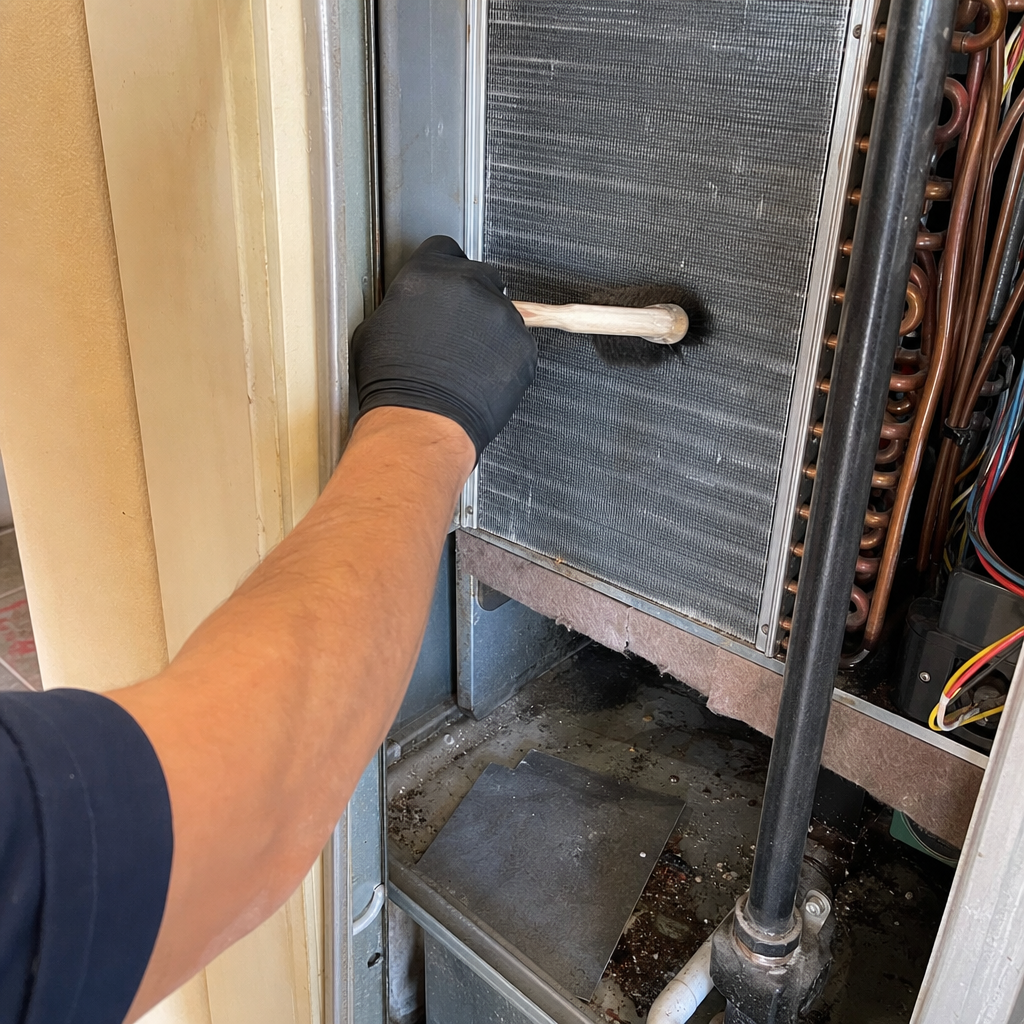
Our HVAC Cleaning in Seymour service addresses this specifically: cleaning the air handler, coils, and accessible ductwork, then testing system performance to identify where leakage and contamination enter. No bait pricing - the number on the phone is the number on the invoice, disclosed before a single tool is lifted.
What Professionals Check That Homeowners Cannot
Some assessment requires equipment and access that homeowners reasonably don’t have. Understanding what professionals check helps you evaluate any service you consider.
Borescope inspection of duct interiors: A flexible camera with LED lighting reveals conditions inside main trunks and branch lines that no flashlight through a register can show. We document with photos and video, dated and referenced to specific duct locations.
Particle counting at supply and return: A laser particle counter measures particulate concentration in real time, comparing what’s entering the system against what’s being distributed. A significant increase indicates internal contamination being picked up and circulated.
Moisture mapping: Infrared thermography and pinless moisture meters identify condensation points, leaks, and areas of biological risk that visual inspection misses. Critical in Los Angeles, where slab ductwork and buried flex runs create hidden moisture traps.
Static pressure testing: Measures airflow resistance through the system. Excessive static pressure indicates blockage, collapsed flex duct, or filter issues that reduce efficiency and increase particle deposition.
Register and boot inspection: The connection between duct and room is often the dirtiest point in the system, with years of accumulation at the terminal. We remove and inspect each register, clean the boot interior, and verify proper airflow direction.
At Bellows, we use equipment from Honeywell and Aprilaire for air quality measurement - brands that build the controls and sensors serious contractors rely on. The inspection itself is educational: homeowners see their system’s condition in real time, and we explain what each finding means for health, efficiency, and necessary service. No scare tactics. No bait coupons. Just what we found, what it means, and what honest correction costs.
Our Dryer Vent Cleaning in Seymour service applies the same documentation standard. Dryer vent fires are a leading cause of residential fire in Los Angeles County, and blocked vents are the primary cause. Camera inspection reveals blockages, damage, and improper materials that visual inspection from the exterior cannot.
Common Mistakes to Avoid
- Attributing all symptoms to outdoor pollen counts. Los Angeles pollen is real, but it’s seasonal and weather-dependent. Symptoms that persist in January or correlate with HVAC operation are not pollen.
- Buying room air purifiers instead of addressing the source. A purifier in the bedroom treats symptoms while the duct system continues distributing contamination. It’s managing the effect, not the cause.
- Accepting “that’s just how old houses are” from anyone, including yourself. Age explains construction methods, not health effects. Properly maintained older homes can have excellent air quality; poorly maintained newer homes can be hazardous.
- Using chemical sanitizers or ozone generators without source removal. These add volatile compounds to the air and can react with existing duct deposits to create more hazardous byproducts. Physical removal first; any sanitizing after, with appropriate dwell time and ventilation.
- Ignoring the dryer vent as an air quality factor. A blocked dryer vent backs up moisture and lint into the laundry area, increasing humidity that affects adjacent ductwork and circulating fine particles through any connected air pathways.
- Hiring based on the lowest coupon price without verifying what’s included. Los Angeles has no shortage of “$49 whole house” offers that cover two registers and upsell aggressively. Verify scope, equipment, documentation, and guarantee in writing before booking.
- Waiting for “obvious” problems before acting. By the time problems are obvious - visible mold, persistent odors, chronic illness - correction is more extensive and expensive. Preventive assessment every three to five years is the prudent approach.
When to Call a Professional
Call when symptom timing correlates with HVAC operation, even if symptoms are mild. Call when you see dark streaking, smell mustiness, or notice any odor from registers. Call before adaptation normalizes conditions that are slowly degrading your family’s health. Call immediately for sweet or chemical odors - evacuate first, then call.
Bellows Air Duct & Vent Co. offers free estimates in Los Angeles. We’ll inspect your system with a camera, show you what we find, and quote honest upfront pricing before any work begins. Calls are answered by a live person, 24 hours a day - not a voicemail, not an app. Most jobs are completed in a single visit. And every job is backed by our 90-Day Done Right Promise: if it’s not right, we return at no charge with no paperwork required. That’s been our standard since 1984.
Call (844) 685-6342 for your free estimate.
Frequently Asked Questions
Every three to five years for typical residential systems, more frequently if you have pets, allergies, or recent renovation. Los Angeles homes with continuous HVAC operation and coastal moisture exposure benefit from the shorter interval. Call (844) 685-6342 for a free assessment of your specific system condition.
Professional cleaning typically costs one-tenth to one-fifth of partial duct replacement, and full replacement is rarely necessary. We recommend cleaning first with camera verification; replacement is only indicated for severely corroded metal, collapsed flex duct, or asbestos-containing materials. Our $89 Seasonal Tune-Up includes basic duct inspection to help you plan.
Yes. Most Bellows jobs are completed in a single visit by a two-technician team, typically four to six hours for a complete residential system including air handler, coils, and all accessible ductwork. We’ll be there when we say, and we finish what we start.
Symptoms that worsen when the system cycles on but clear when it’s off point to the distribution system. Odors from the unit itself, or symptoms present even with the fan running continuously, suggest the air handler or coil. Our inspection evaluates both; we don’t guess. The camera shows what’s in the ducts, and coil inspection reveals the source side.
Usually not. Source removal with professional equipment eliminates the material that supports biological growth. We recommend sanitizers only where active contamination is documented and after physical removal is complete. When used, we apply EPA-registered products with appropriate dwell time and ventilation, never as a substitute for cleaning. Ask about our process during your free estimate.
Yes. We maintain a permanent 5% Senior and Veteran discount on all services, applied to the final invoice with valid ID. We also offer $50 Off Any Repair Over $250 and Free Second Opinion on Any Written Estimate from another contractor. All pricing is disclosed upfront before work begins - no surprises on the bill.
The Bottom Line
Your body is already telling you what your ducts contain. The question is whether you’ll recognize the signal before adaptation silences it. Track symptom timing against HVAC operation. Look at your registers with fresh eyes. Notice what guests or new pets react to. And understand that in Los Angeles, where our climate demands near-constant system operation, duct contamination isn’t a minor maintenance issue - it’s a continuous exposure source affecting everyone in the home, every day, often without anyone recognizing the connection. Professional assessment with camera documentation removes the guesswork. The square deal is one honest price, shown before work starts, backed by a promise we put in writing.
Written by the team at Bellows Air Duct & Vent Co., serving Los Angeles since 2012.