
Last updated July 25, 2026
The Complete Air Duct Cleaning Guide for Los Angeles Homeowners
After the 2023 Southern California wildfires, indoor air quality researchers found ultrafine ash particles inside ductwork up to 40 miles from burn perimeters - in homes with all windows closed. That is not a ventilation failure. It is a reminder that Los Angeles air moves through our homes in ways most homeowners never see, and that what settles in your ducts does not stay in your ducts. In this guide, we will show you how wildfire ash, coastal humidity, and year-round air conditioning create contamination patterns that generic cleaning advice misses entirely. You will learn what to look for in a camera inspection, how to tell surface cleaning from real system cleaning, and how to verify the job was done right without becoming an HVAC technician yourself.
Quick Answer
Professional air duct cleaning in Los Angeles should include camera-inspected before-and-after documentation of your entire system - supply and return ducts, coils, plenums, and registers - using equipment like Rotobrush or Nikro systems. Most homes here need cleaning every 3 to 5 years, sooner after wildfire smoke exposure or if you run air conditioning year-round, which accelerates dust-and-moisture buildup in ways seasonal climates do not.
Table of Contents
- Why Los Angeles Ducts Are Different From the Rest of the Country
- What Really Accumulates in Your Ducts (And What Does Not)
- How to Read a Camera Inspection - Before You Hire Anyone
- Surface Cleaning vs. Full System Cleaning: The Price Gap Explained
- How Often Los Angeles Homes Actually Need Duct Cleaning
- How to Verify the Job Was Done Right
- Common Mistakes to Avoid
- When to Call a Professional
- Frequently Asked Questions
Why Los Angeles Ducts Are Different From the Rest of the Country
Most air duct advice written online comes from contractors in the Midwest or Northeast, where furnaces run hard for five months and sit idle for seven. That seasonal rhythm shapes everything - how dust settles, how moisture behaves, how often systems need attention. Los Angeles does not work that way.
Here, air conditioning runs 10 to 12 months a year in many neighborhoods. The San Fernando Valley sees 100-degree stretches that keep compressors cycling daily from May through October. Coastal zones like Santa Monica or Palos Verdes run dehumidification modes constantly to manage marine layer moisture. That continuous airflow does not let dust settle quietly in one layer. It keeps particles circulating, grinding them finer, embedding them deeper into porous duct liner where standard vacuums cannot reach them.
Then there is the wildfire factor. The 2023 research finding ash particles 40 miles inside sealed homes was not an anomaly. Santa Ana winds push ultrafine particulate - PM2.5 and smaller - through every crack in a building envelope. Your return air grille becomes the path of least resistance. Unlike household dust, which is mostly skin cells and fabric fiber, wildfire ash is chemically active: alkaline, abrasive, and capable of corroding metal duct seams over time. We have opened systems in Pasadena and Glendale where the interior metal showed etching patterns that plain dust simply does not create.
Finally, Los Angeles has construction density that keeps outdoor particulate levels elevated year-round. Demolition, grading, and freeway expansion in areas like the 405 corridor or the ongoing Metro projects create silica-heavy dust that infiltrates older homes with compromised seals. A 1960s ranch in Woodland Hills or a 1970s condo in Culver City often has original ductwork with joints that were never sealed to modern standards.
The result: Los Angeles ducts accumulate a specific cocktail - fine mineral dust, wildfire ash residue, coastal salt humidity, and biological growth from constant condensation - that behaves differently from the lint-heavy, seasonal dust of other climates. Cleaning methods designed for Ohio winters will not address what is actually in your walls here.
What Really Accumulates in Your Ducts (And What Does Not)
Homeowners often imagine ducts filling up like vacuum cleaner bags, with visible piles of debris you could scoop out. That is rarely the case. In our experience with Los Angeles homes, contamination layers are thin, adhered, and chemically bonded to duct surfaces. Here is what we actually find:
- Fine particulate film: A gray-to-brown coating, often less than 1/16 inch thick, bonded to metal by electrostatic charge and humidity. This is the bulk of what restricts airflow and recirculates into living spaces.
- Wildfire ash residue: Identifiable by its lighter color, slightly greasy texture, and alkaline pH. Found in systems throughout the San Gabriel Valley after major fire seasons, even years later if not properly removed.
- Coastal salt corrosion: In homes within five miles of the ocean, we see white crystalline deposits on metal duct seams and register edges. This accelerates rust and compromises structural integrity over decades.
- Biological growth: Not the dramatic black mold of internet photos, but patchy discoloration on porous duct liner in high-humidity zones. The constant cooling cycle in Los Angeles creates condensation points that seasonal climates avoid.
- Construction debris: In homes built 1940-1980, we still find original drywall dust, sawdust, and occasionally discarded material left by builders. A 2019 job in a Los Feliz Spanish Colonial revealed 1940s newspaper fragments and plaster chunks that had circulated for 80 years.
What we do not find: large debris you could remove by hand, dead animals in most cases, or the thick “blanket” of dust that discount duct cleaners sometimes photograph from extreme outlier jobs to scare homeowners into service.
The health question always follows. We do not make medical claims. We do know that the EPA identifies duct cleaning as one component of an overall indoor air quality strategy, and that Los Angeles County Department of Public Health notes wildfire smoke particulate as a particular concern for sensitive groups. Clean ducts reduce the reservoir of material your system recirculates. That is a mechanical fact, not a health promise.
How to Read a Camera Inspection - Before You Hire Anyone
Any technician can tell you your ducts are dirty. A camera inspection lets you see for yourself. But the image alone does not tell the full story. Here is how to interpret what you are shown, and what to ask before work begins.
- Ask where the camera entered. A register opening shows only the first few feet of duct. A proper inspection accesses the main trunk line through a sealed port, or uses a flexible borescope around multiple bends. If you are only shown register-level footage, you are not seeing the full system.
- Look for consistent lighting and focus. Blurry or dim footage hides as much as it reveals. Professional equipment from Honeywell or Aprilaire inspection systems provides LED-lit, high-resolution imagery. Ask the technician to pause on a seam or joint - if you cannot read the manufacturing stamp or see surface texture, the image quality is insufficient for documentation.
- Identify the surface type. Bare sheet metal, insulated flex duct, and fiberboard duct liner each show contamination differently. A gray film on bare metal may be 1/32 inch thick and significant. The same visual on white duct liner may be superficial. The technician should explain what surface you are viewing.
- Note the location markers. Professional systems include distance counters or branch identifiers. “This is the main return, 12 feet from the air handler” means something. “Here’s your duct” does not.
- Request the after-inspection protocol before work starts. Will they re-run the exact same path? Will the video file be provided to you? At Bellows, we date-stamp both recordings and provide them on request. A company unwilling to commit to comparable documentation has something to hide.
In Los Angeles specifically, ask to see footage of the coil compartment and plenum, not just the duct runs. The evaporator coil sits in a dark, humid environment perfect for biological growth, and it is often the dirtiest component in a system that runs cooling 10 months a year. A duct cleaner who skips the coil is addressing symptoms, not sources.
Surface Cleaning vs. Full System Cleaning: The Price Gap Explained
The Los Angeles market shows duct cleaning quotes from $89 to $800 or more for a typical single-family home. That range is not arbitrary. It reflects genuinely different scopes of work, and the low end often leaves the most contaminated components untouched.
Surface duct cleaning typically covers:
- Register removal and basic vacuuming
- Agitation brushing of accessible supply and return duct runs
- Filter replacement
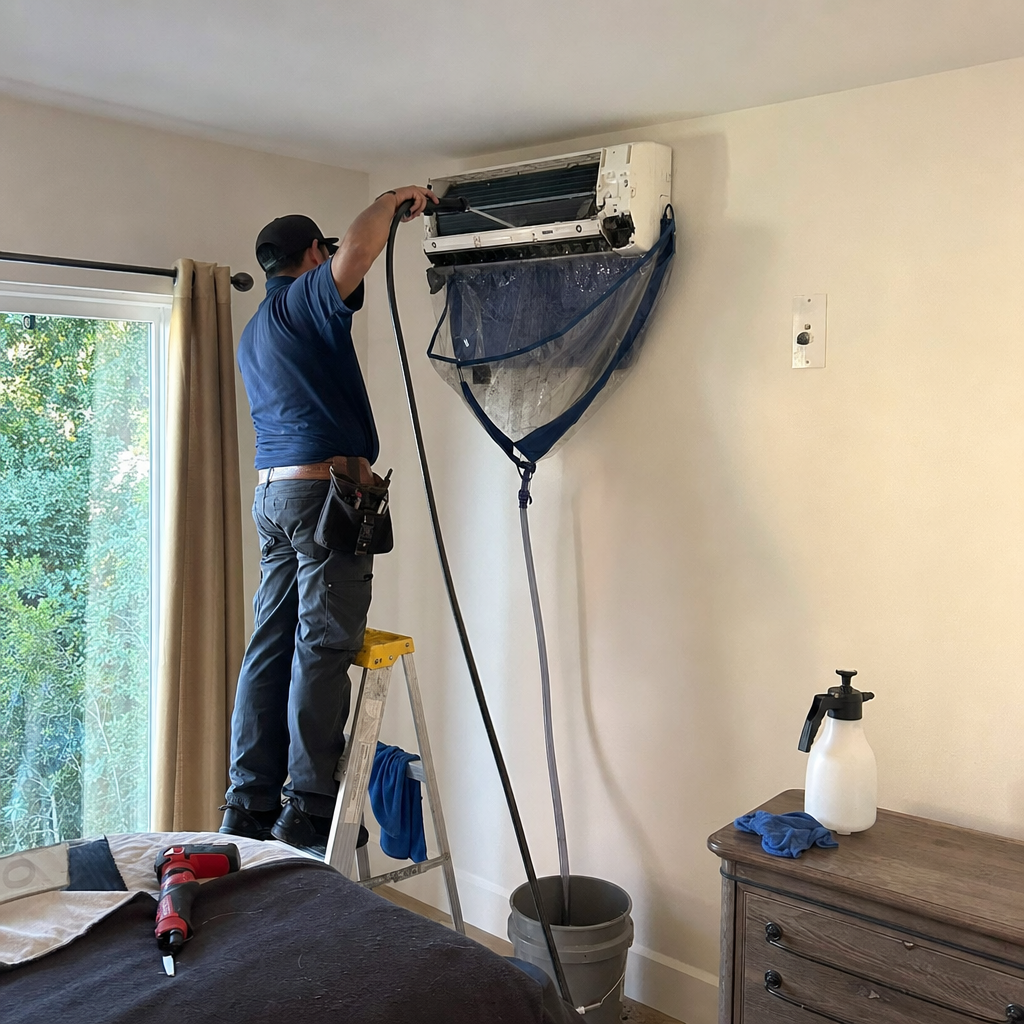
What it often skips: the evaporator coil, the blower assembly, the plenum (the central distribution box), and sealed trunk lines that require access ports. In a Los Angeles home running air conditioning constantly, the coil and plenum are where moisture and dust combine most aggressively. Leaving them contaminated means your “clean” ducts immediately begin recontaminating.
Full system cleaning includes:
- All surface cleaning components
- Coil cleaning with appropriate foaming or low-pressure solutions
- Blower assembly removal and cleaning
- Plenum access and vacuuming
- Sealed trunk line access ports, brushed and vacuumed with negative air machines
- Sanitizing treatment where biological growth is present
- Before-and-after camera documentation of all accessed areas
The equipment difference matters. Rotobrush systems and Nikro negative air machines are professional-grade tools that cost $5,000-$15,000 per unit. They provide the suction power and agitation necessary for adhered contamination. Discount operators often use shop vacuums with brush attachments - adequate for loose surface dust, ineffective for bonded film.
Our position at Bellows is straightforward: we quote full system cleaning or we decline the job. Partial cleaning in a Los Angeles climate creates a false sense of resolution that wastes the homeowner’s money and our reputation. Our Bellows Air Duct & Vent Co. home page details how we structure quotes with no-hassle upfront pricing disclosed before any tool is lifted.
How Often Los Angeles Homes Actually Need Duct Cleaning
The national recommendation of “every 3 to 5 years” assumes average conditions. Los Angeles conditions are not average. Here is how we adjust based on local factors:
| Home Situation | Recommended Interval | Los Angeles-Specific Trigger |
|---|---|---|
| Standard residential, no pets, no recent fires | 4-5 years | Year-round AC runtime accelerates buildup vs. seasonal climates |
| Homes with pets or allergy-sensitive occupants | 3 years | Pet dander + continuous airflow = deeper embedding |
| Post-wildfire smoke exposure | Inspect within 6 months; clean if particulate detected | 2023 fires showed infiltration 40 miles from burn zones |
| Coastal homes within 3 miles of ocean | 3-4 years | Salt corrosion accelerates metal degradation; humidity supports biological growth |
| Homes built 1940-1980 with original ductwork | Inspect every 2-3 years | Unsealed joints, original construction debris, possible asbestos-containing duct liner |
| Recent major renovation | Clean immediately post-construction | Silica dust from tile, drywall, concrete cutting infiltrates even “sealed” systems |
Neighborhood specifics matter. A home in Encino with mature trees and Santa Ana wind exposure sees different pollen and dust loading than a Marina del Rey condo with marine layer humidity. We have cleaned systems in Altadena where oak pollen accumulated in patterns we do not see in concrete-heavy Downtown lofts. There is no universal calendar. There is your specific home, its specific exposures, and what a camera inspection actually shows.
How to Verify the Job Was Done Right
You are not an HVAC technician. You should not need to be. Here is how to confirm a cleaning was actually completed without disassembling your own system.
- Demand comparable before-and-after footage. The camera should follow the same path, show the same identifiers, and demonstrate visible contamination removal. Not “cleaner” - actually clean. Metal should show its original finish or manufacturing marks. Duct liner should show uniform color, not patchy shadows.
- Inspect the registers yourself. Remove two or three after the job. The boot (the short duct section behind the register) should be visibly clean to arm’s length. If you see debris within easy reach, the full run was not addressed.
- Check the filter. A proper full-system cleaning disturbs debris that will catch in a new filter within 24-48 hours. If the filter looks pristine after a week, either your system was exceptionally clean (possible) or the cleaning was superficial (more likely).
- Listen to airflow change. Restricted ducts create turbulence you can hear - whistling, rumbling, or uneven delivery from room to room. Post-cleaning, airflow should sound smoother and feel more consistent at registers. This is subjective but real.
- Request the debris collection. Professional systems using Nikro or Rotobrush equipment collect debris in sealed canisters. A technician should be able to show you what was removed. Not a dramatic pile - that is a red flag for planted debris - but a measured, plausible quantity for your home’s size and condition.
- Review your invoice against the quoted scope. Every component promised should be listed as completed. If “coil cleaning” or “plenum access” was quoted but does not appear on the final document, ask why before paying.
At Bellows, our 90-Day Done Right Promise exists because we believe verification should not end at the truck. If something does not look or feel right after we leave, we return at no charge. No paperwork, no arguing. That promise is stamped on every job because we have learned over 42 years that trust is built on what happens after the technician drives away.
Common Mistakes to Avoid
- Hiring based on coupon price alone. The $89 Los Angeles duct special almost always covers register vacuuming only, leaving coils and plenums untouched. The “upcharge” conversation happens after arrival. We do not use bait coupons for this reason.
- Assuming new construction means clean ducts. Los Angeles building booms create compressed schedules where drywall dust, sawdust, and worker debris are routinely left in systems. We have found construction gloves and soda cans in “new” ductwork. Always clean before occupancy.
- Ignoring the return side. Homeowners focus on supply registers where air blows out. The return grille pulls air in - and pulls contamination with it. Return ductwork is often dirtier and harder to access, which is why discount services skip it.
- Cleaning without fixing leaks first. Duct seams in older Los Angeles homes leak 20-30% of conditioned air into attics or crawl spaces. Cleaning a leaking system is polishing a pipe with a hole in it. Seal first, or clean and seal together.
- Expecting health miracles. Duct cleaning improves mechanical system performance and reduces recirculated particulate. It does not cure asthma, eliminate allergies, or replace medical treatment. Companies making such claims are selling hope, not service.
- Waiting for visible dust at registers. By the time you see dust blowing out, contamination has advanced significantly. The goal is prevention, not crisis response. Camera inspections catch what eyes cannot.
When to Call a Professional
Call for an inspection - not necessarily a cleaning - when you notice uneven heating or cooling between rooms, musty odors that intensify when the system runs, visible debris at registers, or after any wildfire smoke event in your region. If your home was built before 1980 and has never had ducts cleaned, assume inspection is overdue. The original duct liner in many Los Angeles neighborhoods of that era degrades and can release fiber into airflow.
We do not believe in scare tactics. We do believe in looking. A camera inspection takes 30 minutes and tells you exactly what you have. Bellows Air Duct & Vent Co. offers free estimates in Los Angeles - call (844) 685-6342. We will show you what is in your ducts, explain what it means, and quote full-system cleaning only if the inspection warrants it. The price we quote is the price on the invoice. No surprises on the bill.
Frequently Asked Questions
Full-system duct cleaning for a typical Los Angeles single-family home runs $400-$800 depending on system size, accessibility, and contamination level. Surface-only cleaning quotes below $200 typically exclude coils, plenums, and sealed trunk lines. Call (844) 685-6342 for an exact quote - estimates are free.
Yes. Research after the 2023 Southern California wildfires found ultrafine ash particles inside ductwork up to 40 miles from burn perimeters, even in homes with windows closed. Smoke infiltrates through building envelope gaps, and the return air system actively draws it inside. Inspection after major fire events is prudent.
Most full-system cleanings take 3 to 5 hours for a typical home. Larger Los Angeles homes with multiple HVAC zones, or older homes requiring access port installation, may extend to a full day. We complete most jobs in a single visit by background-checked, uniformed technicians.
Moderately, if your system was significantly restricted. The Department of Energy estimates duct leakage and restriction can waste 20-30% of HVAC energy. Cleaning alone does not seal leaks, but removing buildup improves airflow and reduces blower motor strain. Combined with proper sealing, the savings become meaningful in a climate where air conditioning runs 10 months a year.
Not necessarily. Dark staining can be dust, soot, or biological growth. Laboratory testing is the only definitive identification. We do not diagnose mold from visual inspection alone. If testing confirms biological growth, we can apply appropriate sanitizing treatments as part of a full cleaning scope.
Red flags include: quoting by phone without asking system size or access questions, arriving with a different price than quoted, discovering “unexpected” contamination that requires immediate costly treatment, or refusing to provide before-and-after documentation. At Bellows, all pricing is disclosed before work begins, consistent with our founding promise of no scare tactics and no bait coupons.
The Bottom Line
Los Angeles ducts face a specific set of challenges - wildfire ash infiltration, coastal humidity, year-round air conditioning, and aging building stock - that make generic advice unreliable. The right approach starts with understanding what actually accumulates in your system, demanding camera-verified documentation, insisting on full-system scope including coils and plenums, and verifying results with your own eyes rather than a technician’s word. Price matters, but the gap between surface cleaning and proper cleaning explains most of the market variation. A square deal means one honest price, shown before work starts, backed by a guarantee that does not require paperwork to enforce.
For homeowners who have lived in the same house for twenty years and plan to stay, the question is not whether to clean your ducts eventually. It is whether to do it right the first time, or pay twice.
Call Bellows Air Duct & Vent Co. at (844) 685-6342 for a free estimate. Calls are answered by a live person, 24 hours a day. Ask about our $89 Seasonal Tune-Up, $50 off any repair over $250, free second opinion on any written estimate, and permanent 5% senior and veteran discount. We have served Los Angeles homeowners for over 42 years. We stand behind it - no paperwork, no arguing.
Written by the team at Bellows Air Duct & Vent Co., serving Los Angeles since 2012.