
Last updated July 25, 2026
Air Quality & Sanitizing Troubleshooting: Common Problems and How to Fix Them
Running an air purifier in a home with dirty or leaky ducts is like trying to clean a fish tank without addressing its filter - the source of contamination keeps cycling back in faster than the purifier can remove it. In our 42 years serving Los Angeles homeowners, we’ve found that most air quality problems are misdiagnosed because people start with the air itself and work backward. The real diagnostic path runs through the duct system first, because the ducts are what move every contaminant from source to breathing zone. This guide will teach you to troubleshoot systematically: fix the distribution path before treating the air, know when to call for professional testing, and avoid the common mistake of over-sanitizing that creates new problems.
Quick Answer
Most home air quality problems in Los Angeles trace back to three root causes: duct leakage pulling contaminants from attics or crawl spaces, biological growth in the air handler or coil due to humidity above 50%, and inadequate exhaust ventilation trapping pollutants indoors. Fix these distribution and moisture problems first, then address sanitizing - otherwise you’re treating symptoms while the source keeps circulating.
Table of Contents
- Why Your House Keeps Getting Dusty After Cleaning
- Musty Smells That Won’t Go Away: Mold vs. Misdiagnosis
- Stale Air in Modern Homes: The Ventilation Problem
- The Humidity-First Principle for Los Angeles Homes
- The Over-Sanitizing Trap: When Clean Air Becomes Irritated Air
- Systematic Troubleshooting: The Room-by-Room Decision Tree
- When Professional Testing Is Worth the Cost
- Building a Practical Cleaning and Inspection Schedule
Why Your House Keeps Getting Dusty After Cleaning
The most common misdiagnosed air quality problem we see in Los Angeles homes is persistent dust blamed on “inadequate filtration.” Homeowners upgrade to MERV 13 filters, buy HEPA air purifiers for every room, and still wipe thick layers off surfaces weekly. The real culprit is usually duct leakage pulling from unconditioned spaces.
Here’s how it works. Your return ducts run through hot attics or crawl spaces, and when joints separate or seams crack - common in homes built before 1990 in neighborhoods like Encino, Van Nuys, or older Pasadena - they create negative pressure. That vacuum pulls fiberglass particles, rodent droppings, attic dust, and insulation fragments directly into your airflow. Your MERV 13 filter never sees that debris because it enters downstream of the filter, after the air handler.
How to diagnose it yourself:
- Turn your HVAC fan to “ON” and inspect visible ductwork in the attic or crawl space with a flashlight.
- Look for disconnected flex duct, gaps at plenum connections, or dust streaks on duct exteriors indicating air being drawn in.
- Check the dust pattern in your home: is it worse in rooms farthest from the air handler? That’s often the signature of return-side leakage, as those rooms have the longest duct runs and most joints.
- Hold a smoke pencil or even a stick of incense near duct seams while the fan runs. Inward-drawn smoke confirms leakage.
The fix isn’t more filtration. It’s duct sealing with mastic or professional aerosol sealant, followed by a thorough cleaning. In Los Angeles, where we see temperature swings of 30 degrees between day and night, thermal expansion accelerates duct joint failure. We’ve found that homes in the San Fernando Valley, with their extreme summer heat, experience this problem two to three years sooner than coastal properties.
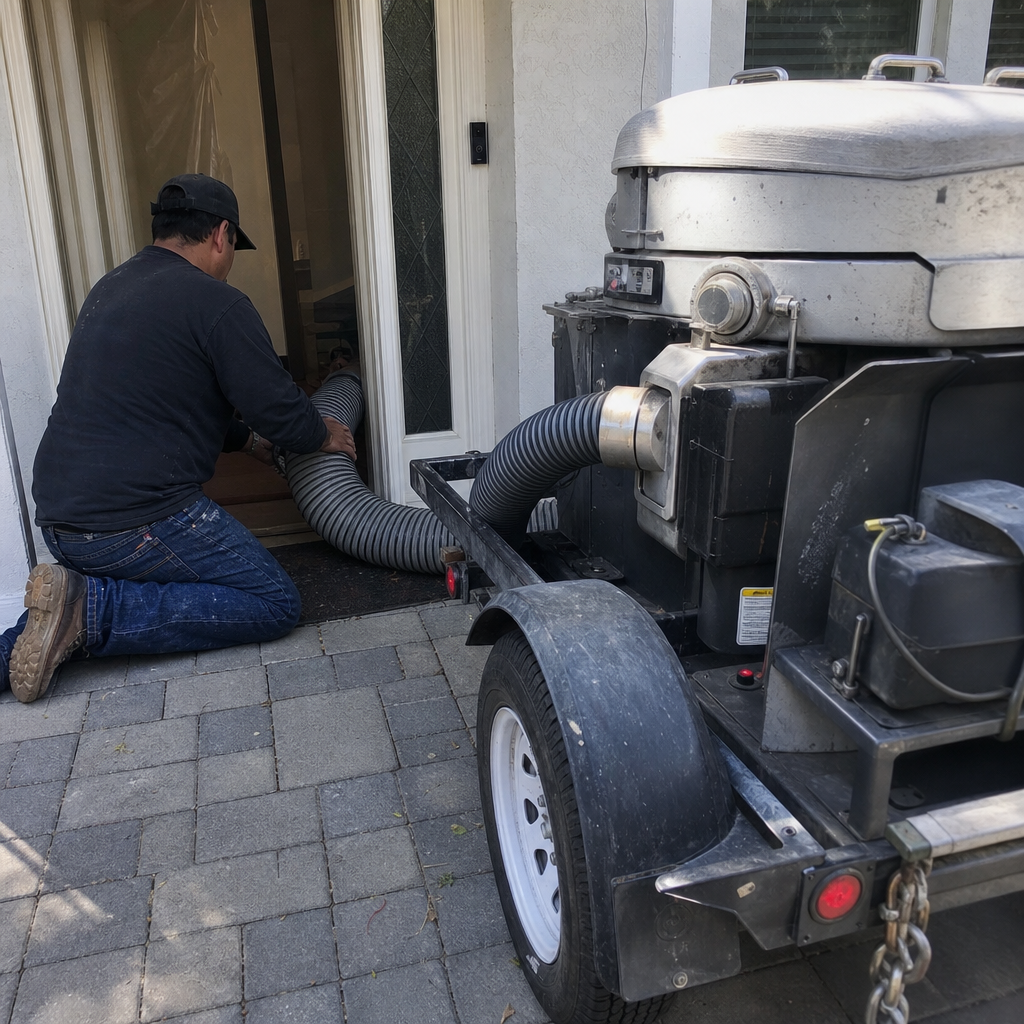
After sealing, a camera-inspected duct cleaning removes the accumulated debris. That’s the approach we take on every Air Duct Cleaning in Seymour job, and it’s the standard we’ve held for over four decades.
Musty Smells That Won’t Go Away: Mold vs. Misdiagnosis
Homeowners with musty odors almost always look to the basement first. In Los Angeles, where true basements are rare, they blame the crawl space or a damp bathroom. But in our experience, the actual source is often mold growth on the air handler’s evaporator coil or in the condensate pan - places you can’t see without opening the unit.
The coil stays wet for months during cooling season. Dust that passes through or bypasses the filter lands on that wet surface and becomes a growth medium. The musty smell isn’t from your crawl space; it’s being manufactured inside your HVAC system and distributed to every room.
Signs that point to coil or pan mold rather than structural dampness:
- The smell intensifies when the AC first kicks on, then fades as the fan runs - this is the “puff” of spores dislodged by airflow startup.
- It’s present in rooms with no plumbing, no exterior walls, and no history of leaks.
- The odor correlates with cooling season, not rainy weather.
- You’ve had the crawl space inspected and found no mold, yet the smell persists.
Cleaning the coil requires professional-grade equipment. Consumer foams and sprays rarely reach the full depth of the coil fins, and improper cleaning can bend fins or push debris deeper. Our technicians use Abatement Technologies HEPA-contained equipment and camera verification to confirm the coil is clean before reassembling the unit.
For Los Angeles homeowners near the coast in Santa Monica or Redondo Beach, where marine layer humidity keeps coils wet longer, we recommend coil inspection every two years minimum. Inland homes in Burbank or Glendale, with drier conditions, can often stretch to three years - but the camera tells the real story.
Stale Air in Modern Homes: The Ventilation Problem
Another frequent misdiagnosis: “stale” air blamed on the house being “too tight.” Homeowners in newer Los Angeles construction, especially in developments around Playa Vista or the Arts District, assume their energy-efficient envelope is trapping pollutants. Sometimes that’s true. More often, the problem is inadequate exhaust ventilation - the house isn’t too tight, it’s not breathing in the right places.
Building code requires balanced ventilation in new construction, but older homes and many renovations lack it. Kitchens vent into recirculating hoods. Bathrooms have weak or non-functional exhaust fans. Laundry rooms vent dryers internally or through long, restricted duct runs. The result isn’t stale air from tightness; it’s stale air from no exhaust removing moisture, odors, and combustion byproducts at the source.
The diagnostic question: Does the stuffiness improve when you open windows? If yes, your house isn’t too tight - it’s under-ventilated in the wrong way. Opening windows isn’t a solution in Los Angeles fire season or during high ozone days, when outdoor air quality advisories are common from July through October.
Proper fixes include upgrading to externally vented range hoods (minimum 300 CFM for gas cooking), installing timer-controlled bathroom exhaust fans, and ensuring your dryer vent is clean and properly routed. Our Dryer Vent Cleaning in Seymour service addresses the last point - restricted dryer vents not only trap moisture and lint indoors but create fire hazards.
For whole-house solutions, we specify Aprilaire fresh air ventilators on HVAC systems where appropriate, bringing in filtered outdoor air on a controlled schedule rather than through random window openings.
The Humidity-First Principle for Los Angeles Homes
Most biological air quality problems in Los Angeles homes won’t stay solved until relative humidity is controlled between 40-50%, regardless of what sanitizing measures are applied. This is the principle competitors miss: they sell UV lights, ozone generators, and chemical treatments without addressing the moisture that enables biological growth in the first place.
Los Angeles presents a split climate challenge. Coastal zones - Venice, Marina del Rey, San Pedro - battle high humidity from marine influence, especially June through August when overnight lows stay above 65 degrees and air conditioners short-cycle, failing to dehumidify adequately. Inland valleys - Woodland Hills, Northridge, Pomona - swing to desert-dry conditions in winter, dropping below 30% humidity and causing respiratory irritation, static electricity, and cracked woodwork that generates particulates.
Zone-specific guidance:
- Coastal/high-humidity homes: If your AC runs less than 15 minutes per cycle, it’s not dehumidifying. Consider a whole-house dehumidifier, or at minimum, run bathroom and kitchen exhaust fans 30 minutes after use. Check that your condensate drain isn’t clogged - a full drain pan raises humidity in the duct system.
- Inland/dry homes: Winter humidity below 35% cracks nasal passages and dries protective mucus, making occupants more susceptible to airborne irritants. A bypass or steam humidifier, properly maintained and set to 40-45%, solves this. But skip the portable units - they’re mold factories if not cleaned weekly, and most homeowners don’t.
We use Rotobrush equipment with moisture meters during duct inspections to identify humidity problems hidden in duct runs. A reading above 60% in any duct section indicates a leak or insulation failure that will defeat any sanitizer you apply.
The Over-Sanitizing Trap: When Clean Air Becomes Irritated Air
In the years since 2020, we’ve seen a troubling pattern in Los Angeles homes: homeowners running ozone generators continuously, fogging ducts with chemical sanitizers quarterly, or installing unregulated UV-C lamps that create ozone as a byproduct. The result is often worse air quality than when they started, particularly for occupants with asthma, COPD, or chemical sensitivities.
Ozone is a lung irritant at any concentration. The EPA states clearly that ozone generators are not effective air cleaners and can cause respiratory harm. Yet they’re still sold with claims of “purifying” air. We’ve entered homes in Silver Lake and Los Feliz where occupants were experiencing headaches, throat irritation, and worsened asthma - all traced to ozone generators running in bedrooms.
Honest guidance on sanitizing:
- Physical removal beats chemical treatment. HEPA vacuuming, agitation, and extraction remove allergens and particulates. Sanitizers are adjuncts, not substitutes.
- If sanitizers are used, specify EPA-registered products with published safety data, applied at labeled concentrations by trained technicians - not fogged by homeowners from hardware store bottles.
- UV-C has a narrow application: properly installed in the air handler, it can reduce coil mold. It does not “sanitize” moving air in ducts - the exposure time is milliseconds, insufficient for microbial kill rates.
- Never run ozone generators in occupied spaces. The California Air Resources Board has warned against this practice specifically.
Our approach at Bellows: camera-inspected cleaning first, then targeted sanitizing only where biological growth is confirmed. We use Guardsman products where appropriate, applied with controlled equipment, never as a blanket treatment. The 90-Day Done Right Promise covers our work because we verify results visually, not with chemical cover-ups.
Systematic Troubleshooting: The Room-by-Room Decision Tree
Effective troubleshooting requires answering three questions in order. Skip this structure and you’ll treat symptoms while missing the source.
Question 1: Does the problem occur system-wide or in specific rooms?
System-wide problems point to central equipment or main duct trunks. Room-specific problems point to local sources: a bathroom with failed exhaust, a bedroom with a closet on an exterior wall trapping moisture, a kitchen with recirculating ventilation.
In Los Angeles, we see room-specific patterns tied to architecture. Postwar bungalows in Highland Park have small bedrooms with single windows and poor cross-ventilation - CO2 and humidity build overnight. Mid-century ranch homes in the Hollywood Hills have central atriums that create stack-effect drafts, pulling garage fumes or attic dust into living spaces through pressure imbalances.
Question 2: Does the problem correlate with HVAC operation?
If symptoms start when the fan turns on, the distribution system is involved. If they’re constant regardless of HVAC, look to ambient sources: off-gassing furniture, stored chemicals, outdoor pollution infiltration.
We use this correlation test: run the fan continuously for two hours with windows closed. If symptoms worsen, the problem is in the ducts or air handler. If unchanged, it’s ambient. Simple, free, and definitive.
Question 3: Is it worse in humid conditions?
Humidity-correlated problems are biological: mold, dust mites, bacterial growth. Dry-correlated problems are particulate: dust, dander, combustion particles. This distinction determines whether you need moisture control or filtration improvement.
Los Angeles adds a local variable: Santa Ana wind events, typically October through March, bring extremely dry, dusty conditions. Air quality plummets, and homes without adequate filtration see particle counts spike tenfold. During these events, even clean ducts can’t overcome poor envelope sealing and inadequate filter efficiency.
When Professional Testing Is Worth the Cost
Particle counters, VOC sampling, and mold spore counts provide data, but they’re not always the most practical first step. In our experience, a systematic visual inspection and cleaning history review answers the question more directly for about 70% of Los Angeles homeowners.
Professional testing is worth the cost when:
- Occupants have unexplained respiratory symptoms that medical evaluation hasn’t resolved - here, data builds the case for insurance or landlord action.
- You’re purchasing a home with no maintenance history, particularly pre-1970s construction with original ductwork in areas like Echo Park or Eagle Rock.
- A remediation was performed and you need clearance documentation - we see this after water damage restoration, where visual “clean” doesn’t confirm spore levels.
- You’ve addressed obvious sources and symptoms persist - the data reveals hidden problems like formaldehyde off-gassing from new flooring or elevated CO2 from inadequate fresh air.
For most homeowners, our $89 Seasonal Tune-Up includes visual duct inspection, filter assessment, and coil evaluation - enough to identify the common problems covered in this guide. If testing is warranted, we refer to certified industrial hygienists and interpret results against what we’ve observed in your system. No upsell, just clarity.
Our HVAC Cleaning in Seymour service includes this diagnostic layer as standard practice, because cleaning without understanding the problem is just moving dirt around.
Building a Practical Cleaning and Inspection Schedule
Air quality maintenance isn’t one-and-done. It’s a schedule matched to your home’s age, location, and occupancy. Here’s what we recommend for Los Angeles conditions:
Annual tasks:
- Replace filters every 60-90 days (monthly during Santa Ana events or nearby wildfires).
- Inspect visible ductwork for new gaps, rust, or pest intrusion.
- Run and test all exhaust fans; replace any with airflow below rated CFM.
- Schedule professional HVAC inspection, including coil and pan assessment.
Every 2-3 years:
- Camera-inspected duct cleaning, more frequently if you have pets, recent renovation, or occupancy by respiratory-sensitive individuals.
- Dryer vent cleaning - restricted vents raise humidity and create fire risk.
- Humidifier/dehumidifier service and pad replacement.
Every 5 years:
- Duct integrity assessment with pressure testing, particularly for homes over 30 years old.
- Insulation inspection in attics and crawl spaces; degraded insulation releases particulates into leaky returns.
Homes near active construction - currently common in Downtown LA, the Arts District, and along the Expo Line corridor - need more frequent filter changes and duct inspections. Construction dust is fine particulate that overwhelms standard filtration and settles in ductwork during equipment downtime.
Common Mistakes to Avoid
- Upgrading filters without checking duct capacity. A MERV 13 filter in a system designed for MERV 8 restricts airflow, strains the blower motor, and can cause coil freezing. We measure static pressure before recommending filter upgrades.
- Sealing supply leaks but ignoring return leaks. Return-side leakage pulls unfiltered, contaminated air directly into your breathing zone. It’s the more critical fix, yet often overlooked.
- Running ozone generators for “freshness.” In Los Angeles, where asthma rates exceed national averages, this practice actively harms sensitive occupants. Fresh air means filtered outdoor air, not chemically reactive ozone.
- Cleaning ducts without sealing them. You’ll be back in two years with the same dust load, because the leakage pulling contaminants was never addressed. Our camera inspection catches this before we quote.
- Ignoring the condensate drain. A clogged drain pan overflows, floods the air handler platform, and creates a humid microclimate that defeats coil cleaning. We check drains on every service call.
- Buying air purifiers for every room instead of fixing central distribution. It’s expensive, noisy, and treats symptoms. Fix the ducts first, then supplement if needed.
When to Call a Professional
Some problems exceed homeowner troubleshooting. Call for professional assessment if you find visible mold in ducts or on the coil, smell musty odors that persist after cleaning, experience symptoms that correlate with HVAC operation, or your home was built before 1980 with original ductwork. Duct repair and sealing require specialized equipment and safety protocols for attic and crawl space work.
Bellows Air Duct & Vent Co. offers free estimates in Los Angeles - call (844) 685-6342. We’ll show you camera footage of your system, explain what we find in plain language, and give you one honest price before any work begins. The 90-Day Done Right Promise means if it’s not right, we return at no charge. No paperwork, no arguing. That’s how we’ve operated since 1984.
Frequently Asked Questions
The dust is entering through leaks in your return ductwork, typically in the attic or crawl space, pulling unfiltered air from those spaces. Sealing the ducts stops the source; cleaning alone just removes what’s already inside. Call (844) 685-6342 for a camera inspection that shows exactly where your system is leaking.
We don’t recommend it. Most consumer foggers oversaturate surfaces, leave residues that become irritants, and can’t reach the full duct run. Worse, without identifying the moisture source that enabled biological growth, the problem returns within months. Professional application with EPA-registered products, after proper cleaning and moisture control, is the safer approach.
Most whole-home duct cleaning with camera inspection runs between $400 and $800 for typical Los Angeles homes under 3,000 square feet, depending on duct complexity and accessibility. Homes with multiple HVAC zones, extensive flex duct in tight attics, or severe contamination may run higher. We provide upfront pricing before starting - the number on the phone is the number on the invoice. Call (844) 685-6342 for a free estimate.
No. The EPA and California Air Resources Board have both warned against using ozone generators in occupied spaces. Ozone is a lung irritant that can worsen asthma and cause respiratory symptoms even at low concentrations. Effective air cleaning relies on filtration and source removal, not chemical reactions.
Every 2-3 years for most homes, annually if you have pets, recent renovation, nearby construction, or occupants with allergies or respiratory conditions. Los Angeles-specific factors that accelerate need: Santa Ana wind dust, wildfire smoke events, and the older housing stock in neighborhoods like Los Feliz or Koreatown with original ductwork.
The tune-up includes a full HVAC system inspection, filter assessment, coil and pan visual check, condensate drain test, blower component evaluation, and temperature differential measurement across the coil. It’s designed to catch the problems described in this guide before they become expensive repairs. The permanent 5% Senior and Veteran discount applies.
The Bottom Line
Fix the distribution path before treating the air. Start with duct inspection and sealing, control humidity between 40-50%, ensure adequate exhaust ventilation, and clean based on verified contamination rather than calendar schedule. Avoid over-sanitizing that creates new irritants. When in doubt, a camera inspection reveals what guesswork cannot. These principles have guided our work at Bellows for over 42 years, and they’re the difference between treating symptoms and solving problems.
Written by the team at Bellows Air Duct & Vent Co., serving Los Angeles since 2012.