
Last updated July 25, 2026
HVAC Cleaning Warning Signs Every Homeowner Should Know
Here’s something that catches Los Angeles homeowners off guard every year. A family in Silver Lake watches their summer electric bill climb $80, $120, then $180 higher than the year before. They blame the heat, the rate hike, the old compressor. They call an HVAC company for a new system quote when the real problem is a layer of packed dust and debris choking the ductwork their eyes never see. We’ve been cleaning ducts across Los Angeles since 2012, and this story repeats in every neighborhood from the Valley to the basin. This guide will teach you to read the quiet signals your home sends before the loud problems arrive.
Quick Answer
The most reliable signs your HVAC system needs professional cleaning include rising energy bills despite unchanged usage, visible dust accumulation at vent registers, musty odors when the system first cycles on, uneven heating or cooling between rooms, and allergy symptoms that worsen at home but improve elsewhere. These warning signs develop gradually and often precede equipment failure by months or years.
Table of Contents
- When Your Energy Bill Rises and Nothing Changed
- What Dust at Your Vent Registers Really Means
- The Musty Smell That Appears Only When the System Kicks On
- Uneven Temperatures: A Duct Problem in Disguise
- Allergy and Respiratory Symptom Patterns to Track
- A Simple Self-Assessment Before You Call
- Common Mistakes to Avoid
- When to Call a Professional
- Frequently Asked Questions
When Your Energy Bill Rises and Nothing Changed
The thermostat stayed at 72. The family size didn’t grow. The season was the same. Yet the bill climbed. This is the warning sign most homeowners in Los Angeles dismiss, and it’s the one that costs them the most money while the real problem goes untreated.
Dirty ductwork restricts airflow through your HVAC system. When air cannot move freely, your equipment runs longer cycles to reach the temperature set on the thermostat. The compressor works harder, the blower motor draws more current, and your utility bill absorbs the difference. In Los Angeles, where summer cooling loads already push systems to their design limits, even moderate duct restriction can add 15 to 25 percent to seasonal energy costs.
We’ve measured this directly. A home in Encino with 2,400 square feet and a fifteen-year-old system showed supply static pressure nearly double the manufacturer’s specification. After cleaning with our Rotobrush and Nikro equipment, the pressure dropped to normal range. The homeowner’s August bill fell $147 compared to the previous year, same temperature settings, same utility rate structure.
The connection works like this. Dust and debris accumulate on duct walls, particularly at turns, dampers, and where flex duct sags between supports. Over years, this buildup narrows the effective diameter of the airway. Your system was designed to move a specific volume of air per minute against a specific resistance. When resistance rises, the system compensates with longer runtime. It is not broken. It is laboring under conditions it was not designed for.
Before you assume your compressor is failing or your refrigerant is low, check whether your energy increase correlates with reduced airflow at the vents. Hold your hand up to a supply register. The airflow should feel steady and firm. If it seems weak compared to memory or compared to other rooms, restricted ductwork is a likely cause.
Los Angeles homeowners face an additional factor. The dry, dusty climate of the basin and the Santa Ana wind events that sweep particulate through every gap in a building envelope mean local duct systems accumulate debris faster than systems in more humid climates where moisture binds dust and keeps it from becoming airborne. A system that might go eight years between cleanings in Seattle often needs attention at five or six years in Los Angeles.
What Dust at Your Vent Registers Really Means
Visible debris collecting on the fins or in the gaps of your supply registers is not surface dust settling from the room. It is material being pushed out of your ductwork under pressure. What you can see at the register is typically the smallest fraction of what exists deeper in the system.
The register acts as a final filter. Larger particles collide with the grille and accumulate there. Finer particles pass through into your living space, where they settle on furniture, electronics, and horizontal surfaces. When you notice yourself dusting more often, or when a sunbeam reveals more particulate floating in the air than you remember, both observations point to the same source.
In our camera inspections across Los Angeles homes, we regularly find supply ducts with debris layers a quarter-inch thick or more. This material is not ordinary household dust. It is a compressed mixture of skin cells, textile fibers, pollen, soil particles, and in older homes, often degraded duct liner or remnants of previous rodent activity. The material at registers is your system’s attempt to expel what it cannot process.
What to look for specifically:
- Dark streaking on walls or ceilings near register edges, indicating air bypassing the grille under pressure
- Debris that returns quickly after cleaning, within days rather than weeks
- Registers in some rooms showing more accumulation than others, suggesting partial blockage or disconnected duct runs upstream
- Particles that feel gritty or fibrous rather than fine and powdery
A homeowner in Los Feliz called us after replacing her HVAC filter monthly for a year, frustrated that filters clogged in three weeks instead of three months. Camera inspection revealed a collapsed flex duct section in the attic where a storage box had been placed during a move. The restriction forced the system to pull return air through every available gap, overloading the filter and pushing accumulated debris out the supply side. Cleaning and repair solved both problems.
The key insight: registers are windows into the duct system. What you see there reflects conditions you cannot see without professional inspection equipment.
The Musty Smell That Appears Only When the System Kicks On
Perhaps the most specific warning sign is an odor that exists only during system operation. You do not smell it when the house has been quiet for hours. The moment the blower engages, a faint musty or earthy note arrives through the registers. Within minutes it fades, either because your nose adapts or because the airflow dilutes the concentration below your detection threshold.
This pattern indicates biological growth or accumulated organic debris in the duct system, typically in the return side or at the air handler where moisture and temperature conditions support it. The smell intensifies at startup because the initial airflow disturbs material that has settled during the off cycle. Once distributed, the concentration drops below noticeable levels.
Los Angeles presents a particular version of this problem. The coastal influence brings morning marine layers that raise humidity in homes near the beach, from Santa Monica through Torrance. Even inland, the combination of evaporative cooling from irrigation, pool equipment, and occasional rain events can create localized humidity pockets in crawl spaces and attics where ductwork runs. These conditions do not produce the sustained humidity of Florida or the Gulf Coast, but they are sufficient to support mold and mildew in debris-laden ducts where airflow is restricted and condensation forms on cool duct surfaces.
The odor is not merely unpleasant. It signals that your duct system contains material that can become airborne and respirable. We do not overstate health claims, and we do not diagnose medical conditions. We do note that homeowners who report this symptom pattern often also report that family members experience throat irritation, morning congestion, or headaches that improve when away from home for extended periods.
Our process when we encounter this pattern: camera inspection first, to locate the source and document conditions; then targeted cleaning with appropriate methods based on what we find; then post-cleaning verification with the same camera to confirm removal. The before-and-after record belongs to the homeowner. This is standard on every job, not an upgrade or add-on.
Uneven Temperatures: A Duct Problem in Disguise
The bedroom at the end of the hall runs four degrees warmer in summer. The downstairs office is comfortable only when the rest of the house is cold. Homeowners adjust dampers, buy portable units, or raise the thermostat and accept higher bills. Often the root cause is duct restriction or leakage that cleaning and sealing can resolve.
Your HVAC system was designed as a balanced network. Each supply register should deliver a calculated volume of conditioned air based on the heating and cooling load of the room it serves. When ductwork becomes partially blocked, that balance shifts. Rooms at the end of long duct runs suffer first because they have the least pressure to overcome restriction. Rooms with the shortest runs or fewest turns may receive excess airflow, creating the temperature disparity you feel.
In Los Angeles, this pattern appears frequently in homes built during the 1950s through 1980s, which comprise a significant portion of the housing stock from the Valley to San Pedro. Original ductwork in these homes was often galvanized steel with unsealed joints, or early flex duct that has degraded, sagged, or become crushed in attics where storage or work activity occurred. The debris accumulation we remove during cleaning often includes degraded duct material itself, compounding the restriction.
Steps to diagnose uneven temperatures yourself:
- Check all supply and return registers for open dampers and unobstructed airflow. Furniture, rugs, or closed doors can create apparent duct problems that are actually room airflow problems.
- With the system running, hold a lightweight ribbon or tissue near each supply register. Compare the deflection or pull. Significant variation between registers on the same system suggests duct restriction or leakage.
- Note whether temperature problems correlate with time of day. Ducts in unconditioned attics gain heat during Los Angeles summer afternoons. If a room is uncomfortable only from 2 PM to 6 PM, attic duct insulation may be the primary issue, not duct cleanliness. If the room is consistently off-target, duct restriction is more likely.
- Listen for whistling or rushing air at registers or in walls. These sounds indicate high velocity at restrictions or leaks, both of which waste energy and reduce comfort.
Cleaning alone does not repair disconnected ducts or replace degraded flex. Our camera inspection identifies whether restriction is from debris, mechanical damage, or both. When we find duct damage, we explain what we see and offer repair options with the same upfront pricing we apply to cleaning. No separate trip, no surprise scope change.
Allergy and Respiratory Symptom Patterns to Track
We are careful here. Duct cleaning is not a medical treatment, and we do not promise health outcomes. What we can describe, based on forty-two years of homeowner reports and the consistent patterns we observe, is how symptoms correlate with duct conditions in ways that suggest a connection worth investigating.
The pattern to track is location-dependent and time-dependent. Do symptoms worsen during hours spent at home and improve during workdays or travel? Do they intensify during system operation, particularly at startup? Do they correspond to seasons when windows are closed and the system recirculates indoor air more exclusively? These patterns point toward indoor air quality factors, including but not limited to duct contamination.
Los Angeles adds a local variable: the extended fire season and associated smoke events that have become regular rather than exceptional. During these periods, even homes with closed windows and standard filtration experience elevated particulate levels. Duct systems that already contain debris loads become reservoirs that prolong exposure. Cleaning after significant smoke events removes accumulated particulate that standard filters do not capture and that continues to redistribute during normal operation.
What we find in ducts that correlates with symptom reports:
- High concentrations of pollen and outdoor particulate, indicating inadequate filtration or filter bypass
- Pet dander accumulation in homes with current or previous animal residents
- Dust mite debris in humid coastal zones or where evaporative coolers were previously used
- Remnants of construction or renovation activity, particularly drywall dust and insulation fragments, in homes where ductwork was not protected during work
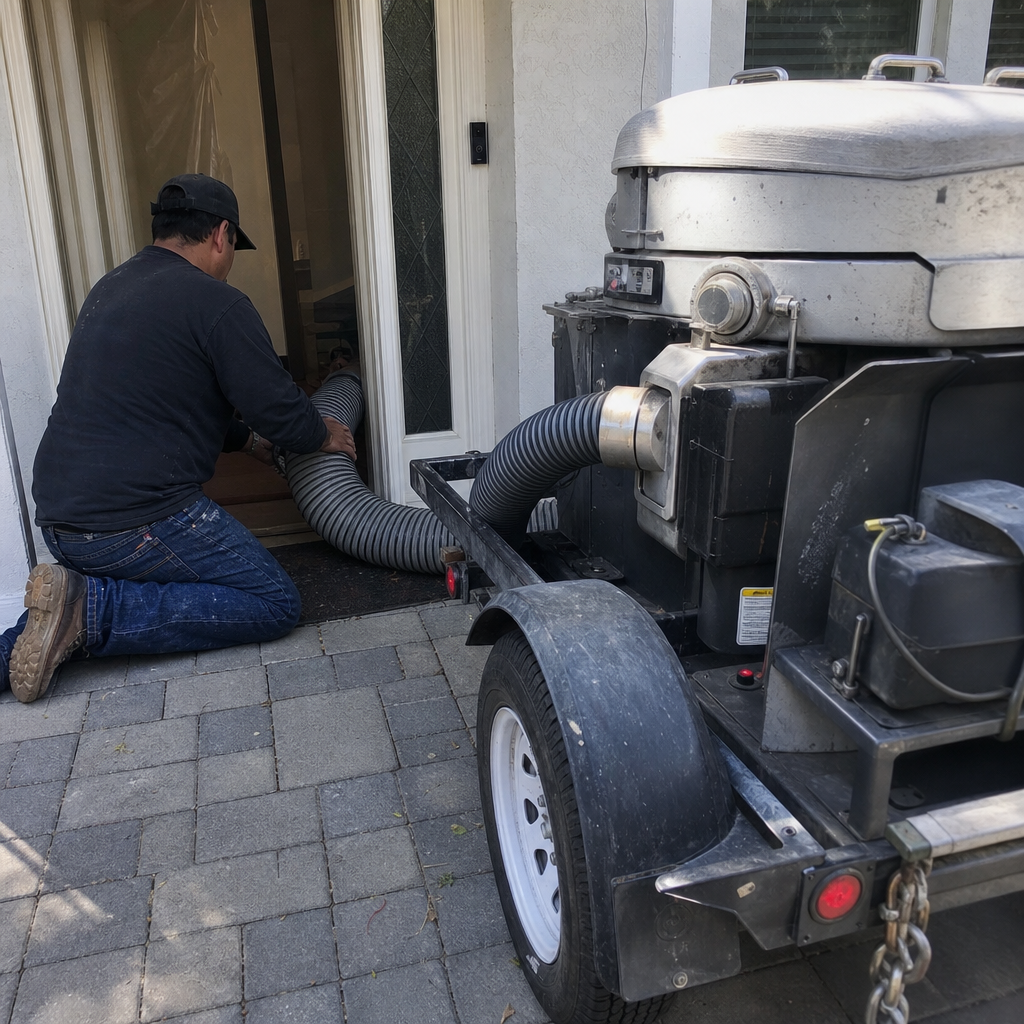
Our equipment from Abatement Technologies and Honeywell is specified for particulate removal and containment, not just disturbance and redistribution. The critical difference between amateur and professional duct cleaning is negative pressure: our systems maintain suction at the point of contact so dislodged debris is captured immediately rather than released into your living space.
If you track symptoms and find the patterns described, duct inspection and cleaning is a reasonable step in a broader indoor air quality assessment. We can describe what we find and what we remove. We cannot predict individual health responses. What we do promise: camera-verified results, documented before and after, with the debris removed rather than redistributed.
A Simple Self-Assessment Before You Call
Before you contact any professional, including Bellows Air Duct & Vent Co. home, a brief self-assessment helps you describe your situation accurately and helps us respond with appropriate recommendations. This takes ten minutes and requires no tools beyond a flashlight and your normal attention.
What to Look At
Remove two or three supply register covers and shine a flashlight into the duct opening. Look past the boot to where the duct turns or continues. You are not evaluating surface dust, which is normal. You are looking for accumulated debris, discoloration, or visible restriction. Take a photo with your phone for reference.
Examine your HVAC filter. Note the date you installed it, the condition now, and whether it shows uneven loading, which indicates air bypass around the filter rather than through it. A filter that is clean on one side and dirty on the other is not filtering properly.
What to Smell
Position yourself near a supply register when the system has been off for at least an hour. Note any odor at the moment the blower engages. Describe it specifically: musty, earthy, chemical, oily, burnt. Each description points to different possible sources. Musty or earthy suggests biological growth or organic debris. Chemical or oily suggests contamination from nearby storage or previous activity. Burnt suggests overheating components, which is an equipment issue, not a duct issue.
What to Listen For
With the system running, move through your home and note any registers with unusual sound: whistling, rattling, or pronounced airflow noise. Compare to other registers on the same system. Mark locations that seem different.
What to Record
- Your home’s approximate square footage and the age of the HVAC system and ductwork if known
- Date of last professional duct cleaning, or “never” if applicable
- Any renovations, pest treatments, or water damage events in the past five years
- Current filter type and replacement schedule
- The specific symptoms or observations that prompted your concern
This information allows a meaningful phone conversation. Our office staff answer calls directly, 24 hours a day. They are not reading from scripts and they are not incentivized to book appointments that do not fit your situation. If your self-assessment suggests a problem outside our scope, we will say so directly.
For homeowners in Los Angeles considering HVAC Cleaning in Seymour or nearby communities, this same assessment applies. Climate and housing stock vary by neighborhood, but the fundamental warning signs remain consistent.
Common Mistakes to Avoid
- Waiting for visible mold before acting. Mold in ducts is a late-stage indicator, not an early warning. By the time mold is visible at registers, conditions have supported growth for extended periods. Address musty odors and debris accumulation before visible growth develops.
- Assuming a new filter solves everything. Filters protect equipment and capture a portion of circulating particulate. They do not clean duct walls, remove existing deposits, or address restrictions in the duct network. A clean filter in dirty ducts is like a new oil filter in an engine with sludge buildup.
- Accepting “blow and go” cleaning without verification. Some operators disturb debris without containing it, or clean only accessible register areas without addressing the full duct run. Always ask how results are verified. Camera inspection before and after is the standard we apply.
- Ignoring return duct conditions. Supply ducts deliver conditioned air. Return ducts pull air back to the system. Return ducts are typically larger, run through less accessible spaces, and often contain more debris because they are not filtered. Cleaning supply only addresses half the system.
- Treating duct cleaning as a one-time event. In Los Angeles conditions, particularly with pets, recent construction, or proximity to high-traffic corridors, debris accumulation resumes after cleaning. Establish a reasonable maintenance interval based on your specific conditions rather than assuming permanent results.
- Choosing by lowest price without verifying scope. The discount coupon that covers “unlimited vents” often excludes returns, mains, and the air handler. The number on the phone becomes a different number at the door. Verify exactly what is included, how long the work takes, and how results are documented.
When to Call a Professional
Call when you have completed the self-assessment and can describe specific observations. Call when energy costs have risen without explanation. Call when comfort has degraded and you have eliminated simple causes like closed dampers or blocked registers. Call when odors, dust, or symptoms follow the patterns described in this guide.
Do not call in response to scare tactics or unsolicited offers. Do not call because a postcard claims your neighbors are having work done. Do not call for “free inspections” that are sales presentations in disguise.
Bellows Air Duct & Vent Co. offers free estimates in Los Angeles. The estimate is a conversation about your specific situation, followed by a written scope and price before any work is scheduled. Call (844) 685-6342. A live person answers, 24 hours a day. We will be there when we say, we will show you what we find, and we will stand behind the work with our 90-Day Done Right Promise in writing.
If your needs include Air Duct Cleaning in Seymour or Dryer Vent Cleaning in Seymour, we apply the same standards and the same process.
Frequently Asked Questions
Most complete residential duct cleaning projects in Los Angeles range from $400 to $900 depending on home size, system accessibility, and whether dryer vent cleaning or duct sealing is included. Bellows provides upfront pricing before work begins, so the estimate you receive is the amount on your invoice. Call (844) 685-6342 for a specific quote based on your home - estimates are free.
For typical Los Angeles conditions, we recommend professional inspection every three to five years and cleaning when camera inspection shows significant accumulation. Homes near high-traffic corridors, with multiple pets, or that have experienced recent construction may need more frequent attention. The dry, dusty climate and seasonal Santa Ana wind events accelerate particulate loading compared to more humid regions.
A shop vacuum can remove surface debris at registers but cannot reach the full duct run, maintain negative pressure to prevent redistribution, or inspect conditions deeper in the system. More importantly, disturbing debris without proper containment can worsen indoor air quality temporarily. For safety and effectiveness, professional equipment and technique are warranted.
When duct restriction is the cause of excessive runtime, cleaning can restore system efficiency and reduce energy consumption. We have documented reductions of 15 to 25 percent in seasonal cooling costs following cleaning of significantly restricted systems. The effect depends on the degree of restriction and whether other efficiency issues exist. Camera inspection determines whether duct conditions justify the investment.
Most residential duct cleaning projects are completed in a single visit of four to six hours. Larger homes, complex duct networks, or combined services such as dryer vent cleaning may extend the timeline. We schedule with specific arrival windows and call ahead to confirm. Background-checked, uniformed technicians perform all work.
Complete service includes supply ducts, return ducts, main trunk lines, and the air handler cabinet, with camera inspection before and after. We use professional-grade Rotobrush and Nikro equipment with HEPA containment. Pricing is presented upfront. Our 90-Day Done Right Promise covers all work: if it’s not right, we return at no charge with no paperwork required.
The Bottom Line
The warning signs that matter are not dramatic. They are the gradual shifts you might attribute to weather, age, or imagination: the bill that creeps higher, the dust that returns faster, the room that never quite matches the thermostat, the smell that greets you when the system wakes. These signals precede equipment problems by months or years, and addressing them early costs less than replacing a compressor or living with discomfort. In Los Angeles, where systems work hard and the climate loads debris into ducts steadily, learning to read these signs is part of maintaining a home that performs as designed.
Written by the team at Bellows Air Duct & Vent Co., serving Los Angeles since 2012.