
Last updated July 26, 2026
Seasonal Air Duct Cleaning Care for Los Angeles: Year-Round Homeowner’s Guide
Most air duct cleaning guides tell Los Angeles homeowners to schedule service in spring or fall, before the heating season starts. That advice was written for houses in Minneapolis or Boston, where furnaces sit idle for six months and ducts collect dust in the downtime. In Los Angeles, your HVAC system likely ran yesterday, and it will run tomorrow. The conventional seasonal calendar doesn’t fit here because our climate doesn’t cooperate with it. What actually matters for duct care in this city is tracking four distinct stress phases that have nothing to do with equinoxes, from Santa Ana wind events that dump wildfire ash into attic systems to marine layer humidity that breeds condensation in uninsulated ducts common to pre-1980s housing stock. This guide maps what to watch, when to act, and when the right move is simply to wait.
Quick Answer
Los Angeles homeowners should inspect their air ducts after each Santa Ana wind event and major fire season, schedule Air Duct Cleaning services when utility bills spike unexpectedly or visible debris returns within 90 days of service, and otherwise maintain a baseline of changing HVAC filters every 60-90 days rather than following a fixed spring/fall calendar. The four real duct stress periods in Los Angeles are Santa Ana/fire season (August through November), peak cooling load (June through September), marine layer humidity (May through early July), and the brief winter heating window (December through February).
Table of Contents
- Los Angeles’s Four Real HVAC Seasons
- Santa Ana Winds and Fire Season: The Critical Window
- Marine Layer, June Gloom, and Hidden Condensation
- Peak Cooling Load: When Your Ducts Work Hardest
- The Brief Winter Heating Window
- Reading Your Utility Bills as a Duct Health Proxy
- Month-by-Month: What to Check, Not What to Do
- Common Mistakes to Avoid
- When to Call a Professional
- Frequently Asked Questions
- The Bottom Line
Los Angeles’s Four Real HVAC Seasons
The climate calendar that governs air duct condition in Los Angeles looks nothing like the four-season model most national guides assume. We’ve been cleaning ducts across this basin since 2012, and the pattern we see in actual homes, from Pasadena to the Pacific Palisades, breaks down into four distinct stress phases that each affect ductwork differently.
Santa Ana and fire season runs roughly August through November. Dry, hot winds pull ash, particulate, and settled outdoor debris into attic vents and through compromised seals. Even homes miles from active burns see measurable particulate loading during major events. The 2017 Thomas Fire and 2020 Bobcat Fire both produced callbacks from homeowners in Silver Lake and Los Feliz who thought they were outside the plume zone.
Peak cooling load spans June through September, overlapping with fire season. Your system runs longer, moves more air, and any existing leak in the duct network becomes more expensive by the day. A 15% duct leakage rate, common in homes with original flex duct, can add $40-80 to a monthly summer bill in Los Angeles utility territory.
Marine layer and humidity arrives May through early July, especially in coastal zones from Santa Monica to San Pedro. Cool, moist air meets warm duct surfaces in unconditioned attics or crawl spaces. Condensation forms on metal trunk lines and inside uninsulated flex duct. This is the only period when mold risk in ductwork exceeds fire season particulate risk for most Los Angeles homes.
The brief winter heating window, December through February, matters less for contamination than for revealing problems. You switch from cooling to heating, air moves through different pathways, and dormant dust gets disturbed. Homeowners often call us in January reporting “a burning smell the first time we turned on the heat” - usually dust on heating elements, but sometimes the first sign of a rodent issue that developed unseen during summer.
The key insight: no single season in Los Angeles is the “right” time for duct cleaning. The right time follows a specific event or a specific signal from your house.
Santa Ana Winds and Fire Season: The Critical Window
This is the season that separates Los Angeles duct care from every other major U.S. market. Santa Ana wind events can push sustained winds above 40 mph with gusts to 70, pulling outdoor contaminants through every gap in your building envelope. In our experience, post-fire-season duct inspections reveal ash loading in roughly 60% of homes that reported no visible indoor smoke damage.
What actually happens to your ducts:
- Attic intake vents become entry points for fine particulate. Standard mesh screens stop leaves, not ash.
- Flex duct seams stressed by thermal cycling separate slightly under wind pressure differentials.
- Return air pathways pull air from wall cavities and soffits where outdoor air has infiltrated.
- Filter loading accelerates by 2-3x normal rates; homeowners who change filters quarterly often need monthly changes during active fire periods.
After a major Santa Ana event or regional fire, check these three things before calling for service:
- Remove and inspect your HVAC filter. If it’s gray or ashy rather than dusty, your system processed outdoor contamination.
- Run the system and check every supply register for unusual odor or visible particulate discharge.
- Check attic access points for visible ash accumulation on the floor or insulation surface.
If all three are clear, professional cleaning likely isn’t urgent. If two or more show contamination, schedule an inspection. This is where our camera inspection matters: we can show you exactly what entered the system and where, rather than selling cleaning on speculation. Our Bellows Air Duct & Vent Co. home page explains how we document every job with before-and-after video.
One Los Angeles-specific note: homes in the foothill zones, from Altadena to Topanga, see more severe loading than basin or coastal homes. The elevation differential creates stronger pressure gradients during wind events. If you live above 1,000 feet in Los Angeles County, treat post-fire inspection as non-optional.
Marine Layer, June Gloom, and Hidden Condensation
May through early July in Los Angeles brings a phenomenon most national duct guides never address: cool, saturated air from the Pacific meets warm attic structures, and condensation forms inside ductwork that lacks proper insulation. This is particularly common in homes built before 1980, which represent a significant portion of Los Angeles’s housing stock in neighborhoods like Koreatown, Echo Park, and the older sections of the San Fernando Valley.
The mechanics are straightforward but easy to miss. Marine layer air at 62-65°F and 85-95% relative humidity enters attic spaces through gable vents, soffits, and recessed lighting penetrations. Metal ductwork or the inner liner of flex duct, heated by previous-day attic temperatures, cools this air below its dew point. Water forms on interior surfaces. In a dark, enclosed duct with organic dust loading, mold growth can establish within 48-72 hours.
We’ve pulled flex duct in Los Angeles homes that showed no external damage but contained active mold growth on the interior liner, entirely from this seasonal mechanism. The homeowner typically reports “a musty smell that started in June and went away by August” - exactly the marine layer window.
Prevention focuses on three points:
- Insulation integrity: Check that all metal trunk lines have intact fiberglass wrap with no compression or gaps at hangers.
- Ventilation balance: Attic ventilation should move air without creating strong negative pressure that pulls conditioned air out of ducts.
- Condensate drainage: If your system has a cooling coil with a drain pan, verify it flows freely before humidity season starts.
The HVAC Cleaning in Seymour page details our full system approach, which includes coil and drain pan inspection as standard. In Los Angeles, we apply the same protocol with particular attention to humidity-related contamination.
If you smell mustiness that correlates with overcast mornings and clears by afternoon sun, that’s a marine layer signature. Don’t wait for it to become a persistent problem.
Peak Cooling Load: When Your Ducts Work Hardest
June through September in Los Angeles isn’t just hot. It’s the period when your duct system’s inefficiencies cost the most money, and when hidden problems become unavoidable. A duct leak that wastes 20% of conditioned air in March wastes the same percentage in July, but the absolute dollar cost doubles or triples with extended run times.
Los Angeles-specific cooling factors that stress ducts:
- Extended daily run cycles: Systems that cycle 4-6 times daily in spring may run near-continuously for 8-12 hours during heat waves.
- Thermal expansion stress: Metal ductwork expands and contracts more dramatically when temperature differentials between attic and conditioned air reach 40-50°F.
- Filter compromise: Homeowners running systems harder sometimes remove restrictive filters to increase airflow, bypassing protection entirely.
- Attic temperature extremes: Unconditioned Los Angeles attics can reach 140-150°F during September heat waves, accelerating degradation of flex duct adhesive and support straps.
The utility bill signal is particularly reliable in this season. If your July or August bill jumps 25% or more from the previous year with no rate change, and your usage patterns are consistent, duct leakage or blockage is a leading suspect. We see this pattern repeatedly in Los Angeles homes with original 1980s or 1990s flex duct that has developed seam separations or hanger failure.
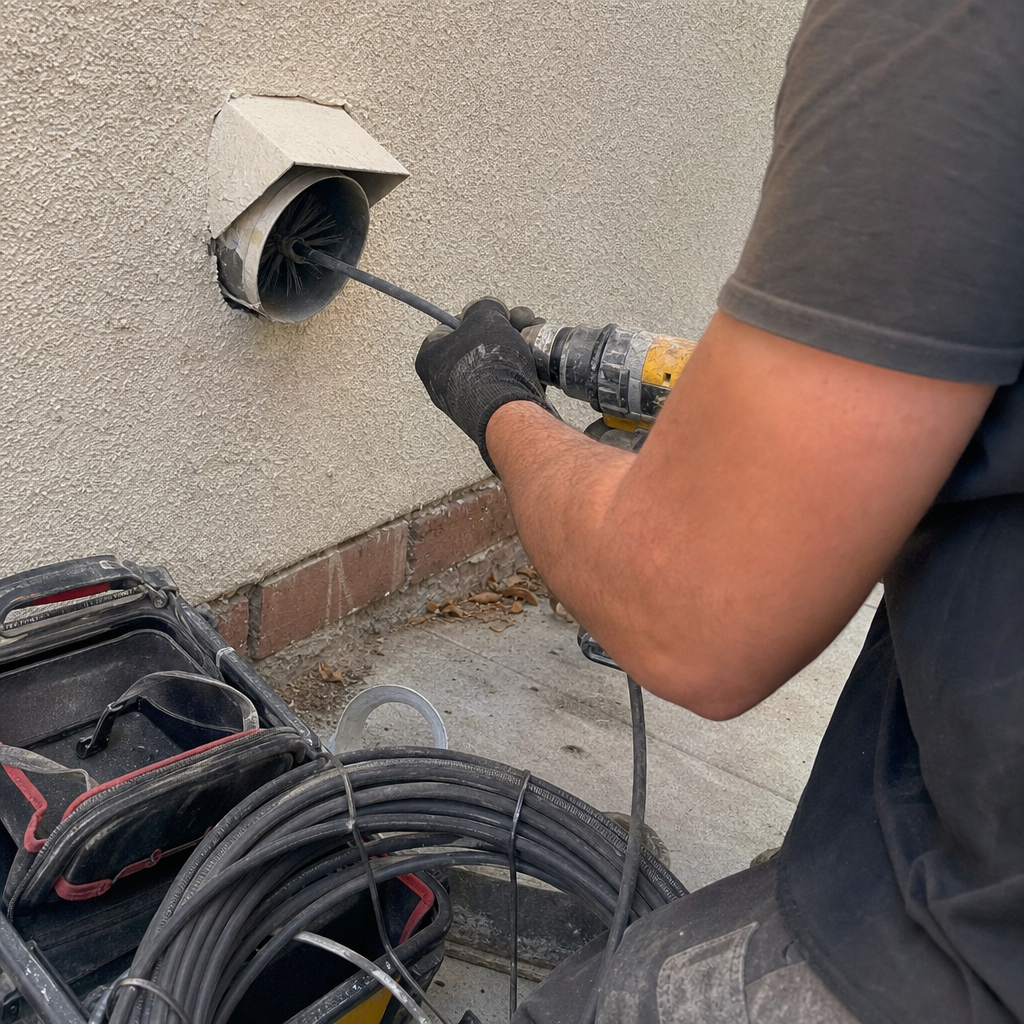
Our approach during peak season emphasizes efficiency verification alongside cleaning. We use Rotobrush equipment with HEPA containment for the cleaning itself, but we also pressure-test duct networks to identify leakage points that cost you money every hour the system runs. The camera inspection shows you the condition; the pressure test shows you the financial impact. Both are documented before we start any work, so you see exactly what the problem costs and exactly what improvement the service delivers.
For homes with older duct infrastructure, we also inspect support strap condition. Sagging flex duct creates low points where debris collects and airflow restricts. In Los Angeles’s older neighborhoods, from Highland Park to Venice, this is more common than failed seams.
The Brief Winter Heating Window
December through February in Los Angeles is the only period when most homes switch from cooling to heating, and that transition reveals problems that stay hidden during continuous cooling operation. The heating cycle moves air through different temperature pathways, activates components that sat idle for months, and often produces the first homeowner-noticeable symptoms of duct issues.
The “burning smell on first heat” call is so common we’ve developed a specific protocol. In most cases, it’s dust accumulation on electric heating elements or heat exchanger surfaces that burns off within minutes. But we always ask three screening questions:
- Does the smell persist beyond 30 minutes of continuous operation?
- Is it accompanied by visible smoke or haze from registers?
- Did you hear any unusual sounds (scraping, rattling) when the heat first activated?
Persistent smell suggests debris accumulation that needs inspection. Visible discharge indicates significant contamination. Unusual sounds often mean a rodent has nested in ductwork during the quiet summer months, or that a section of flex duct has detached and is flapping in airflow.
Winter in Los Angeles also brings the only sustained period when indoor-outdoor temperature differentials remain moderate for weeks. This is actually favorable for duct sealing work if leaks are found. Mastic sealants and foil tapes cure more predictably at 55-70°F than during summer attic extremes. If our inspection reveals separations or leakage points, January and February often provide the best conditions for lasting repairs.
One practical note: Los Angeles homes with gas furnaces should verify carbon monoxide detector function before heating season. While not directly a duct issue, any combustion appliance connected to a shared air distribution system warrants this basic safety check. We don’t install detectors, but we note their absence during inspections and recommend qualified electricians for installation.
Reading Your Utility Bills as a Duct Health Proxy
Between professional inspections, your utility bills are the most reliable indicator of duct condition. This approach is particularly suited to Los Angeles, where mild temperature swings mean usage patterns stay relatively stable year-over-year, making anomalies easier to spot.
Here’s the method we teach homeowners:
- Establish a baseline: Collect 24 months of bills and note the kWh (electric) or therms (gas) for each month, not just the dollar amount. Rates change; usage patterns reveal more.
- Normalize for weather: Compare each month to the same month in the previous year, not to adjacent months. July 2024 should compare to July 2023, not June 2024.
- Flag 20%+ variances: A usage increase of 20% or more, with no known cause (new appliance, extended occupancy, rate change), warrants duct inspection.
- Track the trend: Two consecutive years of gradual 10-15% increases often indicate slowly worsening leakage or filter restriction, not a sudden failure.
In Los Angeles specifically, watch for these patterns:
- Summer spike without temperature record: If July was milder than last year but your usage rose, duct leakage is likely.
- Shoulder season elevation: April-May or October-November bills that creep upward suggest the system works harder to maintain setpoint due to compromised distribution.
- Gas heating cost jump: Winter gas bills that outpace temperature severity indicate furnace runtime extension, often from duct losses.
This isn’t precision diagnostics. It’s a screening tool that catches problems before they become emergency calls - for Air Duct Cleaning Emergency Preparedness Guide for Los Angeles Homes and related resources. We’ve had Los Angeles homeowners identify duct issues six months before they would have scheduled routine cleaning, simply by tracking usage trends. The $89 Seasonal Tune-Up we offer includes filter change, basic coil inspection, and a summary of any duct concerns we can observe without disassembly. It’s designed for this kind of proactive monitoring.
Month-by-Month: What to Check, Not What to Do
Most months, the right action is observation. This calendar reflects what we’ve learned serving Los Angeles homes since 2012. It deliberately avoids prescribing unnecessary work.
| Month | Primary Concern | What to Check | Typical Action |
|---|---|---|---|
| January | Heating transition | Filter condition, unusual odors on first heat | Change filter; schedule inspection if smell persists |
| February | Heating steady-state | Even heating across rooms, thermostat satisfaction | Nothing if performance is normal |
| March | Pre-marine layer | Attic insulation on ductwork, visible gaps | Visual inspection only |
| April | Early marine layer | Musty morning odors, register condensation | Monitor; call if odor persists past 10 AM |
| May | Marine layer peak | Filter loading, any visible mold near registers | Change filter; schedule if mold suspected |
| June | June Gloom, cooling start | System response time, humidity comfort | Nothing if performance normal |
| July | Peak cooling load begins | Utility bill vs. prior year | Track usage; flag 20%+ increases |
| August | Santa Ana risk opens | Outdoor air quality alerts, filter condition | Change filter before wind events if due |
| September | Santa Ana peak, fire season | Ash accumulation, register discharge, attic inspection | Schedule post-event inspection if contamination found |
| October | Fire season continues | Repeat September checks | Same protocol |
| November | Fire season closes | Final filter change, system readiness for heating | Change filter; schedule full inspection if not done since spring |
| December | Heating activation | First-heat odor, carbon monoxide detectors | Replace detector batteries; call if smell persists |
The pattern here: only three months (May, September-November) typically prompt professional service calls for most Los Angeles homes with no known issues. The rest of the year is maintenance and observation. This calendar saves most homeowners one unnecessary service call annually compared to rigid spring/fall scheduling.
Common Mistakes to Avoid
- Following national spring/fall schedules blindly. These were designed for climates with six-month heating shutdowns. Your Los Angeles system doesn’t hibernate; neither should your maintenance logic.
- Cleaning after every Santa Ana event regardless of inspection results. Not all wind events contaminate ducts. Camera inspection prevents unnecessary service. We’ve turned down cleaning jobs where visual inspection showed clean ductwork.
- Ignoring musty smells that clear by afternoon. Marine layer condensation often produces transient odor that homeowners dismiss. By the time it’s persistent, mold remediation may be required instead of simple cleaning.
- Replacing filters on calendar schedule without visual check. In Los Angeles fire season, a filter can load in three weeks. In winter, the same filter might last four months. Check the filter, not the calendar.
- Sealing ducts without cleaning first. Sealing contaminated ductwork traps debris and can accelerate microbial growth. Always clean before sealing, or verify cleanliness through inspection.
- Assuming new construction means clean ducts. Los Angeles’s construction boom has produced homes with significant drywall dust, insulation fragments, and even discarded lunch wrappers in new duct systems. We recommend post-construction inspection even in brand-new homes.
- Using the lowest bid without equipment verification. Portable shop vacuums with inadequate containment can release more contamination than they remove. Professional-grade equipment from manufacturers like Abatement Technologies and Nikro uses HEPA containment and negative air pressure to protect your home during service.
When to Call a Professional
Some conditions in Los Angeles homes warrant immediate professional inspection rather than continued monitoring. Call for service if you observe any of the following: visible mold growth on or near registers; persistent musty or burning odor that doesn’t resolve within 48 hours; sudden increase in dust accumulation on surfaces; uneven heating or cooling between rooms that develops over weeks rather than years; utility bill spike of 25% or more with no identifiable cause; or known rodent activity in attic or crawl space areas connected to ductwork.
After major regional fire events, we also recommend professional inspection for homes within 10 miles of active burn zones, even without visible indoor smoke damage. Fine particulate infiltration is not always apparent to homeowners but is readily visible through camera inspection.
Bellows Air Duct & Vent Co. offers free estimates in Los Angeles. We’ll camera-inspect your system, show you exactly what we find, and quote one honest price before any work begins. No bait coupons, no price changes at the door. Call (844) 685-6342 to schedule. Most jobs are completed in a single visit by background-checked, uniformed technicians, and every service is backed by our 90-Day Done Right Promise in writing.
Frequently Asked Questions
Most Los Angeles homes benefit from professional air duct cleaning every 3-5 years, with inspection after each major Santa Ana wind event or regional fire. Homes with pets, recent construction, or known rodent issues may need more frequent service. The marine layer season can also accelerate contamination in homes with uninsulated ductwork. Call (844) 685-6342 for a free estimate if you’re unsure about your home’s schedule.
Repair is typically more cost-effective for isolated damage to accessible sections, especially in Los Angeles’s mild climate where ducts don’t face freeze-thaw stress. Full replacement becomes justified when multiple sections show degradation, when the original material is below current code requirements, or when repairs would exceed 50% of replacement cost. We provide both options with upfront pricing for comparison. Our $50 Off Any Repair Over $250 applies to qualifying duct repairs.
Dirty ducts can contribute to respiratory irritation, particularly during Los Angeles fire season when particulate loading is highest, and during marine layer season when humidity supports microbial growth. However, ducts are rarely the sole cause of illness. They are one factor in overall indoor air quality alongside filtration, ventilation, and source control. Camera inspection reveals whether duct contamination is significant enough to warrant cleaning or if other measures would be more effective.
Professional air duct cleaning for a typical Los Angeles single-family home ranges from $400-$800 depending on system size, accessibility, and contamination level; see our Air Duct Cleaning Cost Breakdown: The Los Angeles Homeowner’s Reference for 2026 for detailed pricing factors. Larger homes, multi-zone systems, or those requiring post-fire remediation fall at the higher end. We disclose full pricing before work begins, consistent with our no-bait-pricing policy. Call (844) 685-6342 for an exact quote - estimates are free.
There is no single best time. Post-fire-season inspection (November-December) catches Santa Ana contamination before heating season. Post-marine-layer inspection (July-August) addresses humidity-related issues before peak cooling load. The worst time is during active fire season or extreme heat waves, when outdoor conditions compromise service quality and technician safety. We schedule around these constraints.
Demand visual documentation. A properly cleaned duct system should have before-and-after video or photographic evidence from inside the ductwork, not just surface cleaning of registers. You should also observe improved airflow at registers, reduced dust accumulation in the weeks following service, and no residual odor from cleaning agents. Our 90-Day Done Right Promise covers re-inspection and correction if results don’t match documentation.
Yes, unless the seller provides recent camera inspection documentation. Los Angeles’s housing stock includes many homes with decades of accumulated debris, prior owner pets, unpermitted additions with substandard duct connections, and fire season exposure. A baseline inspection establishes condition and identifies any immediate concerns. We offer this as a standard service with full documentation for new homeowners.
The Bottom Line
Los Angeles’s climate demands a duct care approach built around actual local conditions, not imported seasonal calendars. The four stress phases, Santa Ana winds, marine layer humidity, peak cooling load, and brief winter heating, each create distinct risks that respond to specific timing. Most months, observation and filter maintenance suffice. The critical actions are post-wind-event inspection, utility bill monitoring, and responding promptly to musty odors or visible contamination. A fixed schedule cleans ducts that don’t need it and misses ducts that do. The better approach matches service to signals from your specific home. For more guides & resources on Los Angeles duct care, visit our blog.
Since 1984, Bellows Air Duct & Vent Co. has served Los Angeles homeowners with camera-verified results, upfront pricing, and a 90-Day Done Right Promise that requires no paperwork to invoke. If your ducts need attention, or if you’re unsure whether they do, call (844) 685-6342 for a free estimate. We’ll show you what we find, quote one honest price, and stand behind the work in writing. That’s the square deal we’ve delivered for over 42 years.
Written by the team at Bellows Air Duct & Vent Co., serving Los Angeles since 2012.