
Last updated July 25, 2026
The Complete Guide to Air Duct Cleaning in Los Angeles
After the 2023 wildfire seasons, air quality monitors inside some Los Angeles homes showed particulate levels higher indoors than out - and the ducts were a primary reason why. That’s not a coincidence. LA’s unique combination of wildfire ash, coastal humidity, and near-constant HVAC operation creates conditions that standard cleaning advice simply doesn’t address. In this guide, we’ll explain how wildfire particulates behave differently from ordinary dust, which cleaning methods actually work for the city’s varied housing stock, and how to verify you’re getting what you paid for. Whether you live in a 1950s ranch in the Valley, a hillside build in the Hollywood Hills, or a condo in DTLA, this is written for your actual home.
Quick Answer
Air duct cleaning in Los Angeles should be performed every 2-3 years under normal conditions, or annually if your home was exposed to wildfire smoke or you run AC year-round. The process involves a camera-inspected assessment, debris removal using negative-pressure or portable systems matched to your home type, and verification through post-cleaning camera documentation. In Los Angeles, wildfire ash particulates are smaller and more adhesive than household dust, requiring thorough contact cleaning rather than simple vacuum extraction.
Table of Contents
- Why Los Angeles Ducts Are Different
- Wildfire Ash vs. Ordinary Dust: What Actually Builds Up
- Truck-Mounted vs. Portable: Which System Fits Your Home
- What Happens During a Professional Duct Cleaning
- How Often Should Los Angeles Homes Clean Their Ducts
- How to Verify Results: Camera Documentation Standards
- What Air Duct Cleaning Costs in Los Angeles
- Common Mistakes to Avoid
- When to Call a Professional
- Frequently Asked Questions
Why Los Angeles Ducts Are Different
Los Angeles isn’t Phoenix, and it isn’t Seattle. The conditions that fill your ductwork here don’t exist in that combination anywhere else in the country.
First, there’s the runtime. In neighborhoods from Santa Monica to Pasadena, air conditioning runs 8-10 months of the year. That constant airflow doesn’t just move conditioned air - it continuously circulates whatever’s already in your ducts. In seasonal-use markets, a furnace might run four months and then sit idle. Here, the system never gets a break to let debris settle. We’ve seen ducts in Brentwood homes with three times the accumulation rate of comparable homes in Denver.
Second, the coastal influence. That marine layer that rolls in overnight? It brings humidity that lets dust and pollen adhere to duct walls more stubbornly than in dry climates. Then the Santa Ana winds arrive, driving wildfire particulates and desert dust through every gap in your home’s envelope. Your ducts become a record of every environmental event.
Third, housing variety. A condo in Koreatown with a rooftop package unit needs a completely different approach than a 1970s ranch in Woodland Hills with attic flex duct, or a hillside build in Los Feliz with long horizontal runs and multiple zones. One method doesn’t fit all here.
These factors mean generic advice - “clean every three to five years” - is close to meaningless for Los Angeles homeowners. The right interval and method depend on where you live, what your home experienced, and how your system runs.
Wildfire Ash vs. Ordinary Dust: What Actually Builds Up
Not all debris is equal, and wildfire ash is where Los Angeles diverges most sharply from national norms.
Wildfire smoke contains particulate matter as small as 2.5 microns (PM2.5) - roughly 1/30th the width of a human hair. These particles don’t behave like ordinary household dust. They’re carbon-rich, electrostatically charged, and adhesive. Once they enter your ductwork, they cling to walls and build up in layers rather than settling as loose accumulation.
We’ve inspected ducts in Glendale homes six months after the 2023 fires. The particulate had formed a gray, almost greasy film on metal trunk lines. Standard vacuum extraction, the kind that pulls loose debris, left that film intact. Only contact cleaning with rotating brushes actually removed it.
Here’s what typically accumulates in Los Angeles ducts, ranked by how problematic each is:
- Wildfire ash and smoke residue - Adhesive, potentially toxic, requires contact cleaning; most common in areas downwind of recent burns (Pasadena, Altadena, Topanga, Malibu corridor)
- Coastal pollen and mold spores - Humidity-activated, can colonize if moisture enters the system; prevalent west of the 405 and in canyon-adjacent neighborhoods
- Urban particulate (freeway proximity) - Soot and tire-wear particles, finest near the 10, 110, 405, and 101 corridors
- Standard household dust and dander - Loose accumulation, responds to vacuum extraction; baseline issue everywhere
- Construction debris - Common in remodeled homes or new construction; drywall dust is particularly abrasive to blower motors
The distinction matters because pricing and method should reflect what’s actually in your system. A contractor who treats wildfire residue like loose dust is doing half a job.
Truck-Mounted vs. Portable: Which System Fits Your Home
Los Angeles housing stock demands flexibility that many national franchises don’t accommodate. The right equipment depends on your home type, not a brand’s fleet investment.
Negative-pressure truck-mounted systems use a large vacuum unit parked outside, connected to your ductwork via an 8-10 inch hose. They generate 10,000-15,000 CFM of suction and are the industry standard for single-family homes with accessible trunk lines. In Los Angeles, they work well for:
- Valley ranch homes with attic or crawlspace access
- Mid-century builds in the San Fernando Valley with straight metal duct runs
- Homes where the furnace is in a garage with exterior access
The limitation? Condos, townhomes, and hillside builds. Many Los Angeles condos have HVAC closets with no exterior access for large hoses. Rooftop units in DTLA and Koreatown buildings require technicians to haul equipment up multiple stories. Truck-mounted systems simply can’t reach.
Portable HEPA-filtered systems - units from manufacturers like Nikro and Abatement Technologies - generate less raw suction but offer maneuverability. They’re essential for:
- Condos and townhomes with interior mechanical rooms
- Hillside homes in the Hollywood Hills or Pacific Palisades where driveways are steep or nonexistent
- Any home where parking restrictions or HOA rules prevent service vehicle access
Here’s what we’ve learned in 42 years: the equipment brand matters less than whether the technician chooses the right system for your home. A portable unit with a skilled operator outperforms a truck mount forced into the wrong application. At Bellows, we specify Rotobrush contact systems for adhesive wildfire residue and Nikro portable HEPA units for restricted-access jobs. The diagnosis comes first; the tool choice follows.
Be wary of any contractor with only one system. That’s a sign they’re selling their equipment, not solving your problem.
What Happens During a Professional Duct Cleaning
A proper duct cleaning isn’t a vacuum hose waved at a register. Here’s the sequence we follow on every Los Angeles job, and what you should expect from any contractor you hire.
- Pre-cleaning camera inspection. We run a borescope camera through the main trunk lines and several branch ducts. You see the footage. We document timestamped images. This isn’t courtesy - it’s the baseline against which results are measured. If a contractor won’t show you pre-cleaning footage, they don’t want accountability.
- System protection. Registers are removed and protected. The blower compartment is sealed or accessed as needed. We cover floors and furniture in the work path. In Los Angeles homes with original hardwood or tile, this matters.
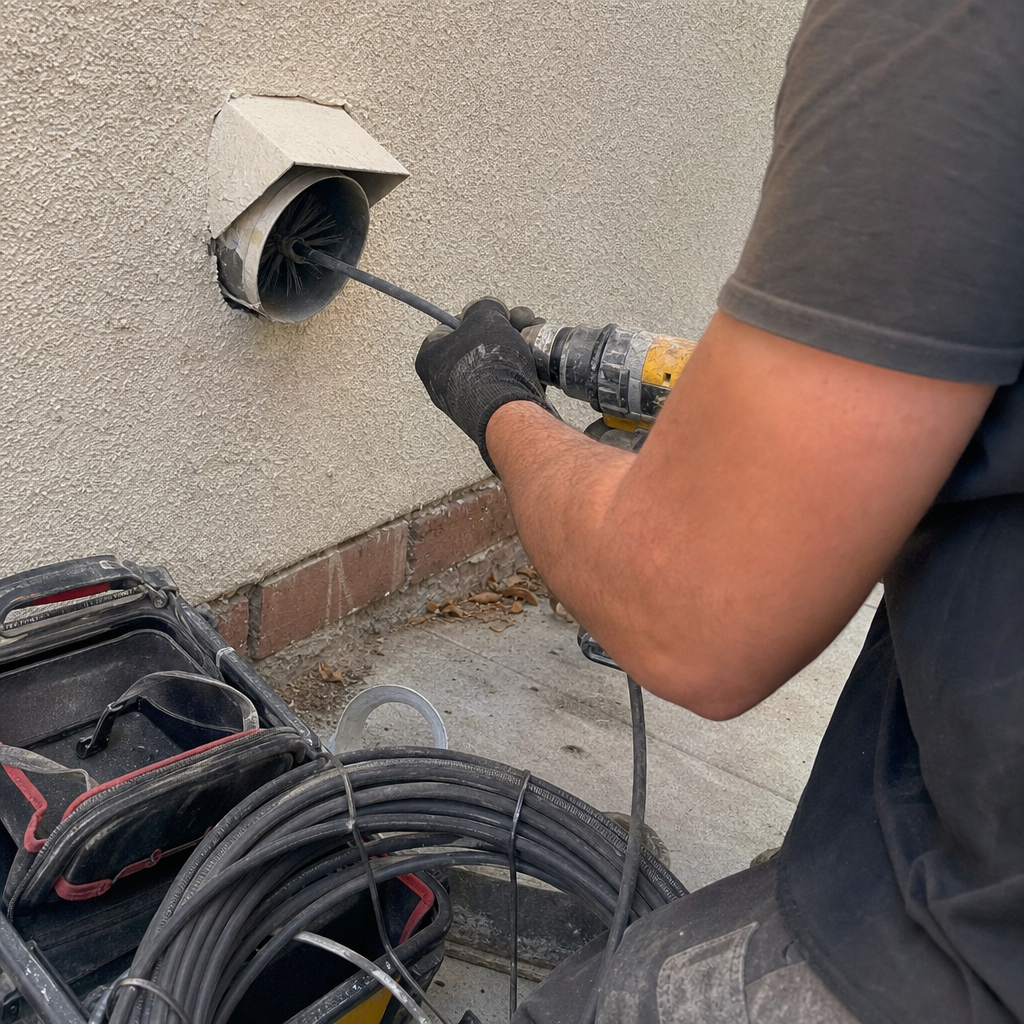
- Agitation and extraction. Based on the inspection, we select contact cleaning (rotating brushes that scrub duct walls) or air-whip systems for loose debris. Wildfire ash requires brushes; standard dust may not. Extraction runs simultaneously, maintaining negative pressure so debris doesn’t escape into your home.
- Component cleaning. The blower wheel, evaporator coil (if accessible), and plenum are cleaned. These components affect airflow and air quality as much as the ducts themselves. Skipping them is common and costly.
- Sanitizing (when warranted). EPA-registered sanitizers are applied only if microbial growth is present - not as a routine upsell. We use Honeywell and Aprilaire compatible treatments. In coastal Los Angeles neighborhoods where humidity has activated mold spores, this step is sometimes necessary.
- Post-cleaning camera verification. We re-run the camera through the same access points. You receive before-and-after documentation. The timestamp proves the sequence; the imagery proves the result.
- System test and walkthrough. We run the HVAC, check static pressure, and review documentation with you. No signature until you’ve seen the evidence.
Most residential jobs in Los Angeles take 3-5 hours for a single system. Condos with rooftop units may take longer due to access. Anyone promising a 90-minute whole-house clean is cleaning registers, not ducts.
How Often Should Los Angeles Homes Clean Their Ducts
The national “every 3-5 years” guideline assumes seasonal HVAC use and ordinary dust. Los Angeles conditions demand a different framework.
| Home situation | Recommended interval | Rationale |
|---|---|---|
| Standard residential, no wildfire exposure, AC-only or minimal heating | Every 2-3 years | Year-round runtime doubles accumulation vs. seasonal markets |
| Within 10 miles of recent wildfire burn zone | Annually for 2 years post-event, then reassess | PM2.5 particulate continues circulating and adhering; one cleaning rarely removes all residue |
| Coastal zone (Santa Monica, Venice, Pacific Palisades, Malibu) | Every 2 years | Humidity activates pollen and spore adhesion; salt air corrodes metal ducts, increasing surface roughness that traps debris |
| Freeway-adjacent (within 500 feet of 10, 110, 405, 101, 5) | Every 2 years | Ultrafine particulate from traffic penetrates homes continuously; studies show indoor levels track outdoor traffic density |
| Post-renovation or new construction | Immediately upon completion, then normal interval | Drywall dust, insulation particles, and sawdust damage blower motors and coat duct walls |
| Allergy or respiratory sensitivity in household | Every 1-2 years, with filter upgrades | Reduced particulate load matters more than interval optimization; pair with MERV 13+ filtration |
These aren’t arbitrary numbers. They’re based on what we’ve measured in Los Angeles homes over four decades. The homeowner in Encino who waits five years because “that’s what the internet says” often has ducts dirtier than the homeowner in Minneapolis at three years - because that Minneapolis system sat idle for seven months.
How to Verify Results: Camera Documentation Standards
The air duct industry has a trust problem. Too many homeowners have paid for cleaning they can’t verify. Camera inspection is the only objective standard, and in Los Angeles, where wildfire residue isn’t visible to the naked eye from a register, it’s essential.
Here’s what legitimate documentation includes:
- Timestamped before-and-after footage from identical access points - same branch duct, same distance from the opening, same lighting conditions
- Trunk line imagery showing the full cross-section, not just a close-up of a clean spot
- Blower wheel and coil photographs if component cleaning was performed
- Static pressure readings before and after, where equipment allows - measurable airflow improvement
- Written summary of what was found, what was done, and what remains (some damage or contamination can’t be fully remediated in one visit)
What to reject: a single “after” photo with no baseline; footage that doesn’t show duct walls clearly; claims of improvement based on “airflow feel” or a technician’s verbal assurance; before-and-after images that clearly come from different locations.
At Bellows Air Duct & Vent Co. home, we stamp every job with our 90-Day Done Right Promise. The camera record is how we prove we earned it - and how you hold us to it. No paperwork, no arguing. If it’s not right, we return at no charge.
We’ve been called to homes in Silver Lake and Culver City where a previous cleaner claimed success but left wildfire residue coating the trunk lines. The homeowner had no documentation and no recourse. Don’t let that be you.
What Air Duct Cleaning Costs in Los Angeles
Pricing in Los Angeles reflects labor costs, access difficulty, and the equipment required. Be skeptical of prices that don’t account for these variables.
| Service scope | Typical Los Angeles range | What affects the price |
|---|---|---|
| Basic duct cleaning (single system, up to 12 vents) | $400-$700 | Number of vents, system accessibility, debris type |
| Whole-home with wildfire residue remediation | $600-$1,100 | Contact cleaning required, multiple passes, sanitizing |
| Condos and townhomes (portable equipment, restricted access) | $500-$900 | Equipment haul, parking, HOA coordination, rooftop unit access |
| Dryer vent cleaning (standalone) | $150-$300 | Length of run, number of turns, roof vs. wall termination |
| HVAC component cleaning (blower, coil, plenum) | $200-$400 add-on | Accessibility, contamination level, refrigerant handling if coil involved |
Red flags in pricing: flat rates advertised without seeing your system; prices that double at the door for “unexpected” contamination; any quote that doesn’t specify what’s included. At Bellows, we provide no-hassle upfront pricing before a single tool is lifted. The number on the phone is the number on the invoice.
Our standing offers include $50 off any repair over $250, a free second opinion on any written estimate, and a permanent 5% senior and veteran discount. We also run an $89 seasonal tune-up that includes basic inspection - a useful starting point if you’re unsure whether full cleaning is warranted.
Call (844) 685-6342 for an exact quote on your Los Angeles home. Estimates are free, and we’ll tell you honestly if your ducts don’t need cleaning yet.
Common Mistakes to Avoid
- Waiting for visible dust at registers. By the time you see it, your ducts are heavily loaded. Registers are the end of the line; trunk lines can be coated while registers look clean.
- Hiring based on coupon price alone. The $99 whole-house special is a well-documented bait-and-switch pattern. The technician arrives, finds “mold” or “dangerous buildup,” and the final bill hits $800-$1,500. Los Angeles has active consumer complaints against operators using this model.
- Ignoring wildfire exposure. Homeowners in Altadena and Pacific Palisades after 2023 often assumed one rain season would clear the problem. Wildfire particulate is indoor now; outdoor air quality recovery doesn’t clean your ducts.
- Choosing equipment over technician judgment. A contractor proud of their truck mount who forces it into a DTLA condo with no exterior access is damaging your property or doing half a job. Ask how they’ll handle your specific home type.
- Skipping post-cleaning verification. Without documentation, you have no leverage if results are poor. Any honest contractor welcomes camera verification; only those with something to hide resist it.
- Cleaning ducts but not the dryer vent. In Los Angeles, where year-round AC means the dryer runs constantly too, lint buildup is a genuine fire hazard. Dryer vent cleaning is often the more urgent service.
- Assuming new homes are clean. Construction debris in new Los Angeles builds is often severe. We’ve found ducts packed with drywall dust and wood scraps in “move-in ready” homes from Sherman Oaks to Playa Vista.
When to Call a Professional
Call for an inspection - not necessarily a cleaning - if you notice any of the following: persistent dust accumulation shortly after cleaning; musty or acrid odors when the system runs; reduced airflow from specific registers; visible mold near vents; or if your home was within the smoke plume of any Southern California wildfire in the past two years.
Also call before major HVAC work. A new furnace connected to dirty ducts is like a new engine with a clogged air filter. The equipment suffers immediately.
Bellows Air Duct & Vent Co. offers free estimates in Los Angeles. We’ll camera-inspect your system, show you exactly what’s there, and recommend only what’s needed. Sometimes that’s cleaning. Sometimes it’s a filter upgrade. Sometimes it’s simply waiting another year. We’re not interested in selling you a service your home doesn’t need - we’re interested in being the company you call back when it does.
Call (844) 685-6342. A live person answers, 24 hours a day. No voicemail, no app.
Frequently Asked Questions
Most Los Angeles homeowners pay between $400 and $700 for standard single-system duct cleaning, with wildfire remediation or restricted-access jobs running $600-$1,100. Condos in DTLA or Koreatown often cost more than Valley ranch homes due to equipment access challenges. Call (844) 685-6342 for a free exact quote - estimates are free, and we disclose all pricing before work begins.
Yes. Wildfire particulate (PM2.5) is carbon-based and electrostatically adhesive. It clings to metal duct walls rather than settling as loose debris. We’ve inspected Los Angeles ducts 8-10 months after fire events and found intact residue layers. Standard vacuum extraction without contact brushing often leaves this film in place.
It depends on your home type. Single-family Valley ranches with exterior access suit truck-mounted negative-pressure systems. Condos, townhomes, and hillside builds in the Hollywood Hills or Pacific Palisades typically need portable HEPA units. The right choice depends on access, not equipment marketing. A qualified technician diagnoses first, then selects tools.
Demand timestamped before-and-after camera footage from identical access points. Legitimate documentation shows trunk line cross-sections, not just register close-ups. Static pressure readings before and after provide measurable verification. Without this evidence, you’re relying on a technician’s word - and in an industry with documented bait-and-switch problems, that’s not sufficient.
It can, but it’s not a cure-all. Cleaning reduces circulating particulate load, which helps if your triggers are dust, pollen, or pet dander. For wildfire-related respiratory sensitivity, cleaning is more strongly indicated. Pair duct cleaning with upgraded filtration (MERV 13 or higher) for best results. We assess this during our free estimate.
Yes, but it requires portable equipment and technicians experienced with vertical access. We’ve cleaned systems in DTLA and Koreatown high-rises where equipment had to be carried up 15+ stories. The method changes; the documentation standard doesn’t. Camera inspection before and after applies regardless of building type.
The Bottom Line
Los Angeles air duct cleaning isn’t a commodity service. The city’s wildfire exposure, coastal humidity, year-round HVAC runtime, and varied housing stock mean that generic advice and generic methods fall short. The homeowners who get it right prioritize camera-verified results, equipment matched to their specific home, and contractors who price honestly before work starts. Wildfire residue doesn’t remove itself. Coastal mold doesn’t dry out in January. And a 90-minute “whole house” clean cleans nothing that matters. Get the inspection, see the footage, and hold every claim to visual proof. That’s the standard we’ve operated by since 1984.
Written by the team at Bellows Air Duct & Vent Co., serving Los Angeles since 2012.